




broncepulido
Members
-
Joined
-
Last visited
Everything posted by broncepulido
-
 Western Sahara Tin Can Sailors, circa 1985: Note: In this scenario, to avoid spoilers, it is better to play the Spanish/Blue side first a few times, and only after play the Polisario Front/Moroccan/Red side, and keeping in mind the special considerations writed in the Red Orders. My aim in this scenario is to capture the flavour of small and very limitated conflicts, almost naval guerrilla warfare. It's also inspired by the recent implementation of the Lepanto/Fletcher class destroyers in the simulation DataBase and of course in the vivid historical events of our recent past. Historical introduction: In the first eighties, when the then modern Descubierta class frigate was introduced in the Spanish Navy, the venerable Pacific War veterans Fletcher class destroyers (nicknamed Los Cinco Latinos) were detached from the original Destroyer Squadron 21 (On that time renamed Escort Squadron 21) homeported in Cartagena, and scattered between the different Spanish local sea commands or Zonas Maritimas. D-21 Lepanto and D-22 Almirante Ferrandiz were from 1980 detached from the Destroyer Squadron 21 and employed on secondary roles as High Seas Patrol ship in the Canary Islands Maritime Zone (Lepanto was later transferred to the Cantabrian Sea Maritime Zone from 1983). This scenario depicts a amalgamation of a series of difficult, confuse, censored and very unknown incidents between the Spanish patrol forces and the Western Saharan Polisario Front and the Moroccan Forces, fighting for the control of the old province of Spanish Sahara. As examples on 1980 Almirante Ferrandiz was apparently straffed by a Moroccan Mirage F1, and on 1985 in other incidente the Anaga class patrol gunboat Tagomago was attacked from the shore by unknown origin 12.7mm and 106mm recoiless shots, causing one dead, and Almirante Ferrandiz was called on her help. After Spain the Western Sahara territory was claimed by the own Saharawis integrated in the Polisario Front, Morocco, Argelia and Mauritania. Both Polisario Front and Morocco were trying to do maritime actions vindicatives of the disputated territory control, basically exercing control of the Spanish and other fishermen traditionally fishing on the Western Sahara bank. Morocco trying it with action as an apparent transnational law enforce, and Polisario Front exerciting attacks with inflatable boats, shore firing and kidnapping of fishermen and his crews. We must remember Western Sahara economy is bases almost exclusively on fishing which employs two thirds of his labour force, but now they are suspictions about the existence of reasonably exploitable off-shore oil fields, but his explotation is today doubtious because the international law. The European Union fishing agreements with Morocco include Western Sahara, but they are many doubts about if this is adjusted to the international law and were denonced as unlawful recently. Note about the map: I've chosed the Mediterranean Sea map because I don't think worth to make another specialized map for this scenario with the Canary Islands adding nothing to the scenario and the playability, and so the installation of the scenario is improved and easier. Western Sahara coast and Canary Islands is some 270 nm southwest of the southwest map corner, but the distances and angles between the bases is the same as in the real world, after a vertical rotation over the horizontal axis and a rightward rotation over the vertical axis. Notes about the platforms: The 802 Squadron Spanish Fokker 27-200 Maritime for SAR duties were actually of a older type, without weapons neither ESM, the Blue player must not use them armed. The 462 Squadron Spanish Mirage F1EE were apparently only trained for the Canary Islands air defence, without surface attack capabilities. Generic unnamed places are: ZYa El Aaioun Airport GSAI/GMML, Western Sahara. ZZa Sidi Ifni Airport GMMF, Morocco. AAs Gando Air Base GCLP, Canary Islands, Spain. Enrique Mas, January 2012
-
Thanks, reading it and transferred to other readers ...
-
Sure, in H4 terms: Yes, Brad has reflected the P-1000 Vulkan in the HCDB from sometime ago for the Echo II mod Project 675MKV. It's implemented in the HCDB also in the entry 2144 Slava (1164/92) class cruisers (Historically from the yard number 2010 Chervona Ukraina/Varyag, commissioned 1989) and later retrofitted in the others ships of the class. http://russian-ships.info/eng/warships/project_1164.htm I've read the same in other russians sources, but it's never nothing sure about the Soviets/Russians (For russian-ships-info the Charlie II is equipped with 2x650mm TT, but they were only in the initial project).
-
Certainly within the realm of possibility. I will have a look. Enrique, do you have an online source for the IOC dates, conversions, etc? Oh, yes, but I insist, it's not a clear matter. In http://www.vectorsite.net/ave2c.html About "E-2C Hawkeye Group 0 (1973): with APS-120 radar, in service from October 1973" About "E-2C Hawkeye Group 0 (1978): with APS-125 radar, in service from 1978"
-
The link mentioned weeks ago (acig, not agsi ): http://www.acig.info/CMS/index.php?option=...28&Itemid=1
-
Digesting the Brad’s new impressive new of more than 120 ships : About the Van Speijk/Ahmad Yani class frigates in Indonesian service, some new points to research: Steam turbines replaced by many types diesel engines between 2003-2008, top speed now some 24 knots. Some equipped with SS-N-26 Yakhont replacing Harpoon, others with C-802, apparently. http://en.wikipedia.org/wiki/Van_Speijk_class_frigate http://warships1discussionboards.yuku.com/...-Class-Frigates http://www.seaforces.org/marint/Netherland...peijk-class.htm http://riships.blogspot.com/2007/02/frigat...yani-class.html Historical note about the first refit dates when in service on the Royal Netherlands Navy for interest in the Cold War time period (new sensors, obtaining a Radar 1006 for navigation purposes on this time period (and not a Decca Series), 324mm TT, Limbo deletion; Harpoon and 76mm Compact, and other changes), a obscure data obtained at last from Janes 1981-1982: Van Speijk: 12/76-1/78. Van Galen: 7/77-11/79. Van Nes: 3/78-12/80. Tjerk Hiddes: 12/78-8/81. Evertsen: 7/79-4/82. Isaac Sweers: 7/80-12/82.
-
Thanks to everyone and I hope to do my duty better this year
-
A little more on the EDAR in a press release from the French Navy here. (Defense Aerospace link) More links about EDA-R and a lot of pictures: http://www.meretmarine.com/article.cfm?id=118374
-
Is a good compendium of risible aeronautics and programa management:
-
Thanks, Brad! The new eighties old units are a very good motivation for classical and not standard scenarios ...
-
File Name: Operation Praying Mantis 1988, Hypothetical Scenario File Submitter: broncepulido File Submitted: 07 Jan 2012 File Category: Middle East Operation Praying Mantis 1988, All-Out Engagement. Note: This scenario is designed mostly to be played from the US/Blue and it's better to play that side in first place, and to play it later from the Iranian/Red side because it can be a little frustrating and boring, but the victory is also possible. Operation Praying Mantis was the Reagan administration answer to the Irani attacks on neutral tanker shipping and inmediate consequence of the mining deployed from the LST Iran Arj against the USS Samuel B. Roberts (FFG-58) on 14 April 1988. This operation is often cited as one of the five historical naval actions to decisively stablish the USN supremacy in a determined theater of operations. It also marked the U.S. Navy's first exchange of anti-ship missiles by ships. In the context of Iran-Iraq War the Tanker War phase (1984-1988) was one of the more complex post-WWII campaigns from the naval viewpoint. Both Iran and Iraq attacked oil tankers and merchant ships, including those of neutral nations, to deprive the opponent of trade earnings. As higher stage answer the Iranians might close the Strait of Hormuz to all shipping, but as United States had threatened several times to go to war if the Strait was closed the Iranians refused to take the risk,, limiting their attacks in retaliation first to Iraqi commercial ships but also extended to neutral shipping. After several Iranian attacks on Kuwaiti and other neutral shipping, the United States Navy started in March 1987 to escort Kuwaiti tankers the United States after had reflagged half of Kuwait's fleet of twenty-two tankers. In April 1987, the then Soviet Navy also started escorting Kuwaiti tankers. Praying Mantis was a one-day retaliation strike focused in oil rigs and other instalations where the Iranians small forces were based to assault the neutral and Western shipping. Those had included bases for the minelaying operations that damaged the USS Samuel B. Roberts. The US forces were organized in three groups and with air support and air defence of the CVN-65 USS Enterprise Carrier Air Wing Eleven, escorted by CGN-35 USS Truxtun and FF-1063 USS Reasoner: VF-114 Aardwarks with F-14A Tomcat. VF-213 Black Lions with F-14A Tomcat. VA-22 Fighting Redcocks with A-7E Corsair II. VA-94 Shrikes with A-7E Corsair II. VA-95 Green Lizards with A-6E/KA-6D Intruder. VAW-117 Wallbangers with E-2C Hawkeye Group 0. VAQ-135 Black Knights with EA-6B Prowler ICAP I (ICAP II from late 1988). Surface Action Group Bravo, targets Sassan and Rahkish/Rahksh oil platforms (renamed Salman and Resalat after the Islamic Revolution): DD-976 USS Merrill, with 1xSH-2F. DDG-8 USS Lynde McCormick. LPD-14 USS Trenton, with 4xAH-1T, 2xCH-46, 2xUH-1, and the USS Samuel L. Roberts SH-60B. Surface Action Group Charlie, target Sirri oil platform (renamed Nasr after the Islamic Revolution): CG-28 USS Wainwright. FFG-56 USS Simpson, with 1xSH-60 and 1xUH-60. FF-1069 USS Bagley, with 1xSH-2F. Surface Action Group Delta, composed partly of former escort ships from the Enterprise group, with target the Iranian warship FFL Sabalan, because her reputation for deliberately attacking the crew quarters of neutral ships: DDG-16 USS Joseph Strauss. DD-975 USS O'Brien, with 2xSH-2F and 1xUH-60. FFG-24 USS Jack Williams, with 2xSH-2F. The rest is history ... or not. Historical Note: This scenario represents a What if? scenario, with a full compromise of all the Iranian forces against the US side, without the prudence demostrated in the historical engagement. In the historical scenario the US side decided to not attack mainland Iran to prevent a escalade, and the Iranian response was limited to a few warships and warplanes and not launching shore-based SSM (they are contradictory reports about that) because the Iranian fears to US retaliatory strikes over mainland Iran, and as in the case of the Gadaffi's Libya on 1981 and 1986, the fear of heavy losses on his own side could weak his position as regional power (In the case of Iran we should remember was in war with Iraq on 1988, and the outcome of Praying Mantis also forced Iran to settle the peace with Iraq). In the historical aftermath, Iran losed the FFL Sahand, the PTM Joshan (after be notified many times of "stop your engines, abandon ship, I intend to sink you", Joshan launched the last operational Harpoon in the Iranian Navy againts the CG-28 USS Wainwright who decoyed it, receiving in interchange a salvo of six Standard SM-1 and one Harpoon) and some three PG type Toragh/Boghammar based in the Abu Musa Island to attack commercial shipping, and also the FFL Sabalan resulted crippled, but was returned to service on 1989. The oil platforms of Sassan and Sirri, employed as bases for the attacks on commercial shipping, rested unoperative after the previously demanded evacuation and subsequent combined attack of warships, Cobra helicopters and SEAL and USMC teams. The attack against the Rahksh oil platform was called off to ease pressure on the Iranians and denote a desire for de-escalation. The FFL Sabalan not was sunk also because when Defense Secretary Carlucci asked Admiral Crowe, then CJCS, what he thought about launch another strike to finish she, Crowe responded, "Sir, I think we've shed enough blood today". Enrique Mas, January 2012 Click here to download this file
-
 Operation Praying Mantis 1988, All-Out Engagement. Note: This scenario is designed mostly to be played from the US/Blue and it's better to play that side in first place, and to play it later from the Iranian/Red side because it can be a little frustrating and boring, but the victory is also possible. Operation Praying Mantis was the Reagan administration answer to the Irani attacks on neutral tanker shipping and inmediate consequence of the mining deployed from the LST Iran Arj against the USS Samuel B. Roberts (FFG-58) on 14 April 1988. This operation is often cited as one of the five historical naval actions to decisively stablish the USN supremacy in a determined theater of operations. It also marked the U.S. Navy's first exchange of anti-ship missiles by ships. In the context of Iran-Iraq War the Tanker War phase (1984-1988) was one of the more complex post-WWII campaigns from the naval viewpoint. Both Iran and Iraq attacked oil tankers and merchant ships, including those of neutral nations, to deprive the opponent of trade earnings. As higher stage answer the Iranians might close the Strait of Hormuz to all shipping, but as United States had threatened several times to go to war if the Strait was closed the Iranians refused to take the risk,, limiting their attacks in retaliation first to Iraqi commercial ships but also extended to neutral shipping. After several Iranian attacks on Kuwaiti and other neutral shipping, the United States Navy started in March 1987 to escort Kuwaiti tankers the United States after had reflagged half of Kuwait's fleet of twenty-two tankers. In April 1987, the then Soviet Navy also started escorting Kuwaiti tankers. Praying Mantis was a one-day retaliation strike focused in oil rigs and other instalations where the Iranians small forces were based to assault the neutral and Western shipping. Those had included bases for the minelaying operations that damaged the USS Samuel B. Roberts. The US forces were organized in three groups and with air support and air defence of the CVN-65 USS Enterprise Carrier Air Wing Eleven, escorted by CGN-35 USS Truxtun and FF-1063 USS Reasoner: VF-114 Aardwarks with F-14A Tomcat. VF-213 Black Lions with F-14A Tomcat. VA-22 Fighting Redcocks with A-7E Corsair II. VA-94 Shrikes with A-7E Corsair II. VA-95 Green Lizards with A-6E/KA-6D Intruder. VAW-117 Wallbangers with E-2C Hawkeye Group 0. VAQ-135 Black Knights with EA-6B Prowler ICAP I (ICAP II from late 1988). Surface Action Group Bravo, targets Sassan and Rahkish/Rahksh oil platforms (renamed Salman and Resalat after the Islamic Revolution): DD-976 USS Merrill, with 1xSH-2F. DDG-8 USS Lynde McCormick. LPD-14 USS Trenton, with 4xAH-1T, 2xCH-46, 2xUH-1, and the USS Samuel L. Roberts SH-60B. Surface Action Group Charlie, target Sirri oil platform (renamed Nasr after the Islamic Revolution): CG-28 USS Wainwright. FFG-56 USS Simpson, with 1xSH-60 and 1xUH-60. FF-1069 USS Bagley, with 1xSH-2F. Surface Action Group Delta, composed partly of former escort ships from the Enterprise group, with target the Iranian warship FFL Sabalan, because her reputation for deliberately attacking the crew quarters of neutral ships: DDG-16 USS Joseph Strauss. DD-975 USS O'Brien, with 2xSH-2F and 1xUH-60. FFG-24 USS Jack Williams, with 2xSH-2F. The rest is history ... or not. Historical Note: This scenario represents a What if? scenario, with a full compromise of all the Iranian forces against the US side, without the prudence demostrated in the historical engagement. In the historical scenario the US side decided to not attack mainland Iran to prevent a escalade, and the Iranian response was limited to a few warships and warplanes and not launching shore-based SSM (they are contradictory reports about that) because the Iranian fears to US retaliatory strikes over mainland Iran, and as in the case of the Gadaffi's Libya on 1981 and 1986, the fear of heavy losses on his own side could weak his position as regional power (In the case of Iran we should remember was in war with Iraq on 1988, and the outcome of Praying Mantis also forced Iran to settle the peace with Iraq). In the historical aftermath, Iran losed the FFL Sahand, the PTM Joshan (after be notified many times of "stop your engines, abandon ship, I intend to sink you", Joshan launched the last operational Harpoon in the Iranian Navy againts the CG-28 USS Wainwright who decoyed it, receiving in interchange a salvo of six Standard SM-1 and one Harpoon) and some three PG type Toragh/Boghammar based in the Abu Musa Island to attack commercial shipping, and also the FFL Sabalan resulted crippled, but was returned to service on 1989. The oil platforms of Sassan and Sirri, employed as bases for the attacks on commercial shipping, rested unoperative after the previously demanded evacuation and subsequent combined attack of warships, Cobra helicopters and SEAL and USMC teams. The attack against the Rahksh oil platform was called off to ease pressure on the Iranians and denote a desire for de-escalation. The FFL Sabalan not was sunk also because when Defense Secretary Carlucci asked Admiral Crowe, then CJCS, what he thought about launch another strike to finish she, Crowe responded, "Sir, I think we've shed enough blood today". Enrique Mas, January 2012
-
File Name: Operation Praying Mantis 1988, Historical Scenario File Submitter: broncepulido File Submitted: 07 Jan 2012 File Category: Middle East Operation Praying Mantis 1988, historical engagement. Note: This scenario is designed mostly to be played from the US/Blue and it's better to play that side in first place, and to play it later from the Iranian/Red side because it can be a little frustrating and boring, but the victory is also possible. Operation Praying Mantis was the Reagan administration answer to the Irani attacks on neutral tanker shipping and inmediate consequence of the mining deployed from the LST Iran Arj against the USS Samuel B. Roberts (FFG-58) on 14 April 1988. This operation is often cited as one of the five historical naval actions to decisively stablish the USN supremacy in a determined theater of operations. It also marked the U.S. Navy's first exchange of anti-ship missiles by ships. In the context of Iran-Iraq War the Tanker War phase (1984-1988) was one of the more complex post-WWII campaigns from the naval viewpoint. Both Iran and Iraq attacked oil tankers and merchant ships, including those of neutral nations, to deprive the opponent of trade earnings. As higher stage answer the Iranians might close the Strait of Hormuz to all shipping, but as United States had threatened several times to go to war if the Strait was closed the Iranians refused to take the risk,, limiting their attacks in retaliation first to Iraqi commercial ships but also extended to neutral shipping. After several Iranian attacks on Kuwaiti and other neutral shipping, the United States Navy started in March 1987 to escort Kuwaiti tankers the United States after had reflagged half of Kuwait's fleet of twenty-two tankers. In April 1987, the then Soviet Navy also started escorting Kuwaiti tankers. Praying Mantis was a one-day retaliation strike focused in oil rigs and other instalations where the Iranians small forces were based to assault the neutral and Western shipping. Those had included bases for the minelaying operations that damaged the USS Samuel B. Roberts. The US forces were organized in three groups and with air support and air defence of the CVN-65 USS Enterprise Carrier Air Wing Eleven, escorted by CGN-35 USS Truxtun and FF-1063 USS Reasoner: VF-114 Aardwarks with F-14A Tomcat. VF-213 Black Lions with F-14A Tomcat. VA-22 Fighting Redcocks with A-7E Corsair II. VA-94 Shrikes with A-7E Corsair II. VA-95 Green Lizards with A-6E/KA-6D Intruder. VAW-117 Wallbangers with E-2C Hawkeye Group 0. VAQ-135 Black Knights with EA-6B Prowler ICAP I (ICAP II from late 1988). Surface Action Group Bravo, targets Sassan and Rahkish/Rahksh oil platforms (renamed Salman and Resalat after the Islamic Revolution): DD-976 USS Merrill, with 1xSH-2F. DDG-8 USS Lynde McCormick. LPD-14 USS Trenton, with 4xAH-1T, 2xCH-46, 2xUH-1, and the USS Samuel L. Roberts SH-60B. Surface Action Group Charlie, target Sirri oil platform (renamed Nasr after the Islamic Revolution): CG-28 USS Wainwright. FFG-56 USS Simpson, with 1xSH-60 and 1xUH-60. FF-1069 USS Bagley, with 1xSH-2F. Surface Action Group Delta, composed partly of former escort ships from the Enterprise group, with target the Iranian warship FFL Sabalan, because her reputation for deliberately attacking the crew quarters of neutral ships: DDG-16 USS Joseph Strauss. DD-975 USS O'Brien, with 2xSH-2F and 1xUH-60. FFG-24 USS Jack Williams, with 2xSH-2F. The rest is history ... or not. Historical Note: This scenario represents aproximatively only the historically engaged forces, as the US side decides to not attack mainland Iran to prevent a escalade, and the Iranian response was limited to a few warships and warplanes and not launching shore-based SSM (they are contradictory reports about that) because the Iranian fears to US retaliatory strikes over mainland Iran, and as in the case of the Gadaffi's Libya on 1981 and 1986, the fear of heavy losses on his own side could weak his position as regional power (In the case of Iran we should remember was in war with Iraq on 1988, and the outcome of Praying Mantis also forced Iran to settle the peace with Iraq). In the historical aftermath, Iran losed the FFL Sahand, the PTM Joshan (after be notified many times of "stop your engines, abandon ship, I intend to sink you", Joshan launched the last operational Harpoon in the Iranian Navy againts the CG-28 USS Wainwright who decoyed it, receiving in interchange a salvo of six Standard SM-1 and one Harpoon) and some three PG type Toragh/Boghammar based in the Abu Musa Island to attack commercial shipping, and also the FFL Sabalan resulted crippled, but was returned to service on 1989. The oil platforms of Sassan and Sirri, employed as bases for the attacks on commercial shipping, rested unoperative after the previously demanded evacuation and subsequent combined attack of warships, Cobra helicopters and SEAL and USMC teams. The attack against the Rahksh oil platform was called off to ease pressure on the Iranians and denote a desire for de-escalation. The FFL Sabalan not was sunk also because when Defense Secretary Carlucci asked Admiral Crowe, then CJCS, what he thought about launch another strike to finish she, Crowe responded, "Sir, I think we've shed enough blood today". Enrique Mas, January 2012 Edited 7 January 2012 because bad characters in the text file. Click here to download this file
-
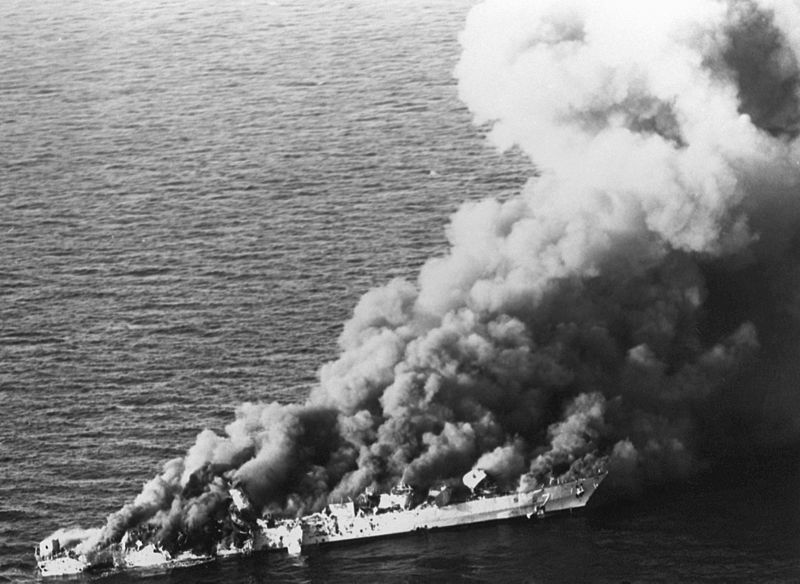 Operation Praying Mantis 1988, historical engagement. Note: This scenario is designed mostly to be played from the US/Blue and it's better to play that side in first place, and to play it later from the Iranian/Red side because it can be a little frustrating and boring, but the victory is also possible. Operation Praying Mantis was the Reagan administration answer to the Irani attacks on neutral tanker shipping and inmediate consequence of the mining deployed from the LST Iran Arj against the USS Samuel B. Roberts (FFG-58) on 14 April 1988. This operation is often cited as one of the five historical naval actions to decisively stablish the USN supremacy in a determined theater of operations. It also marked the U.S. Navy's first exchange of anti-ship missiles by ships. In the context of Iran-Iraq War the Tanker War phase (1984-1988) was one of the more complex post-WWII campaigns from the naval viewpoint. Both Iran and Iraq attacked oil tankers and merchant ships, including those of neutral nations, to deprive the opponent of trade earnings. As higher stage answer the Iranians might close the Strait of Hormuz to all shipping, but as United States had threatened several times to go to war if the Strait was closed the Iranians refused to take the risk,, limiting their attacks in retaliation first to Iraqi commercial ships but also extended to neutral shipping. After several Iranian attacks on Kuwaiti and other neutral shipping, the United States Navy started in March 1987 to escort Kuwaiti tankers the United States after had reflagged half of Kuwait's fleet of twenty-two tankers. In April 1987, the then Soviet Navy also started escorting Kuwaiti tankers. Praying Mantis was a one-day retaliation strike focused in oil rigs and other instalations where the Iranians small forces were based to assault the neutral and Western shipping. Those had included bases for the minelaying operations that damaged the USS Samuel B. Roberts. The US forces were organized in three groups and with air support and air defence of the CVN-65 USS Enterprise Carrier Air Wing Eleven, escorted by CGN-35 USS Truxtun and FF-1063 USS Reasoner: VF-114 Aardwarks with F-14A Tomcat. VF-213 Black Lions with F-14A Tomcat. VA-22 Fighting Redcocks with A-7E Corsair II. VA-94 Shrikes with A-7E Corsair II. VA-95 Green Lizards with A-6E/KA-6D Intruder. VAW-117 Wallbangers with E-2C Hawkeye Group 0. VAQ-135 Black Knights with EA-6B Prowler ICAP I (ICAP II from late 1988). Surface Action Group Bravo, targets Sassan and Rahkish/Rahksh oil platforms (renamed Salman and Resalat after the Islamic Revolution): DD-976 USS Merrill, with 1xSH-2F. DDG-8 USS Lynde McCormick. LPD-14 USS Trenton, with 4xAH-1T, 2xCH-46, 2xUH-1, and the USS Samuel L. Roberts SH-60B. Surface Action Group Charlie, target Sirri oil platform (renamed Nasr after the Islamic Revolution): CG-28 USS Wainwright. FFG-56 USS Simpson, with 1xSH-60 and 1xUH-60. FF-1069 USS Bagley, with 1xSH-2F. Surface Action Group Delta, composed partly of former escort ships from the Enterprise group, with target the Iranian warship FFL Sabalan, because her reputation for deliberately attacking the crew quarters of neutral ships: DDG-16 USS Joseph Strauss. DD-975 USS O'Brien, with 2xSH-2F and 1xUH-60. FFG-24 USS Jack Williams, with 2xSH-2F. The rest is history ... or not. Historical Note: This scenario represents aproximatively only the historically engaged forces, as the US side decides to not attack mainland Iran to prevent a escalade, and the Iranian response was limited to a few warships and warplanes and not launching shore-based SSM (they are contradictory reports about that) because the Iranian fears to US retaliatory strikes over mainland Iran, and as in the case of the Gadaffi's Libya on 1981 and 1986, the fear of heavy losses on his own side could weak his position as regional power (In the case of Iran we should remember was in war with Iraq on 1988, and the outcome of Praying Mantis also forced Iran to settle the peace with Iraq). In the historical aftermath, Iran losed the FFL Sahand, the PTM Joshan (after be notified many times of "stop your engines, abandon ship, I intend to sink you", Joshan launched the last operational Harpoon in the Iranian Navy againts the CG-28 USS Wainwright who decoyed it, receiving in interchange a salvo of six Standard SM-1 and one Harpoon) and some three PG type Toragh/Boghammar based in the Abu Musa Island to attack commercial shipping, and also the FFL Sabalan resulted crippled, but was returned to service on 1989. The oil platforms of Sassan and Sirri, employed as bases for the attacks on commercial shipping, rested unoperative after the previously demanded evacuation and subsequent combined attack of warships, Cobra helicopters and SEAL and USMC teams. The attack against the Rahksh oil platform was called off to ease pressure on the Iranians and denote a desire for de-escalation. The FFL Sabalan not was sunk also because when Defense Secretary Carlucci asked Admiral Crowe, then CJCS, what he thought about launch another strike to finish she, Crowe responded, "Sir, I think we've shed enough blood today". Enrique Mas, January 2012 Edited 7 January 2012 because bad characters in the text file.
-
A gentlemen's war and a great, great adventure ... and I was ignoring of the schooner was named Ayesha, what evocative name ...
-
The planes and ships models sembled purchased in a chinese convenience store
-
And two trascendental links for that: To check carrier by carrier, as in the USS Enterprise example: http://www.uscarriers.net/cvn65.htm and go to deployments: http://www.uscarriers.net/cvn65deploy.htm And in the very dense Gonavy.jp website: http://gonavy.jp/CVf.html
-
A request of very easy execution and not requering a new loadout, finded when thinking about other first eigthies scenarios: The E-2C Hawkeye is a high value aircraft and many airframes were updated many times from one variant to another and the production data are doubtous and confuse. In the DB is present the E-2C Hawkeye Group 0 (1984), with APS-138 radar and in service from 1984. We can add two variants more for older scenarios: E-2C Hawkeye Group 0 (1973): with APS-120 radar, in service from October 1973, first cruise in the USS Saratoga on September 1974, some 55 built (We can remember the essential difference with E-2B/APS-120, the E-2B variants lack the ESM, introduced only from the first E-2C). E-2C Hawkeye Group 0 (1978): with APS-125 radar, in service from 1978, some eight built (and perhaps others converted). Table with radar types and in-service dates on page 56 of E-2 Hawkeye, Walk Around number 53, by Ken Neubeck, Squadron-Signal 2008, and others checkings.
-
The direct link is the mentioned http://harpgamer.com/harpforum/index.php?a...mp;showfile=235 The DB is dated 2007 because was first uploaded that year. The last iteration is dated "Last Updated Dec 11 2011, 04:48 PM" Only click "Download File"
-
After those years of development, don't sound it as proper of a great military plane ...
-
You can download the standard DB (HCDB 1980-2015) from here: http://harpgamer.com/harpforum/index.php?a...mp;showfile=235 After downloading, you unzip the file and replace the resulting commondb file on your HCE directory. If do you want (and I'm sure do you want ), you can import with the HCE Platform Editor this same commondb file to analyze it in deep ... simply pulse the virtual button "Import New Database". Browsing on http://harpgamer.com/harpforum/index.php?a...s&showcat=3 you can see a multitude of DBs, some of them discontinued. The cause is the limit of 2055 or so entries on each item of each DB, our main limitation now is the limited number of aircraft loadouts in the standard DB, also because that, they is not a standard DB, for instance, for the time period 1946-2012 and beyond in the future, we must segmentate the platforms on concrete time periods. About the Club-K-armed merchant ships, any serious input about platforms (we don't include habitually speculative or never in-service platforms on this DB, partly because the aforementioned space limitations, partly because the sad demise of the RAH-66 Comanche and other similar cases, but the last word is of course of Brad ) is ever welcomed, and about this concrete case, I'm shamed because I don't know what is a Club-K-armed merchant ship We are ever learning naval history on this site, a month ago I've not idea about Sea Specter and find she very casually ... Oh, I see, I think it's not in the DB because the mentioned causes: http://blog.heritage.org/2011/08/22/the-cl...ruise-missiles/
-
Don't forget the long-term aim of Brazil is his a force of SSN of local design and construction, program in the future from 30 years ago or so ... and we can remember also the problems of India with his indigenous SS( B )N program ...
-
Very interested, thanks, and welcome
-
Some minor considerations about the HCDB-111211: Submarine entry 6405 Romei (Tang) lacks sensors (Incidentally in the text the sensor named BQG-5 PUFFS should be called BQG-1). The Audace (1980) entries 30502 and 30503 have a entry 59688 Mk 13 mount with the very later SM-2MR Block II (1984), it should be equipped with 59684 SM-1MR Block V (1969). I think entry 3509 Alpino (1997) should be classified as MCM. Entry Carabiniere was equipped with 8xAster 15 from October 2000. Entry 3518 DD HMAS Vampire: the LW.02 and 2xWM.22 radars were apparently keeped, as in this picture of the preserved ship in http://commons.wikimedia.org/wiki/File:Exc..._Sydney_024.jpg All the River and Yarra Australian frigates are equipped with WM.20 and LW.02 (and not Radar 994 (AWS-4)), as per photographic evidence. Entry 3538 Santa Maria (94) lacks the ship names (Navarra, Canarias). Entry 3539 Baleares (1980) and entry 3540 Baleares (1987) lacks the sensor fit. Entry 3548 Anaga: the main gun is an old 76mm/50 Mk22 of discarted US ships, not a modern 76mm/62 OTO Melara Compact as was originally pretended. The named Consilium Selesmar radars I suspect are local commercial names for Sperry Mk 127E (Consilium Selesmar SRL MM950 F/I-band) and Decca 1226 (Consilium Selesmar RTM 12X/M I-band): http://es.wikipedia.org/wiki/Clase_Anaga http://www.losbarcosdeeugenio.com/barcos/es/es/ae_P24.html http://www.armada.mde.es/ArmadaPortal/page...ros-clase-anaga Entry 3549 Alcitepe (82) has the speed number erronously transcripted, 34, not 43 !!! Some irrelevant, but the number of ASROC reloads in FRAM I destroyers are 9, as we can see in (the nine dots in the after superstructure) the USS Fiske: http://www.navsource.org/archives/05/842.htm http://www.navsource.org/archives/05/0584201.jpg and more clearly on: http://www.gyrodynehelicopters.com/asroc_loading.htm About the SPS-29 or SPS-40 radar in the Turkish DDs: by photographic evidence on navsource.org, a number of they were equipped with SPS-29 at the start of the Turkish service, and later equipped with SPS-40, and I think only Yucetepe retains SPS-29 to the end of her career.
-
This widely showed picture depicts some very similar to a Standard MR missile. http://internacional.elpais.com/internacio...709_644243.html The fact: a new propaganda victory for Iran, and a new exhibition of lack of professionalism on the mainstream media ... and they are keeping on the information business
