Jump to content

donaldseadog

Members
  • Posts

    1,394
  • Joined

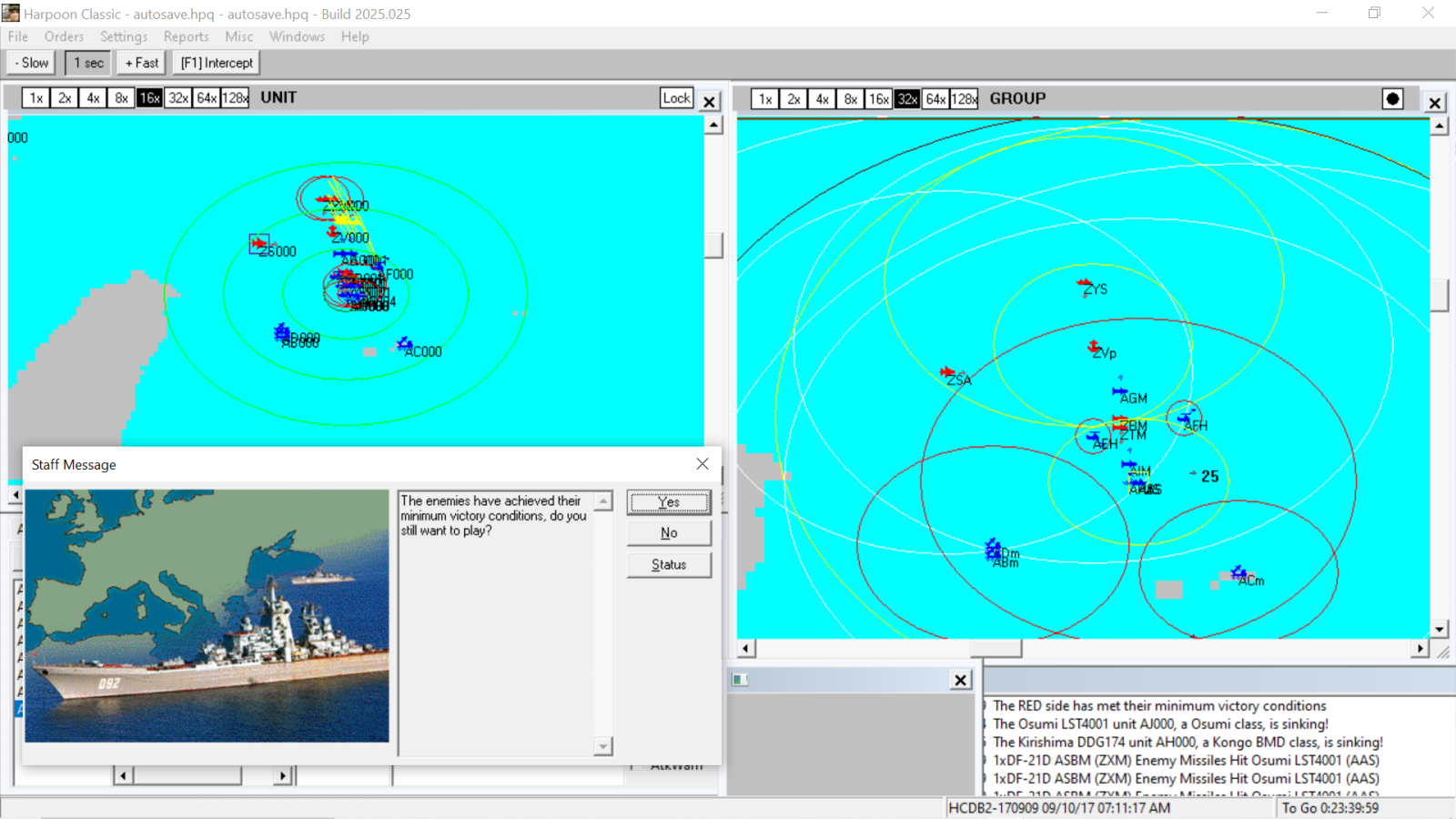
  • Last visited

  • Days Won

    124

Everything posted by donaldseadog

  1. From Australian ABC news service https://www.abc.net.au/news/2025-12-05/aukus-review-pentagon-donald-trump-administration/105588512
  2. Are you attempting an intercept with an airbourne ac group or launching a new group from a base. In this situation we've never been able to launch a new ac group to attack a missile group. You must launch it as a patrol then do an intercept. If attempting an intercept by an airbourne group then I think it should at least assign it as a target. Have you tried the same thing in a manageable sized scenario?
  3. Wow, very interesting, once I found the English version switch
  4. View File Turkey in the Black Sea Photo: Ada-class ASW corvettes of the Turkish Navy This scenario can be played with GE version 2022.027 (matrix last release) or newer, Database HCDB2-170909 in Medc 2003 Battleset. While Russia is still busy fighting it's war with Ukraine she has been harassing other countries with aircraft incursions, but Turkey fights back. Submitter donaldseadog Submitted 11/11/2025 Category MEDC  
  5. Version 1.0.0

    4 downloads

    Photo: Ada-class ASW corvettes of the Turkish Navy This scenario can be played with GE version 2022.027 (matrix last release) or newer, Database HCDB2-170909 in Medc 2003 Battleset. While Russia is still busy fighting it's war with Ukraine she has been harassing other countries with aircraft incursions, but Turkey fights back.
  6. This might be getting close save game ...B1 should be 1 or 2 secs before the red group (2 ac unit) fires on blue group (single ac unit). I believe AI wants to fire 4 missiles but only fires 2, 4 out of 8 are remaining. save game ...B1.0002 is shortly after and in one or two seconds the red group expends all LR missile but none are fired. Using DB HCDB2-170909, westpac BS, GE vers 2025.025 pacMissTest-B1.zip
  7. I've done a small revision of the test scenario by deleting one blue base and adding some blue planes of the same type as I set to patrol in the red base. The scenario and a few saved games are in the zip attached. The save games are (if I remember correctly) 1/ playing blue I send up two patrolilng ac and flys towards the red base, they are intercepted by the red formation patrol identical AC with identical loadout who fire 4 LR missile at me but have only 2 out of 8 left. I attack and AI suggests I fire 6 missile, I fire 6 and have 2 left. 2/ a little later the red intercepting plains 'loose' their remaining 2 missile but none have been fired. 3/ similar but I send up a single patrolling AC. I'll simplify further and try for a game save a second before red fires, but what seems to be happening is that AI is deciding to fire X number of missiles, X is deleted from the planes available missiles but less than X are actually fired. pacMissTest-A.zip
  8. I think it's simulating shody launch rails😁 I have a couple of test ideas and should look at it tonight. I've been in the bush for a couple of days but did a quick run and saw the same thing happen. It is the AI side that has the problem, initial number minus number fired is greater than number left. The only add I have at moment is that store consumed procedure tallys with the number of missile fired and in the attacking missile group.
  9. I don't for certain but does the steam hc97 have a scenario editor that would let you edit the battleset scenario and replace the units with something more suitable. It sounds like a clerical error in putting the database together. In these old games the database is built into the game,so fixing it is a major item that I'd guess isn't likely to happen, but who knows. Someone else might very well have better ideas.
  10. From Australian ABC news service https://www.abc.net.au/news/2025-10-20/chinese-fighter-jet-released-flares-close-to-australian-aircraft/105913308?utm_source=abc_news_app&utm_medium=content_shared&utm_campaign=abc_news_app&utm_content=other
  11. From Australian ABC news service https://www.abc.net.au/news/2025-10-16/australian-spy-plane-deployed-45-times-to-help-ukraine/105897496?utm_source=abc_news_web&utm_medium=content_shared&utm_campaign=abc_news_web&utm_content=link
  12. View File Operation FRUKIS For play with Harpoon Classic vers 2022.027 or newer, Middle East Battleset and HCCW 140314 Database. Israel invaded Egypt on 29 October 1956, having done so with the primary objective of re-opening the Straits of Tiran and the Gulf of Aqaba as the recent tightening of the eight-year-long Egyptian blockade further prevented Israeli passage. After issuing a joint ultimatum for a ceasefire, the United Kingdom and France joined the Israelis on 5 November, seeking to depose Egyptian president Gamal Abdel Nasser and regain control of the Suez Canal. [from wikipedia Suez Crisis Suez Crisis - Wikipedia ] In this scenario I've used as much as possible the platforms in use then by each country, but much reduced in numbers and non historically correct locations, and a very simplified strategic plan. The platforms of this era (and upto say late 60's) are interesting to use with usually radar controlled gunnery as primary AA defense and non guided short ranged rocket or bombs as primary aircraft launched surface attack weapons. The lack of terrain following ac equipment prevents close formation multi ac attacks instead requiring either high exposure to detection multi ac formation or multiple effectively single ac wave skimming attacks. Even in the early 70's non formation but close proximity wave skimming attacks by A4 skyhawks was still practiced by RAN fleet air arm. Submitter donaldseadog Submitted 10/13/2025 Category Middle East  
  13. Version 1.0.0

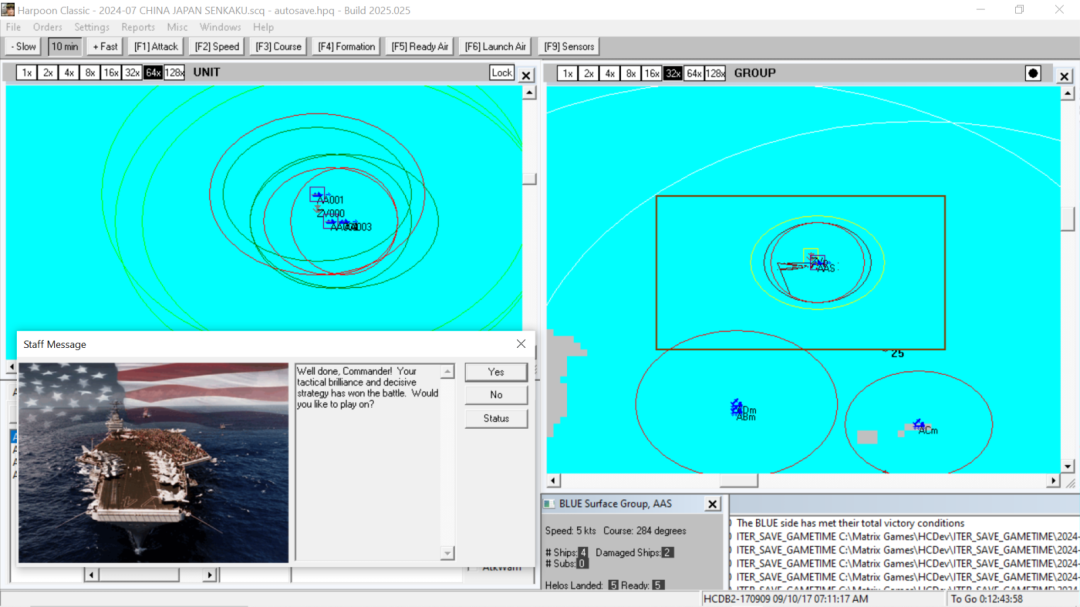
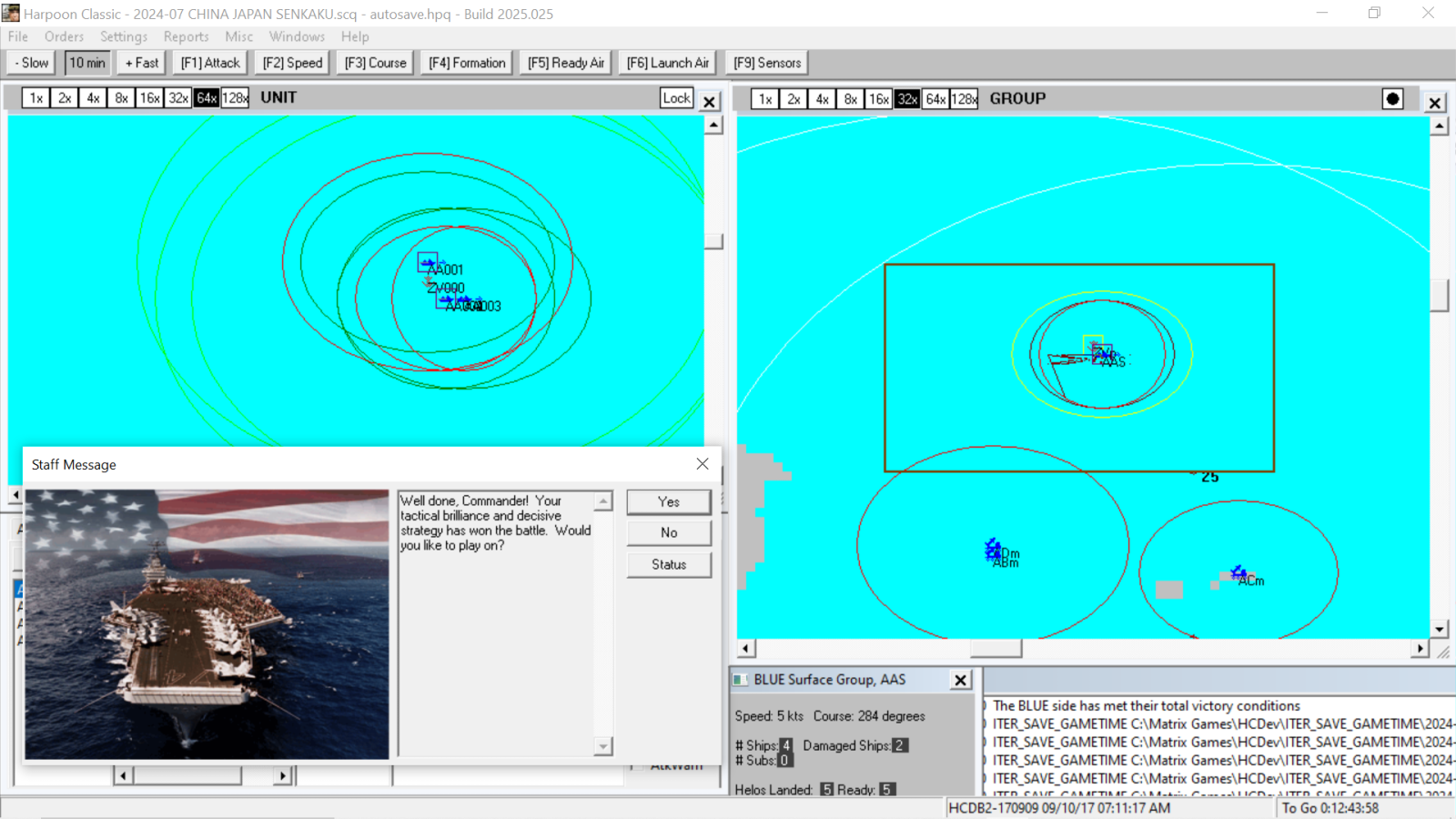
    13 downloads

    For play with Harpoon Classic vers 2022.027 or newer, Middle East Battleset and HCCW 140314 Database. Israel invaded Egypt on 29 October 1956, having done so with the primary objective of re-opening the Straits of Tiran and the Gulf of Aqaba as the recent tightening of the eight-year-long Egyptian blockade further prevented Israeli passage. After issuing a joint ultimatum for a ceasefire, the United Kingdom and France joined the Israelis on 5 November, seeking to depose Egyptian president Gamal Abdel Nasser and regain control of the Suez Canal. [from wikipedia Suez Crisis Suez Crisis - Wikipedia ] In this scenario I've used as much as possible the platforms in use then by each country, but much reduced in numbers and non historically correct locations, and a very simplified strategic plan. The platforms of this era (and upto say late 60's) are interesting to use with usually radar controlled gunnery as primary AA defense and non guided short ranged rocket or bombs as primary aircraft launched surface attack weapons. The lack of terrain following ac equipment prevents close formation multi ac attacks instead requiring either high exposure to detection multi ac formation or multiple effectively single ac wave skimming attacks. Even in the early 70's non formation but close proximity wave skimming attacks by A4 skyhawks was still practiced by RAN fleet air arm.
  14. View File Tarakan Passage WW2 For play in HC game version 2022.027 (matrix patch) or newer. Westpac BS and using database HCWW 101110. 21 January, 1941, a Japanese invasion fleet of one light cruiser, ten destroyers, four minesweepers, three submarine chasers, three patrol boats and sixteen transport ships left Tarakan for Balikpapan, (oil rich areas of Borneo). A MLD Dornier spotted the fleet that same day, but heavy clouds with strong winds and prolonged rain prevented the plane from shadowing the fleet. On the next day, U.S. Navy submarines S-40, Pickerel, Porpoise, Saury, Spearfish and Sturgeon were ordered to intercept the fleet. Later, they were joined by Dutch submarines K-XIV and K-XVIII. Sturgeon fired several torpedoes on the convoy and reported sinking three ships. However, postwar records failed to confirm any damages to the convoy. In this scenario a simplified version of the situation is recreated with the submarine force intercepting the south bound invasion fleet at the narrow northern entrance to the Makassar Strait. (ScreenShot US SS Porpoise, http://www.navsource.org/archives/08/08172.htm, Public Domain, https://commons.wikimedia.org/w/index.php?curid=2030041) Submitter donaldseadog Submitted 10/05/2025 Category WestPac  
  15. Version 1.0.0

    9 downloads

    For play in HC game version 2022.027 (matrix patch) or newer. Westpac BS and using database HCWW 101110. 21 January, 1941, a Japanese invasion fleet of one light cruiser, ten destroyers, four minesweepers, three submarine chasers, three patrol boats and sixteen transport ships left Tarakan for Balikpapan, (oil rich areas of Borneo). A MLD Dornier spotted the fleet that same day, but heavy clouds with strong winds and prolonged rain prevented the plane from shadowing the fleet. On the next day, U.S. Navy submarines S-40, Pickerel, Porpoise, Saury, Spearfish and Sturgeon were ordered to intercept the fleet. Later, they were joined by Dutch submarines K-XIV and K-XVIII. Sturgeon fired several torpedoes on the convoy and reported sinking three ships. However, postwar records failed to confirm any damages to the convoy. In this scenario a simplified version of the situation is recreated with the submarine force intercepting the south bound invasion fleet at the narrow northern entrance to the Makassar Strait. (ScreenShot US SS Porpoise, http://www.navsource.org/archives/08/08172.htm, Public Domain, https://commons.wikimedia.org/w/index.php?curid=2030041)
  16. From aussie ABC news service https://www.abc.net.au/news/2025-10-02/australian-army-apache-helicopters-arrive-in-townsville/105833650?utm_campaign=abc_news_web&utm_content=link&utm_medium=content_shared&utm_source=abc_news_web
  17. View File Indonesia-Malayasia Conflict 3 Use game version 2022.027 (matrix patch) or later in Westpac Battleset with Database HCCW 140314 The "Landing at Pontian" (17 August 1964) was an amphibious landing made by a small body of Indonesian troops in the Pontian District, Johor, Malaysia. The landing took place during the Indonesia-Malaysia confrontation, an undeclared war fought between Malaysia and Indonesia during the early 1960s over the creation of a Malaysian Federation encompassing parts of northern Borneo, areas that Indonesia sought to increase its own power in Southeast Asia. On 17 August 1964, Indonesian President Sukarno announced a 'Year of Dangerous Living' as a part of his country's Independence Day celebrations. To reinforce his point, Sukarno had ordered that a force of Indonesian troops and exiled Malaysian-Chinese land in mainland Malaysia to kick off a campaign of such invasions to create guerrilla bases in enemy territory and stir up Communist sympathizers. The effort was a failure, as targeted Malaysians proved unreceptive to Indonesian efforts and the invaders were swiftly rounded up by Anglo-Malaysian security forces. The landing shocked the British, who had not expected such a strong and prominent step from the Indonesians, but did not incite them to respond to Sukarno's escalation of tensions. The absence of violent reply stiffened Sukarno's burgeoning resolve, and led him to continue with more landings, amphibious and airborne, throughout the fall and winter of 1964. The landings at Pontian, though small in scale, and unsuccessful in nature, caused a huge political crisis for Britain. The Malaysian government was infuriated, and accused the Indonesians of "blatant aggression," threatening to strike (through Britain) at their bases in Sumatra, simultaneously putting immense pressure on London to act. Though Sukarno had suffered a minor defeat, he had still managed to put the British in an extremely awkward position: if they did not retaliate, they would be seen to have lost face and to lack enough resolve to risk escalating the crisis. Retaliation, however, might bring the Confrontation towards open war, which the British were understandably unwilling to consider. The debate whether or not to act raged on in Cabinet backrooms. Lord Anthony Head proved an influential voice in the conversation, stating that interrogation had shown that more raids were impending, which would stretch British forces between the Malaysian Peninsula and Borneo, forcing an unwanted reinforcement of Southeast Asia. Head advocated preventative strikes against Indonesian bases should another raid occur. Before the British could decide upon a policy, however, Sukarno struck again, making an airborne assault Labis in the night of 1-2 September. Though the raid was a catastrophic failure, with one of the transport planes crashing en route, and the remainder of the troops arriving scattered with little food and battered morale, the move further infuriated the Malaysians, who in turn put pressure upon the British to act. The next day, colonial secretary Duncan Sandys authorized on-site naval commander Admiral Varyl Begg to plan for strikes against Indonesian bases in Sumatra. In this scenario the British begin their actions of retaliation in Sumatra without waiting for further Indonesian attacks. Submitter donaldseadog Submitted 10/02/2025 Category WestPac  
  18. Version 1.1.0

    5 downloads

    Use game version 2022.027 (matrix patch) or later in Westpac Battleset with Database HCCW 140314 The "Landing at Pontian" (17 August 1964) was an amphibious landing made by a small body of Indonesian troops in the Pontian District, Johor, Malaysia. The landing took place during the Indonesia-Malaysia confrontation, an undeclared war fought between Malaysia and Indonesia during the early 1960s over the creation of a Malaysian Federation encompassing parts of northern Borneo, areas that Indonesia sought to increase its own power in Southeast Asia. On 17 August 1964, Indonesian President Sukarno announced a 'Year of Dangerous Living' as a part of his country's Independence Day celebrations. To reinforce his point, Sukarno had ordered that a force of Indonesian troops and exiled Malaysian-Chinese land in mainland Malaysia to kick off a campaign of such invasions to create guerrilla bases in enemy territory and stir up Communist sympathizers. The effort was a failure, as targeted Malaysians proved unreceptive to Indonesian efforts and the invaders were swiftly rounded up by Anglo-Malaysian security forces. The landing shocked the British, who had not expected such a strong and prominent step from the Indonesians, but did not incite them to respond to Sukarno's escalation of tensions. The absence of violent reply stiffened Sukarno's burgeoning resolve, and led him to continue with more landings, amphibious and airborne, throughout the fall and winter of 1964. The landings at Pontian, though small in scale, and unsuccessful in nature, caused a huge political crisis for Britain. The Malaysian government was infuriated, and accused the Indonesians of "blatant aggression," threatening to strike (through Britain) at their bases in Sumatra, simultaneously putting immense pressure on London to act. Though Sukarno had suffered a minor defeat, he had still managed to put the British in an extremely awkward position: if they did not retaliate, they would be seen to have lost face and to lack enough resolve to risk escalating the crisis. Retaliation, however, might bring the Confrontation towards open war, which the British were understandably unwilling to consider. The debate whether or not to act raged on in Cabinet backrooms. Lord Anthony Head proved an influential voice in the conversation, stating that interrogation had shown that more raids were impending, which would stretch British forces between the Malaysian Peninsula and Borneo, forcing an unwanted reinforcement of Southeast Asia. Head advocated preventative strikes against Indonesian bases should another raid occur. Before the British could decide upon a policy, however, Sukarno struck again, making an airborne assault Labis in the night of 1-2 September. Though the raid was a catastrophic failure, with one of the transport planes crashing en route, and the remainder of the troops arriving scattered with little food and battered morale, the move further infuriated the Malaysians, who in turn put pressure upon the British to act. The next day, colonial secretary Duncan Sandys authorized on-site naval commander Admiral Varyl Begg to plan for strikes against Indonesian bases in Sumatra. In this scenario the British begin their actions of retaliation in Sumatra without waiting for further Indonesian attacks.
  19. View File Indonesia-Malayasia Conflict 2 Can be played game versions 2022.27 (matrix patch) and later Play in Westpac Battleset using HCCW 140314 database. The Sunda Straits Crisis was a two-week confrontation between the United Kingdom and Indonesia over the passage of the Illustrious-class aircraft carrier HMS Victorious through the Sunda Strait, a major waterway separating the Indonesian islands of Java and Sumatra, occurring between August and September 1964. The incident was part of the larger Indonesia-Malaysia confrontation, an armed conflict between Indonesia and Malaysia (with the military support of Britain) over the formation of the latter as an independent state. On 27 August 1964, the British aircraft carrier HMS Victorious and her two destroyer escorts sailed through the Sunda Strait, an international waterway claimed by Indonesia, en route to Australia. Upset by the casual warning the British had given of the ships' impending passage through the Strait (a telephone call made two days before, which did not mention the carrier) and wary of the possibility that the British were attempting to provoke a violent response, the Indonesian Ministry of Foreign Affairs decided two days later to prohibit the warships from making the return journey to Singapore, scheduled for the middle of September. Infuriated by what was perceived as another affront to British prestige after the recent landings at Pontian and Labis by Indonesian volunteers in southwestern Malaysia, members of the British Cabinet, particularly Peter Thorneycroft and Louis Mountbatten, favoured sending the carrier back through the Strait in spite of the Indonesian ban. Though British naval commanders in the Far East had grave concerns that the Victorious would be indefensible while in passage, the prevailing opinion was that not to send the ship would result in an immense political defeat on both a domestic and international scale as well as the loss of rights to an important waterway. Tension mounted as the British and Indonesians each refused to bend, and as the carrier's time to sail came, war became increasingly likely. On 10 September, however, the Indonesians proposed a way out: an alternative route through the Lombok Strait. The British took them up on this offer. In this scenario Peter Thorneycroft and Louis Mountbatten have their way and Victorious turns to transit the Sunda Straight while the reinforcing carrier group Centaur speeds down from Singapore. NOTE: to transit the exit from Sunda Strait you will need to carefully manage you group and close in the formation watching for shallowing waters. see https://en.wikipedia.org/wiki/Sunda_Straits_Crisis#Victorious_sails_from_Singapore Submitter donaldseadog Submitted 09/30/2025 Category WestPac  
  20. Version 1.1.0

    7 downloads

    Can be played game versions 2022.27 (matrix patch) and later Play in Westpac Battleset using HCCW 140314 database. The Sunda Straits Crisis was a two-week confrontation between the United Kingdom and Indonesia over the passage of the Illustrious-class aircraft carrier HMS Victorious through the Sunda Strait, a major waterway separating the Indonesian islands of Java and Sumatra, occurring between August and September 1964. The incident was part of the larger Indonesia-Malaysia confrontation, an armed conflict between Indonesia and Malaysia (with the military support of Britain) over the formation of the latter as an independent state. On 27 August 1964, the British aircraft carrier HMS Victorious and her two destroyer escorts sailed through the Sunda Strait, an international waterway claimed by Indonesia, en route to Australia. Upset by the casual warning the British had given of the ships' impending passage through the Strait (a telephone call made two days before, which did not mention the carrier) and wary of the possibility that the British were attempting to provoke a violent response, the Indonesian Ministry of Foreign Affairs decided two days later to prohibit the warships from making the return journey to Singapore, scheduled for the middle of September. Infuriated by what was perceived as another affront to British prestige after the recent landings at Pontian and Labis by Indonesian volunteers in southwestern Malaysia, members of the British Cabinet, particularly Peter Thorneycroft and Louis Mountbatten, favoured sending the carrier back through the Strait in spite of the Indonesian ban. Though British naval commanders in the Far East had grave concerns that the Victorious would be indefensible while in passage, the prevailing opinion was that not to send the ship would result in an immense political defeat on both a domestic and international scale as well as the loss of rights to an important waterway. Tension mounted as the British and Indonesians each refused to bend, and as the carrier's time to sail came, war became increasingly likely. On 10 September, however, the Indonesians proposed a way out: an alternative route through the Lombok Strait. The British took them up on this offer. In this scenario Peter Thorneycroft and Louis Mountbatten have their way and Victorious turns to transit the Sunda Straight while the reinforcing carrier group Centaur speeds down from Singapore. NOTE: to transit the exit from Sunda Strait you will need to carefully manage you group and close in the formation watching for shallowing waters. see https://en.wikipedia.org/wiki/Sunda_Straits_Crisis#Victorious_sails_from_Singapore
  21. View File Indonesia-Malayasia Conflict 1 Requires Harpoon Classic version 2022.027 (matrix patch) or later, Westpac BattleSet and HCCW 140314 database. (Photo circa 1965 HMAS Melbourne, Vendetta and Voyager) The Indonesia - Malaysia confrontation was an armed conflict from 1963 to 1966 that stemmed from Indonesia's opposition to the creation of the state of Malaysia from the Federation of Malaya. After Indonesian president Sukarno was deposed in 1966, the dispute ended peacefully. The creation of Malaysia was a merger of the Federation of Malaya (now Peninsular Malaysia), Singapore and the British Crown colonies of North Borneo and Sarawak (collectively known as British Borneo, now East Malaysia) in September 1963. Vital precursors to the conflict included Indonesia's policy of confrontation against Dutch New Guinea from March to August 1962 and the Indonesia-backed Brunei revolt in December 1962. Malaysia had direct military support from the United Kingdom, Australia, and New Zealand. Indonesia had indirect support from the USSR and China, thus making it an episode of the Cold War in Asia. The conflict was an undeclared war with most of the action occurring in the border area between Indonesia and East Malaysia on the island of Borneo (known as Kalimantan in Indonesia). However Indonesia also conducted lower intensity covert actions on the Malay Peninsula and in Singapore. The conflict was characterised by restrained and isolated ground combat, set within tactics of low-level brinkmanship. Combat was usually conducted by company- or platoon-sized operations on either side of the border. It has been claimed that a Central Intelligence Agency memorandum of 1962 indicated that UK Prime Minister Macmillan and US President Kennedy were increasingly alarmed by the possibility of the confrontation with Malaysia spreading, and agreed to "liquidate President Sukarno, depending on the situation and available opportunities". [extract from Wikipedia] In this alternative to history situation Sukarno has been removed by external efforts but rather than calm the situation it has inflamed it and resulted in more direct involvement of China and the USSR. Submitter donaldseadog Submitted 09/24/2025 Category WestPac  
  22. Version 1.0.0

    9 downloads

    Requires Harpoon Classic version 2022.027 (matrix patch) or later, Westpac BattleSet and HCCW 140314 database. (Photo circa 1965 HMAS Melbourne, Vendetta and Voyager) The Indonesia - Malaysia confrontation was an armed conflict from 1963 to 1966 that stemmed from Indonesia's opposition to the creation of the state of Malaysia from the Federation of Malaya. After Indonesian president Sukarno was deposed in 1966, the dispute ended peacefully. The creation of Malaysia was a merger of the Federation of Malaya (now Peninsular Malaysia), Singapore and the British Crown colonies of North Borneo and Sarawak (collectively known as British Borneo, now East Malaysia) in September 1963. Vital precursors to the conflict included Indonesia's policy of confrontation against Dutch New Guinea from March to August 1962 and the Indonesia-backed Brunei revolt in December 1962. Malaysia had direct military support from the United Kingdom, Australia, and New Zealand. Indonesia had indirect support from the USSR and China, thus making it an episode of the Cold War in Asia. The conflict was an undeclared war with most of the action occurring in the border area between Indonesia and East Malaysia on the island of Borneo (known as Kalimantan in Indonesia). However Indonesia also conducted lower intensity covert actions on the Malay Peninsula and in Singapore. The conflict was characterised by restrained and isolated ground combat, set within tactics of low-level brinkmanship. Combat was usually conducted by company- or platoon-sized operations on either side of the border. It has been claimed that a Central Intelligence Agency memorandum of 1962 indicated that UK Prime Minister Macmillan and US President Kennedy were increasingly alarmed by the possibility of the confrontation with Malaysia spreading, and agreed to "liquidate President Sukarno, depending on the situation and available opportunities". [extract from Wikipedia] In this alternative to history situation Sukarno has been removed by external efforts but rather than calm the situation it has inflamed it and resulted in more direct involvement of China and the USSR.
  23. There's quite a bit of interesting reading here especially if you follow the various links. I'm wondering if things had gone bad and the conflict escalated to include significant naval and combat air action what would it have been like? https://en.wikipedia.org/wiki/Indonesia–Malaysia_confrontation?wprov=sfla1
  24. Good to know, it is likely something to do with my 2025.025 install which went straight over 2025.023 beta. I'll look at my BS files.
  25. in GE vers 2025.025 scenario 2 there are a significant number of aground ships. When looking in the Scenario Editor and comparing with 2022.027 the BS map appears to have been distorted. Screen shots below
×
×
  • Create New...