

donaldseadog
Members
-
Joined
-
Last visited
Everything posted by donaldseadog
-
From Australian ABC news service https://www.abc.net.au/news/2025-10-16/australian-spy-plane-deployed-45-times-to-help-ukraine/105897496?utm_source=abc_news_web&utm_medium=content_shared&utm_campaign=abc_news_web&utm_content=link
-
View File Operation FRUKIS For play with Harpoon Classic vers 2022.027 or newer, Middle East Battleset and HCCW 140314 Database. Israel invaded Egypt on 29 October 1956, having done so with the primary objective of re-opening the Straits of Tiran and the Gulf of Aqaba as the recent tightening of the eight-year-long Egyptian blockade further prevented Israeli passage. After issuing a joint ultimatum for a ceasefire, the United Kingdom and France joined the Israelis on 5 November, seeking to depose Egyptian president Gamal Abdel Nasser and regain control of the Suez Canal. [from wikipedia Suez Crisis Suez Crisis - Wikipedia ] In this scenario I've used as much as possible the platforms in use then by each country, but much reduced in numbers and non historically correct locations, and a very simplified strategic plan. The platforms of this era (and upto say late 60's) are interesting to use with usually radar controlled gunnery as primary AA defense and non guided short ranged rocket or bombs as primary aircraft launched surface attack weapons. The lack of terrain following ac equipment prevents close formation multi ac attacks instead requiring either high exposure to detection multi ac formation or multiple effectively single ac wave skimming attacks. Even in the early 70's non formation but close proximity wave skimming attacks by A4 skyhawks was still practiced by RAN fleet air arm. Submitter donaldseadog Submitted 10/13/2025 Category Middle East
-
 For play with Harpoon Classic vers 2022.027 or newer, Middle East Battleset and HCCW 140314 Database. Israel invaded Egypt on 29 October 1956, having done so with the primary objective of re-opening the Straits of Tiran and the Gulf of Aqaba as the recent tightening of the eight-year-long Egyptian blockade further prevented Israeli passage. After issuing a joint ultimatum for a ceasefire, the United Kingdom and France joined the Israelis on 5 November, seeking to depose Egyptian president Gamal Abdel Nasser and regain control of the Suez Canal. [from wikipedia Suez Crisis Suez Crisis - Wikipedia ] In this scenario I've used as much as possible the platforms in use then by each country, but much reduced in numbers and non historically correct locations, and a very simplified strategic plan. The platforms of this era (and upto say late 60's) are interesting to use with usually radar controlled gunnery as primary AA defense and non guided short ranged rocket or bombs as primary aircraft launched surface attack weapons. The lack of terrain following ac equipment prevents close formation multi ac attacks instead requiring either high exposure to detection multi ac formation or multiple effectively single ac wave skimming attacks. Even in the early 70's non formation but close proximity wave skimming attacks by A4 skyhawks was still practiced by RAN fleet air arm.
-
View File Tarakan Passage WW2 For play in HC game version 2022.027 (matrix patch) or newer. Westpac BS and using database HCWW 101110. 21 January, 1941, a Japanese invasion fleet of one light cruiser, ten destroyers, four minesweepers, three submarine chasers, three patrol boats and sixteen transport ships left Tarakan for Balikpapan, (oil rich areas of Borneo). A MLD Dornier spotted the fleet that same day, but heavy clouds with strong winds and prolonged rain prevented the plane from shadowing the fleet. On the next day, U.S. Navy submarines S-40, Pickerel, Porpoise, Saury, Spearfish and Sturgeon were ordered to intercept the fleet. Later, they were joined by Dutch submarines K-XIV and K-XVIII. Sturgeon fired several torpedoes on the convoy and reported sinking three ships. However, postwar records failed to confirm any damages to the convoy. In this scenario a simplified version of the situation is recreated with the submarine force intercepting the south bound invasion fleet at the narrow northern entrance to the Makassar Strait. (ScreenShot US SS Porpoise, http://www.navsource.org/archives/08/08172.htm, Public Domain, https://commons.wikimedia.org/w/index.php?curid=2030041) Submitter donaldseadog Submitted 10/05/2025 Category WestPac
-
 For play in HC game version 2022.027 (matrix patch) or newer. Westpac BS and using database HCWW 101110. 21 January, 1941, a Japanese invasion fleet of one light cruiser, ten destroyers, four minesweepers, three submarine chasers, three patrol boats and sixteen transport ships left Tarakan for Balikpapan, (oil rich areas of Borneo). A MLD Dornier spotted the fleet that same day, but heavy clouds with strong winds and prolonged rain prevented the plane from shadowing the fleet. On the next day, U.S. Navy submarines S-40, Pickerel, Porpoise, Saury, Spearfish and Sturgeon were ordered to intercept the fleet. Later, they were joined by Dutch submarines K-XIV and K-XVIII. Sturgeon fired several torpedoes on the convoy and reported sinking three ships. However, postwar records failed to confirm any damages to the convoy. In this scenario a simplified version of the situation is recreated with the submarine force intercepting the south bound invasion fleet at the narrow northern entrance to the Makassar Strait. (ScreenShot US SS Porpoise, http://www.navsource.org/archives/08/08172.htm, Public Domain, https://commons.wikimedia.org/w/index.php?curid=2030041)
-
From aussie ABC news service https://www.abc.net.au/news/2025-10-02/australian-army-apache-helicopters-arrive-in-townsville/105833650?utm_campaign=abc_news_web&utm_content=link&utm_medium=content_shared&utm_source=abc_news_web
-
View File Indonesia-Malayasia Conflict 3 Use game version 2022.027 (matrix patch) or later in Westpac Battleset with Database HCCW 140314 The "Landing at Pontian" (17 August 1964) was an amphibious landing made by a small body of Indonesian troops in the Pontian District, Johor, Malaysia. The landing took place during the Indonesia-Malaysia confrontation, an undeclared war fought between Malaysia and Indonesia during the early 1960s over the creation of a Malaysian Federation encompassing parts of northern Borneo, areas that Indonesia sought to increase its own power in Southeast Asia. On 17 August 1964, Indonesian President Sukarno announced a 'Year of Dangerous Living' as a part of his country's Independence Day celebrations. To reinforce his point, Sukarno had ordered that a force of Indonesian troops and exiled Malaysian-Chinese land in mainland Malaysia to kick off a campaign of such invasions to create guerrilla bases in enemy territory and stir up Communist sympathizers. The effort was a failure, as targeted Malaysians proved unreceptive to Indonesian efforts and the invaders were swiftly rounded up by Anglo-Malaysian security forces. The landing shocked the British, who had not expected such a strong and prominent step from the Indonesians, but did not incite them to respond to Sukarno's escalation of tensions. The absence of violent reply stiffened Sukarno's burgeoning resolve, and led him to continue with more landings, amphibious and airborne, throughout the fall and winter of 1964. The landings at Pontian, though small in scale, and unsuccessful in nature, caused a huge political crisis for Britain. The Malaysian government was infuriated, and accused the Indonesians of "blatant aggression," threatening to strike (through Britain) at their bases in Sumatra, simultaneously putting immense pressure on London to act. Though Sukarno had suffered a minor defeat, he had still managed to put the British in an extremely awkward position: if they did not retaliate, they would be seen to have lost face and to lack enough resolve to risk escalating the crisis. Retaliation, however, might bring the Confrontation towards open war, which the British were understandably unwilling to consider. The debate whether or not to act raged on in Cabinet backrooms. Lord Anthony Head proved an influential voice in the conversation, stating that interrogation had shown that more raids were impending, which would stretch British forces between the Malaysian Peninsula and Borneo, forcing an unwanted reinforcement of Southeast Asia. Head advocated preventative strikes against Indonesian bases should another raid occur. Before the British could decide upon a policy, however, Sukarno struck again, making an airborne assault Labis in the night of 1-2 September. Though the raid was a catastrophic failure, with one of the transport planes crashing en route, and the remainder of the troops arriving scattered with little food and battered morale, the move further infuriated the Malaysians, who in turn put pressure upon the British to act. The next day, colonial secretary Duncan Sandys authorized on-site naval commander Admiral Varyl Begg to plan for strikes against Indonesian bases in Sumatra. In this scenario the British begin their actions of retaliation in Sumatra without waiting for further Indonesian attacks. Submitter donaldseadog Submitted 10/02/2025 Category WestPac
-
 Use game version 2022.027 (matrix patch) or later in Westpac Battleset with Database HCCW 140314 The "Landing at Pontian" (17 August 1964) was an amphibious landing made by a small body of Indonesian troops in the Pontian District, Johor, Malaysia. The landing took place during the Indonesia-Malaysia confrontation, an undeclared war fought between Malaysia and Indonesia during the early 1960s over the creation of a Malaysian Federation encompassing parts of northern Borneo, areas that Indonesia sought to increase its own power in Southeast Asia. On 17 August 1964, Indonesian President Sukarno announced a 'Year of Dangerous Living' as a part of his country's Independence Day celebrations. To reinforce his point, Sukarno had ordered that a force of Indonesian troops and exiled Malaysian-Chinese land in mainland Malaysia to kick off a campaign of such invasions to create guerrilla bases in enemy territory and stir up Communist sympathizers. The effort was a failure, as targeted Malaysians proved unreceptive to Indonesian efforts and the invaders were swiftly rounded up by Anglo-Malaysian security forces. The landing shocked the British, who had not expected such a strong and prominent step from the Indonesians, but did not incite them to respond to Sukarno's escalation of tensions. The absence of violent reply stiffened Sukarno's burgeoning resolve, and led him to continue with more landings, amphibious and airborne, throughout the fall and winter of 1964. The landings at Pontian, though small in scale, and unsuccessful in nature, caused a huge political crisis for Britain. The Malaysian government was infuriated, and accused the Indonesians of "blatant aggression," threatening to strike (through Britain) at their bases in Sumatra, simultaneously putting immense pressure on London to act. Though Sukarno had suffered a minor defeat, he had still managed to put the British in an extremely awkward position: if they did not retaliate, they would be seen to have lost face and to lack enough resolve to risk escalating the crisis. Retaliation, however, might bring the Confrontation towards open war, which the British were understandably unwilling to consider. The debate whether or not to act raged on in Cabinet backrooms. Lord Anthony Head proved an influential voice in the conversation, stating that interrogation had shown that more raids were impending, which would stretch British forces between the Malaysian Peninsula and Borneo, forcing an unwanted reinforcement of Southeast Asia. Head advocated preventative strikes against Indonesian bases should another raid occur. Before the British could decide upon a policy, however, Sukarno struck again, making an airborne assault Labis in the night of 1-2 September. Though the raid was a catastrophic failure, with one of the transport planes crashing en route, and the remainder of the troops arriving scattered with little food and battered morale, the move further infuriated the Malaysians, who in turn put pressure upon the British to act. The next day, colonial secretary Duncan Sandys authorized on-site naval commander Admiral Varyl Begg to plan for strikes against Indonesian bases in Sumatra. In this scenario the British begin their actions of retaliation in Sumatra without waiting for further Indonesian attacks.
-
View File Indonesia-Malayasia Conflict 2 Can be played game versions 2022.27 (matrix patch) and later Play in Westpac Battleset using HCCW 140314 database. The Sunda Straits Crisis was a two-week confrontation between the United Kingdom and Indonesia over the passage of the Illustrious-class aircraft carrier HMS Victorious through the Sunda Strait, a major waterway separating the Indonesian islands of Java and Sumatra, occurring between August and September 1964. The incident was part of the larger Indonesia-Malaysia confrontation, an armed conflict between Indonesia and Malaysia (with the military support of Britain) over the formation of the latter as an independent state. On 27 August 1964, the British aircraft carrier HMS Victorious and her two destroyer escorts sailed through the Sunda Strait, an international waterway claimed by Indonesia, en route to Australia. Upset by the casual warning the British had given of the ships' impending passage through the Strait (a telephone call made two days before, which did not mention the carrier) and wary of the possibility that the British were attempting to provoke a violent response, the Indonesian Ministry of Foreign Affairs decided two days later to prohibit the warships from making the return journey to Singapore, scheduled for the middle of September. Infuriated by what was perceived as another affront to British prestige after the recent landings at Pontian and Labis by Indonesian volunteers in southwestern Malaysia, members of the British Cabinet, particularly Peter Thorneycroft and Louis Mountbatten, favoured sending the carrier back through the Strait in spite of the Indonesian ban. Though British naval commanders in the Far East had grave concerns that the Victorious would be indefensible while in passage, the prevailing opinion was that not to send the ship would result in an immense political defeat on both a domestic and international scale as well as the loss of rights to an important waterway. Tension mounted as the British and Indonesians each refused to bend, and as the carrier's time to sail came, war became increasingly likely. On 10 September, however, the Indonesians proposed a way out: an alternative route through the Lombok Strait. The British took them up on this offer. In this scenario Peter Thorneycroft and Louis Mountbatten have their way and Victorious turns to transit the Sunda Straight while the reinforcing carrier group Centaur speeds down from Singapore. NOTE: to transit the exit from Sunda Strait you will need to carefully manage you group and close in the formation watching for shallowing waters. see https://en.wikipedia.org/wiki/Sunda_Straits_Crisis#Victorious_sails_from_Singapore Submitter donaldseadog Submitted 09/30/2025 Category WestPac
-
 Can be played game versions 2022.27 (matrix patch) and later Play in Westpac Battleset using HCCW 140314 database. The Sunda Straits Crisis was a two-week confrontation between the United Kingdom and Indonesia over the passage of the Illustrious-class aircraft carrier HMS Victorious through the Sunda Strait, a major waterway separating the Indonesian islands of Java and Sumatra, occurring between August and September 1964. The incident was part of the larger Indonesia-Malaysia confrontation, an armed conflict between Indonesia and Malaysia (with the military support of Britain) over the formation of the latter as an independent state. On 27 August 1964, the British aircraft carrier HMS Victorious and her two destroyer escorts sailed through the Sunda Strait, an international waterway claimed by Indonesia, en route to Australia. Upset by the casual warning the British had given of the ships' impending passage through the Strait (a telephone call made two days before, which did not mention the carrier) and wary of the possibility that the British were attempting to provoke a violent response, the Indonesian Ministry of Foreign Affairs decided two days later to prohibit the warships from making the return journey to Singapore, scheduled for the middle of September. Infuriated by what was perceived as another affront to British prestige after the recent landings at Pontian and Labis by Indonesian volunteers in southwestern Malaysia, members of the British Cabinet, particularly Peter Thorneycroft and Louis Mountbatten, favoured sending the carrier back through the Strait in spite of the Indonesian ban. Though British naval commanders in the Far East had grave concerns that the Victorious would be indefensible while in passage, the prevailing opinion was that not to send the ship would result in an immense political defeat on both a domestic and international scale as well as the loss of rights to an important waterway. Tension mounted as the British and Indonesians each refused to bend, and as the carrier's time to sail came, war became increasingly likely. On 10 September, however, the Indonesians proposed a way out: an alternative route through the Lombok Strait. The British took them up on this offer. In this scenario Peter Thorneycroft and Louis Mountbatten have their way and Victorious turns to transit the Sunda Straight while the reinforcing carrier group Centaur speeds down from Singapore. NOTE: to transit the exit from Sunda Strait you will need to carefully manage you group and close in the formation watching for shallowing waters. see https://en.wikipedia.org/wiki/Sunda_Straits_Crisis#Victorious_sails_from_Singapore
-
View File Indonesia-Malayasia Conflict 1 Requires Harpoon Classic version 2022.027 (matrix patch) or later, Westpac BattleSet and HCCW 140314 database. (Photo circa 1965 HMAS Melbourne, Vendetta and Voyager) The Indonesia - Malaysia confrontation was an armed conflict from 1963 to 1966 that stemmed from Indonesia's opposition to the creation of the state of Malaysia from the Federation of Malaya. After Indonesian president Sukarno was deposed in 1966, the dispute ended peacefully. The creation of Malaysia was a merger of the Federation of Malaya (now Peninsular Malaysia), Singapore and the British Crown colonies of North Borneo and Sarawak (collectively known as British Borneo, now East Malaysia) in September 1963. Vital precursors to the conflict included Indonesia's policy of confrontation against Dutch New Guinea from March to August 1962 and the Indonesia-backed Brunei revolt in December 1962. Malaysia had direct military support from the United Kingdom, Australia, and New Zealand. Indonesia had indirect support from the USSR and China, thus making it an episode of the Cold War in Asia. The conflict was an undeclared war with most of the action occurring in the border area between Indonesia and East Malaysia on the island of Borneo (known as Kalimantan in Indonesia). However Indonesia also conducted lower intensity covert actions on the Malay Peninsula and in Singapore. The conflict was characterised by restrained and isolated ground combat, set within tactics of low-level brinkmanship. Combat was usually conducted by company- or platoon-sized operations on either side of the border. It has been claimed that a Central Intelligence Agency memorandum of 1962 indicated that UK Prime Minister Macmillan and US President Kennedy were increasingly alarmed by the possibility of the confrontation with Malaysia spreading, and agreed to "liquidate President Sukarno, depending on the situation and available opportunities". [extract from Wikipedia] In this alternative to history situation Sukarno has been removed by external efforts but rather than calm the situation it has inflamed it and resulted in more direct involvement of China and the USSR. Submitter donaldseadog Submitted 09/24/2025 Category WestPac
-
 Requires Harpoon Classic version 2022.027 (matrix patch) or later, Westpac BattleSet and HCCW 140314 database. (Photo circa 1965 HMAS Melbourne, Vendetta and Voyager) The Indonesia - Malaysia confrontation was an armed conflict from 1963 to 1966 that stemmed from Indonesia's opposition to the creation of the state of Malaysia from the Federation of Malaya. After Indonesian president Sukarno was deposed in 1966, the dispute ended peacefully. The creation of Malaysia was a merger of the Federation of Malaya (now Peninsular Malaysia), Singapore and the British Crown colonies of North Borneo and Sarawak (collectively known as British Borneo, now East Malaysia) in September 1963. Vital precursors to the conflict included Indonesia's policy of confrontation against Dutch New Guinea from March to August 1962 and the Indonesia-backed Brunei revolt in December 1962. Malaysia had direct military support from the United Kingdom, Australia, and New Zealand. Indonesia had indirect support from the USSR and China, thus making it an episode of the Cold War in Asia. The conflict was an undeclared war with most of the action occurring in the border area between Indonesia and East Malaysia on the island of Borneo (known as Kalimantan in Indonesia). However Indonesia also conducted lower intensity covert actions on the Malay Peninsula and in Singapore. The conflict was characterised by restrained and isolated ground combat, set within tactics of low-level brinkmanship. Combat was usually conducted by company- or platoon-sized operations on either side of the border. It has been claimed that a Central Intelligence Agency memorandum of 1962 indicated that UK Prime Minister Macmillan and US President Kennedy were increasingly alarmed by the possibility of the confrontation with Malaysia spreading, and agreed to "liquidate President Sukarno, depending on the situation and available opportunities". [extract from Wikipedia] In this alternative to history situation Sukarno has been removed by external efforts but rather than calm the situation it has inflamed it and resulted in more direct involvement of China and the USSR.
-
There's quite a bit of interesting reading here especially if you follow the various links. I'm wondering if things had gone bad and the conflict escalated to include significant naval and combat air action what would it have been like? https://en.wikipedia.org/wiki/Indonesia–Malaysia_confrontation?wprov=sfla1
-
Good to know, it is likely something to do with my 2025.025 install which went straight over 2025.023 beta. I'll look at my BS files.
-
in GE vers 2025.025 scenario 2 there are a significant number of aground ships. When looking in the Scenario Editor and comparing with 2022.027 the BS map appears to have been distorted. Screen shots below


-
I've uploaded a new version for running in the last few betas (2025.015+) and the release 2025.025. This fixes a (rare) crash when playing legacy scenario and fighter type aircraft engage aircraft with their in built A2A cannon. I took the opportunity to tidy up some code relating to saving console position between sessions and increased the max number of lines in the message window to 999. Also added if you don't want the game message window but want to see messages regarding iterative game saves then there is a check box too get this. I am also wondering if it is time to do a run down of what toolbox does, my actual assumption is that mostly I'm the only person that uses it so maybe that's not needed, let me know if I'm wrong. There is a fair rundown in the settings window of operations...
-
From Australian ABC news service https://www.abc.net.au/news/2025-09-10/ghost-shark-underwater-drone-fleet-plan/105758720?utm_source=abc_news_web&utm_medium=content_shared&utm_campaign=abc_news_web&utm_content=link
-
-
I'm away from home (going back tomorrow) and forgot my powerpack for the computer. I just got enough done in a resaved version of erics saved game to be fairly sure it's the problem but didn't have enough battery to try some code upgrade. I suspect I foolishly assumed any storeconsumed passed info would relate to an item in the database and included no checks. The fix should be easy if thats the case. The slow bit will be remembering what I did as it shares the info with AARData for game analysis over multiple sessions of game play. I don't think the problem is in the StoreConsumed code although I didn't get time to test it in LAZGui. I suspect that the pointer passed (i think its either the consuming unit or the mount or both) is going to be nil in this case but I didn't check for that possibility.
-
-
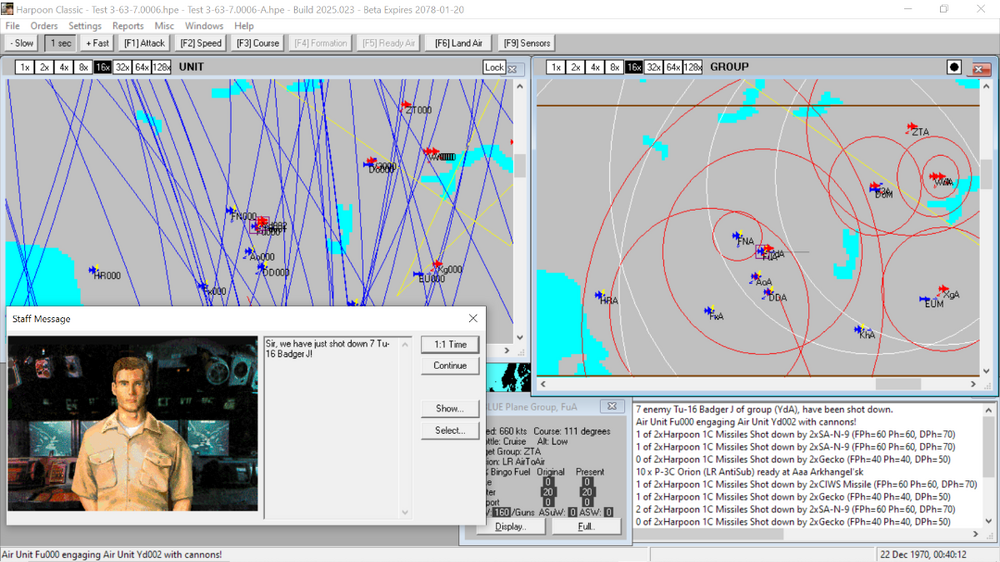
I've given eric some homework on this but I'm not home and forgot my power pack and now have no operational computer. What really strikes me as strange is that the blue air group seems to attack with cannon with no orders to do so. It's current course (which I checked and is an attack course) seems to me to indicate it is intercepting one of the ac groups to the NE. You can even cancel its course and give it an out and return to the vacinity of the red group and it will open fire with cannon with no instructions. Its a bit like a vessel with aa engaging automatically.
-
I think this relates to the use of either toolbox or Lazgui-extn which both collect information on stores used and the seemingly automatic use of cannon by air group FuA attacking air group YdA. It's not a problem that has occurred before but then I've never seen the apparent automatic engage A2A with cannon. In the saved game YdA Attack etc this occurs at time 40:12. If before that you change the course of FuA to avaoid coming within 3 nm of YdA all is good, if you then steer FuA back on a collision course you get the crash. If you have neither toolbox nor Lazgui-extn operating there is no problem either.
-
From Australian ABC news service https://www.abc.net.au/news/2025-09-04/military-gift-warship-artifical-reef-illegal-dumping/105728244?utm_source=abc_news_app&utm_medium=content_shared&utm_campaign=abc_news_app&utm_content=otherp
-
The yanks left taking theirs and we've (Aus) never had any. It sure is a leveler if only one side has them and they get the chance to let loose. I had wondered if to be fair Taipei should have better SAM, I think there was a more advanced NIKE available then. It's to my mind a very fascinating bit of military/political history, Bay of Pigs stuff. It probably deserves a better scenario writer
-
Second Taiwan Strait Crisis (versionB) View File This scenario has been written to be playable in Harpoon Classic version 2022.027 (last available Matrix Patch) and is a variation of my previous version A 2nd Taiwan Strait Crisis Escalation. Play in Westpac BS using HCCW-140314 DB. On 24 and 25 August 1958 Chinese Communist (PRC) forces and Taiwanese (ROC) forces clashed in the vicinity of Dongding Island, which the Nationalist (ROC) troops controlled. The action was seen as an attempt by the communists to land on the island. This was the only naval and amphibious landing action during the crisis. ROC had begun to build military installations on the island of Kinmen (Quemoy) and the Matsu archipelago, very close to the Chinese mainland. The PRC shelled the islands of Kinmen (Quemoy) and the Matsu Islands in an attempt to take them from Taiwan, governed by the Kuomintang (KMT), and to probe the extent of American commitment to defend the Republic of China. The conflict also involved air, naval, and amphibious operations. Then U.S. secretary of state Christian Herter reportedly described it as the "first serious nuclear crisis". The USA provided military assistance in both material, especially aircraft and artillery, and a strong naval presence including naval escorts for island replenishments. The Communist Chinese government announced a unilateral ceasefire on 6 October 1958. However, on 20 October the PLA resumed artillery fire on Kinmen because a U.S. Navy warship had breached the PRC-declared 3 nautical miles exclusive zone from the coast of China that they claimed was a stipulation for their unilateral ceasefire agreement. In this scenario we play with the idea of the situation escalating, rather than subsiding. The powerful US carrier group has left and a major portion of the Taiwanese air force is in maintenance and repair. Word has it that USSR and China are getting restless SPOILER ensure you play with nuclear release enabled Submitter donaldseadog Submitted 09/02/2025 Category WestPac