Herman
Banned
-
Joined
-
Last visited
Everything posted by Herman
-
Defect Name: HARM cannot launch Build: HCE 2007.000 Repeatable: Y Operating System: XP DB used: HCDB-070524 Scenario used: HARM cannot launch.hpq Long Description: HARM cannot launch against targets that report with radar active. Sequence to reproduce: 1. Order air group to attack ZZb or OOm. 2. "Cannot conduct Land Attack" message received 3. Look in Unit display and several ZZ units are active, but Airbase radar is off. Same for OOm group. 4. Allow missiles to destroy the base. 5. Air group can now attack new group (WT) once the base has been destroyed. Expected behaviour: Should be able to attack active radar in the group Observed behaviour: Cannot attack active radar units in the group. HARM_cannot_launch.zip
-
When the group ignores the "Forced re-fuel" command (Alt+R), you can sometimes get around it by: 1) Select group 2) F8 (divide group) 3) Move all elements of the group to a new group 4) Alt+R on the new group.
-
The 285th NEW Harpoon scenario of the year! Brown Water Transit Unlike the United States and Canada, neighbourly relations between India and Pakistan have a distinctly cold feel. India's goal to be the dominant regional power is not a secret to the other nations of the area. Of course, a fleet of submarines, three aircraft carriers, and a nuclear weapons program communicate intentions without the need for words. Unable to afford the quantities of conventional weapons systems to constitute an effective deterrent, Pakistan has turned to devoting a growing percentage of its defense spending toward development of nuclear weapons. Assuring safe passage for the materials required for this program is one of the highest priorities of the Pakistani armed forces. Original designer: Delwin Hinkle Author: Herman Hum With over 103,000 PlayersDB scenarios downloaded in the last 33 weeks alone, the PlayersDB has proven itself the unequivocal players' favourite. Harpoon3.6.3 users can get the Complete Harpoon 3.6.3 Library [PlayersDB-7.4.7] The HDS II IOPG Battleset is available at: HDS II IOPG Battleset Scenarios can also be loaded individually at: http://www.GameSquad.com/forums/downloads....o=cat&id=36 This scenario requires the latest release of the PlayersDB v7.4.7 Get it via: ughHQ, GameSquad, HarpGamer, SimHQ, Matrix, SubSim, or Frugal's World of Simulation. Harpoon ANW users can get the: Complete Harpoon ANW Library [PlayersDB-7.4.7-ANW] Home of the Harpoon3 PlayersDB FilesOfScenShare
-
Looks just fine.
-
Defect Name: Ferry flameout Build: HCE 2007.000 Repeatable: Y Operating System: XP DB used: HCDB Scenario used: Ferry flameout.sc1 Long Description: Aircraft on ferry mission run out of fuel. Sequence to reproduce: 1. Order 1 Hawk to Ferry from Banak to Orland 2. Order 70 Hawk to Ferry from Banak to Orland 3. Solo aircraft will arrive safely, but large group of 70 aircraft will run out of fuel and crash. In previous versions, aircraft on Ferry mission began to move immediately. Now that they remain stationary until the entire group has launched, the fuel calculation is erroneous. This will also cause problems in groups with mixed aircraft. Expected behaviour: Aircraft allowed to launch on Ferry mission should arrive at destination. Observed behaviour: Large groups of aircraft launched on Ferry mission run out of fuel. Ferry_flameout.zip
-
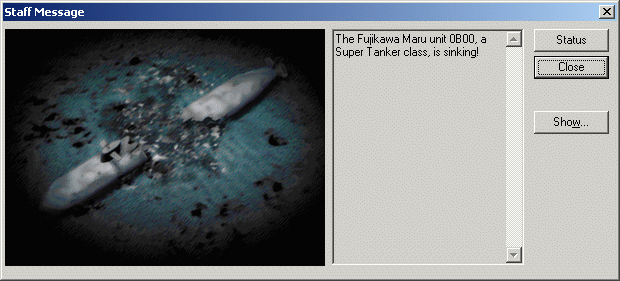
Defect Name: Incorrect Sinking Icon Build: HCE Repeatable: Unknown Operating System: XP DB used: HCDB Scenario used: Backyard -- Incorrect Sinking Icon.hpq Long Description: Ship sunk window image shows sunken submarine Sequence to reproduce: 1. Order SubGru AOU to conduct attack on unknown OOS group 2. Fire all 3 Harpoon. Activation range 5nm 3. When ship is sunk, incorrect image displayed. When other ships were sunk, the correct image was displayed. Problem seems to only manifest with an accidental sinking of a neutral vessel. Expected behaviour: Image of sinking/exploding ship should be displayed when a ship is sunk. Observed behaviour: Image of sunken submarine displayed Incorrect_Sinking_Icon.zip
-
Defect Name: Missing planes Build: HCE 2007.000 Repeatable: Y Operating System: XP DB used: HCDB Scenario used: HDS9 - #4 The Devil's Due Long Description: Planes do not appear in selection menu when splitting group. Sequence to reproduce: 1. Select Air group ZLA 2. Group display indicates 12 aircraft. 12 aircraft can also be seen in unit menu. 3. Hit F8 to divide group. 4. Only 4 aircraft appear in the selection window. Expected behaviour: All 12 aircraft should be available for division of group Observed behaviour: Only 4 aircraft are offered for division of group. Missing_planes.zip
-
Alan Lewis (a.k.a. McInLew) has played Harpoon since 1994 and has been waiting for the day when he could go head-to-head with another opponent. Today was that day. We met up on HarpGamer and played Dawn Patrol and Power Sweep back-to-back and switched sides and then played them, again. Both selections are made with the Harpoon community's favourite database, the PlayersDB. In Power Sweep we had a truly challenging experience. I controlled 3 Soviet submarines trying to break past 2 NATO boats charged with stopping them. As my boats cruised along to their destination, the first hint of enemy activity was the sudden announcement of "Torpedoes in the water!" from my SSGN Charlie II. These were Type61 from the SSK Kobben. Hurriedly, the Charlie turned around and fled the scene at flank speed while her two companions quickly dropped an SS-N-15 Starfish atop the newly discovered contact. The Charlie was VERY lucky. The expenditure of two decoys saved her life. Luck was not on the side of the Kobben as the torpedo delivered by the Starfish caught her and sent her to the bottom. With the enemy apparently vanquished, my subs continued on to their destination. Once more, torpedoes were detected. SSN Spartan had launched fearsome Spearfish torpedoes at both the Charlie and her Victor II escort. There was no way to outrun these phenomenal weapons with 80kt+ speed. The Victor II succumbed to one but, once again, the Charlie miraculously escaped destruction by firing off a second salvo of decoys. Before her death, the Victor II managed to drop an SS-N-16 Stallion into the vicinity of the Spartan. I assumed that the Stallion had caught the NATO submarine and the coast was clear for my Charlie and Tango to complete their mission. No sooner had they closed on their final waypoint when the Spartan was re-detected once again at point-blank range! This time, SS Tango was quicker on the draw and loosed 3x SET-65 torpedoes at her. The range was so short that the run time was measured in seconds and not minutes. The death of SSN Spartan was sufficient to grant me victory. A really great game. The last 13 years that Alan has spent in 'training' could be seen in the way he drove his boat. If not for the incredible luck of the Charlie and her decoys, victory would surely have been on the other foot. Thanks for a superb game and thanks to HarpGamer for the use of their server. Anyone looking for an MP game can drop a line here or look for us on HarpGamer pHp chat room or the HG mIRC chat room.
-
First review already in: GamersInfo
-
Yeah, I hit that problem on my first time out. I tried to launch an air patrol to a fixed point. The cross-hairs appeared and I clicked a point on the map. After that, I couldn't find the confirmation window that normally says, "OK / Cancel". I went through a whole swack of combinations and permutations before I stumbled upon one way of getting it back. I think that if you hit the "Reset Options" right after you start the game up for the first time, it works, too. I don't remember exactly what I did, but this sounds familiar.
-
Oops. It looks like, "Fully Featured version..." doesn't include the ability for MP play.
-
AAR: Operation: Island Wind [spoiler Alert] A Harpoon Classic scenario By Akula North Korea has recently been threatening to test a long range ballistic missile, shrugging off the concerns of the world community. Despite the threat of sanctions, they have persisted with preparations. The orders specified that I had 24 hours to accomplish the mission. That seemed like ample time to win aerial superiority before sending in the strike elements. With two Sentinels available, airborne radar coverage was not going to be a problem. The DPRK must have known that something was afoot. Flights of MiG-29 Fulcrums and MiG-23 Floggers were detected inbound to intercept the CAP [Combat Air Patrols] and Airborne-Early Warning [AEW] aircraft. For years, the level of North Korean penetration of the Japanese Self-Defence Forces had always been suspected, but today, it would be proven. One Sentinel was stationed over the DDG Kongo to take advantage of her Aegis SAM envelope. The other was positioned in the middle of the Sea of Japan. Several Surface-to-Air [sAM] units were detected from their radar emissions and it was decided to stay well outside of their range. The North Korean MiGs played into our hands. The Eagles exchanged AIM-120 AMRAAM with AA-10 Alamo from the North Koreans. Fortunately, the AMRAAM arrived first and swept the MiGs from the sky. Once guidance was lost by the Alamo, they harmlessly fell into the Sea of Japan. This chapter was to repeat itself over and over again, this day. The North Korean pilots did not waver in their aggressiveness. Flights of antiquated MiG-17 Fresco and MiG-21 Fishbed continued to rise from DPRK airfields. Instead of wasting the limited AMRAAM inventories swatting these interceptors, they were allowed to close to AAM-5 range before being blotted from the sky. Only one MiG-21 was able to launch a single AA-2 Atoll back at the Eagles before its destruction. Although the DPRK air force was taking horrendous losses, they were fulfilling their sworn duty of defending the fatherland because the JSDF strike elements dared not launch while they were active. The missile boats of the DPRK would also do their part. A flotilla of four was detected by the Sentinel above the Kongo. Although the F-2s were not able to initiate their strike on Hochon, yet, they quickly re-loaded with ASM-2 [Type 93] missiles and sank all four boats before they even realized that they were under attack. The strike planners could see that Hochon would be a hornet's nest. From ESM [Electronic Support Measures] contacts, they could see that the missile complex was well covered by SAM and AAA batteries of all calibres. However, there were no SEAD weapons in the JSDF inventory. It was going to a very bloody job. The F-2s could only carry electro-optically-guided bombs and the missile complex would be at the edge of their combat range. They would not even have an opportunity to try and fly a circuitous route to avoid the worst of the air defences nor would they have much manoeuvrability on afterburner. It was the nightmare of all aviators. They would have to fly into the teeth of the dragon and at cruise speed. All twelve F-2s launched and were covered by six Eagles. As it turned out, the worst hazard came from the AAA as the KS-12 guns claimed two. The survivors lofted their bombs and fled the scene. Post-strike analysis determined that the launch platform was likely still 60% capable. When dealing with nuclear weapons, the possibility of the DPRK still having an operational WM D was much too high. A second strike was needed. Once re-loaded, the second strike followed the same procedure as the first and suffered the same losses on their ingress. The surviving eight aircraft released their bombs and made their escape. Although fewer in number, their aim was better as the launch complex was left a smoking ruin. On their egress, another flotilla of missile boats was detected. The Oyashio was nearby and quickly launched a Harpoon attack on them - sinking three - to clear the way home. Although four more aviators would now be worshipped at the Yasukuni shrine, there would be no second Hiroshima. Congratulations on your first scenario and thanks for sharing it with us. GS file archives - Home of the Harpoon3 PlayersDB FilesOfScenShare
-
http://www.advancedgaming.biz/forum/viewtopic.php?p=350#350
-
The 284th NEW Harpoon scenario of the year! Re-Take: Orange or Red? The Ukraine's "Orange Revolution" has failed. The pro-Russian party which won the last elections has used its renewed power to move the country back towards Russia and an autocratic regime. Russian forces were invited to "secure" Ukraine's borders against "potential aggressors". There has been a massive influx of Russian naval aircraft and the Ukraine is now "guarded" by Russian warships and submarines. A few hours prior to that, parts of Ukraine's armed forces declared that they will not follow any orders of the new regime dominated by Russia. They have taken sides with "Free Ukraine" - a political movement of those still believing in the "Orange Revolution". The "Free Ukrainian Forces" (FUF) have joined a US Carrier group which has arrived in order to protect Romania and its forward-based deployment against any Russian attack out of the Ukraine. The stakes are high and an epic clash is about to begin. This scenario is a re-make of a Harpoon Classic scenario written by Ralf Koelbach for the HC_EuroDB (edited by Rene Haar) and has been re-made for compatibility with the PlayersDB v7.4.7 and Harpoon3 with the consent of the author. Author: Herman Hum With over 97,000 PlayersDB scenarios downloaded in the last 32 weeks alone, the PlayersDB has proven itself the unequivocal players' favourite. Harpoon3.6.3 users can get the Complete Harpoon 3.6.3 Library [PlayersDB-7.4.7] The Stand-Alone Scenario Battleset is available at: Stand-Alone Scenario Battleset Scenarios can also be loaded individually at: http://www.GameSquad.com/forums/downloads....o=cat&id=36 This scenario requires the latest release of the PlayersDB v7.4.7 Get it via: ughHQ, GameSquad, HarpGamer, SimHQ, Matrix, SubSim, or Frugal's World of Simulation. Harpoon ANW users can get the: Complete Harpoon ANW Library [PlayersDB-7.4.7-ANW] Home of the Harpoon3 PlayersDB FilesOfScenShareHave you tried: Jet Fighters OoB Comprehensive German site for air branches of the world (German only) http://www.jet-fighters.de/ Navy Matters Unofficial Site on Royal Navy including future Royal Navy http://navy-matters.beedall.com/index.html Official Royal Navy Site Official site http://www.royal-navy.mod.uk/ World Airforces Aerial Orders of Battle http://www.worldairforces.com/Countries/countriesindex.html Scramble Research Link Detailed air OoB for the entire world http://airforces.scramble.nl/ I think that Scramble is the best for the aerial OoB. So, what are you working on?Dangerous waters: Ignoring operational art at sea could doom U.S. maritime strategy BY MILAN VEGO armedforcesjournal The new U.S. maritime strategy to be unveiled this fall is expected to fill the lack of a clear and well-articulated vision of the role of U.S. maritime forces in defense and protection of the national interests at sea and of those of its allies and other friendly nations. However, the lack of sound theory and doctrine for the employment of maritime forces at the operational level of war might pose some serious limitations and ultimately doom the execution of the new U.S. maritime strategy. This situation might not be acute in the case of the employment of U.S. maritime forces in operations short of war or to fight some weak opponents at sea, but in the case of a war with a strong regional competitor it will be quite different. The Navy urgently needs to address its lamentable lack of interest in the theory and practice of operational warfare; otherwise, it might find itself outthought and outfought. Despite all the experiences of naval history, too many naval officers seem to believe that operational art is valid only for war on land, or even worse, has little if any utility for war at sea. Another major reason for the general lack of interest in and knowledge of operational art in the Navy is its traditional focus on technology and naval tactics, and tactical employment of single platforms and weapons in particular. What is maritime strategy? In U.S. terms, depending on the predominant sources of national power to be used in accomplishing political strategic objectives, the distinction is made between the national security strategy and military strategy. The U.S. military strategy must be consonant with the diplomatic, political, economic, informational and other aspects of the national security strategy; otherwise, it cannot be successful. The new maritime strategy should explain in some detail how the national interests at sea should be protected, defended and enhanced across the entire spectrum of conflict — that is, from peacetime competition to crisis, operations short of war to high-intensity conventional war. This task cannot be accomplished by U.S. national security and military strategies because they are concerned with much more diverse and broader sources of non-military or military sources of national power. Like the U.S. military strategy, the new maritime strategy must be all-encompassing. Afterward, the combatant commanders of maritime theatres should translate the objectives of the maritime strategy into maritime theatre strategic objectives — not an easy task. At the same time, the maritime strategy must be in full harmony with the U.S. national security and military strategies; otherwise, it would not accomplish its stated purpose. The maritime strategy supports the accomplishment of the military strategy by focusing on those aspects of the military strategic objectives that pertain to the sea. At the same time, it also supports those non-military aspects of the national security strategy concerned with protecting national interests in the maritime domain. Policy and strategy provide the framework and set limitations to national security and military strategies. Likewise, the maritime strategy must be fully subordinate to the national military strategy. The scope and extent of the new maritime strategy should be large because of the sheer diversity and complexity of the real and potential threats facing the U.S. in the maritime domain. One of the most critical parts of any maritime strategy is to articulate strategic objectives at sea. Specifically, the new maritime strategy should focus on the role of maritime forces in enhancing strategic deterrence and on objectives in operations short of war and in a regional or global conflict at sea. A critical but difficult part of the new maritime strategy is articulating a sound vision of and duration of the future conflict at sea. The lack of such a vision would make it difficult to write service wide doctrine and thereby prepare maritime forces for a future war at sea. Also, the vision of the future war at sea plays a critical role in planning for the maritime forces’ structure. war at sea The new maritime strategy should also explain ways of enhancing the U.S. maritime geostrategic position by strengthening the existing alliances or coalitions and building new ones. These actions must be in harmony with the corresponding aspects of the U.S. national security and military strategies. It also needs to address ways of enhancing deterrence and creating prerequisites to win the war at sea if deterrence fails. The new maritime strategy should not ignore the possibility of fighting a high-intensity conventional war at sea. Such a conflict might break out because of the threats to vital U.S. national interests posed by a single or a combination of regional powers in a certain littoral area. A high-intensity conflict at sea also could ensue because of the need to roll back aggression by a rising major power at sea. Hence, the new maritime strategy should describe in some detail strategic objectives at sea in a single or multiple maritime theatres, determine whether war at sea will be offensive and/or defensive, and determine which maritime theatre should be the theatre of main effort. It should also determine in broad terms the distribution of the maritime forces among the various maritime theatres. In the case of a regional or global conflict, the tasks of the maritime strategy are to articulate maritime aspects of the desired strategic end state and the timing and conditions for war termination. In the modern era, victory in a war was the result of close cooperation among all the services of the country’s armed forces. Although the land forces invariably had the most decisive role in winning one’s wars, such victories were difficult, if not impossible, to achieve without strong and effective support from one’s maritime and air forces. Traditionally, the strategic objective of the Navy has been, in the case of war or, sometimes, in operations short of war, to obtain and then maintain and exercise sea control in a specific part of the maritime theatre. These objectives will remain an integral part of a war’s overall objectives. GLOBAL SEA CONTROL All too often, the Navy’s high officials claim publicly and in various official documents that the Navy enjoys so-called global sea control. However, no navy in history, even the Royal Navy at the height of its power in the 19th century, was able to have control in all the parts of the world’s ocean. The situation today is even more complex because of the proliferation of modern weapons and the ability of many weaker powers in the littorals to frustrate and possibly even prevent the Navy from achieving the desired degree of sea control. The Navy might be opposed by either a strong regional sea power or an inferior littoral navy that might use its limited strengths asymmetrically and quite successfully against the Navy’s weaknesses. In a war at sea, a blue-water navy such as the U.S. Navy would rarely achieve sea control in all three physical mediums (surface, subsurface and air) and over large areas of the world’s ocean and for the duration. As in the past, various degrees of sea control would exist. The extent and degree of one’s sea control is also subject to great fluctuations in the course of a war. For example, the Navy might obtain a general control of a large part of the Indian Ocean but only local control of the surface and the air in the Arabian Sea or the Persian Gulf. That control might be temporary, not permanent, until the weaker side suffers substantial losses. These are the realities that the new U.S. maritime strategy should not ignore. Sea control, properly understood, refers only to the strategic or operational, not tactical, levels of war. In practical terms, strategic sea control pertains to the entire maritime theatre. Control of a major part of a maritime theatre represents operational sea control. The Navy’s term “battle space dominance” clearly refers to a tactical, not operational or strategic, level of war at sea. It essentially deals with temporary control of a part of a maritime theatre in which one’s forces are engaged in accomplishing some major tactical objective. The new maritime strategy should also anticipate the possibility that in the case of two simultaneous or nearly simultaneous regional conflicts, the Navy might not have sufficient forces to go on the offensive in both maritime theatres. In such a case, the initial strategic objective in one theatre might be sea denial, not sea control. Only after sufficient forces were released from the theatre of main effort would the U.S. Navy go on the offensive, obtain and then maintain/exercise sea control. British naval historian and theoretician Julian Corbett observed that when the command is in dispute, the general conditions might give a stable or unstable equilibrium. Then, the power of neither side preponderates to any appreciable extent. It may also be that the command lies with the opponent. Then both sides at sea operate at high risk, because their strength is approximately in balance. One side usually controls one or more parts of a given theatre, while its opponent controls the remaining part. Each side’s control of a specific sea area is usually limited in time. OPERATIONAL ART Strategy in general is often misunderstood to also include the combat employment of one’s maritime forces. This was true until the late 19th century, when military art consisted only of strategy and tactics. However, because of radical changes in the character of war as a result of political and social changes and advances in technology in the 19th century, a new and intermediate field of study and practice emerged from the lower part of strategy. The term “operational art” was coined by the Soviet theoretician and former tsarist general Aleksandr A. Svechin 1923. The same term was borrowed by the U.S. Army in the early 1980s and then adopted by the U.S. joint community. Today, there is no common, agreed definition of what operational art is. However, there is a common understanding that operational art is an intermediate field of study and practice between strategy and tactics. In generic terms, operational art at sea can be defined as a component of military art concerned with the theory and practice of planning, preparing and conducting major naval/joint operations and maritime campaigns aimed at accomplishing operational or strategic objectives in a given part of a maritime theatre. Only by applying tenets of operational art is it possible to accomplish objectives determined by national strategy and policy in the most decisive manner and with the fewest losses in personnel and materiel by friendly forces. The main role of operational art is to properly sequence and synchronize or orchestrate the use of all available military and non-military sources of one’s power. The executor of any maritime strategy is service doctrine. The Navy has written numerous naval warfare publications (NWPs) focused on tactical employment of naval combat arms and individual platforms. For the most part, they are well-written. However, none of these NWPs was based on the requirements of a servicewide doctrine; that is, one providing for the employment of the U.S. maritime forces at the operational level of war. The last servicewide doctrinal document, Naval Warfare, was written in 1947. Not until 1994, when the Naval Doctrinal Publication (NDP)-1, Naval Warfare, was published by the former Naval Doctrine Command in Norfolk, Va., was an effort made to fill the doctrinal gap between the tactical and operational levels of war at sea. However, this publication was deeply flawed because its focus was almost entirely on the tactical level of war. The new NDP-1, Naval Warfare, Rev, is supposed to remedy this problem by embracing tenets of operational war at sea. This publication is under review and is expected to be eventually adopted by the Navy. However, it would be a mistake to approve the NDP-1 Rev before its content is brought into harmony with the new maritime strategy; otherwise, this document would be in disconnect with the larger framework provided by the U.S. maritime strategy. Without a sound servicewide doctrine focused on the operational level of war at sea, it is hard to see how the U.S. maritime strategy can be applied in both peacetime and in times of war. Afterward, the Navy should review and, if necessary, change, modify or rewrite all its naval warfare publications that deal with tactical employment of naval combat arms. The NDP-1 Rev should provide the much-needed overarching structure in ensuring that training for tactical combat at sea is in harmony with the larger objectives at the operational level and thereby also with the new maritime strategy. The new U.S. maritime strategy cannot be successful unless it is executed using all applicable instruments of national power in a synchronized fashion. Clearly, the non-military sources of national power should play the predominant role in the execution of maritime strategy in times of peace and in operations short of war. In operations short of war, such as support of insurgency or counterinsurgency and counterterrorism, the U.S. maritime forces would accomplish operational objectives by conducting a series of naval and air tactical actions over time in a specific part of the maritime theatre. The main methods of obtaining sea control in a certain sea or ocean area have traditionally included the destruction or neutralization of the enemy fleet at sea and/or in its bases, and naval blockade. Destroying the enemy’s naval forces is the most direct and effective means of obtaining control of operationally or strategically important areas. The most effective and quickest way of accomplishing this is through the planning and execution of a series of major naval and joint/combined operations. The Navy can possibly accomplish the same objectives by conducting a series of tactical actions such as strikes and attacks. However, that would require much more time and would invariably result in larger losses for friendly forces. Only major naval/joint operations would allow the U.S. maritime forces to seize the initiative and destroy enemy forces relatively quickly and thereby bring about a radical change of the situation in a given part of the maritime theatre. A major naval operation consists of a series of related tactical actions (naval battles, engagements, strikes, attacks, etc.), sequenced and synchronized in terms of place and time and aimed to accomplish an operational (and sometimes even a major part of the strategic) objective. Major naval operations should normally be planned and executed by a single commander (or Joint Force Maritime Component Commander/Combined Force Maritime Component Commander) and planned in accordance with a common operational idea (scheme). They are normally an integral part of a maritime or land campaign, but they can sometimes be conducted outside of the framework of a campaign. Today, major naval operations will be predominantly conducted by the Navy in the littoral waters and rarely on the open ocean. In the littorals, such operations will be predominantly joint or combined, because they will involve the participation of not only the Navy and Marine Corps, but also of the Air Force and the Army, and the services of our allies or coalition partners. In short, they will be joint and often combined in character. Specifically, the main purpose of major naval/joint operations conducted by the Navy can be aimed to destroy or annihilate the enemy’s fleet at sea or in its bases, to neutralize the enemy’s fleet by establishing a naval blockade of a sea’s exits or the larger part of the enemy’s coast, to seize control of a strait/narrows or some other operationally significant position within an enclosed or semi-enclosed sea, or to capture the enemy’s naval basing areas. The new maritime strategy can be successful only if the Navy embraces and properly applies tenets of operational warfare at sea. It is operational art that serves both as a bridge and as an interface between maritime strategy and naval tactics. The results of naval tactical actions are useful only when linked together as part of a larger design framed by strategy and orchestrated by operational art. By themselves, technological advances, numerical superiority, and brilliant tactical performance are inadequate to achieve ultimate success in war. A sound, coherent maritime strategy combined with operational excellence were the keys to winning wars in the past and will remain so for the near future.British nukes were protected by bike locks By Meirion Jones Newsnight producer BBC News Newsnight has discovered that until the early days of the Blair government the RAF's nuclear bombs were armed by turning a bicycle lock key. Inserting a key into a nuclear device There was no other security on the Bomb itself. While American and Russian weapons were protected by tamper-proof combination locks which could only be released if the correct code was transmitted, Britain relied on a simpler technology. The Dr Strangelove scenario The British military resisted Whitehall proposals to fit bombs with Permissive Action Links - or PALs - which would prevent them being armed unless the right code was sent. Ministry of Defence UK nuclear weapons are designed first and foremost to be secure and safe Read the MoD statement PALs were introduced in the 1960s in America to prevent a mad General or pilot launching a nuclear war off their own bat - the Dr Strangelove scenario. President Kennedy ordered that every American nuclear bomb should be fitted with a PAL. The correct code had to be transmitted by the US Chiefs of Staff and dialled into the Bomb before it could be armed otherwise it would not detonate. Safeguards Crews in missile silos also had a dual key arrangement so one man could not launch Armageddon. They are familiar from numerous Hollywood films such as Broken Arrow with John Travolta, The Peacemaker with Nicole Kidman and various James Bond films. Under control Papers at the National Archive show that as early as 1966 an attempt was made to impose PAL security on British nuclear weapons. The Chief Scientific Adviser Solly Zuckerman formally advised the Defence Secretary Denis Healey that Britain needed to install Permissive Action Links on its nuclear weapons to keep them safe. "The Government will need to be certain that any weapons deployed are under some form of 'ironclad' control". The Royal Navy argued that officers of the Royal Navy as the Senior Service could be trusted: "It would be invidious to suggest... that Senior Service officers may, in difficult circumstances, act in defiance of their clear orders". Neither the Navy nor the RAF installed PAL protection on their nuclear weapons. The RAF kept their unsafeguarded bombs at airbases until they were withdrawn in 1998. Bicycle lock key With the help of Brian Burnell - a researcher into the history of the British nuclear weapons programme who once designed bomb casings for atom bombs - Newsnight tracked down a training version of the WE 177 nuclear bomb at the Bristol Aero collection at Kemble. Tornado and earlier V-bomber crews trained with these, which were identical in every way to the live bombs except for the nuclear warhead. To arm the weapons you just open a panel held by two captive screws - like a battery cover on a radio - using a thumbnail or a coin. Inside are the arming switch and a series of dials which you can turn with an Allen key to select high yield or low yield, air burst or groundburst and other parameters. The Bomb is actually armed by inserting a bicycle lock key into the arming switch and turning it through 90 degrees. There is no code which needs to be entered or dual key system to prevent a rogue individual from arming the Bomb.Over 24 new aircraft, ships, submarines, facilities, classes, countries, and weapons have been added to the Harpoon3 PlayersDB with the official Database editor issued by AGSI. Get the PlayersDB 7.4.7-ANW on Gamesquad, HarpDB, or ughHQ. Get the PlayersDB 7.4.7 on Gamesquad, HarpDB, or ughHQ. Additions include: A-7A Corsair II USN 67 AAA 35mm Oerlikon GDF Twin AR75 AAA 35mm Oerlikon GDF Twin ZA AAA 35mm Oerlikon Twin x2 AR Arty 130mm/53 Tornikanuuna FIN Bell AB.412 PK 07 F-4B Phantom II USA 65 J-6A Farmer C IR JAS 39C Gripen TH 11 SSM MtO-85 Battery FIN 85 SSM MtO-85M Battery FIN 95 SSM No-Dong 1 DPRK SSM RBS-15F Battery SE 84 SSM SS-1 Scud B Battalion DPRK SSM Taepo-Dong 1 DPRK SSM Taepo-Dong 2 DPRK - countless changes and improvements guaranteed not to crash any earlier scenario built with the PlayersDB Harpoon3.6.3 users can get the Complete Harpoon 3.6.3 Library [PlayersDB-7.4.7] Harpoon ANW users can get the Complete Harpoon ANW Library [PlayersDB-7.4.7-ANW] Home of the Harpoon3 PlayersDB FilesOfScenShareThe 283rd NEW Harpoon scenario of the year! Nicobar Vengeance Friction has been growing between Indonesia and her neighbours. Amongst other issues, Indonesia claims that other nations have been illegally fishing in her waters while other nations accuse Indonesia of not doing enough to reduce piracy. Four days ago, an Indonesian submarine in the waters between the Nicobar islands and Sumatra sank an Indian merchant vessel that it mistook for a commercial fishing boat. Sixteen Indian sailors were killed in the incident. Author: Herman Hum With over 93,000 PlayersDB scenarios downloaded in the last 31 weeks alone, the PlayersDB has proven itself the unequivocal players' favourite. Harpoon3.6.3 users can get the Complete Harpoon 3.6.3 Library [PlayersDB-7.4.7] The Stand-Alone Scenario Battleset is available at: Stand-Alone Scenario Battleset Scenarios can also be loaded individually at: http://www.GameSquad.com/forums/downloads....o=cat&id=36 This scenario requires the latest release of the PlayersDB v7.4.7 Get it via: ughHQ, GameSquad, HarpGamer, SimHQ, Matrix, SubSim, or Frugal's World of Simulation. Harpoon ANW users can get the: Complete Harpoon ANW Library [PlayersDB-7.4.7-ANW] Home of the Harpoon3 PlayersDB FilesOfScenShareHow about this one: This used to work in H3, but hasn't worked since ANW 3.7.0 was released.The 282nd NEW Harpoon scenario of the year! Beida-La Boom History is replete with interesting surprises. The mercurial leader of Libya, having made much of his reputation as a foe of the West, ultimately decided that the future of his country (and his own future) might be secured more easily by adopting a policy of moderation. He was promptly ousted and forced into exile. The new regime is openly hostile to the West. Its ultimate goal is to dominate North and Central Africa and it has started an agressive campaign of purchasing weapons from nations such as China, North Korea, Russia, and Iran. In addition, it has purchased materials necessary for the creation of chemical and biological weapons. This scenario is a re-make of a Harpoon Classic scenario by Mark Gellis and has been re-made with the author's permission. Author: Herman Hum With over 91,000 PlayersDB scenarios downloaded in the last 30 weeks alone, the PlayersDB has proven itself the unequivocal players' favourite. Harpoon3.6.3 users can get the Complete Harpoon 3.6.3 Library [PlayersDB-7.4.7] The Stand-Alone Scenario Battleset is available at: Stand-Alone Scenario Battleset Scenarios can also be loaded individually at: http://www.GameSquad.com/forums/downloads....o=cat&id=36 This scenario requires the latest release of the PlayersDB v7.4.7 Get it via: ughHQ, GameSquad, HarpGamer, SimHQ, Matrix, SubSim, or Frugal's World of Simulation. Harpoon ANW users can get the: Complete Harpoon ANW Library [PlayersDB-7.4.7-ANW] Home of the Harpoon3 PlayersDB FilesOfScenShareJerome (a.k.a. Angle of Attack), a native of Argentina, and I had played Malvinas II several times. Each time, AoA played the Argentines while I played the UK. After several losses, we switched sides to see if I could do better. Malvinas II, has been made with the Harpoon community's favourite database, the PlayersDB. We began, as usual, with a round of scouting and counter-scouting. AoA had his AEW helos airborne in hopes of locating my surface fleet. I immediately activated the jamming suite on DD Hercules to counter his efforts. While his helos were brightly radiating their position, I ordered my Mirage fighters to creep in and shoot them down from low level. Once the UK was effectively blinded, I focused on his Harrier CAP, next. The Harriers were much slower than the supersonic Mirage, but they carried the lethal Sidewinder AAMs that far out-ranged my own Magic missiles. It was quite a tricky task to engage them. Luckily, he flew his CAP at high altitude so they were clearly seen by my own radar stations on Malvinas and the Hercules. Several were caught from behind and shot down before they even knew I was in the neighbourhood by using Ground-Controlled Intercept solutions. However, revenge was swift. In the end, I managed to kill 8 Harriers for the lost of all 12 of my Mirage. It was a steep price, but it had to be paid. Generally free from Harrier depredation, my Trackers roamed the skies. I had grouped my surface forces near Port Stanley to await the invasion force. A sudden missile attack on them was repulsed after using up nearly all my SAMs. However, the attack suggested the presence of a submarine so a search was conducted by Tracker. Sure enough, a sub was detected 6nm away from the ships. As the Alouette and Trackers began their attack, the submarine showed here teeth by firing a spread of torpedoes back at me. My blood froze when I detected these phenomenal weapons. With a top speed of 70 knots, there simply would be no escape from them in a straight chase situation. The only defense would be to put a wall of earth between my ships and the torpedoes. The Trafalgar died quickly, but she would have been quite surprised to see my ships dart behind the bay. When they reached their Pre-planned Activation Points [PAP], they promptly slammed into the shore. Whew, that was close. However the tactic was not without cost. DD Sarandi somehow managed to beach herself (another stupid game bug) and thus ended up as a partial mission kill. I used the trackers to generally locate the enemy amphibious forces and sent in my Exocet-armed Super Etendards. Although the positions were very hazy, they were sufficient for the Exocets. I needed to soak up some of the dangersous Sea Dart SAMs the enemy carried. The enemy was no slouch, either. Once I carried out my AShM attack, he replied with an AShM strike of his own delivered by Sea King helos. I had re-positioned my ships into a bay in hopes of the tall valley walls providing some semblance of protection from missile strikes as my own SAMs were severely depleted. A second strike was also repulsed, but DDG La Argentina took a missile strike that left her limping along at 8 knots. I was in fear of losing her, but her valiant crew managed to limit the flooding to 50% and she sailed onward. Unfortunately, the ships were now virtually naked as nearly all SAMs had been expended. A final round of SSM attack was mixture of Harpoons from the destroyer escorts combined with the remaining Sea Eagle from the Sea Kings. It felt like Ft. Apache with missiles coming in from all directions. Without any SAMs to counter the threat, several ships were struck and destroyed. However, some did survive. At this point, I decided to throw the dice and gamble the game on one stroke. The five Etendard were re-launched along with 12 Skyhawks from Port Stanley. With the enemy SAM shooters closing on the base, air operations would soon be too dangerous to conduct since they would be launching and landing under the enemy's SAM umbrella. The Trackers had located the Amphibious vessels thus allowing my strike elements to make their long circuitous journey around the enemy CAP and knocking directly on his back door. Unfortunately, the surprise party was prematurely detected by a roving Harrier. It shot down one of the Etendard before the release point. All hope of further surprise went down in flames with the unlucky plane and the strike leader decided to initiate the attack immediately. (This was probably the best point in the game. AoA nearly wet his pants when he saw the mass of Skyhawks appear next to his Amphibs and said, "That's it. I'm dead. Game over" on the mIRC channel ) The four surviving Super Etendard released their Exocet at the nearest DDG. They held no expectation of actually getting a hit, but they hoped that the salvo would occupy the DDG long enough for the Skyhawks to slip past the defenses. The Skyhawks hugged the waters and drove in their attack at 30m altitude. The SAMs got a few and four of them decided to suppress the DDG on their ingress. They dropped their loads of Mk82 bombs and emptied their 20mm cannon on her to leave her a mass of flames as the strike split up to pass east and west of her to bore in on the Sir Galahad. The western element died when it was shot to ribbons by Sea Wolves as it tried to split the defences between two Broadsword frigates. The eastern element took losses, too, but 3 survived long enough to deliver their bombs on target. Unfortunately, this was insufficient to sink the vessel. The damage was significant, but the flooding was eventually stopped at 30%. (I'll never know if the four bombers that took out the DDG Birmingham would have made the difference if they had survived long enough to bomb the Galahad. ) With no surviving strike assets, AoA merrily continued his parade to the beach. I had 3 diesel subs waiting for him, but with a surfeit of ASW helos to conduct a thorough search of the waters, they were soon located and killed by aerial torpedoes. Thanks for yet another superb game, AoO. Games that are fought to the last round of ammunition are the best. Thanks also to HarpGamer for the use of their server. Anyone looking for an MP game can drop a line here or look for us on HarpGamer pHp chat room or the HG mIRC chat room.Well, your first mistake was not using the PlayersDB... Just kidding. Just a minor thing comes to mind. After you change the port / IP settings on either machine, do you remember to hit "OK" and close the launcher (and save the new settings) before re-opening the launcher and trying to connect?The 281st NEW Harpoon scenario of the year! Matrix Knight O 221200ZFEB93 CCCCCCCC FR: NATO HQ, Mons, Belgium TO: Capt, USS Hartford AAS Capt, FN S615 L'Inflexible ABS Subj: Matrix Knight training exercise 1. Commence exercise receipt this message. Strictly observe the time limit. 2. Objectives: 2.1 French SSBN is the subject of search and destroy operations to be conducted by Royal Navy OpFor. Avoid detection for the duration of the operation. Maintain patrol zone within 25nm of your current position. 2.2 USS Hartford is to seek out and destroy a simulated Delta-class SSBN operating in your AOR. 3. OpFor estimates 3.1 Royal Navy Trafalgar, Valiant, or Swiftsure-class to be employed. Author: Herman Hum With over 90,000 PlayersDB scenarios downloaded in the last 29 weeks alone, the PlayersDB has proven itself the unequivocal players' favourite. Harpoon3.6.3 users can get the Complete Harpoon 3.6.3 Library [PlayersDB-7.4.7] The HDS II NACV Battleset is available at: HDS II NACV Battleset This scenario requires the latest release of the PlayersDB v7.4.7 Get it via: ughHQ, GameSquad, HarpGamer, SimHQ, Matrix, SubSim, or Frugal's World of Simulation. Harpoon ANW users can get the: Complete Harpoon ANW Library [PlayersDB-7.4.7-ANW] Home of the Harpoon3 PlayersDB FilesOfScenShare