HG S2 (Intel Bot)
Members
-
Joined
-
Last visited
Never
Everything posted by HG S2 (Intel Bot)
-
An independent U.S. analyst has rejected reports that Ukrainian long-range missiles struck Russia’s Kapustin Yar missile test range, saying satellite imagery cited as evidence shows no damage to the facility. The response follows recent reporting by Ukrainian and regional defense outlets claiming that Ukraine’s domestically developed FP-5 “Flamingo” cruise missile was used in a strike […]View the full article
-
Egypt has signed a $130 million contract to acquire the Turkish-developed TOLGA short-range air defense system. According to a press release issued by Makine ve Kimya Endüstrisi (MKE), the agreement was concluded with the Egyptian Ministry of Defence and covers the delivery of the TOLGA SHORAD system, which is designed to counter unmanned aerial vehicles, […]View the full article
-
A Czech unmanned systems manufacturer with Ukrainian roots has entered the Indian defense market after signing a contract to supply unmanned aerial systems to a local aerospace firm, marking a new phase in defense-industrial cooperation between Europe and India. According to a report by CZDEFENCE, U&C UAS signed the contract on February 3, 2026, with […]View the full article
-
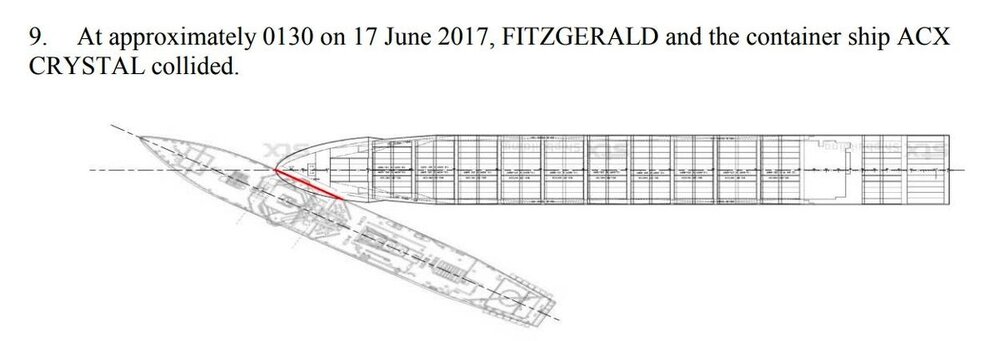
Still, almost nine years later, the disasters of the summer of 2017 involving the USS Fitzgerald and USS McCain come up in conversation with others, and out of nowhere pops into my mind. As I last did back in 2021, let’s look back to AUG 2017 when I first wrote this. There can be only one FbF today, nothing else comes close. The supplemental preliminary inquiry into the collision involving the USS FITZGERALD (DDG 62) and the ACX CRYSTAL from 17 JUN of this year is out. The report is dated 11 AUG 17. You can get it from the SECNAV’s site here, or read the whole thing posted below. I wanted to pull one extended quote from it for your review. It really got hold of me, as it drove something home about the sea that Sailors know, but others don’t; there is no normal day at sea. You are always one moment away from water, fire, steam, or flying shards of metal. It also shows that on every ship, on every watch, there are Sailors who will be capable of exceptional bravery and sacrifice - the opportunity to demonstrate that character just hasn’t come up yet. Even at sleep, the sea waits for her time. Evacuating Berthing 2 21. Of the 42 Sailors assigned to Berthing 2, at the time of collision, five were on watch and two were not aboard. Of the 35 remaining Sailors in Berthing 2, 28 escaped the flooding. Seven Sailors perished. 22. Some of the Sailors who survived the flooding in Berthing 2 described a loud noise at the time of impact. Other Berthing 2 Sailors felt an unusual movement of the ship or were thrown from their racks. Still other Berthing 2 Sailors did not realize what had happened and remained in their racks. Some of them remained asleep. Some Sailors reported hearing alarms after the collision, while others remember hearing nothing at all. 23. Seconds after impact, Sailors in Berthing 2 started yelling “Water on deck!” and “Get out!” One Sailor saw another knocked out of his rack by water. Others began waking up shipmates who had slept through the initial impact. At least one Sailor had to be pulled from his rack and into the water before he woke up. Senior Sailors checked for others that might still be in their racks. 24. The occupants of Berthing 2 described a rapidly flooding space, estimating later that the space was nearly flooded within a span of 30 to 60 seconds. By the time the third Sailor to leave arrived at the ladder, the water was already waist deep. Debris, including mattresses, furniture, an exercise bicycle, and wall lockers, floated into the aisles between racks in Berthing 2, impeding Sailors’ ability to get down from their racks and their ability to exit the space. The ship’s 5 to 7 degree list to starboard increased the difficulty for Sailors crossing the space fromthe starboard side to the port side. Many of the Sailors recall that the battle lanterns were illuminated. Battle lanterns turn on when power to an electrical circuit is out or when turned on manually. The yellow boxes hanging from the ceiling in Figure 14 are battle lanterns. 25. Sailors recall that after the initial shock, occupants lined up in a relatively calm and orderly manner to climb the port side ladder and exit through the port side watertight scuttle. Figure 14 provides an example of the route Sailors would have taken from their racks to the port side watertight scuttle on a ship of the same class as FITZGERALD. They moved along the blue floor and turned left at the end to access the ladder. Figure 14 provides an example and sense of scale. Even though the Sailors were up to their necks in water by that point, they moved forward slowly and assisted each other. One Sailor reported that FC1 Rehm pushed him out from under a falling locker. Two of the Sailors who already escaped from the main part of Berthing 2 stayed at the bottom of the ladder well (see Figure 8) in order to help their shipmates out of the berthing area. 26. The door to the Berthing 2 head (bathrooms and showers) was open and the flooding water dragged at least one person into this area. Exiting from the head during this flood of water was difficult and required climbing over debris. 27. As the last group of Sailors to escape through the port side watertight scuttle arrived at the bottom of the ladder, the water was up to their necks. The two Sailors who had been helping people from the bottom of the ladder were eventually forced to climb the ladder as water reached the very top of the Berthing 2 compartment. They continued to assist their shipmates as they climbed, but were eventually forced by the rising water to leave Berthing 2 through the watertight scuttle themselves. Before climbing the ladder, they looked through the water and did not see any other Sailors. Once through the watertight scuttle and completely out of the Berthing 2 space (on the landing outside Berthing 1) they continued to search, reaching into the dark water to try to find anyone they could. From the top of the ladder, these two Sailors were able to pull two other Sailors from the flooded compartment. Both of the rescued Sailors were completely underwater when they were pulled to safety. 28. The last Sailor to be pulled from Berthing 2 was in the bathroom at the time of the collision and a flood of water knocked him to the deck (floor). Lockers were floating past him and he scrambled across them towards the main berthing area. At one point he was pinned between the lockers and the ceiling of Berthing 2, but was able to reach for a pipe in the ceiling to pull himself free. He made his way to the only light he could see, which was coming from the port side watertight scuttle. He was swimming towards the watertight scuttle when he was pulled from the water, red-faced and with bloodshot eyes. He reported that when taking his final breath before being saved, he was already submerged and breathed in water. 29. After the last Sailor was pulled from Berthing 2, the two Sailors helping at the top of the port side watertight scuttle noticed water coming into the landing from Berthing 1. They remained in case any other Sailors came to the ladder. Again, one of the Sailors stuck his arms through the watertight scuttle and into the flooded space to try and find any other Sailors, even as the area around him on the landing outside of Berthing 1 flooded. Berthing 1, with no watertight door between it and the landing, began to flood. 30. Another Sailor returned with a dogging wrench, a tool used to tighten the bolts, on the hatch to stave off flooding from the sides of the hatch. The three Sailors at the top of the ladder yelled into the water-filled space below in an attempt to determine if there was anyone still within Berthing 2. No shadows were seen moving and no response was given. 31. Water began shooting up and out of the watertight scuttle into the landing. Finding no other Sailors, they tried to close the watertight scuttle to stop the flood of water. The force of the water through the hatch prevented closing the watertight scuttle between Berthing 2 and Berthing 1. The scuttle was left partially open. They then climbed the ladder to the Main deck (one level up from the Berthing 1 landing), and secured the hatch and scuttle between Berthing 1 and the Main deck. In total, 27 Sailors escaped Berthing 2 from the port side ladder. 32. One Sailor escaped via the starboard side of Berthing 2. After the collision, this Sailor tried to leave his rack, the top rack in the row nearest to the starboard access trunk, but inadvertently kicked someone, so he crawled back into his rack and waited until he thought everyone else would be out of the Berthing 2. When he jumped out of his rack a few seconds later, the water nearly reached his top bunk, already chest high and rising. 33. After leaving his rack, the Sailor struggled to reach the starboard egress point through the lounge area. 34. He moved through the lounge furniture and against the incoming sea. Someone said “go, go, go, it’s blocked,” but he was already underwater. He was losing his breath under the water but found a small pocket of air. After a few breaths in the small air pocket, he eventually took one final breath and swam. He lost consciousness at this time and does not remember how he escaped from Berthing 2, but he ultimately emerged from the flooding into Berthing 1, where he could stand to his feet and breathe. He climbed Berthing 1’s egress ladder, through Berthing 1’s open watertight scuttle and collapsed on the Main Deck. He was the only Sailor to escape through the starboard egress point. 35. The flooding of Berthing 2 resulted in the deaths of seven FITZGERALD Sailors. The racks of these seven Sailors were located in Rows 3 and 4, the area closest to the starboard access trunk and egress point and directly in the path of the onrushing water, as depicted in Figure 15. 36. After escaping Berthing 2, Sailors went to various locations. Some assembled on the mess decks to treat any injuries and pass out food and water. Others went to their General Quarters (GQ) stations to assist with damage control efforts. Another Sailor went to the bridge to help with medical assistance. One Sailor later took the helm and stood a 15-hour watch in aft steering after power was lost forward. As a side note, BZ to the main author of this report, you can read it in full at this link. Through their exceptional writing and narrative style, they brought great honor to those Sailors on the FITZGERALD who died, lived, saved others, and fought to keep their ship afloat that night and following days. “In the finest traditions of the naval service” is almost a cliche, but these men and women proved it that day. Fullbore. I believe it does great credit to our Navy and its culture that we make these reports open to the public. I hope we are able to learn and incorporate as many damage control lessons as possible from this unfortunate incident so that in the future, other lives and ships may be saved. This Substack is reader-supported. To receive new posts and support my work, consider becoming a free or paid subscriber. Share Leave a comment View the full article
-
Ukraine’s Ministry of Defense said Canada has begun transferring AIM missiles to Ukraine to strengthen the country’s air defense and improve its ability to counter cruise missile threats, with the weapons already in the process of delivery. The announcement followed a meeting between Ukrainian Defense Minister Mykhailo Fedorov and Canadian Minister of National Defence David […]View the full article
-
South Africa’s Paramount Group is seeking a foothold in Ukraine’s armored vehicle market, which has become one of the largest and most active in the world due to the ongoing war, by offering a locally adapted version of its Mbombe 4 armored vehicle to the Armed Forces of Ukraine. The effort is being advanced through […]View the full article
-
Uzbekistan’s armed forces conducted a live-fire air defense exercise using multiple Chinese-made surface-to-air missile systems. The exercise involved launches from three Chinese systems: the long-range FD-2000B, the medium-range KS-1C, and the short-range FM-90. All missiles were fired as part of an integrated air defense target practice aimed at training crews in detection, tracking, and engagement […]View the full article
-
The Department of War has awarded BlueHalo a contract valued at up to $19.95 million to develop advanced frameworks for human biological modeling, according to a contract announcemen. The award covers the development of next-generation modeling systems that integrate large-scale biological data with artificial intelligence and machine learning to support flexible, modular approaches to understanding […]View the full article
-
Everyone and every institution has a role to play at a particular time and place. Sometimes it serves as an example to follow; at other times, as a warning to others. Virginia in general, and the Virginia Military Institution (VMI) specifically, are in 2026 firmly in the latter category. For over 20 years we have come back to many Thursdays for DivThu. In times when the forces of sectarianism and division were on the march almost unopposed, and then it times like we have seen since 2022—starting in the courts—where the final pushback arrived with reinforcements. The last year, especially on the military side of the house, we have gone from hope to joy as so much positive movement has happened across a broad front something that, as little as half a decade ago, I would not have believed. The time for basking in accomplishments is past, as we have been enjoying our moment, the enemy has been regrouping and gathering strength. The diversity industry has regained much of its former strength. It cannot yet take full power at the national level right now, but its spirit has lost none of its potency. Concealed within its fortress in academia and the Democrat Party, the lords of division and sectarianism see all. Its gaze pierces government, business, institutions, and education. You know of what I speak. A great hate, unquenched, wreathed in resentment. (apologies to Tolkien). I want to repeat here what I have been reminding people on a regular basis over the last year—the left is not done. All the progress made with Executive Orders can—and will—be repealed the minute power changes hands. The only bulwark besides relying on the courts to rescue everything years later is legislation. Yes, that too can be overturned, but it is harder. And yet, nothing has been done. As we have seen before with the left, they are very comfortable going after the institution that will resist them the least for the most impact—the military. The Zampolit have fixed their target. They are trying to isolate it, personalize it, and polarize the body politic against it. They will start with the first target they can get to: VMI. The Democrats took power in Virginia last fall. That cleared a clean line of fire to VMI so they can pick up the battle they were forced to retreat from a few years ago. If you are not familiar with the background, this is a fair primer from 2023. What is the left doing now that they have the power in Virginia? The nuclear option. Virginia lawmakers on Tuesday advanced a bill creating a task force that would examine whether the Virginia Military Institute should remain a publicly funded, state-sponsored institution, marking the most consequential legislative step yet in a debate over the school’s governance and culture. The proposal is part of a broader push by Democratic lawmakers to impose new oversight on VMI following a 2021 state-commissioned investigation that found persistent disparities, cultural barriers and a lack of accountability at the school. VMI leaders have said they continue working with state officials to demonstrate progress and the institution’s value to the commonwealth. The House Rules Committee voted along party lines to send the bill to the full House. If approved, the task force would be charged, in part, with determining whether VMI should continue receiving public funds as a state-sponsored military college. Del. Terry Austin, R-Botetourt, whose district includes VMI, voted against the measure but said he would participate constructively if it moves forward. “I know VMI has had its challenges in the past. I know there have been mistakes made in the past at VMI, and I know that I, myself, as a legislator representing VMI, is willing to carry the (mantle) forward, to make certain that we correct those problems,” Austin said. “And whatever this study produces, we’ll do our very best to adhere and amend to that.” This is no simple “asking questions” inquiry. No. You can almost smell the hate. Via Bacon’s Rebellion: Washington Post headline: “Virginia Democrats target military college’s funding after anti-DEI push. Democrats launch effort that could ultimately end Virginia Military Institute’s status as a state-funded university.” Money quote: “We need to determine whether this is an institution capable of change,” said resolution sponsor Del. Dan Helmer (D-Fairfax), who previously forced VMI to protect students who’ve reported sexual assaults on campus. Helmer, a U.S. Military Academy at West Point graduate, said Virginia taxpayer money should not be given to an institution “incapable of separating itself from a Lost Cause ideology that promotes White supremacy.” The battle is joined. First, with the Cadets stepping forward—as VMI Cadets have always done. Cadets at the Virginia Military Institute went to bat for the historic military college after Virginia Democrats introduced legislation to investigate VMI in a move that would potentially revoke state funding and even close the school’s doors for good. Cadets Michael Ferrara, regimental S3 captain, and Devin Auzenne, regimental commander, sat down for an exclusive interview with Fox News Digital to discuss the core values of VMI, and dispute some of the allegations that have pushed Virginia Democrats to threaten the institution. “I would say on the cadet side, there’s a little bit of confusion,” Ferrara told Fox. “One of the bills questions the contribution that VMI contributes to the commonwealth of the state and this school produces nothing but prestigious men and women ready to serve the country.” “We’ve had approximately 300 generals and flag officers coming from the Virginia Military Institute,” Ferrara added. “We’ve had seven Medal of Honor recipients, 11 Rhodes Scholars, one Nobel Prize winner.” Ferrara graduates from VMI this spring, and is commissioned to serve in the U.S. Air Force as a developmental engineer. He told Fox he attended VMI because he wanted to serve the country. This is a great interview with the two Cadets. Second, the larger VMI community and its supporter are standing up. Gordon C. Morse also over at the excellent Bacon’s Rebellion, Here’s how this goes: Democrats imagine VMI to be a relic of Virginia’s benighted past. They see VMI as being staffed, directed, and supported by Republican reactionaries, and these people, they believe, will never embrace the diversity, equity, and inclusion edicts that have become core to Democratic Party doctrine. DEI has become the thing, a moral language for all Democratic Party actors and aligned organizations – a political manifesto. DEI determines who enters the room, whose leadership is embraced, and whose experiences influence policy. The remarkable thing is that Virginia’s colleges and universities have been free to find their own mountaintops. These schools were not created and sustained to be one thing. In this regard, VMI fights to preserve Virginia’s institutional diversity. It has become a prime battlefield. While Helmer’s task force may be the first, don’t count on it to be the last. The General Assembly appears prepared to police and enforce homogeneity in higher learning. That’s worth fighting over, so let’s have at it. Shelve the apologies. It’s time to stand up in the wind and not flinch. The beauty and majesty of VMI lie in its commitment to the individual, to treating everyone not as members of groups, but rather as individual human beings with inherent dignity. The school judges people by their character and accomplishments and labors to further develop both. And it succeeds. On that basis, pound-for-pound, acre-for-acre, has any campus in Virginia given more to the United States of America? Arguably, no. That needs to be said, said again, said over and over. More recently on Tuesday, the Department of War brought in supporting fires. Department of War Statement on Proposed Legislation Affecting the Virginia Military Institute The Department of War is monitoring Virginia House Bill 1374, focused on the governance of the Virginia Military Institute (VMI), with significant concern. For generations, the unique military environment at VMI has made the Institute a vital source of commissioned officers for the Armed Forces. The stability of this proven leadership pipeline is a matter of direct national security interest and any action that could disrupt the ecosystem requires our full attention. DoW reserves the right to take extraordinary measures to protect the integrity of VMI and our commitment to the cadets and midshipmen currently training there remains steadfast. We urge the Virginia General Assembly to consider the broader implications of this bill on military readiness, as well as the federal government's long-standing investment in this critical institution. Do not rest. Do not think you have won the war. No. Not even close. If anything, the agents of division are full of passionate intensity. If you are a subscriber to National Review, our friend John Noonan has an article worth your time that came out earlier today. Leave a comment Share This Substack is reader-supported. To receive new posts and support my work, consider becoming a free or paid subscriber. View the full article

-
Czech defense company Excalibur International, part of the Czechoslovak Group (CSG), has signed a strategic cooperation agreement with Turkish Aselsan to establish a joint venture in the European Union and integrate the Korkut air defense system onto the Tatra Force 6×6 wheeled platform, the group said on Feb. 4. The agreement marks a concrete step […]View the full article
-
UAE-based TAG Dynamics has developed the VELOX Infantry Squad Vehicle (ISV), a new light tactical platform designed to support small-unit mobility and mission flexibility, the company said in a statement. The VELOX ISV is positioned as a purpose-built infantry squad vehicle focused on rapid movement, modular payload integration, and field reliability. According to TAG Dynamics, […]View the full article
-
The United States Army has selected Swarmbotics AI to develop swarming, attritable small unmanned ground vehicles as part of its Transformation in Contact effort with the 1st Cavalry Division, the company announced on Feb. 5. The award follows Swarmbotics AI’s performance at last year’s xTech Overwatch competition, where Army soldiers evaluated autonomous systems intended for […]View the full article
-
Ukraine’s Defense Forces confirmed that they carried out a series of long-range strikes in January 2026 against infrastructure linked to Russia’s Oreshnik missile complex at the Kapustin Yar test range in Russia’s Astrakhan region, according to an official statement from Ukraine’s General Staff. In a statement released on 5 February, the General Staff said Ukrainian […]View the full article
-
On Feb. 4, 2026, RTX, through its Raytheon business, signed five long-term framework agreements with the U.S. Department of War to expand production capacity and accelerate deliveries of several core missile systems used by U.S. and allied forces. According to a company statement, the agreements cover the Land Attack and Maritime Strike variants of the […]View the full article
-
Israel’s Ministry of Defense has signed an approximately $130 million agreement with Elbit Systems to integrate Israeli-made avionics, command-and-control, electronic warfare, and missile defense systems on the country’s future CH-53K heavy-lift helicopters, the ministry said on Tuesday. The contract, signed by the Defense Procurement Directorate within the Israel Ministry of Defense, covers the integration of […]View the full article
-
Taiwan has reportedly begun receiving shipments of U.S.-made land-based Harpoon anti-ship missile systems. Photos and local reporting confirmed the arrival of convoy vehicles associated with the land-based Harpoon system, including missile launcher trucks, radar vehicles, and command-and-control units. The launcher vehicles are based on the Heavy Expanded Mobility Tactical Truck platform, commonly known as HEMTT. […]View the full article
-
Russia’s Kalashnikov Concern has unveiled a new portable reconnaissance-strike system that closely copies Israel’s Hero-90 loitering munition, according to images and specifications released ahead of the World Defense Show in Saudi Arabia. The system, designated RUS-PE, is scheduled to be formally presented at the World Defense Show in Riyadh from Feb. 8 to Feb. 12. […]View the full article
-
Russian forces used captured M113 armored personnel carriers during an assault on Ukrainian positions near the village of Hryshyne in eastern Ukraine, according to reporting by Militarnyi. The incident occurred amid dense fog, which allowed Russian troops to advance largely undetected. According to the report, two M113 armored personnel carriers and one infantry fighting vehicle […]View the full article
-
Russian military bloggers and media outlets linked to the Ministry of Defense confirmed widespread disruptions of Starlink satellite internet terminals used by Russian forces across the front line and in border regions, sharply degrading battlefield communications. Reports of mass Starlink outages were acknowledged by several of Russia’s largest pro-war Telegram channels and defense-focused publications, which […]View the full article
-
As I said on Monday, I can argue both sides of the battleship debate. I think it is time to flesh that out a bit. If you didn’t read Monday’s post linked above, follow the link and catch up. I’ll reference a few items there that I don’t think I need to repeat here. Additionally, this post is really a follow-up to the earlier one, or at least that is my intention at the start. At the moment, I’m going to do my best to put my emotions and biases I outlined Monday to the side for a bit, and look at it with as cold of an eye as I can. If you are really on team battleship, there are some critical vulnerabilities from the start that you need to accept. The Trump Class: this is the foundational error of what by all logic and tradition should be called the Defiant Class. At the start, this automatically makes 38% of the American public and their elected representatives dislike the entire project. In the greater Washington, DC metropolitan area, where our ruling class lives, 75% of voters supported Harris in the 2024 election. Calling a class of warship that will need bipartisan support, in both the Executive and Legislative branches of government through the length of the program, this poisons the program from the start. For an unnecessarily large percentage, you cannot even begin to argue the merits of the program, their ears and minds are closed to it. I’m not sure how you mitigate that unforced error at the start. Program and Technology Risk: This is a radically new hull design. This will be the largest displacement non-carrier surface ship we will have built in decades. Every new surface warship designed by the US Navy since the end of the Cold War has been a failure. We have not changed the bureaucracy, process, or procedures that were used to create these failures in any meaningful way—and yet we will try again to leverage that failed system to create a monumental warship class. Designing Warships Around PPT Weapons: Will Conventional Prompt Strike (CPS) be the Non-Line-of-Sight (NLOS) missile of A-12 Avenger? Hey, CPS is further along than NLOS was ever…but each LCS ship’s NLOS void is a warning about expecting the magic weapon to appear. The BBG renderings have a railgun at the bow. We don’t have an operational railgun ready for sea. If you honestly dig into those top-three critical vulnerabilities to even get to the point of cutting steel (note I didn’t even include industrial capacity. This list could easily be double), you don’t get too far until you realize that you need a Plan-B. As I see it, the best-selling points for BBG remain. We need CPS at sea, forward, in number. No, it isn’t simply because it uses the Salamander-approved cold-launch system. Zumwalt won’t do it, and you cannot just put these things anywhere. You have to appreciate the scale of this weapon system. The CPS (12 missile) capable Virginia Block V and VI SSNs are years away from being commissioned…and at a very slow rate. Fun note about the Block V and VI, they are almost as long as an Ohio class SSBN. Our Arleigh Burke DDG that are Captain Commands and designed to take over the Air Warfare Commander role our decommissioned Ticonderoga CGs had, are not fit for purpose. We are “making it happen” as we always do, but these ships are not designed to support an afloat staff, nor do they have the VLS cells they need. (min 128 like the Ticos). If the Defiant class BBG winds up displacing water or not, these two baseline requirements remain. So, if we don’t get BBG, then what is Plan-B? We only have one option—another PPT-thick warship class—the DDG(X). Note the caveats at the bottom, but we have to work with what we have to work with. Let’s define a few more terms. If CPS numbers are so important…which they are…then we need to know what is behind each VLS hatch. The “launch tubes” you see in the Zumwalt pictures further up-post, are the Advanced Payload Module (APM). APM holds three CPS “all up round” and canister (4 AUR-C x 3 APM = 12 CPS armed ships…at $40/50 million a missile, give you $600 million of America’s affection coming your way with a full salvo). My understanding is that is the round container OK, the “12 Large Missile Launcher Cells” in the blue text of the DDG(X) slide, could those be the Growth-VLS (GVLS)? Are they the square object on the CPS slide between the AUR and the AUR-C? If it is, then we are talking about 12 CPS per modified DDG(X) that replaces 32 of the 96 VLS cells. I’ve looked for more information on the Destroyer Payload Module (DPM) but nothing more than “additional capability.” OK, fine. Well, that is an up-sell system that will take an already ludicrously large destroyer and would turn it into a cruiser. "The Navy has indicated that the initial [DDG(X)] design now prescribes a displacement of 14,500 tons—1,000 tons more than the design under the [FY]2024 [30-year shipbuilding] plan and 4,800 tons [about 49.5%] more than a DDG-51." How many more tons on top of that 14,500 is it? It gets up pretty close to Japan’s planned 20,000-ton lady, their Aegis system equipped vessels (ASEV). I’m sorry, but that is a cruiser with 128 VLS cells. Yes, yes, yes…that is their smarter answer to ballistic missile defense than Aegis Ashore, but that is, my friends, what CG(X) was supposed to be. I just want to get nakid and roll in it. Wait, let’s not get distracted by coveting thy neighbor’s cruiser, we’re looking for Plan-B to BBG. Focus. So, we have your baseline DDG(X). Let’s call that Flight I a DDG that takes over the mission set of the Arleigh Burke DDG (PBUH). The Navy has envisaged the DDG(X) as a ship with (1) DDG-51 Flight III Aegis combat system elements; (2) more growth margin than the DDG-51 Flight III design, meaning more space, weight-carrying capacity, electrical power, and cooling capacity (aka SWAP-C) for accepting additional or higher-power equipment and weapons (including directed-energy weapons) over the ship's service life; (3) an integrated power system (IPS); (4) reduced vulnerability due to reduced infrared, acoustic, and underwater electromagnetic signatures; (5) increased cruising range and time on station; and (6) increased weapon capacity. Without the BBG in play, we still need to fill the requirements of the BBG. I can already see requirements for three different flights of DDG(X). Flight II would be a CAG. Yes, a guided missile attack cruiser. Baseline Flight I with the addition of the DPM and substituting the 32 VLS forward for 12 CPS in what I assume will be G-VLS…unless, as I have heard rumored, you have to remove the 5” gun forward in order to have your CPS configured like in the Zumwalts with the 4 APM. If you can put 4 APM or 12 G-VLS in the DPM, then that still leaves you, what, 64 MK-41 VLS aft for SM-2/3/6, ASROC, etc? Rumor has it you can pack multiple PAC-3 missiles in the G-VLS as well, so mix and match? Sounds fun either way. Also, sorry about all the acronyms, but as a recidivist staff weenie, this is my happy place. Flight III would be your Air Warfare Commander CVN escort. It’s a CG. Baseline Flight I with the DPM full of G-VLS loaded with PAC-3 missiles, and expanded square footage to support afloat staff. In Sal’s world, in a fit of pique, I’d mandate that we build all three flights in parallel in three different yards. If, as we swag’d Monday, you can buy a bit more than three DDG(X) for each BBG…and let’s say 2.5 CG and CAG for each BBG…then you have a very solid Plan-B. If you really want to seal the deal, bring in the conversation about the intangible advantages of not so much “Distributed Lethality” but “Distributed Risk.” Most of the nightmares that come with the concentrated risk of the Arsenal Ship concept, are there with the BBG as well. Ponder. I can still be sold either way. Leave a comment Share This Substack is reader-supported. To receive new posts and support my work, consider becoming a free or paid subscriber. View the full article

-
Soldiers from the 2nd Armored Brigade Combat Team, 3rd Infantry Division conducted drone bomber training using a C100 Medium Range Reconnaissance unmanned aerial system during a Table VI exercise for Spartan Focus, the division said. According to the 3rd Infantry Division, the training involved unmanned aircraft system operators from the Multi-Function Reconnaissance Troop, 6th Squadron, […]View the full article
-
France’s defense procurement agency, the Direction générale de l’armement, has delivered 1,000 low-cost “drone du combattant” systems to the Armée de Terre, marking the first tranche of a rapid acquisition program launched last year. According to the DGA, the 1,000 micro-drones were delivered following an order placed on June 30, 2025, with French company Harmattan […]View the full article
-
Overland AI announced it has raised $100 million in new funding to scale deployment of autonomous ground systems across the U.S. Armed Forces, as demand for operational ground autonomy accelerates beyond experimentation. According to the company, the equity round was led by 8VC, with continued participation from Point72 Ventures, Ascend Venture Capital, Shasta Ventures, and […]View the full article
-
Leonardo announced at the Singapore Airshow that it has signed a Letter of Intent with PT ESystem Solutions Indonesia and the Ministry of Defence of the Republic of Indonesia to cooperate on the supply and support of M-346F “Block 20” aircraft for the Indonesian Air Force. According to Leonardo, the Letter of Intent follows the […]View the full article
-
A new assessment by Sam Cranny-Evans of Calibre Defence says Chinese defense exports are increasingly under scrutiny as international operators report recurring reliability failures and weak after-sales support across a wide range of systems. According to the analysis, concerns span decades of Chinese arms exports and affect land, air, and naval platforms delivered to multiple […]View the full article