HG S2 (Intel Bot)
Members
-
Joined
-
Last visited
Never
Everything posted by HG S2 (Intel Bot)
-
I don’t know about you, but in the arch from Ukraine to Israel, the Red Sea, and Venezuela to the First Island Chain (OK, that is less of an arc than a Nike Swoosh), it is getting hard to keep up on the natsec front. It is fun, and exciting, to keep track of the flashing objects—it is real, you can see it, and it is what we are most comfortable with. If you are looking at the long-term, there are the things in the background, the machine inside the skin, that really matter. It has been a busy year, and the new Pentagon team—younger and more vigorous than its predecessor—is moving fast across a whole host of fronts when it comes not just to people, but process, organization, and culture. It is a challenge to find in open source where some of those currents are, but last week we got a bit of a glimpse of it in the remarks by Secretary or War Pete Hegseth at SpaceX in Starbase, Texas. The venue is important in understanding the context here: tech, innovation, etc…but in the speech there are some points that I think are helpful if you are trying to get a feeling for some of the ideas bubbling around behind the walls of the Pentagon. Before we do that, I wanted to put out a marker that I was going to put at the end, but I think it is better to bring this up front. I had already been a LCDR for a couple of years when Donald Rumsfeld became Secretary of Defense. Of the many things he was known for, even before the attacks of 09/11/2001, was his commitment to, sigh, transformation. Rumsfeld announced his commitment to a revolution in military affairs in his 2001 confirmation hearing before the Senate Armed Services Committee. In a harbinger of rhetoric to come, he not only refused to rule out another round of military base closings, but he also announced his intention to reform the military acquisition process, which he declared ill-suited “to meet the demands posed by an expansion of unconventional and asymmetrical threats in an era of rapid technological advances.” As we discussed yesterday, in part, especially in the Navy—the results were not that great. It sure did transform the Navy, but not in a positive way. Of course, in 2025, everyone is aware of where the hubris, hand-waving away of program and technology risk got us, but we’ve seen this mindset before. It is a laudatory approach, but it is not as easy as it seems. The future is not written, and nothing is predestined, but this is a road that is well-rutted. As long as we are aware of that, there is a reason to be optimistic. With that caveat on the table, let’s dive in. …Simply put, the United States must win the strategic competition for 21st century technological supremacy. Artificial intelligence, autonomous systems, quantum, hypersonics and long range drones: That is a goal, not unlike in the 1930s, the nation that mastered radar, sonar, submarines, and aircraft would dominate the next war. He then dives into something we have discussed many times here over the last two decades—the accretion encrusted, archaic bureaucratic acquisition system we have allowed to envelop the Pentagon, like so many barnacles, since the Cold War. …this system provided us with the weapons that won the Cold War, it is archaic and inconsistent with the novel threat environment that we face today. At its core, this old approach has the hubris to assume that you can easily predict the future, that you can foresee how an invention becomes a weapon in eight easy steps three decades from first discovery. …the department’s process for fielding new capabilities had become just one more post-Cold War peace dividend relic that has not kept up with the times. Worse than that, we’ve done nothing but add layer upon layer of committees and councils that coordinated but never decided. We created endless projects with no accountable owners. We have high churn with little progress and few outputs. Well, long-standing members of the Front Porch, what can we say? That paraphrases much of what we have talked about here and on the Midrats Podcast for a very long time. No one likes a kiss-ass, but it would be rude to do anything more than say, “Amen.” Even if you don’t like Hegseth or DJT, you have to give them a nod. We can no longer afford to wait a decade for our legacy prime contractors to deliver the next perfect system only to find that it's delivered years behind schedule and cost ten times what it should. Winning requires a new playbook. He is being too kind…at least in the Surface Navy and to a lesser degree TACAIR, we have lost an entire generation due to the failures of the Age of Transformation™. Again, remember the venue here—the emphasis is on the technical side of the house, but it appears this will bleed over into all areas, even some that it will not fit well—which I will mention later on. Let’s see who the players are. …our Undersecretary of War for Research and Engineering, Emil Michael right here in the front row, is the War Department’s single chief technology officer. One CTO for the entire enterprise, novel concept. As the sole CTO, Emil will set the technical direction, lead the innovation ecosystem that will welcome progress from anywhere it resides. And he’ll tell me face-to-face every day, That helps with accountability. If you are not familiar with him, click the hypertext on his name above. Accountability is something that we did not see in the compounding failures in the Age of Transformation, but in this speech, it keeps coming up. The catalyst for this acceleration will be seven pacesetting projects focused on mission threads across warfighting, intelligence and enterprise missions, each with a single accountable leader, aggressive timelines and measurable outcomes that answer a familiar question, Elon: what have you accomplished this week? This is the execution standard for AI first transformation. Each of the seven pacesetting projects will use the following model: one owner who reports monthly on their progress. These projects will not be run in a vacuum but will work directly with warfighters and transition partners to ensure we incorporate real time operational feedback. In some ways, this looks like an accelerated version of Meyer’s, “Build a little, test a little, learn a lot.” That’s why we will run continuous experimentation campaigns, quarterly force on force combat labs with AI coordinated swarms, agent-based cyber defense and distributed command and control, pushing the envelope, learning from failure at every stop, which is exactly what this place does. …And we’re proud to announce that Mr. Cameron Stanley has been appointed the new Chief Digital and Artificial Intelligence Officer, CDAO of our War Department. We also have six new rules. I still feel a little bit of Rumsfeld here…but that may just be my motor memory. Speed: “…Cam and his team at TD — at CDAO will define AI deployment velocity metrics for all the pacesetting projects in the next 30 days and report at least monthly after that. These will become the new benchmarks for programs across the department.“ Bureaucratic blockers: “…I'm establishing a barrier removal SWAT team under R&E with the authority to waive non-statutory requirements and escalate to our great deputy secretary, Steve Feinberg, anything that slows down the acceleration of AI capabilities.“ Yes, yes yes, I remember. I was on a Barrier Removal Team while on staff in the mid-00s. Yes, yes, I know. Compute resource: “…President Trump's executive order has directed us to build data centers on military land and to work with the Department of Energy to ensure that we dramatically increase the number and breadth of resources needed to power this computing infrastructure.“ Talent: “We will use every hiring and pay authority available to us to bring the best American technical talent and reward effective AI transformations by our workforce.“ Responsible AI: “…equitable AI and other DEI and social justice infusions that constrain and confuse our employment of this technology. Effective immediately, responsible AI at the War Department means objectively truthful AI capabilities employed securely and within the laws governing the activities of the department. We will not employ AI models that won’t allow you to fight wars. We will judge AI models on this standard alone; factually accurate, mission relevant, without ideological constraints that limit lawful military applications.“ Wait…what? Someone needs to brief me on what was created that required a pushback against a “woke” and “social justice” AI. There is a backstory here I need to see. Data: “…the US military has an asymmetric data advantage from two decades of military and intelligence operations that no other military in the world can replicate.“ That last bullet—that is what AI is best at, chewing on a mass of data to produce usable information in a tidy package. There is another gem that demands a backstory, “data hoarding?” Too much of our data is stranded. It’s stuck in bespoke program databases locked behind Title 10 or Title 50 stovepipes, … AI is only as good as the data that it receives, and we’re going to make sure that it’s there. Persistent barriers to data access will be escalated to the deputy secretary of war for resolution, with authority to reassign or terminate personnel or withhold funding from non-compliant activities within the statutory limits. We’ll be clear here. As I said, data hoarding is now a national security risk, and we will treat it that way. As long as that data does not include a lot on U.S. citizens, I’m OK with that. If it does, send it to DOJ. We change gears here rather abruptly into an area I’m very glad to see addressed. Some of you will remember this. A generation ago, one of my predecessors, in a dinner speech to industry now infamously known as the Last Supper, advocated for the consolidation of our defense industrial base. This consolidation created a closed innovation ecosystem dominated by just a handful of prime contractors. The results have been characterized by soaring costs, sluggish delivery and stagnant innovation. That’s what President Trump’s recent executive order on the defense industrial base and defense companies seeks to address. It makes crystal clear that the priority of the legacy prime contractors must be our nation’s national security, not the next earnings call. That means less focus on stock buybacks and more investment on the men and women on the factory floor. It means less stockholder dividends and more investment in infrastructure, plant and equipment. Today that old era comes to an end. Yes. Review my Substack back in October. So welcome. So needed. Speaking of previous posts, remember our discussion back in August about the overdue death of JCIDS? More goodness from this corner. For too long, we organized our ecosystem around stages and silos. Labs over here, so-called rapid units over there, commercial outreach in a different building or on another coast altogether, and warfighters somewhere at the end, almost an afterthought. The result is duplication, drift and confusion, and like the acquisition process we are already fixing, the creation of organizations to work around the problems in the innovation ecosystem rather than taking the bold steps needed to transform it. We created an old ecosystem to get around the actual system. No more. Every dollar of innovation, whether it may be in a lab or a startup or a classified shop, must exist to deliver one of three things: game changing technology, scalable products, or new ways of fighting. … Again, what we’re talking about today is a transformation in the way we think about innovation. In requirements reform led by Mike Duffey, we killed an old model, a sclerotic model, and rewired the department so that problems, money and experimentation live in one system. In acquisitions reform, we killed the defense acquisition system and created accountable portfolio acquisition executives, making speed to delivery, speed to delivery, our organizing principle. We’re going to do the same for technological innovation. Ungh, the “T” word. I’m still looking for usable explainer for the new system. So, if you have one, share it in comments. Some things you can’t get away from…and that is acronyms. We have a whole new alphabet soup of them we will need to get used to if we will have any hope of tracking the changes. In fundamentally transforming our acquisition ecosystem, we killed JCIDS that focused only on process and turned the JROC into a body that ranks real world joint operational problems, not paper requirements. We created the MEIA to run experimentation campaigns to solve these problems. We killed the old defense acquisition system and created the warfighting acquisition system to focus on speed, risk and accountability. With the AI strategy and innovation ecosystem transformation that we have just outlined, we are welding that third piece into place. The CTO, DIU, SCO, DARPA, CDAO and OSC are no longer a loose federation. They are the office of the Secretary of War’s innovation operating system. DARPA delivers game changing technology, innovation and strategic surprise. DIU delivers scalable products. SCO delivers new ways of fighting. And CDAO and OSC provide the data, test and capital to move at wartime speed. He wraps things up with, again, an unmentioned nod to Rear Admiral Wayne E. Meyer, USN (PBUH). Problems drive experimentation. Experimentation flows to prototypes. Prototypes flow to our program executives. Program executives flow these to production. Production flows to the warfighter. And the cycle never stops, always iterating. One system, one purpose, speed to the fight. We like to believe that we have a comparative advantage in experimentation and innovation. I think we do. We should lean into that…and not let the inertia of bureaucracy, risk avoidance, and rent-seeking sloth keep getting in the way of it rising to the top. However, before we get too excited, there needs to be an appreciation that a founder’s mindset working at VC speed while changing bureaucracy and C2 diagrams can help, but in the end there are significant, long-dwell systemic issues with raw material, industrial capacity, and workforce that will slow things down unless they are addressed. Iron, coke, chromium, and steel—and the people that put them on rolling stock to shipyards and factories—are suffering under the second-order effects of post-industrialization and low demand. Just a note of caution. If you’d like to watch the full speech as delivered, here you go! Share Leave a comment This Substack is reader-supported. To receive new posts and support my work, consider becoming a free or paid subscriber. View the full article

-
The International Atomic Energy Agency said on Tuesday that several Ukrainian electrical substations critical for nuclear safety were affected by widespread military activity, leading to a temporary loss of external power at the Chornobyl Nuclear Power Plant and disruptions to power lines serving other nuclear facilities. IAEA Director General Rafael Grossi said that Chornobyl Nuclear […]View the full article
-
The North American Aerospace Defense Command confirmed on January 19 that multiple aircraft are en route to Pituffik Space Base in Greenland to support planned operational activities, an announcement made as political tensions rise over the Arctic island’s status. In a statement, NORAD said the deployment “will support various long-planned NORAD activities” and emphasized several […]View the full article
-
India is set to publicly unveil its Long Range Hypersonic Anti-Ship Missile (LRAShM) during the Republic Day parade on January 26, marking the first official presentation of the country’s longest-range hypersonic strike weapon developed for maritime operations. The missile, formally known as the Long Range Anti-Ship Missile, is a boost-glide hypersonic system developed by the […]View the full article
-
Japan’s Ministry of Defense reported a sharp increase in Air Self-Defense Force emergency fighter scrambles in December 2025, with aircraft launched 79 times to intercept foreign military aircraft approaching Japanese airspace, according to data released by the Joint Staff Office on January 16, 2026. The total represented an increase of 46 scrambles compared with November […]View the full article
-
Japan’s Maritime Self-Defense Force (JMSDF) confirmed on January 20, 2026, that it has taken delivery of a newly developed small unmanned underwater vehicle (UUV) designed for underwater defense missions. The announcement was made by the Ministry of Defense’s JMSDF public affairs office, which stated that the domestically developed UUV has now been formally inducted into […]View the full article
-
Ukraine’s Air Force confirmed that Russian forces used a Zircon hypersonic missile during a recent overnight strike, marking another documented combat employment of the advanced weapon against targets on Ukrainian territory. The Ukrainian Air Force Command said the missile was launched from the territory of temporarily occupied Crimea, likely from a ground-based launcher. According to […]View the full article
-
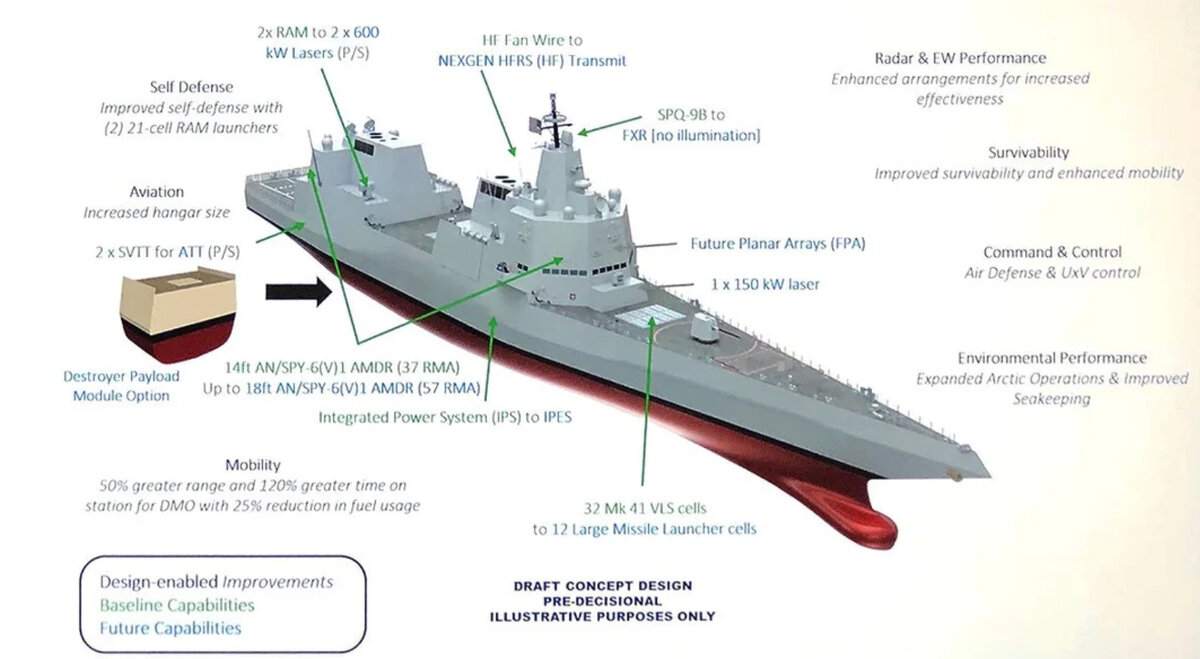
There was a lot to get excited about at last week’s Surface Navy Association confab, and I’ll get to that in a minute, but it would be wise to temper one’s expectations. 20 years seems like a long time, but in many ways it is not. As we look forward to what our fleet will look like at mid-century, we should look back to what we were all promised in January of 2005 that was going to transform into the Navy of the 21st century. There were four ship classes that were going to be the surface fleet that we were promised at the time, were going to ensure America’s dominance at sea for the next half century. (NB: most of the hypertext links below go to the tags from my OG Blog that predate my move to Substack three years ago. Those will point you towards my writing two decades ago or so on these programs at the time, if you are so interested.) LCS. We were once supposed to get 55 of the marketing/consultancy-named Littoral Combat Ship. We’ll wind up with 25. Not suitable for combat in the littorals, but steps are being made to get some use out of them…somehow. DDG-1000. We were once going to have 32 of these. We got three. Its main weapon, the two 155mm guns, were never made operational and are being removed. The ships are being turned into weapons demonstrators for Conventional Prompt Strike. I hear great things about the engineering plant, but they have yet to do a proper deployment, nine and a half years after the commissioning of hull-1. Ford Class CVN. A dozen years ago, we thought it would deploy with UAVs as you can see below (pause for a moment in honor of the martyred X-47B, the greatest crime of the Obama Era Navy), but no. Hull-1 took 8 years to commission. Hull-2 will take 12. Can’t seem to have a workable CHT system. CG(X). In 2005, we thought we would build at least 19. Complete loss of control of the program to the point it was put out of its misery. We still don’t have a proper carrier escort. Looks like the Japanese will build what we should have, and the only hope we have now is…BBG-1. Why dig all this institutional shame and dishonor up, again? Simple, we need to be humble, and the leaders today need to hoist onboard the errors of the past. Now, back to last week. For our fleet of the 2030s and on to face the world’s largest navy (in 2005 it was the US Navy. Now it is the People’s Liberation Army Navy. Well done everyone), there are three ships right now that we have to ponder as our future surface force. BBG-1. I am hearing that we will see 15-24 of these. FFX. 50-65 ships. I may write a critique at some point. ES: I look forward to Flight II. DDG(X). We still do not have a final configuration or a number we want to build…I think. Let’s wind things up with a return to a comment I made at the top. “Why keep beating up on the Age of Transformationalism™?” Whenever I would get pushback on my regular articles about the failure of the Age of Transformationalism™, mostly along the lines of “Why keep digging up all the negative vibes” angle from the usual suspects, I would reply that we had to keep reminding everyone of the errors of the past so that the next generation responsible for husbanding our future surface combatants will not repeat the errors. The collapse of the Constellation Class FFG program dampened my hope that we will take the path of success, but…here we are. Will this generation succeed to the same and opposite degree the previous generation failed? With the same program, people, and bureaucracy in place—it does give one pause, but I am a deeply closeted optimist. With a few exceptions, we seem to be mitigating technology risk by leaning on proven systems, or systems expected to be proven. That may not be sexy, but it displaces water. We are long overdue for world-beating ship designs to show the world what a premier naval power looks like. We should be optimistic…but demanding when it comes to performance and discipline. Keep a weather eye, demand accountability, and smile through the inevitable challenges. We have to get this right. We can’t lose another generation of shipbuilding. Some of the pics above via the irreplaceable Chris Cavas. Leave a comment Share This Substack is reader-supported. To receive new posts and support my work, consider becoming a free or paid subscriber. View the full article

-
United States Central Command confirmed that American forces are operating the Electronic Advanced Ground Launcher System (EAGLS), a mobile counter-drone weapon designed to protect U.S. troops, following recent testing and operational deployment in the Middle East. In a statement published on January 19, 2026, CENTCOM stated that the system “counters drone threats with precision” and […]View the full article
-
A Russian pro-Kremlin media channel released new footage this week showing what it claims is the combat use of a laser weapon against Ukrainian drones in Russia’s Belgorod region, near the border with Ukraine, marking another public appearance of a Chinese-made directed-energy system in Russian service. The video, published on January 2026, shows a stationary […]View the full article
-
EuroTrophy GmbH has signed a €330 million ($383 million) contract with KNDS Deutschland to supply Trophy Active Protection Systems for Leopard 2A8 main battle tanks ordered by Lithuania, the Netherlands, the Czech Republic, and Croatia, the company announced on January 19, 2026. The agreement covers the delivery of Trophy APS units for the four national […]View the full article
-
Ukraine has paused additional orders of HX-2 strike drones from German defense technology firm Helsing after the systems showed technical problems during frontline testing, according to Bloomberg. The decision follows field trials conducted by Ukraine’s 14th Regiment, a unit specializing in unmanned aerial systems, where the HX-2 experienced repeated difficulties during launch and operation. The […]View the full article
-
A Ukrainian defense company, CENTRE ZAKHYST, has announced the successful development and combat testing of its ODIN counter-unmanned aerial systems, a domestically produced solution designed to intercept attack drones, according to a statement released by the company. CENTRE ZAKHYST said the system has been implemented in combat conditions and tested both at training grounds and […]View the full article
-
Poland has tested the KUNA configurable autonomous multi-role platform in winter terrain, confirming its ability to operate in snow, ice, and sub-zero conditions where standard wheeled vehicles lose mobility, according to information released by the Wojskowy Instytut Techniki Pancernej i Samochodowej (WITPiS). The winter evaluation focused on mobility, autonomy, and logistics support in conditions that […]View the full article
-
DARPA, the Pentagon’s research and technology arm, confirmed on January 14, 2026, that its Robotic Autonomy in Complex Environments with Resiliency (RACER) program has completed final operational tests and is ready for transition to U.S. military units and commercial users. The announcement follows a series of Army and Marine Corps demonstrations that showed RACER-equipped vehicles […]View the full article
-
Is four months too short a turnaround for a guest on Midrats? Not if the topic at hand keeps running to the top of your read board. From the unending diplomacy responding to the Trump Administration’s unending drive to get Greenland’s geography—and the resulting security—more firmly under American control, to the sitcom-worthy deployment of a couple of dozen “Coalition of the Freezing”—Greenland can’t-stop-won’t-stop from gathering eyeballs and attention. So, we’re bringing back Elizabeth Buchanan for another visit. We’ll use her recent article in The Spectator as starting off point, A buyer’s guide to Greenland. We go LIVE at 6pm Eastern. If you are reading this after the show, refresh the Substack page later Sunday night for the podcast audio. You can listen live at this link. Dr. Elizabeth Buchanan is a senior fellow with the Australian Strategic Policy Institute and an expert associate of the French Ministry of Armed Forces’ Institute for Strategic Research. Most recently she was Head of Research for the Royal Australian Navy (Department of Defence). Dr Buchanan is co-founder of the polar warfare program (Project 6633) at the Modern War Institute of the West Point Military Academy. Before joining Australia’s Defence Department, Dr. Buchanan was Lecturer of Strategic Studies for the Defence and Strategic Studies Course at the Australian War College. Elizabeth holds a Ph.D. in Russian Arctic Strategy and completed her post-doctoral studies as a Maritime Fellow at the NATO Defense College in Rome. She has published widely on geopolitics, most recently with Australian Foreign Affairs, International Affairs, War on the Rocks, Foreign Policy, Foreign Affairs, The Australian, and The American Conservative. Dr. Buchanan has been a Visiting Scholar with the Brookings Institution and was an analyst with Royal Dutch Shell. Elizabeth has three published books:: Russian Energy Strategy in Asia and Red Arctic: Russian Arctic Strategy under Putin. In addition to, So you want to own Greenland, she also has an upcoming book, Competitive Cooperation at the Ends of the Earth. Leave a comment Share This Substack is reader-supported. To receive new posts and support my work, consider becoming a free or paid subscriber. View the full article

-
India has reportedly acquired dozens of Belarus-made Berkut-BM one-way attack drones, according to defense industry sources. The Berkut-BM is a jet-powered kamikaze drone developed by the Indela company in Belarus and designed to strike time-sensitive battlefield targets before they can relocate. The system is powered by compact Chinese-made micro turbojet engines produced by Swiwin, giving the […]View the full article
-
Japan’s Board of Audit revealed in January 2026 that military equipment worth approximately 1.1 trillion yen ($6.9 billion) purchased from the United States under the Foreign Military Sales (FMS) program has not been delivered to the Japan Self-Defense Forces despite more than five years passing since contracts were signed. The finding is detailed in an […]View the full article
-
South Korea has begun deploying its Hyunmoo-5 surface-to-surface ballistic missile to frontline military units, military officials said Sunday, confirming that the country’s most powerful conventional strike weapon has entered operational service as part of efforts to deter North Korea. According to South Korean military officials, the missile began entering frontline units in late 2025 and […]View the full article
-
The United States Army has missed its deadline to field the Dark Eagle hypersonic missile, acknowledging that the first U.S. ground-based hypersonic weapon will not be deployed until early 2026, despite the unit assigned to operate the system already being trained and ready. According to a report by Bloomberg, the Army confirmed this week that […]View the full article
-
A Chinese-made VN22 6×6 wheeled armored vehicle was spotted at the Military Scientific and Technical Institute of Uzbekistan, confirming the presence of Chinese armored platforms at a key Uzbek defense research facility. Images show the VN22 positioned inside the institute alongside other military vehicles, indicating that the platform is undergoing technical evaluation. The VN22 is […]View the full article
-
A new variant of China’s ZBD-04 infantry fighting vehicle has been spotted during transport at an undisclosed location, showing the platform fitted with an automated, unmanned weapon turret, indicating a possible shift in the Chinese Army’s approach to infantry vehicle design. Images circulating online show a modified ZBD-04 chassis equipped with a lighter, remotely operated […]View the full article
-
Morocco is considering the acquisition of up to 400 K2 Black Panther main battle tanks and the Cheongung (KM-SAM) medium-range air defense system from South Korea, according to South Korean industrial sources. The reported plan would mark the first integration of South Korean military equipment into the Moroccan Armed Forces if it moves forward. The […]View the full article
-
United States Air Force F-15 fighter jets were spotted flying at low altitude over the eastern Aleppo countryside in northern Syria as Syrian government forces moved into the towns of Deir Hafer and Maskana following the withdrawal of Syrian Democratic Forces (SDF) units from the area. The flights were observed as Syrian army units entered […]View the full article
-
The SM-2 Block IIIC/CU medium-range surface-to-air missile was showcased publicly for the first time at the Surface Navy Association (SNA) 2026 symposium, bringing new visibility to the next-generation interceptor developed for U.S. Navy surface combatants. Footage from the exhibition shows the SM-2 Block IIIC/CU, designated RIM-66P by Raytheon, displayed as part of ongoing efforts to […]View the full article