HG S2 (Intel Bot)
Members
-
Joined
-
Last visited
Never
Everything posted by HG S2 (Intel Bot)
-
The United States Army has awarded Rolls-Royce Solutions America Inc. a $73.5 million contract to procure Merkava tank power pack kits and related engineering services under a Foreign Military Sales (FMS) agreement supporting Israel, according to a Feb. 17, 2026 contract announcement released by the U.S. Department of War. The contract covers the delivery of […]View the full article
-
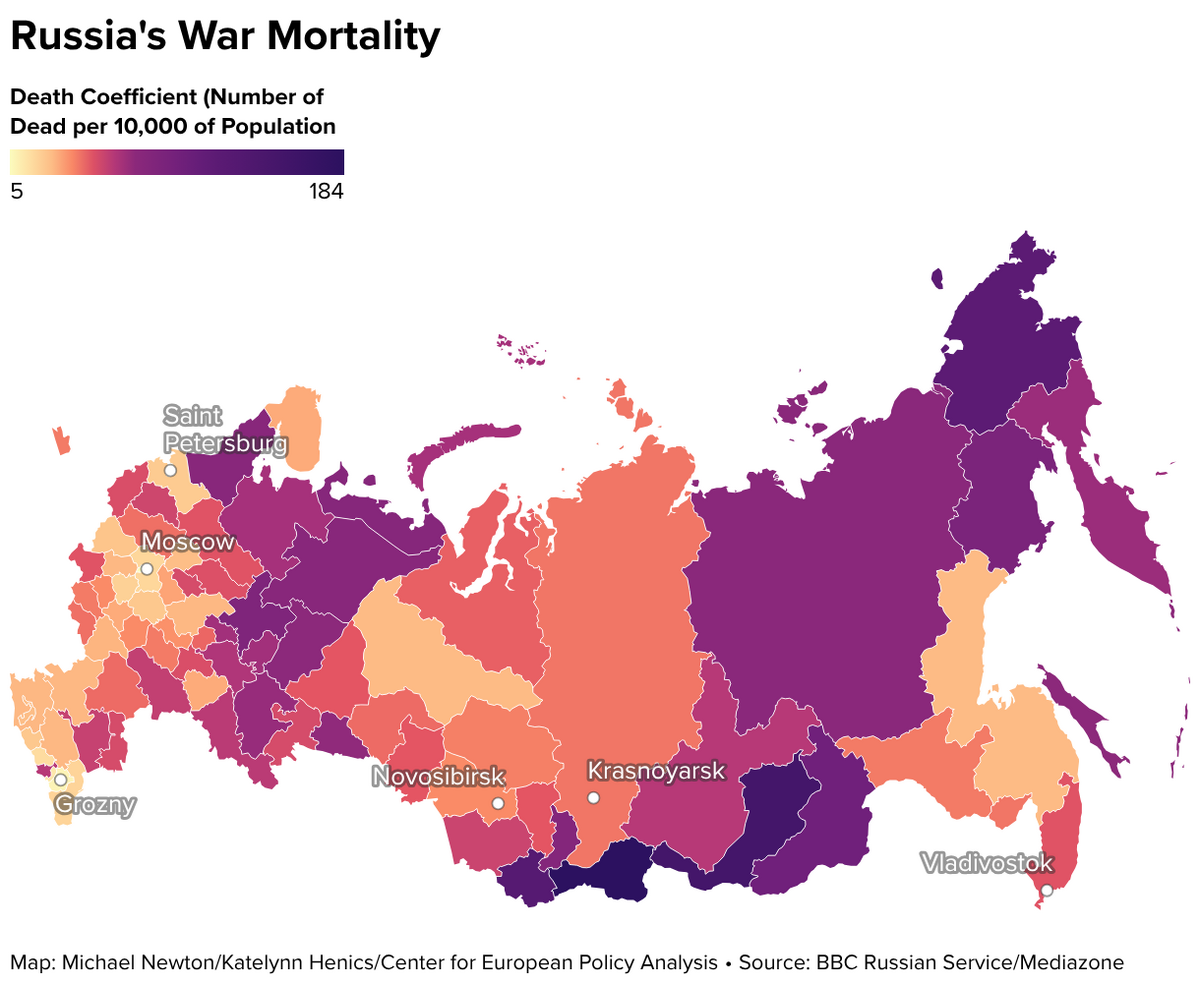
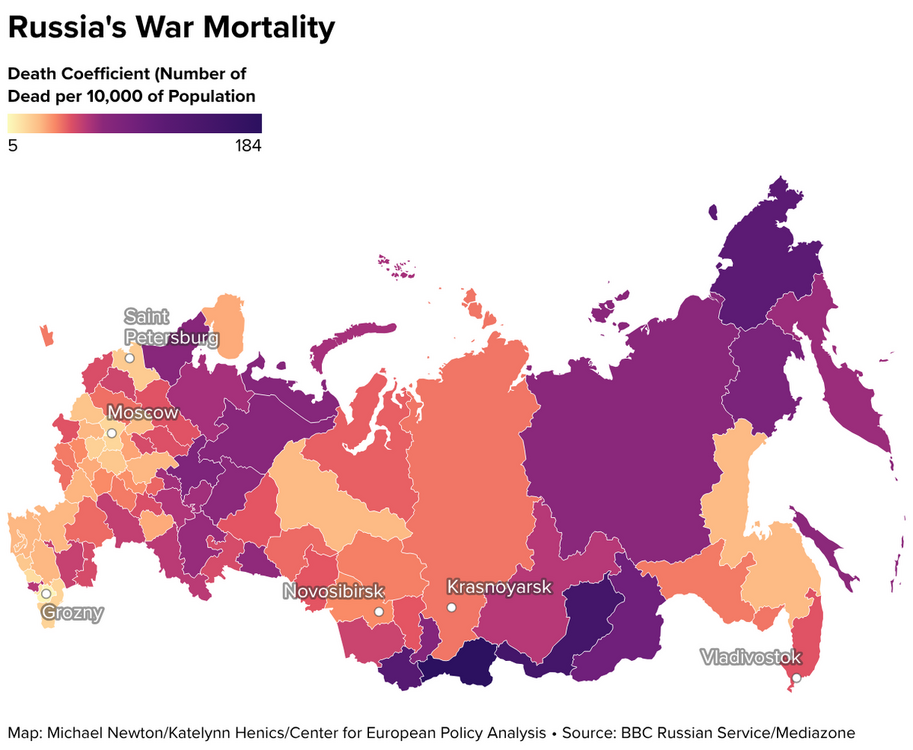
This opening graphic from the Center for European Policy Analysis (CEPA) report by Alexander Kolyandr from last week, Death Without Glory: Russia’s Message to the Frontline Soldier, tells a story. The numbers are staggering. A CSIS report in January estimated Russia has lost up to 325,000 men dead and close to 900,000 wounded, the greatest losses recorded by any major power in any war since World War II. For a country already suffering an acute demographic decline and which has seen perhaps a million emigrate since the war began, this cannot be sustainable, at least in the medium-term. The first thing that came to mind was the low numbers in the VERY ethnic Russian areas, especially around Moscow and St. Petersburg. Correlation or causation? Muscovites are relatively the least likely to suffer death — Moscow has the lowest recorded fatality rate at about 0.02% of residents, or 1 in 5,000. St. Petersburg and Chechnya (the fiefdom of Putin’s local strongman Ramzan Kadyrov) follow at 0.03%. In Buryatia, the rate is 0.4% (1 in 250), and in Chukotka and Tuva it reaches 0.5%. This means that the people of these last-mentioned, unfavored regions are around 25 times more likely to die in combat than Muscovites. Roughly 20 other regions have similarly inflated death tolls. At first glance, this pattern does not simply track regional wealth, measured as gross regional product per capita. Poor Ingushetia and Karachay-Cherkessia, for example, have casualty levels closer to those of affluent Moscow and St. Petersburg than to those of equally poor Chukotka and Tuva. Neither does it reflect the rises in regional median salaries. So what’s going on? Some broad trends help explain the gap: Big-city privilege. Residents of major cities and better-off regions are less likely to enlist and, when they do, are better placed to secure safer roles (in say, the missile forces or the navy) thanks to higher incomes and better education. Moscow holds 9.1% of Russia’s population but provides under 5% of new soldiers. Ethnic stereotypes. As Maria Vyushkova of the Free Buryatia Foundation notes, high losses in the Arctic and East Siberian regions reflect entrenched stereotypes of indigenous peoples as “natural warriors” and marksmen, and these stereotypes are exploited by recruiters. The strongest driver, however, is poverty. The Bell finds a clear correlation between regional death rates and the share of people living below the poverty line, around 19,000 rubles, or $250, a month. Some regions now offer sign-up bonuses totaling 2.5m rubles, around 132 times poverty-level income. And look at which segment of the poor population they are targeting. …among voluntary recruits, the worst-hit group is men aged 45–50 — people more likely to be under financial strain. … When professional soldiers — who took heavy losses early in the war — are excluded, and the analysis is limited to about 60,000 contract recruits, the link between poverty and casualties becomes even clearer. Especially when you consider the demographics of Russia that we’ve discussed before—and giving a nod to the well-known ability for Russia to sustain casualties—how much longer can this go on? Secondly, the economic effects are severe. Men fighting at the front cannot work in a domestic economy where growth is stalling and wages stagnating. That means more Russians are pushed into poverty, making military service for money ever more attractive. This structure of losses is unlikely on its own to trigger systemic collapse. As long as the economy is weak and the war continues, financial incentives will keep drawing in volunteers. Yet if low growth and high inflation persist, deepening poverty may still push many with few alternatives toward the front — ensuring that the poorest continue to die in disproportionate numbers. How long Russia can continue to pay this terrible price is the great unknown. Yes, Ukraine has only ~1/4 the population of Russia and similar demographics, but they are fighting an existential war and may be as tenacious as the men of Paraguay when it is all said and done. I don’t know—but we will find out. I looked for similar data for Ukraine, but no luck. If you find some, share it in the comments. What the data we do have show is that Russia will fight Ukraine to its last poverty stricken middle-aged man before pushing the pampered urbanites in Moscow and St. Petersburg—or the flinty TicTok warriors of Chechnya—into the trenches. Of course, the natural point here is to expect a reprise from the usual suspects, “…but look at what the U.S. did to its minorities and poor in Vietnam…” smear. Sigh, everyone really should read B.G. Burkett and Glena Whitley’s, Stolen Valor: How the Vietnam Generation Was Robbed of Its Heroes and Its History, but let’s look at it for those who have not. Here is where the Vietnam War hit the U.S. worst. Did a disproportionate number of people from high-minority states suffer a disproportionate number of deaths? We know that smear isn’t true by the numbers, but let’s compare graphs. Let’s look at the percentage of “white” ethnicity in 1970s and see if we can make a connection. No we did not seem to target minorities. In many ways it seems that if you were from a majority “white” part of the country, you were more likely to get killed in Vietnam. OK, was it poverty? If you fought in Vietnam, you likely grew up in the 1950s. What did poverty look like to young people then? Did that connect? No, that doesn’t seem to fit either, but “white” and poor? Looking at Arkansas and West Virginia…maybe, but I think if you did a proper regression analysis, it wouldn’t quite fit. Indeed, an MIT study saw no connection, with some data suggesting that high income areas suffered higher than average deaths. I picked the Vietnam War because it was our last war with significant numbers dead. How about a recent conflict, Afghanistan? A modern ethnicity map with the percentage of “white” specified. Again, we are not sending our poor or our minorities to die in disproportionate numbers. Russia is. We are not the same. Leave a comment Share This Substack is reader-supported. To receive new posts and support my work, consider becoming a free or paid subscriber. View the full article
-
China’s AVIC Chengdu Aircraft Industry Group has officially presented a new vertical takeoff and landing (VTOL) unmanned aerial vehicle known as the Yunying (Cloud Shadow in Chinese), a tail-sitter drone featuring a ducted-fan design closely resembling the V-BAT system developed by U.S. company Shield AI. The Yunying-25V UAV was officially showcased during the 2026 CCTV […]View the full article
-
Elbit Systems announced on February 18, 2026, that it has secured contracts valued at approximately $277 million from an international customer for the supply of 30 mm turrets and associated munitions, marking a new export order for the company’s land combat systems portfolio. According to a company statement, the contracts will be executed over a […]View the full article
-
Sweden ranked third worldwide in military assistance to Ukraine in 2025, both in total contributions and as a share of national GDP, according to data cited by the Swedish Embassy in Ukraine based on a report from the Kiel Institute for the World Economy. The embassy said Sweden’s support reflects a clear political commitment despite […]View the full article
-
Bulgaria has received the first batch of Stryker armored vehicles, with five combat vehicles arriving at the port of Burgas on Feb. 14, 2026, marking the start of deliveries under the country’s military modernization program, the Bulgarian Ministry of Defense announced. The shipment represents the initial phase of a broader procurement effort conducted through international […]View the full article
-
The United States Air Force has announced a revised acquisition plan for the LGM-35A Sentinel intercontinental ballistic missile program, confirming that a major restructuring effort will be completed by the end of 2026, with initial operational capability targeted for the early 2030s. The update was released by the Secretary of the Air Force Public Affairs […]View the full article
-
The Defense Advanced Research Projects Agency (DARPA), Pentagon’s research and technology arm, has designated its air-launched missile-carrying uncrewed aircraft developed under the LongShot program as the X-68A, moving the system toward flight testing expected by the end of 2026, the agency confirmed in an official update. According to DARPA, the milestone follows completion of multiple […]View the full article
-
Raytheon has been awarded a contract by the U.S. Air Force Research Laboratory to establish a domestic production capability for thin film lithium niobate (TFLN) wafers, a material used in high-speed communications and advanced sensing systems critical to defense technology, the company announced. The effort aims to create a secure U.S.-based supply chain for TFLN, […]View the full article
-
Russia has warned of potential military action in the Baltic Sea, with senior Kremlin official Nikolai Patrushev stating that the Russian Navy could be used to break what Moscow describes as a possible maritime blockade, according to reporting by Militarnyi. Patrushev, an assistant to the Russian president and a central figure in Russia’s security establishment, […]View the full article
-
In the second half of the last Midrats Podcast, Mark and I discussed the recently released Maritime Action Plan. I still don’t understand why we release such documents on a Friday before a three-day weekend, but whoever makes that call should be left with the next bar tab. To their great credit however, the April 2025 Executive Order demanded a deliverable, and they got it done on time. If you are looking for a naval strategy or other “this type of system doing that” report, you won’t find it here, and nor should you. This is signed by Marco Rubio as National Security Advisor and Russ Vought as the Director of the Office of Management and Budget. It is best seen as an economic, industrial policy, and budget priorities document. It isn’t primarily focused on the deployable fleet, but something foundational and arguably more important that everything else is built on. Here are its four pillars, and the parts of it that got my attention. Pillar I: Rebuild Shipbuilding Capacity and Capabilities Only 8 yards in the USA that can build ships greater than 400 feet Less than 1% of the world’s commercial shipping was built in the USA Maritime Prosperity Zones Focus on geographical diversity, including the Great Lakes and our river systems Universal fees on foreign built vessels bringing products to American ports Pillar II: Reform Workforce Education and Training Fix the deferred maintenance disgrace at the Merchant Marine Academy Help lift up state Merchant Marine Acedemies Workforce development Pillar III: Protect the Maritime Industrial Base Investigate People’s Republic of China’s threats to our industrial base Pillar IV: National Security, Economic Security, and Industrial Resilience Increase US flagged fleet Prioritize robotics and autonomous systems Boost arctic presence Deregulation They wind things up with some solid discussions about deregulation and proposed legislation. That last bit…that is under-appreciated. If used properly, the Maritime Action Plan is a solid “Ref. A.” for follow-on legislation and programs. It gives someone the ability to have the handy hook of, “IAW the Maritime Action Plan…” It also is a useful information source for leaders who have a lot on their plate but are not steeped in maritime issues. They know there are problems that need to be addressed, but don’t fully understand where to place the levers of power they have access to. This can be used as a guide to do just that. In a way, a barrier removal exercise is key to see where we are, where we want to be, and what barriers are between the two. This does that. Give it a read for the details but take this to heart: besides renovations to the Merchant Marine Academy and a few other side items, the core of this requires action that will not have a quick turnaround. This will need to be a multi-administration and bipartisan effort to be a success. This should be a thoroughly non-partisan effort. All sides “win” with a strong maritime industrial base, well capitalized national merchant marine, and a Navy second to none. To enable that, both parties should ensure that their leading people driving this effort to rebuild our maritime infrastructure have exceptionally good playground manners and a reputation for healthy competition but not bringing a baggage train of toxicity with them as they walk through the door. This effort is too important. Leave a comment Share This Substack is reader-supported. To receive new posts and support my work, consider becoming a free or paid subscriber. View the full article

-
Ukraine’s Air Force on Tuesday rejected media reports claiming that a secret multinational F-16 fighter squadron composed of Ukrainian, American, and Dutch pilots had been established to defend Kyiv’s airspace, calling the information inaccurate and unsupported by evidence. The denial followed a report published by French outlet Intelligence Online, which alleged that a covert unit […]View the full article
-
Denmark’s Air Force on Monday formally established Squadron 729 to operate newly acquired MQ-9B long-range remotely piloted aircraft, marking a step in expanding surveillance capabilities across the Arctic, North Atlantic, and Baltic regions. The new unit will be based at Aalborg Air Base under the Air Transport Wing, according to an announcement from the Danish […]View the full article
-
Sierra Nevada Corporation (SNC) has purchased a Bombardier Global 6500 aircraft at its own expense to support the U.S. Army’s High Accuracy Detection and Exploitation System (HADES) program, marking a new step in the development of next-generation aerial intelligence, surveillance and reconnaissance capabilities, the company announced. The acquisition, completed at the close of 2025, provides […]View the full article
-
L3Harris Technologies has received a contract valued at nearly $400 million to produce additional propulsion components for the U.S. military’s Terminal High Altitude Area Defense (THAAD) system, reinforcing production of one of the nation’s primary ballistic missile defense capabilities. The award covers the manufacture of solid rocket boost motors and Liquid Divert and Attitude Control […]View the full article
-
The Bangladesh Army has received a new batch of Chinese-made VT-5 light tanks, expanding its fleet after previously fielding one regiment equipped with 44 vehicles, according to reports from Bangladeshi media and regional defense observers. The delivery represents the latest confirmed reinforcement of Bangladesh’s armored forces and follows earlier sightings of VT-5 tanks photographed during […]View the full article
-
Israel’s defense company Elbit Systems reported record global demand in 2025 for its Laser Target Designator (LTD) systems across both land and airborne military platforms, reflecting growing reliance on precision targeting and networked battlefield operations, according to company statements and The Jerusalem Post. The company said its LTD portfolio, compliant with NATO laser-coding standards, is […]View the full article
-
United States Army soldiers conducted training with the TRV-150 unmanned aerial vehicle during an exercise at Fort Stewart, Georgia, on Feb. 12, 2026, marking the service’s evaluation of a heavy logistics drone already introduced within U.S. Marine Corps units. According to U.S. Army information released alongside the exercise, a TRV-150 drone operated by soldiers from […]View the full article
-
Dutch State Secretary for Defence Gijs Tuinman said the Netherlands could theoretically “jailbreak” the software of its F-35 fighter jets if U.S. support were halted, according to remarks made Feb. 15 during an interview with BNR Nieuwsradio and highlighted by Clash Report. Tuinman made the comment while discussing European dependence on U.S.-managed systems tied to […]View the full article
-
Those who follow me on X know that every couple of months I remind everyone that we are gleefully training those whose life’s work is to defeat this nation. If you have been to a major top-shelf university or research institution’s graduation ceremony in the last two decades, one thing that dramatically stands out is how many People’s Republic of China (PRC) nationals are receiving not just undergraduate degrees, but master’s degrees and PhDs in the most highly skilled STEM fields from biostatistics to quantum physics. From aerospace engineering to industrial design—PRC nationals are overrepresented to an outlandish degree. Don’t forget, these are the places basic research starts, where the future technology is developed. This is also a zero-sum game with a finite number of positions. For each PRC national who is getting a PhD in a STEM field, that is one American who is not. They either don’t go, or have to find a lower-tier university to go to. It isn’t just private institutions. At one of my daughters’ graduation ceremonies at a major land-grant university, the university was proud of the fact that they had more international students than out-of-state students. Think about that. Let it soak in. In some STEM fields, 4 out of 5 or more are non-American. I’m not interested in excuses. The future will be won or lost by those who master emerging technology…or the methods to defend against them. I also don’t want to hear the, “…but they pay full price…” If that is your argument, then we already know what you and your institution are, we are just haggling over the price. I know that administrative bloat won’t pay for itself, but I don’t care. Return to 1996 levels and train Americans. Public or private institutions, they all receive government funds. There is leverage. Enough of my commentary. Our friend Jerry Dunleavy has one of the most important articles related to our future national security that I’ve read so far this year. Yes, national security. This is not so much an education story or an economic argument. No, especially in STEM fields, this is about national security—ours and our allies’. The House Select Committee on the CCP said last year that the “Seven Sons” are “a group of elite Chinese universities known for their deep ties to the PLA and central role in military research and development.” The House committee assessed that these seven academies are “China’s leading defense-focused universities, whose primary mission is to advance defense research and development and drive state-directed military-civil fusion efforts” and that “most maintain partnerships with state-owned defense conglomerates and operate as training grounds for future military leaders, engineers, and technicians working on weapons systems and defense programs.” The committee warned that the Seven Sons “play a central role in developing advanced military technologies, including hypersonic weapons, unmanned systems, cyber warfare tools, and aerospace engineering, often in direct coordination with the PLA and its affiliates” and that “graduates from these institutions frequently enter roles within China’s military, intelligence, or state-owned defense enterprises.” Georgetown University’s Center for Security and Emerging Technology wrote in 2020 that “the Seven Sons of National Defense are important feeders for China’s military and defense industry.” The center said the Seven Sons “contribute the lion’s share of new hires at Chinese defense state-owned enterprises” and “produce nearly three quarters of the elite university graduates hired by China’s largest defense companies.” The Hoover Institution in 2020 argued that the Seven Sons “act as fronts for and extensions of the People’s Liberation Army and the Ministry of State Security” and “directly support military-civil fusion; the PLA; and the defense research and industrial base, weapons programs, and myriad other entities that are part of the PRC’s military, public security, and surveillance apparatus.” The RAND Corporation also warned in 2023 that the “Seven Sons universities contain researchers likely to be tied to China’s military-civil fusion strategy.” SASTIND grads also make their way to AmericaThe House CCP Committee referred to SASTIND as a “Chinese defense agency” linked to the PLA. The committee’s report from last year said that SASTIND “co-administers 58 Chinese universities — out of more than 3,000 Chinese universities — engaged in military-civil fusion research.” Let’s look at this parade of horrors. Dr. Ziang Yu poses an immediate threat to U.S. security. Dr. Yu’s attendance at one of China’s leading defense universities only raises further concerns.” Yu’s LinkedIn page and Google Scholar page say that he is a postdoctoral associate with the University of Wisconsin’s department of nuclear engineering and engineering physics. The Chinese scientist’s LinkedIn profile also says he received an undergraduate degree at Northwestern Polytechnical University. It has been dubbed one of the CCP’s “Seven Sons of National Defense.” Yes, nuclear engineering and engineering physics. Somewhere, there is an American who applied for that slot and was denied. They are not coming to the U.S. for Gender Studies PhDs. The university has long been on U.S. government blacklists, including being blacklisted by the Pentagon. The Defense Department has the Chinese school on its list of “foreign institutions engaging in problematic activity” and says this list “is an important continuing effort in highlighting and countering mechanisms of unwanted technology transfer to foreign countries of concern.” The Commerce Department in 2021 described the school as “a Chinese military university that is heavily involved in military research and works closely with the People’s Liberation Army on the advancement of its military capabilities.” The House Select Committee on the CCP described the school as “a core Chinese military university” last year. The House committee said that the school “was created by the merging of several engineering universities and institutions — including the Air Force Engineering Department of the PLA Military Engineering Institute.” The committee said the university “hosts 13 major defense laboratories and 44 designated defense research areas.” How many Americans are studying such things at PRC universities? We both know the answer. Yu’s school profile says he is a postdoc research associate at the Microstructure Materials Modeling group at Wisconsin, which is also called “Professor Yongfeng Zhang’s Research Group.” Dr. Yongfeng Zhang of the University of Wisconsin himself received two degrees from the University of Science and Technology of China, according to his online biography. The Commerce Department’s Bureau of Industry and Security added that particular Chinese university to a blacklist “for acquiring and attempting to acquire U.S.-origin items in support of advancing China’s quantum technology capabilities, which has serious ramifications for U.S. national security given the military applications of quantum technologies” and said it was “involved in advancing China’s nuclear program development.” Zhang was previously a senior member of the U.S. government’s Center for Thermal Energy Transport under Irradiation, and was also a staff scientist in the Fuel Modeling and Simulation Department at Idaho National Lab. Zhang did not respond to a request for comment. The Wisconsin lab, led by Zhang and counting Yu as a member, receives funding from the Energy Department’s Nuclear Energy University Program, the Idaho National Laboratory, and the Nuclear Regulatory Commission. Yu’s co-author for a 2025 research paper received support from the Idaho National Lab. This is no isolated incident. It gets worse. The AAF report assessed that “Zongliang Xie is conducting research in fields that have potential military applications. He is doing so at Lawrence National Laboratory, a lab with a substantial amount of federal funding. The Chinese University, which Xie attended, is a high-risk institution due to its ties with the CCP military’s adjacent research.” Xie’s LinkedIn page lists him as a postdoctoral researcher at the Lawrence Berkeley National Lab, and his Google Scholar page lists him there too. Xie is part of the Molecular Foundry at the lab, and he says that “I’m working on AI-driven polymer design and nanocomposite fabrication techs.” Xie’s LinkedIn profile also says he received a PhD and undergraduate degree from Xi’an Jiaotong University. The Pentagon has the Chinese school on its list of “foreign institutions engaging in problematic activity,” and the House Select Committee on the CCP assessed in 2025 that Xi’an Jiaotong is administered by SASTIND. No one is hiding anything here. Oh, everyone is aware of the PRC’s 2017 National Intelligence Law and the 2015 National Security Law, yes? If not, read up on it here and continue. “Jinghan Gao’s research on high-temperature-resistant materials and related work in energy-efficient storage and semiconductor technologies represent serious dual-use risk technology and national security concerns.” Gao’s LinkedIn page and her University of Florida profile say she received her PhD and her undergraduate degree at Xi’an Jiaotong University. Gao’s LinkedIn says she was a postdoctoral associate at the University of Florida until last year, but that she is now a postdoc fellow at the University of Michigan. Her Google Scholar profile lists her at Michigan, and the electrical and computer engineering department at Michigan lists her as a research fellow. “Jinghan Gao was a postdoctoral research associate at the University of Florida in the Department of Electrical and Computer Engineering,” a spokesperson for the University of Florida told Just the News. “She left UF in 2025 in good standing.” The spokesperson did not answer specific questions related to any concerns the U.S. university may have had about Gao’s attendance at a Chinese military-linked school. The University of Michigan did not respond to a request for comment. Gao is still listed as a post-doctoral research associate at the Interdisciplinary Microsystems Group at the University of Florida, where she is listed as a member of Professor Roozbeh Tabrizian’s Research Group. The “sponsors” for the microsystems group include the National Energy Technology Laboratory, NIH, NASA, Air Force Office of Scientific Research, the National Science Foundation, and DARPA. Let me repeat this again: there is an American citizen—someone who has loyalty to our nation—who did not get these fellowships that you paid for, but instead is being used to grow the intellectual capital of our nation’s #1 competitor on the world stage. It keeps going. Xiaoyi Chen … “an expert in AI machine learning, who comes to the U.S. from PLA-tied universities, and whose mentor (Wang) at Indiana University was raided by the FBI.” Chen’s GitHub page states that “I’m currently a Postdoctoral Researcher at Indiana University Bloomington, under the supervision of Prof. XiaoFeng Wang and Prof. Haixu Tang. Before joining Indiana University, I completed my Ph.D. in Computer Software and Theory from Peking University.” The House Select Committee on the CCP assessed in 2025 that Peking University is administered by SASTIND. ASPI says that Peking University “is assessed as high risk for its high number of defence laboratories and defence research areas, strong relationship with the defence industry, supervision by SASTIND, secret-level security clearance, and links to China’s nuclear weapons program.” The U.S.-China Economic and Security Review Commission in 2022 also said the Chinese military’s air force “established the ‘Dual-Enrollment Program’ with” Peking University. … Chen, for her part, lists her research areas as “Backdoor Attacks and Defenses” and “AI Web Security.” Indiana University has previously highlighted Chen’s AI research work under Wang’s guidance. Chen also previously conducted web application firewall research funded by the National Natural Science Foundation of China. There are so many PRC nationals that they now have their own self-supporting networks inside our lifelines We are letting this happen in the open. “Bao Xianyang, at Harvard, who is working on Department of War-funded polymers research that could enhance the PLA’s capabilities in a broad variety of military materiel, from vehicles to protective equipment to weapons.” Bao’s LinkedIn says he studied at the South China University of Technology. The House Select Committee on the CCP assessed in 2025 that the school is administered by SASTIND. The China Aerospace Studies Institute said the South China University of Technology is a “PLA and defense-aligned” college. Bao has a profile at Michigan State which says that he is a postdoctoral research associate at the Extreme Soft Materials Laboratory, which aims at developing next-generation technologies” including “physics-empowered tactile robots.” The profile for Bao at Michigan State says that “he aims to develop tough and sustainable soft materials for engineering and biomedical applications.” Jerry’s article has an incredibly large amount of additional information. Give it a full read. Reading it is just an emotional nightmare. We don’t have to do this. This is a choice. No one is forcing this on us. But we are allowing it to happen. Board of Regents/Trustees/Visitors. Chancellors. Governors. Senators. Representatives. Presidents. All share this national disgrace. Who will take action? Leave a comment Share This Substack is reader-supported. To receive new posts and support my work, consider becoming a free or paid subscriber. View the full article

-
Rheinmetall Chief Executive Officer Armin Papperger said insufficient funding is currently limiting the volume of military aid that could be delivered to Ukraine, stating that additional weapons systems are available if financing is secured, according to remarks made in an interview with the Berlin-based media platform Table Media published Feb. 16. Speaking during the Table.Today […]View the full article
-
The United States Air Force has released details of a $145 million contract action to develop and integrate an Air-to-Air Dual Mode weapon based on the Advanced Precision Kill Weapon System (APKWS) designed to counter large groups of unmanned aerial systems, according to an official Justification and Approval document published February 13, 2026. The approval […]View the full article
-
A top-secret United States government body called the Defense Advanced Research Projects Agency (DARPA) has issued a special notice outlining new research priorities for its forthcoming Fleetwood program, an initiative aimed at developing advanced catalytic technologies to convert biomass waste into carbon-based chemicals for resilient global manufacturing supply chains. The notice, published February 13, 2026, […]View the full article
-
Need a moment to recover from Valentine’s Day? Of course you do! This Sunday from 5-6pm Eastern, the Midrats Podcast goes LIVE with our ever popular Free-for-All format. We have our topics, but you can join in during the show chat and offer up your own If you read this after the show, just refresh the Substack page Sunday night to find the uploaded podcast You can join the show at this link. Leave a comment Share This Substack is reader-supported. To receive new posts and support my work, consider becoming a free or paid subscriber. View the full article

-
The United States Air Force is confronting growing scrutiny over the cost structure of the T-7A Red Hawk trainer aircraft program as it approaches the Milestone C decision phase, a key acquisition step that will determine whether the aircraft moves into full-rate production. The review comes amid continued schedule delays and ongoing efforts to stabilize […]View the full article