HG S2 (Intel Bot)
Members
-
Joined
-
Last visited
Never
Everything posted by HG S2 (Intel Bot)
-
The United States Navy has approved Raytheon’s StormBreaker smart weapon for operational use on the F/A-18E/F Super Hornet strike fighter, the company announced Feb. 20, 2026. The approval expands the Navy’s precision strike capability at a time when naval aviation forces are adapting to contested environments that demand engagement of mobile targets in poor visibility […]View the full article
-
The United States Marine Corps has decided to retain the M27 Infantry Automatic Rifle for its close combat formations rather than adopt the Army’s M7 Next Generation Squad Weapon rifle, a Marine Corps spokesperson confirmed to Task & Purpose. “The Marine Corps will retain the M27 for our close combat formations as it best aligns […]View the full article
-
The United States Air Force used the Skiron X hybrid unmanned aircraft as a simulated enemy drone during counter-UAS training at the Grafenwoehr Training Area in Germany on Feb. 19, 2026, according to a statement from the 7th Army Training Command. Instructors supporting the Air Force’s Joint Multi-Domain Counter Unmanned Aircraft Systems Operator Course flew […]View the full article
-
Residents in western Belarus have reported sudden reserve call-ups and rapid deployment orders near the country’s border with NATO member states, according to statements from opposition officials and local accounts published Feb. 2026, raising attention over what critics describe as an undeclared mobilization effort. Reports from the regions of Grodno, Slonim, and the village of […]View the full article
-
Florida-based Petrel Technologies announced new performance results for its AERO Sky hybrid vertical takeoff and landing (VTOL) aircraft, confirming the unmanned system achieved six hours of flight endurance and extended reconnaissance reach during recent testing, the company said in a statement released in February 2026. According to the company, the hybrid-electric aircraft demonstrated sustained airborne […]View the full article
-
The United States Air Force has awarded DCS, based in Alexandria, Virginia, a nearly $100 million research and development contract to deliver advanced tools designed to model and predict mission-level operational effects across multiple warfighting domains, according to a contract announcement released Feb. 19, 2026. The $94,745,601 contract provides the Air Force with analytical capabilities […]View the full article
-
BAE Systems FalconWorks and SURVICE Engineering have signed a framework agreement to collaborate on the development of uncrewed air system (UAS) technologies, expanding cooperation tied to military logistics drones and future tactical unmanned aircraft, the companies announced in a joint statement. The agreement builds on an existing partnership dating back to 2015 involving Malloy Aeronautics, […]View the full article
-
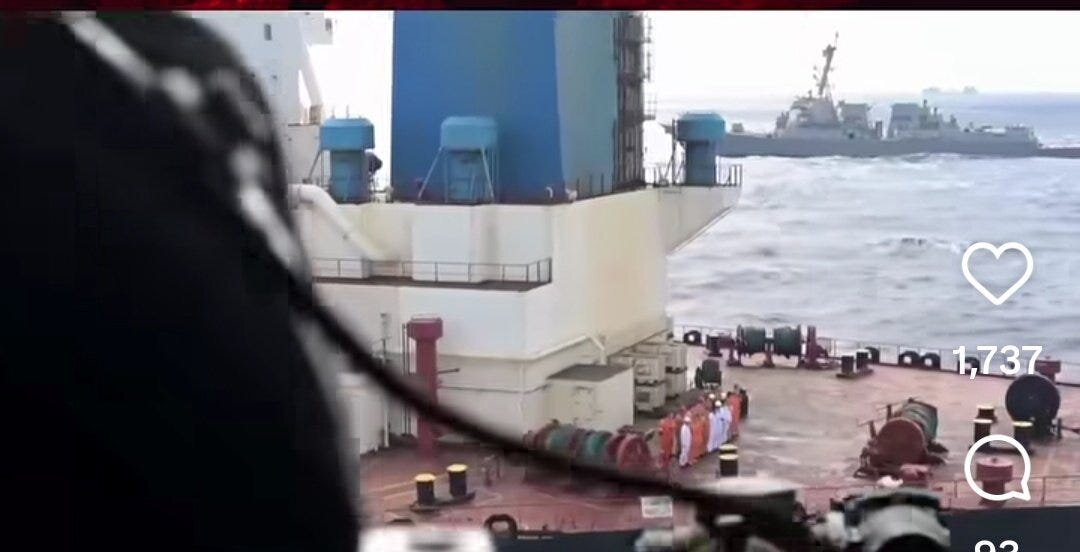
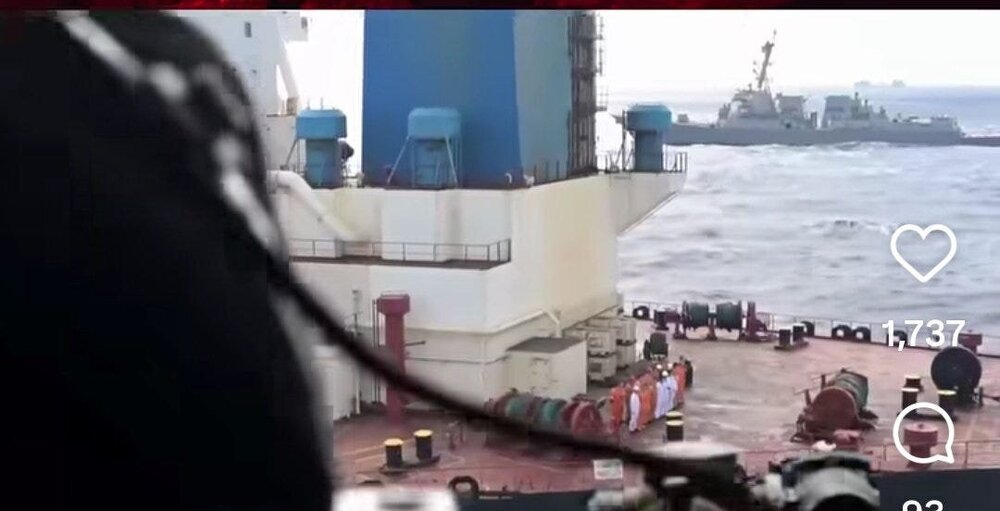
I know it is just a little bit more than a week after my last post on the outstanding performance of the under-appreciated Expeditionary Mobile Base (ESB)—by the way, can we get this class of ships a proper classification? We have other options. However, they are doing the heavy lifting again in the post-Maduro takedown. Here we have U.S. forces capturing the tanker VERONICA III in the Indian Ocean. The tanker is linked to the illegal transportation of crude oil from Iran, Russia, and Venezuela. She could run, but could not hide from the yet-to-be named U.S. Navy Arleigh Burke destroyer. And as Sal Mercogliano let us know over the weekend, in the background of the picture you can see the USS Miguel Keith (ESB-3). In a fashion, she is functioning as a mini-LHA, carrying helicopters and forces used for boarding these vessels…and probably all sorts of other goodies. I would just like to underline that we only have six of these ships; four commissioned and two on order. That is it. Two things need to happen. Extend the buy to at least two, preferably four. Buy and pay for them as a batch purchase, and demand a discount for doing so. We need to up-arm these ships. There is no reason they should not have at least SeaRAM and a couple of 30mm MK 38 remote weapons stations. It is criminal that the crew is only provided—I believe—with .50 cal M2 machine guns as their largest defensive weapon system. NB: for full disclosure, I am not a neutral party in this argument. You can go back to 2012 and the experimentation with USS Ponce (LPD 15) and read about my enthusiasm about the concept, or listen to our Midrats Podcast with her CO from 2014. Leave a comment Share This Substack is reader-supported. To receive new posts and support my work, consider becoming a free or paid subscriber. View the full article
-
Swarm Aero announced the opening of its Advanced Manufacturing Center on Feb. 17, 2026, at Drake Field in Fayetteville, Arkansas, marking the launch of an 80,000-square-foot facility designed to produce large uncrewed aerial vehicle (UAV) swarms, the company said during a ribbon-cutting event attended by Congressman Steve Womack. According to the company, the Arkansas facility […]View the full article
-
BAE Systems announced successful trials of its Autonomous Tactical Light Armour System (ATLAS) uncrewed ground vehicle, confirming testing of a combat-capable autonomous platform designed to support main battle tank and combat reconnaissance operations. The trials evaluated the ATLAS Collaborative Combat Variant (CCV), a fully functional prototype demonstrator first introduced at the Land Forces exhibition in […]View the full article
-
Previously undisclosed details have emerged about Japan’s purchase of unmanned maritime systems from U.S.-based Liquid Robotics, confirming that the platforms acquired under a $25 million Foreign Military Sales program are Wave Glider SV6 unmanned surface vehicles, according to newly released U.S. Air Force procurement documents. The information comes from a Controlled Unclassified Information (CUI) Justification […]View the full article
-
Airmen from the 102nd Security Forces Squadron conducted use-of-force training using a virtual reality system at Otis Air National Guard Base, Massachusetts, on Feb. 8, 2026, employing immersive simulations designed to replicate real-world security and law enforcement scenarios, according to an official unit release. The training used the Street Smarts Virtual Reality system, which places […]View the full article
-
The United States Army has awarded Lockheed Martin a $33.8 million contract to provide ground and flight test support for the Lower Tier Air and Missile Defense Sensor (LTAMDS) integrated with the Patriot Advanced Capability-3 (PAC-3) system, according to a contract announcement released Feb. 18, 2026. The contract was issued by Army Contracting Command at […]View the full article
-
The United States Air Force has awarded Boeing a $13 million contract to upgrade infrared countermeasure systems on C-17 Globemaster III transport aircraft operated by Canada and Australia under a Foreign Military Sales program, according to a contract announcement released Feb. 18, 2026. The award covers upgrades converting existing Block 10 defensive systems to the […]View the full article
-
Divergent Technologies and Mach Industries announced on Feb. 17, 2026, in Los Angeles that they have jointly launched Venom, an autonomous strike aircraft prototype developed and brought to flight readiness in 71 days, demonstrating rapid hardware development enabled by digital manufacturing and modular system design. According to a joint announcement from the companies, the Venom […]View the full article
-
Leonardo DRS announced on Feb. 17, 2026, that it has been awarded multiple contracts under the Missile Defense Agency’s Scalable Homeland Innovative Enterprise Layered Defense (SHIELD) program, an indefinite-delivery/indefinite-quantity agreement with a ceiling value of $151 billion aimed at accelerating delivery of air and missile defense capabilities for U.S. forces. According to a company press […]View the full article
-
The United States Air Force has awarded Liquid Robotics Inc., based in Herndon, Virginia, a $25 million contract to supply 20 unmanned surface vehicles under a Foreign Military Sales (FMS) program supporting Japan, according to a contract announcement released by the U.S. Department of War. The award covers work related to control software, mission payloads, […]View the full article
-
The United States Army has awarded Rolls-Royce Solutions America Inc. a $73.5 million contract to procure Merkava tank power pack kits and related engineering services under a Foreign Military Sales (FMS) agreement supporting Israel, according to a Feb. 17, 2026 contract announcement released by the U.S. Department of War. The contract covers the delivery of […]View the full article
-
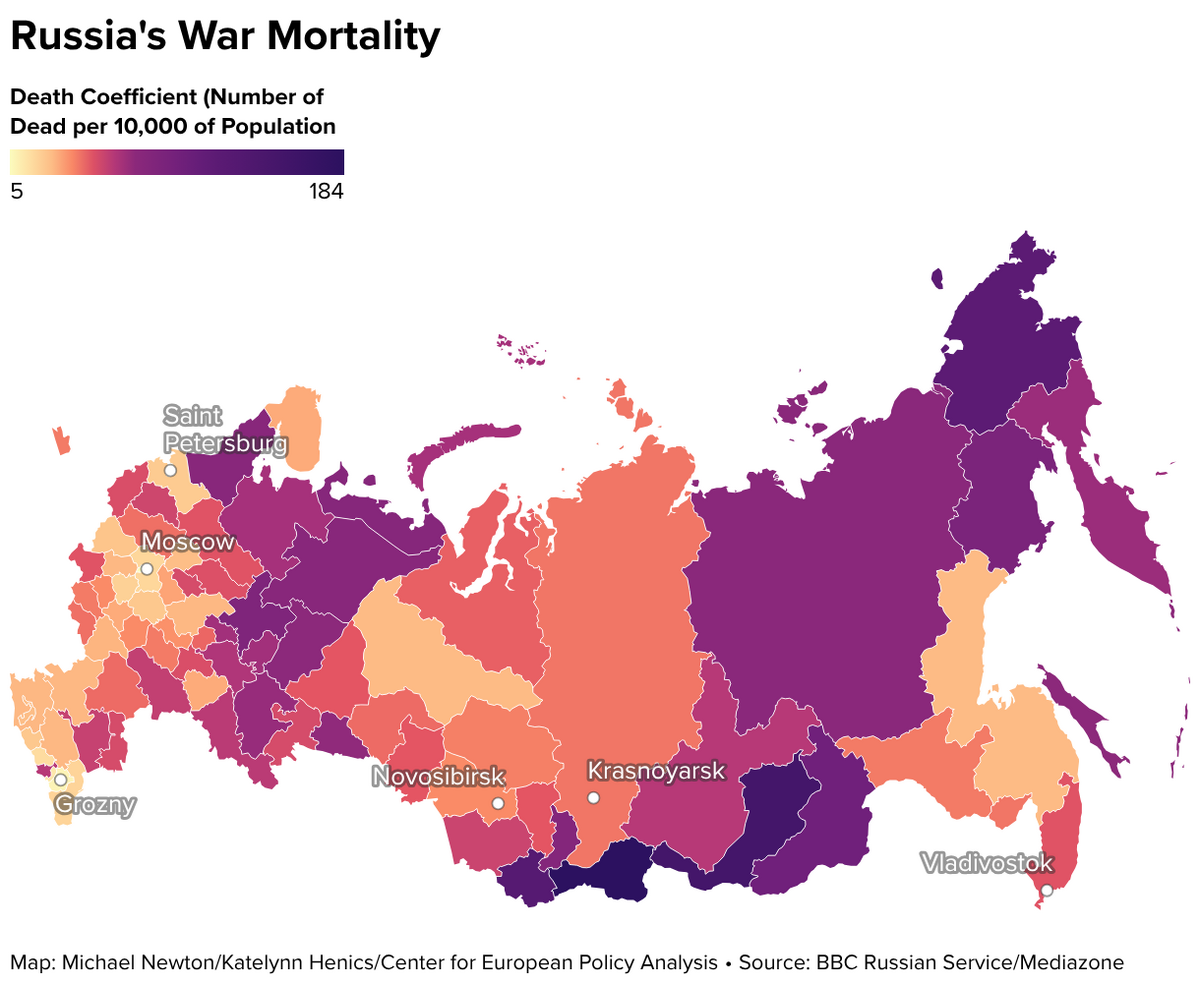
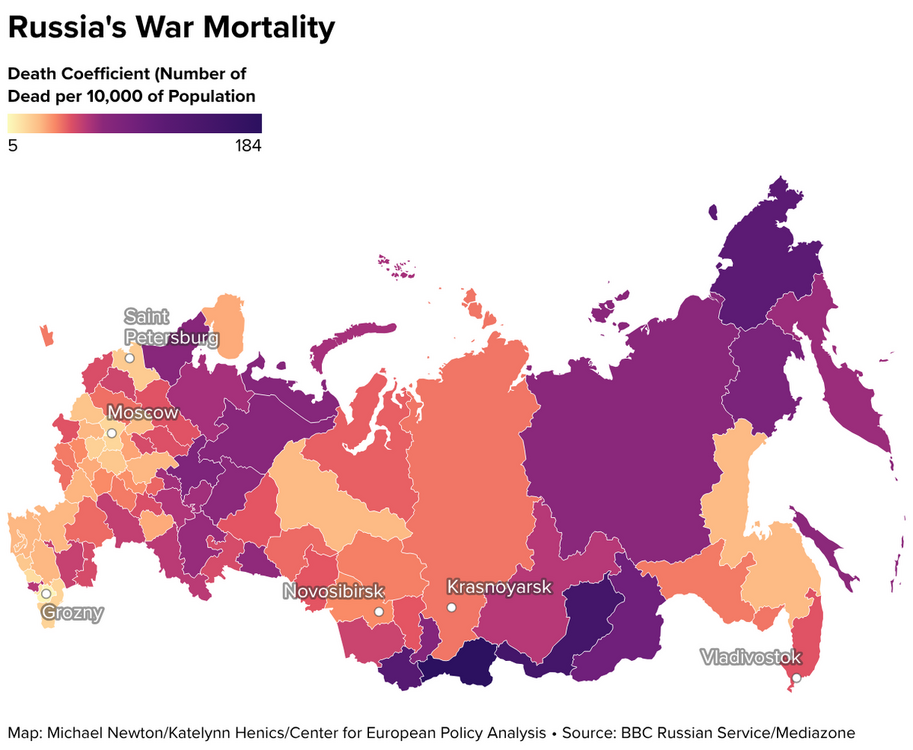
This opening graphic from the Center for European Policy Analysis (CEPA) report by Alexander Kolyandr from last week, Death Without Glory: Russia’s Message to the Frontline Soldier, tells a story. The numbers are staggering. A CSIS report in January estimated Russia has lost up to 325,000 men dead and close to 900,000 wounded, the greatest losses recorded by any major power in any war since World War II. For a country already suffering an acute demographic decline and which has seen perhaps a million emigrate since the war began, this cannot be sustainable, at least in the medium-term. The first thing that came to mind was the low numbers in the VERY ethnic Russian areas, especially around Moscow and St. Petersburg. Correlation or causation? Muscovites are relatively the least likely to suffer death — Moscow has the lowest recorded fatality rate at about 0.02% of residents, or 1 in 5,000. St. Petersburg and Chechnya (the fiefdom of Putin’s local strongman Ramzan Kadyrov) follow at 0.03%. In Buryatia, the rate is 0.4% (1 in 250), and in Chukotka and Tuva it reaches 0.5%. This means that the people of these last-mentioned, unfavored regions are around 25 times more likely to die in combat than Muscovites. Roughly 20 other regions have similarly inflated death tolls. At first glance, this pattern does not simply track regional wealth, measured as gross regional product per capita. Poor Ingushetia and Karachay-Cherkessia, for example, have casualty levels closer to those of affluent Moscow and St. Petersburg than to those of equally poor Chukotka and Tuva. Neither does it reflect the rises in regional median salaries. So what’s going on? Some broad trends help explain the gap: Big-city privilege. Residents of major cities and better-off regions are less likely to enlist and, when they do, are better placed to secure safer roles (in say, the missile forces or the navy) thanks to higher incomes and better education. Moscow holds 9.1% of Russia’s population but provides under 5% of new soldiers. Ethnic stereotypes. As Maria Vyushkova of the Free Buryatia Foundation notes, high losses in the Arctic and East Siberian regions reflect entrenched stereotypes of indigenous peoples as “natural warriors” and marksmen, and these stereotypes are exploited by recruiters. The strongest driver, however, is poverty. The Bell finds a clear correlation between regional death rates and the share of people living below the poverty line, around 19,000 rubles, or $250, a month. Some regions now offer sign-up bonuses totaling 2.5m rubles, around 132 times poverty-level income. And look at which segment of the poor population they are targeting. …among voluntary recruits, the worst-hit group is men aged 45–50 — people more likely to be under financial strain. … When professional soldiers — who took heavy losses early in the war — are excluded, and the analysis is limited to about 60,000 contract recruits, the link between poverty and casualties becomes even clearer. Especially when you consider the demographics of Russia that we’ve discussed before—and giving a nod to the well-known ability for Russia to sustain casualties—how much longer can this go on? Secondly, the economic effects are severe. Men fighting at the front cannot work in a domestic economy where growth is stalling and wages stagnating. That means more Russians are pushed into poverty, making military service for money ever more attractive. This structure of losses is unlikely on its own to trigger systemic collapse. As long as the economy is weak and the war continues, financial incentives will keep drawing in volunteers. Yet if low growth and high inflation persist, deepening poverty may still push many with few alternatives toward the front — ensuring that the poorest continue to die in disproportionate numbers. How long Russia can continue to pay this terrible price is the great unknown. Yes, Ukraine has only ~1/4 the population of Russia and similar demographics, but they are fighting an existential war and may be as tenacious as the men of Paraguay when it is all said and done. I don’t know—but we will find out. I looked for similar data for Ukraine, but no luck. If you find some, share it in the comments. What the data we do have show is that Russia will fight Ukraine to its last poverty stricken middle-aged man before pushing the pampered urbanites in Moscow and St. Petersburg—or the flinty TicTok warriors of Chechnya—into the trenches. Of course, the natural point here is to expect a reprise from the usual suspects, “…but look at what the U.S. did to its minorities and poor in Vietnam…” smear. Sigh, everyone really should read B.G. Burkett and Glena Whitley’s, Stolen Valor: How the Vietnam Generation Was Robbed of Its Heroes and Its History, but let’s look at it for those who have not. Here is where the Vietnam War hit the U.S. worst. Did a disproportionate number of people from high-minority states suffer a disproportionate number of deaths? We know that smear isn’t true by the numbers, but let’s compare graphs. Let’s look at the percentage of “white” ethnicity in 1970s and see if we can make a connection. No we did not seem to target minorities. In many ways it seems that if you were from a majority “white” part of the country, you were more likely to get killed in Vietnam. OK, was it poverty? If you fought in Vietnam, you likely grew up in the 1950s. What did poverty look like to young people then? Did that connect? No, that doesn’t seem to fit either, but “white” and poor? Looking at Arkansas and West Virginia…maybe, but I think if you did a proper regression analysis, it wouldn’t quite fit. Indeed, an MIT study saw no connection, with some data suggesting that high income areas suffered higher than average deaths. I picked the Vietnam War because it was our last war with significant numbers dead. How about a recent conflict, Afghanistan? A modern ethnicity map with the percentage of “white” specified. Again, we are not sending our poor or our minorities to die in disproportionate numbers. Russia is. We are not the same. Leave a comment Share This Substack is reader-supported. To receive new posts and support my work, consider becoming a free or paid subscriber. View the full article
-
China’s AVIC Chengdu Aircraft Industry Group has officially presented a new vertical takeoff and landing (VTOL) unmanned aerial vehicle known as the Yunying (Cloud Shadow in Chinese), a tail-sitter drone featuring a ducted-fan design closely resembling the V-BAT system developed by U.S. company Shield AI. The Yunying-25V UAV was officially showcased during the 2026 CCTV […]View the full article
-
Elbit Systems announced on February 18, 2026, that it has secured contracts valued at approximately $277 million from an international customer for the supply of 30 mm turrets and associated munitions, marking a new export order for the company’s land combat systems portfolio. According to a company statement, the contracts will be executed over a […]View the full article
-
Sweden ranked third worldwide in military assistance to Ukraine in 2025, both in total contributions and as a share of national GDP, according to data cited by the Swedish Embassy in Ukraine based on a report from the Kiel Institute for the World Economy. The embassy said Sweden’s support reflects a clear political commitment despite […]View the full article
-
Bulgaria has received the first batch of Stryker armored vehicles, with five combat vehicles arriving at the port of Burgas on Feb. 14, 2026, marking the start of deliveries under the country’s military modernization program, the Bulgarian Ministry of Defense announced. The shipment represents the initial phase of a broader procurement effort conducted through international […]View the full article
-
The United States Air Force has announced a revised acquisition plan for the LGM-35A Sentinel intercontinental ballistic missile program, confirming that a major restructuring effort will be completed by the end of 2026, with initial operational capability targeted for the early 2030s. The update was released by the Secretary of the Air Force Public Affairs […]View the full article
-
The Defense Advanced Research Projects Agency (DARPA), Pentagon’s research and technology arm, has designated its air-launched missile-carrying uncrewed aircraft developed under the LongShot program as the X-68A, moving the system toward flight testing expected by the end of 2026, the agency confirmed in an official update. According to DARPA, the milestone follows completion of multiple […]View the full article