HG S2 (Intel Bot)
Members
-
Joined
-
Last visited
Never
Everything posted by HG S2 (Intel Bot)
-
Spain unveiled the industrial blueprint for its next generation of fighter pilot training on April 28, 2026, as an Airbus-led consortium presented the full programme structure for the Spanish Air and Space Force’s new Integrated Combat Training System — a contract awarded in December 2025 that will retire the country’s aging F-5 fleet and replace […]View the full article
-
It is well past time that we had a frigate SITREP, specifically the gray-hulled version of the Legend-class Cutter we are going to build for our Navy. No reason to rehash my concerns and assumptions—click the frigate hypertext above if you need to catch up, but…let me just say…though I’m glad she’s on the way and we’ll find good use for her, I hope Flight I is a short run. I know hope is not a plan, but back in December, I had this little bit of hope: I suspect that already there is work being done on a Flight II, which will incorporate the multi-mission capability of the patrol frigate proposed over a dozen years ago … While looking over the FY27 budget request, it appears that my hope is well placed. Here’s the important bit if it is too much to read the fine print above. Frigate will take the same validated flight-upgrade approach as our Arleigh Burke DDG-51 program - incorporating improvements over successive flights to evolve the ship’s capabilities over time. Flight I Frigates will have minimal adaptations from the existing NSC to start production as quickly as possible. The limited modifications of the NSC baseline to the Flight I Frigate requirements incorporate Navy weapons, combat systems, and communications programs of record, add a flexible weapons station in lieu of the NSC stern boat ramp, add a port-mid-ships boat davit, incorporate shipbuilder recommended producibility enhancements, and change to standard Navy grey paint. Studies for future flights will consider expanded capabilities including Vertical Launch Systems, and Anti-Submarine Warfare systems. FF(X) RAS C2 is enabled through use of Navy warfare system programs of record including the FF(X) combat system and eventually Aegis based Integrated Combat System (ICS), communications systems, and design reservations dedicated to future RAS C2 systems. Yes. As we were hoping, smart people in hard jobs have looked at the last successful surface ship program, the Arleigh Burke, and said, “Yes, that process worked. Let’s do that.” This isn’t easy work, but it’s not hard to benchmark success. When will we see Flight I, Hull-1? Looks like 30 June 2030, 1,531 days from now. Using our patented unit of time when looking at Navy programs, the WorldWar™, it will be 1.12 WorldWars™ from today until we have that ship delivered…at the earliest. This is already a mature design, already delivered, so that should not be delayed. Yes, I know. OK, that goes at the speed of smell, but at least it’s moving. When will we see Flight II? Looks like it will still be in the design phase through 30 SEP 2031. Sigh. 5 years too late. We should give the FF(X) Flight II project to Mike Gallagher’s band of merry engineers and move that timeline to 30 SEP 2026, but that’s just me. Sidebar: The last FF in the USN was USS Moinester (FF 1097). DE-1098 through 1107 were planned, but canceled. So, are we going to have FF(X) Hull-1 be FF-1098 or FF-1108? h/t Virtual Bayonet. Leave a comment Share This Substack is reader-supported. To receive new posts and support my work, consider becoming a free or paid subscriber. View the full article

-
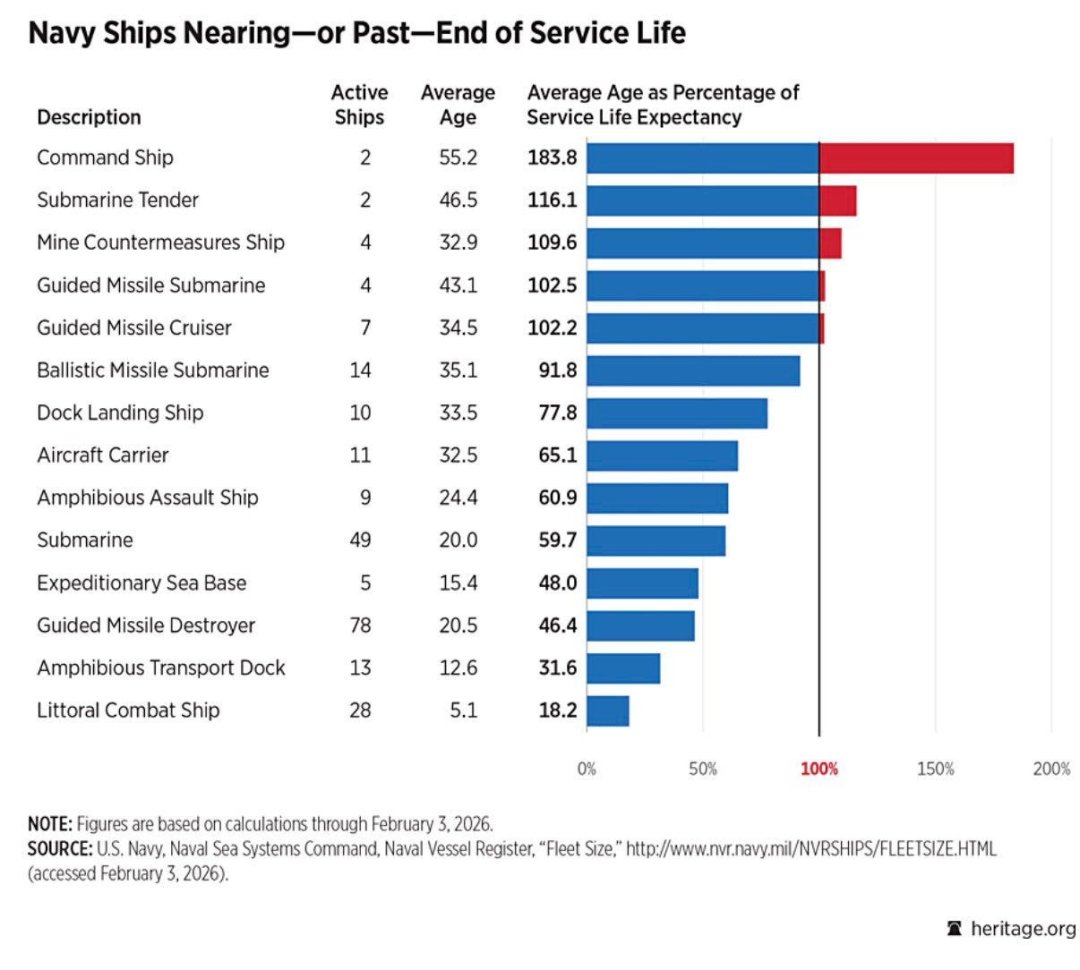
Last week we started things off with a discussion of the 18 battle force and 16 non-battle force ships. Let’s look back at that. It may have taken nine years, but there was a post of mine from 2017 that finally got a smile: On the list of "unsexy but important" are many items from icebreakers, to command ships, to hospital ships, that every POM cycle get left on the cutting room floor by the gaggle of cats chasing laser pointers we have in charge of building our fleet. When you look at the list from last Monday and the news from last summer about icebreakers, we seemed to have one ship that still is not getting the investment it needs—command ships. We’re running out of time. Even “Golden Fleet” documents that include such Salamander requirements like destroyer tenders right keep missing something that the new realities of war that we have learned in the last half-decade have shown are not a luxury, but a requirement for warfighting success—our command ships. As Brent Sadler mentioned over the weekend, Today there are only two of these ships in the Navy - the Mount Whitney (LCC 20) as 6th Fleet Flag Ship in Europe, and the Blue Ridge (LCC 19) as 7th Fleet FlagShip in Japan. … These existing flag ships have modern communications and staffs capable of running a prolonged war from sea - making it a harder target for cyber attacks, strikes and terrorist attacks - a valuable feature in modern warfare characterized by increased importance of connectivity with unmanned assets, dispersed logistics ships, and the strictest of communications requirements of frontline warships. The argument for command ships has never been stronger. In the age of precision warheads on conventional S/M/R/ICBM & the whole constellation of attack drones/cruise missiles, the utility of static shore-based higher headquarters is not just questionable; it is suicidal. We will not be given many more clear warnings as we saw over the last few months with the limited Iranian attacks against our land-based facilities in Bahrain and Saudi Arabia, just to mention two. Never forget, the Chinese have already dialed in every static U.S. military facility inside the range of their rocket forces. While there are threats to anything afloat, in today's threat environment, command ships should be many and redundant in number. Not two replacements, but four. We don't even have to design a new ship. We have the LPD-17 design ready to go as a baseline. Slight mods...and there you go. Other designs can work as well, but the LPD-17 is a proven design, hardened, and easier to add additional self-defense systems to…including anything you can put in a MK-41 VLS cell. We don’t need to continue to appreciate the problem. We don’t need multi-million to billion-dollar studies. No. We just need to accept that previous generations dithered and we will not. Heck, I even know where to get $1.85 billion from to get things started. Cut steel. Leave a comment Share This Substack is reader-supported. To receive new posts and support my work, consider becoming a free or paid subscriber. View the full article
-
Ukraine’s military intelligence directorate has published a detailed technical breakdown of a previously obscure Russian cruise missile developed specifically for the Su-57 stealth fighter, revealing not only the weapon’s architecture and capabilities but the extensive network of foreign components — American, Chinese, Swiss, Japanese, German, Taiwanese, and Irish — that made it possible to build. […]View the full article
-
Elbit Systems inaugurated a new unmanned aerial systems production facility in Chitila, Romania on April 27, 2026 — and marked the occasion by flying the Watchkeeper XR over Romanian skies for the first time, turning a ribbon-cutting into a live capability demonstration for Romanian government and military officials watching from the ground. The Chitila facility […]View the full article
-
The U.S. Navy commissioned its newest fast-attack submarine, USS Idaho, at Naval Submarine Base New London in Groton, Connecticut on April 25, 2026 — adding a boat built for undersea warfare, surveillance, and special operations to a fleet that its leadership describes as operating forward every hour of every day. The ceremony at Groton brought […]View the full article
-
Oshkosh Defense is rolling two significant platforms onto the Modern Day Marine exhibition floor this week — including an autonomous ground vehicle armed with anti-ship missiles that represents one of the Marine Corps’ most consequential doctrinal shifts in a generation. The company will exhibit at Modern Day Marine from April 28 through 30, 2026, showcasing […]View the full article
-
SummaryThis episode features Dr. Colin Dueck, with Mark and Sal, discussing the historical and strategic importance of U.S. policy towards Latin America, the evolution of the Monroe Doctrine, and current challenges and opportunities in the hemisphere. Discussion is centered on how U.S. foreign policy can shape the future of the region amid great power competition. You can listen at this link, subscribe to the podcast, or listen via the Spotify widget below. Show LinksWhy the Monroe Doctrine Still Matters, Colin Dueck Dr. Colin Dueck’s AEI page China’s Growing Influence in Latin America, Council on Foreign Relations Bolivarian Alliance for the Peoples of Our America The band The Minutemen circa 1985 Chapters00:00: Introduction to U.S. Policy in Latin America 03:08: Historical Context of U.S. Influence 06:10: The Monroe Doctrine and Its Evolution 08:49: Cold War Dynamics in Latin America 11:30: Post-Cold War Attitudes and Challenges 14:37: Recent Political Shifts in Latin America 17:22: The Rise of Conservative Governments 19:53: Crime and Governance in Latin America 23:02: Future Implications for U.S.-Latin America Relations 28:33: Revitalizing Latin America: Opportunities and Challenges 29:26: Political Dynamics in Latin America: A Regional Overview 36:00: Energy Resources: The Key to Economic Development 37:51: China’s Influence in Latin America: A Double-Edged Sword 47:03: Strategic U.S. Engagement: Priorities for the Future Dr. Colin Dueck is a nonresident senior fellow at the American Enterprise Institute, where he is focusing on the interconnection between US national security strategies and party politics, conservative ideas, and presidential leadership. He is also a professor in the Schar School of Policy and Government at George Mason University, where he is the faculty adviser for the Alexander Hamilton Society. A senior nonresident fellow at the Foreign Policy Research Institute, he has also served as a foreign policy adviser on several Republican presidential campaigns. Dr. Dueck is the author of three books on American foreign and national security policies: The Obama Doctrine: American Grand Strategy Today (Oxford University Press, 2015), Hard Line: The Republican Party and US Foreign Policy Since World War II (Princeton University Press, 2010), and Reluctant Crusaders: Power, Culture, and Change in American Grand Strategy (Princeton University Press, 2006). He has testified before Congress and has been published in academic journals and the popular press. These include International Security, Orbis, Political Science Quarterly, the Review of International Studies, Security Studies, World Policy Journal, The New York Times, Foreign Affairs, RealClearPolitics, and National Review. A Rhodes scholar, Dr. Dueck has a PhD in politics from Princeton University and an MPhil in international relations from Oxford University. He was also awarded a John M. Olin Postdoctoral Fellowship in national security studies by Harvard University. His earlier degrees in history were obtained from the University of Saskatchewan. Leave a comment Share This Substack is reader-supported. To receive new posts and support my work, consider becoming a free or paid subscriber. View the full article

-
A California defense startup brought its football-sized throw-and-fly drone to a NATO base in Romania and walked away with what its CEO described as massive interest from more than 500 senior military representatives — a significant moment for a company that formally unveiled its STUD system less than a month ago and is already racing […]View the full article
-
A California company better known for building antennas that connect aircraft to satellites has quietly entered one of the most competitive markets in defense — and at the U.S. Army’s recent Cross Domain Fires Concept Focused Warfighting Experiment, its mobile High Power Microwave system showed up mounted on a pickup truck, cued by Echodyne’s EchoShield […]View the full article
-
A Russian military helicopter went down near Wabaria in the Gao region of Mali on April 25, confirmed by Russian sources, as fighters from the Azawad Liberation Front and al-Qaeda-linked JNIM launched the largest coordinated offensive in the country in years — striking simultaneously at the capital Bamako, the military stronghold of Kati, and the […]View the full article
-
U.S. Special Operations Command published a broad industry solicitation on Friday, calling on companies, nonprofits, and research organizations to join a new technology development initiative aimed at pushing cutting-edge capabilities into the hands of special operations forces — with a particular focus on the maritime domain and the multi-domain fight that USSOCOM believes defines the […]View the full article
-
General Dynamics Land Systems quietly crossed a significant threshold this week, pulling in a $13.5 million contract modification that pushed its Abrams technical support contract past the $1 billion mark — a milestone that underscores just how much the U.S. Army spends keeping its primary battle tank operationally ready. Army Contracting Command at Detroit Arsenal […]View the full article
-
The U.S. Marine Corps awarded a $9.5 million contract to a British defense company to procure compact radio frequency jammers capable of neutralizing small drones — and the urgency language attached to the award signals that this is not routine procurement. Marine Corps System Command in Quantico, Virginia, awarded the $9,515,508 firm-fixed-price and cost reimbursement […]View the full article
-
A small California defense company just landed a $105 million Navy contract to push its Blackbeard hypersonic weapon through live fire testing in the Indo-Pacific — and the Pentagon is betting on a startup to deliver one of the most strategically critical weapon types in modern warfare. Naval Air Warfare Center Aircraft Division in Lakehurst, […]View the full article
-
The Defence Blog is publishing this statement to document a pattern of conduct by EOS Defense Systems USA, Inc. and its parent company, Electro Optic Systems (ASX: EOS), that we consider a direct affront to press freedom and independent defence journalism. On April 21, 2026, Electro Optic Systems published a press release announcing the demonstration […]View the full article
-
Poland is running operational tests of acoustic reconnaissance systems and electronic warfare equipment at the Central Air Force Proving Ground in Ustka, as the country’s Ministry of National Defense accelerates technology evaluation under its Tarcza Wschód — Shield East — border defense program. Seven acoustic reconnaissance solutions are currently undergoing testing at the Ustka range. […]View the full article
-
So, what did you do after high school? How long have you had to wait for your full story to be understood? I offer to you Teddy Sheean; On December 1, 1942, Sheean was a gunner’s mate on the corvette HMAS Armidale, when it came under attack during an operation near Japanese-occupied Timor, now the country of Timor-Leste across the Timor Sea from the Australian city of Darwin. ... ...Japanese warplanes swooped in on the Armidale. The Australian corvette was hit by two torpedoes launched by the Japanese planes and quickly began to sink, according to the AWM. An order was given to abandon ship. “Sheean was wounded and, rather than abandon ship, he strapped himself to his Oerlikon (anti-aircraft gun) and began to engage the attacking aircraft even as the ship sunk beneath him. He shot down two planes, and crewmates recall seeing tracer rising from beneath the surface as Sheean was dragged under the water, firing until the end,” the AWM says. There were 149 sailors aboard the Australian ship. Forty-nine survived and were plucked from the Timor Sea a week after the sinking. Each likely owed his life to the 18-year-old gunner’s mate, according to an expert panel established in June of this year to adjudge Sheean’s case. Eventually, all gets settled. ...on Wednesday, almost 78 years after the then 18-year-old sailor provided cover for his comrades to escape the Japanese planes overhead, Sheean was posthumously awarded the Victoria Cross, the British Commonwealth’s highest honor for military valor. The distance they fought from Darwin is about the same distance as from Norfolk, VA to Boston, MA. Of note, Teddy’s ship, HMAS Armidale, was commissioned a little under 6-months when she went down. Total war at sea demands and consumes at rates our modern minds have trouble grasping. Share Leave a comment This Substack is reader-supported. To receive new posts and support my work, consider becoming a free or paid subscriber. View the full article

-
Estonian-based Frankenburg Technologies has released footage of its Mark I missile undergoing ground test firings in an air-to-air system configuration. The test campaign focuses on risk reduction across three specific technical challenges: rail and pylon configuration, safe separation from the launch platform, and the missile’s transition to stable flight after release. All three are critical […]View the full article
-
Hyundai Rotem delivered the best first quarter in its history on April 24, 2026, reporting total sales of approximately $983 million — up 23.9 percent year-over-year — driven by a surging defense business that posted a 27.2 percent operating margin and propelled the company to a credit rating upgrade across all three major agencies. The […]View the full article
-
Rolls-Royce has secured the propulsion contract for Australia’s new general-purpose frigate fleet, with the Royal Australian Navy confirming the MT30 marine gas turbine will power up to 11 ships based on Japan’s upgraded Mogami-class design. The selection follows Australia’s earlier decision to procure the upgraded Mogami-class frigate as its general-purpose naval frigate replacement. Japan’s Mogami-class […]View the full article
-
Babcock International is moving to position itself as the prime contractor for the British Army’s next generation of light utility vehicles, bringing together approximately 30 UK suppliers at a formal engagement event as it pitches its Toyota-based General Logistics Vehicle to replace the Land Rover fleet after 70 years of service. Babcock convened the suppliers […]View the full article
-
The commander of Ukraine’s Unmanned Systems Forces publicly accused domestic warhead manufacturers of delivering substandard products that are forcing frontline units to expend far more drones than necessary to destroy a single target — and he used a real combat operation to prove it. Robert Brovdi, call sign “Madyar,” commander of the Unmanned Systems Forces […]View the full article
-
Boeing reported first-quarter 2026 revenue of $22.2 billion on April 22 — a 14 percent jump from a year ago — but the aerospace giant remained unprofitable, posting a net loss of $7 million even as its defense business delivered its strongest quarterly performance in years. The results cover the three months ended March 31, […]View the full article
-
Lockheed Martin opened 2026 with flat revenue but a notable earnings drop, reporting first-quarter sales of $18.0 billion and net earnings of $1.5 billion — down from $1.7 billion in the same period a year ago — as production problems on the F-16 and CH-53K programs weighed on results across two of its four business […]View the full article