HG S2 (Intel Bot)
Members
-
Joined
-
Last visited
Never
Everything posted by HG S2 (Intel Bot)
-
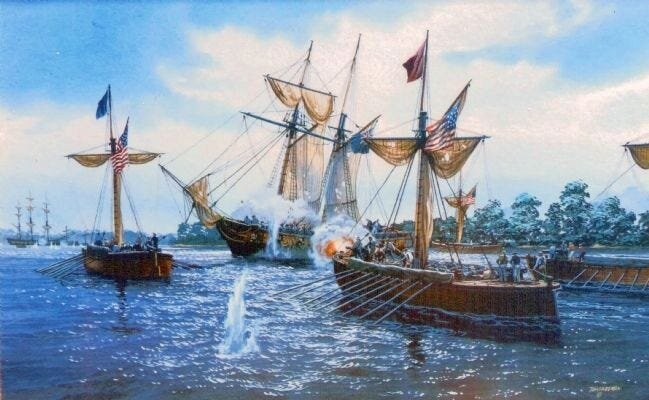
Do you always fight to win at all costs? When do you retreat? If you find yourself in Maryland, you are surrounded by the War of 1812, and you may not even know it. A few years ago, this got my attention, Aboard a pontoon boat chugging past the marshland of Maryland’s upper Patuxent River on a recent Saturday, Ralph Eshelman pointed to the spot where the muddy brown water hides a shipwreck nearly two centuries old, part of the American flotilla that defended the Chesapeake Bay when the British burned Washington during the War of 1812. That only hints at the story. Before we get to the war story, let’s look at the man - and the questions his story asks. When do you stop serving your nation? When your nation is in peril - is any job beneath you? Do you have an idea that can take your “low” position - and make it great? How flexible are your Sailors? How flexible is your leadership? Background, During the Revolutionary War, Barney became the youngest Commander of a Continental Navy frigate. Tales of his capture by the British and his daring escape were well known. After the defeat of England in America, Barney traveled to Paris to deliver peace documents to Benjamin Franklin. While in France, he was introduced at court and met Marie Antoinette. In 1795, he accepted a position as commander for the French Navy which he held for five years before returning to his home in Maryland. In 1812, Joshua Barney was fifty-three years old and living in Elk Ridge, Maryland. Because of his previous service to France, Barney was not allowed a leading position in the U.S. Navy, but accepted command of the schooner Rossie. ....and so a great man gets to work for his nation. By December of 1812, the Royal Navy was raging across the Tidewater region blockading towns, looting and plundering. The Chesapeake and Delaware Bays were blockaded. The first defeat the British suffered was at the mouth of the Elizabeth River in Virginia when they failed to take Norfolk, but their wrath was so great they sacked the city of Hampton for revenge. As the British invaded the Eastern Shore, the American army was concentrated in Canada and the strategic Chesapeake was relatively undefended. Although something had to be done, America’s forces had few reinforcements and little money. In response, Joshua Barney designed a plan entitled “Defense of the Chesapeake,” and submitted it to President Madison. The detailed plan included sketches of gunboats similar to barges, with oars, light sails and one large gun. The small, quick barges, manned by local men would be tricky targets, could keep watch over the enemy and sail into the shallow Chesapeake waters where the larger British gunboats would not dare enter. They were relatively inexpensive to construct, and Barney believed the barges could be sold after the war for commercial use. In August 1813, Barney was appointed commander of the Chesapeake Flotilla and local shipyards began constructing the barges. Bounties were offered to entice men who would otherwise continue to privateer to enlist. News of the flotilla spread quickly and the British began constructing their own barges on Tangier Island. Although stymied by a shortage of men and supplies, Barney’s Chesapeake Flotilla with seven 75’ barges, six 50’ barges, two gunboats, one row galley, one lookout boat and the flagship Scorpion set sail in April 1814 investigate the Potomac and check any defects in the flotilla. Note the nature of his vessels. Do you see the seed of the PT boat? The PGM? Dare I say - irregular warfare - littoral warfare? Nothing is new, only the people and the tools they use are. With eighteen ships and barely a month’s supplies, the flotilla sailed from Baltimore on their first mission, to attack Tangier Island and destroy the British barge fleet under construction. Like all able commanders, Barney adjusted his tactics to his terrain and his strength, becoming a waterborne gadfly. Obviously he could not challenge Cockburn’s heavyweights ship-for-ship. But he knew the Chesapeake: its deep water, its shoals, its numerous shallow creeks and estuaries into which he could fly for safety. So he buzzed, rather than assaulted, the enemy; waiting until a likely victim came too close to his watery sanctuaries, whereupon his flotilla, led by his appropriately named flagship, the sloop-of-war USS Scorpion, mounting eight carronades and one long gun, plus a furnace for heating shot, would sally forth to inflict damage on them. He never hoped to sink them, but he did make Sir George pay attention. On June first the flotilla encountered the British schooner, HMS St. Lawrence and her seven boats, between the mouths of the Potomac and Patuxent Rivers near Cedar Point. The flotilla pursued, firing away, until the beleaguered schooner came under the protection of the huge 74-gun line-of-battle ship HMS Dragon. When Dragon’s big guns opened up, Barney’s gunboats put about and ran for shallow water with the British ship lumbering in futile pursuit. This spirited engagement was known as the Battle of Cedar Point. Because of Barney, Cock burn’s hopes of renewing in 1814 the pillage of the previous year were frustrated, and instead of repeating such atrocities as he had inflicted on the town of Havre de Grace, Maryland, he was reduced to pig-sticking and tobacco-pilfering operations. Thus began a series of darting attacks, retreats and tardy reinforcements, evident on both sides, that ultimately locked the entire Chesapeake Flotilla within the confines of the Patuxent River. But this story is not without its moments of sheer terror, true leadership, frustrations and small victories that proved the men, and their Commodore, to be some of the great American heroes of the War of 1812. “The bravery of the 500 flotillamen and marines was proven time and again as they turned back wave after wave of the numerically superior foe seeking to destroy it ...” says the introduction to Flotilla Battle for the Patuxent. ... On June 7th .... The British Commander Barrie of the HMS Dragon blockaded the mouth of the Patuxent and waited for reinforcements from the eighteen gun Jaseur and the thirty-eight gun HMS Loire. Barney continued to retreat up river and landed on the shores of St. Leonard’s Creek. Outgunned by more than four to one, Barney had little hope for victory. But, the shallow waters of St. Leonard’s Creek and the surrounding high grounds were an excellent location to mount a defense. ... The mouth of the creek was blockaded by two British frigates, HMS Loire of 38 guns and HMS Narcissus of 32 guns, plus the sloop-of-war, HMS Jasseur of 18 guns. For three days the British Navy launched wave after wave of assaults against the U.S. forces, often employing Congreve rockets to destroy the flotilla, but the Commodore and his men stood fast. On each occasion the British boats came up until they caught sight of Barney’s flotilla, and were promptly chased off by the Americans, who took care, however, not to meddle with the larger vessels. Colonel Wadsworth, commanding a force of American artillery on shore, offered to cooperate from the shore while Barney assailed the two frigates with the flotilla. Assisted by a force of U.S. Marines, commanded by Captain Miller, the joint attack took place most successfully on June 26th. The Loire and Narcissus were driven off, although not much damaged, and the flotilla rowed out in triumph into the Patuxent. In mid-August, arrival of a large portion of the Royal Naval fleet commanded by Admiral Cock burn, and four thousand veteran soldiers of “Wellington’s Invincibles” under Major General Robert Ross, made their appearance in the Chesapeake, escalating an already desperate situation. The District of Columbia formed a part of the Fourth Military District, in which the effective troops, under Brigadier General William H. Winder, numbered about two thousand, scattered over widely separated points, some as far away as Nor folk. A company of the Marines was at the barracks in Washington, and a company of Artillery in Fort Washington. General Winder had warned the government that imminent peril threatened and had asked for troops with which to meet it, but it seemed impossible to convince the authorities that he was right, or that any circumstances could arise that would place the capital in peril. General Winder was personally convinced that Annapolis was the real British objective, but most other military and government officials believed that Baltimore must be where the British troops were heading. Commodore Barney moved his flotilla up the Patuxent as far as Nottingham, about 40 miles from Washington, where he reported to the Navy Department that the enemy had entered and were ascending the river. “The British are in the Patuxent,” Commodore Barney wrote Navy Secretary Jones on Friday, the 19th. The Admiral, he was told, planned to destroy Barney’s flotilla and “dine in Washington on Sunday.” The orders of Secretary Jones were to run the flotilla as far up the river as possible, and upon the enemy landing, to destroy it and march to join General Winder. On August 19th and 20th the British invasion forces landed at Benedict, Maryland and directed the march of their forces upon Washington on the 21st, following the Patuxent River both by water and by land. The advancing British troops numbered five thousand, including one thousand Royal Marines. Following his orders, the Commodore retreated upriver to about five miles north of Pig Point. There he landed with four hundred men, leaving about a hundred men to blow up the flotilla. On the morning of August 22nd the British were astounded to see an orderly line of American row galleys and merchant ships extending before them upriver, blown up in quick succession. More than sixteen ships of the Chesapeake Flotilla sank in the Patuxent within a few minutes. General Winder’s militia were scattered here and there, and when it became known that a large land and naval force had landed at Benedict, only a small body of men were at hand to checkmate the movement, and General Winder had slight confidence in them. The General found himself with five hundred regulars and two thousand undisciplined militia -- mostly farmers, many armed only with shot-guns. Learning on the 22nd that the British had camped the previous night at Nottingham, General Winder began to believe that they might indeed be heading for Washington rather than Baltimore or Annapolis. But he sent orders to his various military units to wait at various “half-way points,” in order to ensure at least some defense at each possible objective. The General knew that a sizable British naval force was proceeding up the Potomac, and feared that they would be joined by the British troops to attack Fort Washington, an easy march directly west from Nottingham. Attacking across the bridge over the Eastern Branch of the Potomac at Bladensburg seemed a fairly remote possibility. The General’s scouts continued to report on the activities of the British, now in Upper Marlboro. One report said they were on the road to Annapolis; another that they were heading for Fort Washing-ton; another that they were again on the road to wards Bladensburg. At 10 AM the morning of August 24th, a scout came galloping in with news that the British had been marching for Bladensburg since dawn and were nearly halfway there! ... Commodore Barney’s little force of five hundred flotillamen proceeded by forced march to Bladensburg, accompanied by Captain Samuel Miller and 120 U.S. Marines, and five pieces of heavy artillery from his flotilla and from the Washington Navy Yard. Following were two ammunition wagons which he had hastily procured. General Winder had drawn up his forces to cover the road for some distance west of town, on the west bank of the eastern branch of the Potomac, in a fine position to defend the bridge over which the British must pass. President Madison, Secretary of War General Armstrong, and Secretary of State James Monroe were also there, but they hindered far more than they helped by giving conflicting orders. Arriving at 1 PM, at the same time the British had begun attacking General Winder’s forward line, he arranged his artillery in battery at the center of the second line position on the west bank of the eastern branch of the Potomac. The Commodore himself directed the artillery (2 eighteens and 3 twelve-pounder ship’s guns mounted on carriages), while Captain Miller of the Marines commanded the rest of the force -- 120 Marines and 370 flotillamen armed as infantry. As at Bunker Hill, the two first attacks of the British were bloodily repulsed, chiefly by Barney’s guns. By his own account, “At length the enemy made his appearance on the main road in force and in front of my battery, and on seeing us made a halt. I reserved our fire. In a few minutes the enemy again advanced, when I ordered an 18-pounder to be fired, which completely cleared the road. Shortly after, a second and a third attempt was made by the enemy to come forward, but all were destroyed. They then crossed over into an open field, and attempted to flank our right. He was met there by three 12-pounders, and Marines under Captain Miller, and my men acting as infantry, and again was totally cut up. By this time not a vestige of the American army remained, except a body of five or six hundred posted on a height on my right, from which I expected much support from their fine position.” As the British attempted their flanking movement, the Commodore ordered Captain Miller and the flotillamen-infantry to charge, while he poured a destructive fire upon their flank. The charge was executed with great celerity and determination; the veterans of the 86th and 4th -- the “King’s Own Regiment” -- giving way before it, pursued by their assailants, the sailors crying out to “board `em.” They were driven back to a wooded ravine 3, leaving several of their wounded officers in the hands of the Americans. Colonel William Thornton, who bravely led the attacking British column, was severely wounded, and General Ross had his horse shot under him. It would have been well for the honor of America if all who were present on that day had behaved with the same decision and effect as Commodore Barney and his command. Their heroic resistance saved the combat at Bladensburg from being an unqualified disgrace to American arms. “It was a magnificent stand; the slightest follow-up of Barney’s counterattack might have produced an American victory. As it was, the road to Washington now lay open.” But while they were sustaining the credit of their country, the other troops had disappeared, and in the confusion of their retreat, the wagons containing the ammunition for the cannon and small arms had been carried off. The British light troops acting en tirailleur had, in consequence of the total absence of any support, gained positions on his flanks near enough to produce effect with their fire, and to wound and kill several of his best officers. Captain Miller had been wounded in charging the enemy; and Commodore Barney himself, after having had his horse killed under him, received a musket ball in the thigh. The force of the enemy was constantly increasing, for the lack of ammunition for Barney’s artillery ended the only effective resistance to the British advance. When it became evident that a reinforcing column of Virginia militia could not arrive in time to aid the gallant flotillamen, who were obstinately maintaining their position against fearful odds, and that further resistance would be useless, General Winder ordered a general retreat. The retreat order was never passed to Barney’s command, but with no ammunition, flanked on the right and deserted on the left, the Commodore knew that the end had come. He ordered the guns spiked and the men to retreat. The officers and men who were able to march effected the retreat in excellent order; but the Commodore’s wound rendered him unable to move, and he was made prisoner. General Ross, who had lost nearly three hundred men before getting across the river, gave great attention and care to the wounded Commodore; he so admired the bravery of the “blue-jackets” that he paroled all the flotillamen, including the Commodore, on the spot. The General ordered that he be taken at once into the city and his wounds treated. That is leadership. I took a lot of text, from here and here, but that story needed to be read without interruption. If this doesn’t get you going - I don’t know what will. Want to know what is behind the phrase, “Finest traditions of the Naval Service?” That should help. A friendly note: we have not had a USS Barney since 1992. …and never forget. As I always say: you are irreplaceable until you leave; then you are forgotten. You may love your nation, but that does not mean it loves you. Joshua Barney returned to his home in Anne Arundel County and began petitioning Congress for compensation for his men. The wound he received at the Battle of Bladensburg was a bullet deep in his thigh which could not bq removed and which he lived with for three years before it caused a fever that caused his death on December 1, 1818. This Substack is reader-supported. To receive new posts and support my work, consider becoming a free or paid subscriber. Share Leave a comment View the full article
-
AM General, the maker of the legendary Humvee, says it will spotlight the agility and lethality of its light-force portfolio at the Association of the U.S. Army (AUSA) Annual Meeting, Oct. 13–15, at the Walter E. Washington Convention Center. The company plans to show the restyled Hawkeye 105mm Mobile Howitzer System, the new and recently […] The post Humvee maker offers new pickup for U.S. troops first appeared on Defence Blog.View the full article
-
At the People’s Liberation Army Air Force’s “Anti-Uncontested Front-2025” maker competition in Xi’an, Chinese developers publicly displayed a new family of interceptor drones intended to counter hostile reconnaissance and strike unmanned aerial systems, event coverage shows. The unmanned interceptors were presented as a lower-cost, more flexible alternative to traditional air-defence systems and appear aimed at […] The post China copies Ukrainian drone interceptors first appeared on Defence Blog.View the full article
-
Epirus unveiled a new high-power microwave counter-drone system mounted on a tracked robotic vehicle ahead of its formal debut at AUSA in Washington, the company said, presenting the combination as a mobile, software-defined option for defending bases and forces against swarming drones. “Introducing Leonidas Autonomous Robotic, powered by GDLS TRX: a mobile counter-UAS capability featuring […] The post Epirus unveils robotic Leonidas microwave weapon first appeared on Defence Blog.View the full article
-
U.S. Soldiers from the Multi-Purpose Company, 1st Battalion, 502nd Infantry Regiment, 2nd Mobile Brigade Combat Team, 101st Airborne Division (Air Assault) are field-testing an improvised, 3D-printed munition dropper dubbed the Widowmaker during Combined Resolve 26-1, the unit said. Mounted on a PDW C100 drone platform, the device is being evaluated for its ability to deliver […] The post U.S. troops test 3D-printed munition dropper for drones first appeared on Defence Blog.View the full article
-
China’s Ministry of National Defense announced that the Chinese and Saudi Arabian navies will conduct a joint naval exercise, “Blue Sword-2025,” in Saudi Arabia later this month. At a press briefing on Oct. 10, Senior Colonel Jiang Bin, Deputy Director of the Information Bureau of China’s Ministry of National Defense and ministry spokesperson, said the […] The post China, Saudi Arabia to hold joint naval drills first appeared on Defence Blog.View the full article
-
Japan’s Ministry of Defense announced on Oct. 7 that it has signed two major contracts with Mitsubishi Heavy Industries to begin mass production of a new submarine-launched cruise missile and a ship-launched, extended-range variant of the Type 12 anti-ship missile. The ministry said the first contract, signed Sept. 1 and valued at roughly ¥2.9 billion […] The post Japan develops 1,500 km-range submarine-launched missile first appeared on Defence Blog.View the full article
-
Japan’s Defense Minister Gen Nakatani announced on October 10 that the Japan Ground Self-Defense Force (JGSDF) will dispatch two instructors to Lithuania to provide landmine clearance training for Ukrainian personnel. The move represents Japan’s first activity under the framework it joined in 2023 to support Ukraine. In a press conference, Nakatani said the initiative aims […] The post Japan sends military instructors to train Ukrainian soldiers first appeared on Defence Blog.View the full article
-
Japan’s Ground Self-Defense Force (JGSDF) has begun testing two foreign-made unmanned ground vehicles (UGVs) as part of its effort to enhance unmanned defense capabilities under its ongoing initiative for the “Fundamental Reinforcement of Japan’s Defense Capabilities.” According to an official post published by the JGSDF on October 3, 2025, the service is currently evaluating the […] The post Japanese military evaluates foreign robotic vehicles first appeared on Defence Blog.View the full article
-
Germany’s Bundestag Budget Committee has approved a multi-project defense package to equip the Bundeswehr’s Special Forces with new air-transportable light combat vehicles, mid-range operational boats, and high-frequency radios. The acquisitions aim to strengthen the mobility, communication, and maritime capability of Germany’s elite units, according to hartpunkt. Both the Budget Committee and the Defense Committee endorsed […] The post Germany approves new FTS/IAI ZD vehicles for Special Forces first appeared on Defence Blog.View the full article
-
Taiwan will construct a dome-like air defense network to strengthen its protection against “hostile threats,” President William Lai announced Friday, describing the system as a national security priority amid rising military pressure from China. Lai, speaking during Taiwan’s National Day, stopped short of naming China directly. But the statement came just one day after Taipei’s […] The post Taiwan announces “T-Dome” defense shield first appeared on Defence Blog.View the full article
-
From the better-late-than-never file: after waiting for well over a decade, this is simply the correct call here. U.S. President Donald Trump and Finnish counterpart Alexander Stubb will meet on Thursday at the White House to sign a pact for the U.S. Coast Guard to buy up to four icebreaker ships from Finnish shipyards, the White House and Stubb said. … A White House official earlier said Trump would sign a memorandum of understanding with Finland to build four “Arctic security cutters” at shipyards in Finland, calling the plan a national security necessity to permit foreign construction. … The 11 Arctic security cutters - new medium icebreakers to be used by the U.S. Coast Guard - are expected to cost about $6.1 billion, the official said. Three of the ships will be built by Davie in Galveston, Texas, and four will be built by Bollinger Shipyards in Houma, Louisiana, the official said. The aim is for the first icebreaker to be delivered by 2028. The official said the deals would result in billions of dollars of new investment in the U.S. maritime industrial base and add thousands of skilled trades jobs for Americans. The Coast Guard’s operational polar fleet currently includes only two operational Arctic security cutters, the official said. Here’s an overview of the design. My primary critique here is that they are poorly armed. They need to be at least wired for SeaRAM and at least four ASCM. That 25mm should be 57mm or 76mm. I have no idea if that is even possible in this design. I’ll let the engineers tell me. Make no mistake, the Russian and Chinese Arctic ships in the case of war will come out shooting—and are armed to do so. I would hope this flush of icebreakers will cause a fresh look at opening up a base at Nome, AK, as we have been calling for over the last decade. If you tilted your head a bit at what Davie has planned, there’s great summary over at gCaptain. The American Icebreaker Factory is being developed in collaboration with Pearlson, a Florida-based leader in shipyard design and program management, whose portfolio includes work for BAE Systems, Austal USA, and Fincantieri Marinette. The initiative aligns with current U.S. administration priorities, including the executive order on Restoring American Maritime Dominance and the recently-reintroduced SHIPS for America Act. … Once contracts are secured, Davie Defense anticipates supporting over 2,000 direct jobs at Gulf Copper and more than 7,000 statewide, with a total projected economic impact exceeding $9 billion, according to an independent study by Impact Data Source. Davie has viewed establishing local shipbuilding capacity as critical to securing the Arctic Security Cutter contract as it competes with a newly established consortium lead by Louisiana-based Bollinger Shipyards. Bollinger recently joined forces with Rauma Shipyards of Finland, Seaspan Shipyards of Canada, and Aker Arctic Technology Inc. to form a strategic partnership aimed at building the next generation icebreaker. The urgency of the project is underscored by the current shortfall in U.S. polar icebreaking capacity compared to adversaries like Russia and China. The U.S. currently operates just three polar icebreakers, with the flagship Polar Security Cutter still undelivered. In contrast, Russia has a fleet of over 40 polar icebreakers, and China is rapidly expanding its own fleet. This should be a low-risk program. Keep your fingers crossed and remember, Peter Rybski’s Substack is your one-stop shop for this program. Subscribe to keep up. Leave a comment Share This Substack is reader-supported. To receive new posts and support my work, consider becoming a free or paid subscriber. View the full article

-
A Kremlin-linked media outlet has published rare footage reportedly showing a Russian air-defense drone intercepting and destroying a Ukrainian long-range loitering one-way attack drone, best known as a kamikaze drone. The interception highlights a new layer in Russia’s evolving counter-drone strategy amid continued long-range strikes by Ukraine. The video shows the downing of two different Ukrainian drones: one […] The post Russian drones shoot down Ukrainian “kamikazes” first appeared on Defence Blog.View the full article
-
Hacker group Black Mirror has released a new cache of intercepted internal documents allegedly tied to Russia’s state defense conglomerate Rostec, including never-before-seen photographs of the assembly and testing process for the 1RL257 Krasukha-4 electronic warfare system. The materials appear to be part of a formal production report created for a foreign customer—possibly Serbia—and provide […] The post Leak reveals production photos of Russia’s secret EW system first appeared on Defence Blog.View the full article
-
A new leak by the hacker group Black Mirror has exposed internal Russian documents detailing persistent technical problems with the Zhuk-ME radar system installed on the Indian Navy’s MiG-29K and MiG-29KUB carrier-based fighter jets. The document — titled “Report on the Reliability and Performance of the Zhuk-ME Radar in MiG-29K/KUB Aircraft of the Indian Navy” […] The post Leak exposes radar failures in India’s MiG-29K fighters first appeared on Defence Blog.View the full article
-
AimLock, a developer of autonomous targeting and engagement systems, announced a new partnership with Overland AI, the leading provider of ground autonomy for defense, to integrate AimLock’s systems into Overland’s ULTRA autonomous ground vehicle. The collaboration aims to deliver modular, multi-mission capabilities for the modern battlefield using a human-in-the-loop approach. According to the companies, the […] The post U.S. companies unite to bring AI targeting to future combat vehicles first appeared on Defence Blog.View the full article
-
Raytheon, an RTX business, has been chosen by the German government to supply its SPY-6(V)1 radar system for installation on eight F127-class frigates, under a proposed foreign military sales contract with the U.S. Navy. The deal would make Germany the first international customer for Raytheon’s SPY-6 radar, the cornerstone of the U.S. Navy’s next-generation air […] The post Germany to equip new frigates with Raytheon’s SPY-6 radar first appeared on Defence Blog.View the full article
-
Show LinksIan Ellis’s outline of Caribbean U.S. Navy deployment The Melting Point: High Command and War in the 21st Century, by Kenneth F. McKenzie SummaryIn this conversation, Sal discusses various geopolitical issues, including a potential peace deal in Israel and Gaza, the implications of Iran’s weakened position, reflections on General McKenzie’s book… Read more View the full article
-
Rightfully, over the last week there’s been a fair bit of chatter about TLAM going to Ukraine. The United States is considering Ukraine’s request to obtain long-range Tomahawk missiles for its effort to push back against Russian invaders, Vice President JD Vance said on Sunday. Ukrainian President Volodymyr Zelenskiy has asked the United States to sell Tomahawks to European nations that would send them to Ukraine. Vance said on “Fox News Sunday” that U.S. President Donald Trump would make the “final determination” on whether to allow the deal. ISW, where the above graphic came from, had a solid thread over at X on the implications, but it could use a little bit of a wet blanket. ISW assesses that there are at least 1,945 Russian military objects within range of the 2,500-kilometer variant Tomahawk and at least 1,655 within range of the 1,600-kilometer variant. Ukraine likely can significantly degrade Russia’s frontline battlefield performance by targeting a vulnerable subset of rear support areas that sustain and support Russia’s frontline operations. As an old TLAM fella, I can’t let this stand. Let me give everyone an opportunity to take a deep breath and relax. First of all, Europe has not seen a Western Ground Launched Cruise Missile (GLCM) since the Cold War nuclear-armed Gryphon. That disappeared decades ago. We never had a conventional GLCM then or until very recently. TLAM of any tactical utility is a sea-based weapon, for now. We are only now getting in the GLCM game with the U.S. Army’s Typhon system we covered a bit over a year ago. In summary, you get four MK-41 VLS cells like you have on Navy ships in a shipping container. A battery has four of them, but 16 missiles total. We are building them as fast as we can for our Army, but Germany wants some, so does the Philippines, and maybe the USMC as well. The only way Ukraine could even hope to get a single battery would be if the next one set for the U.S. was diverted to them. Whenever that will be. My great TLAM day was over a quarter century ago when we disgorged well over 300 TLAM during Desert Fox. Trust me on this: 16 TLAM will not make a tactical impact in the Russo-Ukrainian War…however… What sending TLAM to Ukraine will do is strategic. Yes, Ukraine will be able to strike a few significant targets deeper. Expanding attacks on oil/gas industry for example. It will cause Russia to defend more strategically important targets. That isn’t nothing. The substantial impact will be in underlining the course of action towards Russia we’ve talked about all year. If every effort the Trump administration can make will not bring Russia to the table in good faith, then the only option is to further back Ukraine in her fight. There are few other weapons still not provided to Ukraine. TLAM would be the next step…but as a messaging effort more than anything else. It has to be. We don’t produce enough TLAM for our own needs. We can only send a token number to Ukraine. One does not simply become a TLAM operator. There is A LOT of support and infrastructure that comes with being able to operate TLAM. From mission building teams, to software, hardware, and not to mention the crews to plan and execute the mission. At a standstill, leveraging Ukrainian forces trained in other missile systems such as Neptune, you might be able to have a team ready in, what, six months? We do not have warehouses full of Typhon to give away, as mentioned above. Tactically, Russia’s deep targets are safe from TLAM. In a year, maybe some will be in danger. A year is a long time at war…but here’s a funny thing. What if smart people in hard jobs have already started the process of getting Ukraine ready to receive TLAM via Typhon months ago, just waiting for CINC to give the green light? In that case, what if they rolled off the ramps of C-17s in Ukraine on Halloween? Interesting times, friends. Interesting times. Leave a comment Share This Substack is reader-supported. To receive new posts and support my work, consider becoming a free or paid subscriber. View the full article

-
The United States Space Force has released a Request for Prototype Proposal (RPP) for its Space-Based Interceptor (SBI) program. The solicitation was issued by Space Systems Command’s Space Combat Power Program Executive Office and seeks multiple industry partners to design and deliver prototype interceptor systems. According to the Department of War, the awards will be […] The post U.S. Space Force launches competition for space-based interceptor first appeared on Defence Blog.View the full article
-
China’s hypersonic ambitions are taking shape in new ways as Lingkong Tianxing Aerospace marked its seventh anniversary with a promotional video highlighting several of its ongoing advanced projects — including next-generation hypersonic missiles and a high-speed aircraft designed to operate in near-space. The video, shared this week by the company, includes multiple glimpses of prototype […] The post China moves closer to operational hypersonic capability first appeared on Defence Blog.View the full article
-
Russia’s once-deep reserves of armored vehicles are shrinking rapidly, with new open-source assessments showing dramatic reductions in stored tanks, infantry fighting vehicles, and artillery systems since the start of the full-scale war in Ukraine. Yet analysts caution that the data should not be interpreted as evidence that Moscow has run out of equipment altogether. OSINT […] The post OSINT data shows Russia’s tank reserves shrinking but far from exhausted first appeared on Defence Blog.View the full article
-
U.S. soldiers from the 1-16th Infantry Regiment, 1st Armored Brigade Combat Team, 1st Infantry Division carried out live-fire exercises in Bulgaria from September 29 to October 5, 2025, conducting a week of intensive training with Abrams tanks aimed at enhancing precision, maneuvering, and team effectiveness on the battlefield. The training focused on engaging tactical targets […] The post U.S. Abrams crews sharpen skills in Bulgaria live-fire drills first appeared on Defence Blog.View the full article
-
The U.S. Air Force has acquired the wreckage of a downed UH-1 Iroquois helicopter and transported the iconic airframe to Dyess Air Force Base, Texas, where it will serve as a hands-on teaching platform for accident investigation and flight safety courses. The helicopter, nicknamed “Huey,” crashed during a training mission at the Wyoming Air National […] The post U.S. Air Force buys crashed UH-1 helicopter first appeared on Defence Blog.View the full article
-
Pentagon’s No.1 weapons supplier Lockheed Martinis rapidly expanding production of some of the most critical missile and launcher systems in the U.S. arsenal — from PAC-3 and GMLRS to HIMARS, Javelin, PrSM, and JASSM/LRASM — as demand for precision strike capabilities grows amid rising global security challenges. The company said the scaling effort reflects both […] The post U.S. missile production surges as Lockheed ramps up for future wars first appeared on Defence Blog.View the full article