HG S2 (Intel Bot)
Members
-
Joined
-
Last visited
Never
Everything posted by HG S2 (Intel Bot)
-
Russia carried out another large-scale missile strike against Ukraine overnight on October 3, employing a new tactic that relied heavily on ground-launched cruise missiles from the Iskander system rather than its usual air- or sea-launched weapons, according to a report from the Air Force of Ukraine. The Ukrainian Air Force said that during the assault, […] The post Ukraine hit by wave of ground-launched Iskander cruise missiles first appeared on Defence Blog.View the full article
-
The Ukrainian-made Inguar-3 armored vehicle has once again proven its durability on the battlefield, withstanding a coordinated ambush and multiple drone strikes while keeping its crew alive. According to Ukrainian troops, the vehicle came under attack after being caught in an ambush and targeted by three optic-controlled FPV drones in rapid succession. Despite the precision […] The post Ukraine’s next-gen armored vehicle withstands triple drone attack first appeared on Defence Blog.View the full article
-
Regulars here know I am a big supporter of the underdog, and in naval warfare few things are more of an underdog than Mine Warfare (MIW). Effective, deadly, affordable, and few things will terrify a ship faster than its crew yelling “MINE”! Forgotten and neglected in peace, absolutely devastating at war. Regulars also know that I love nothing more than dragging the Littoral Combat Ship (LCS), AKA Little Crappy Ship (as popularized on this blog two decades ago) around. Where do they intersect where the former negates the latter? Friend to the blog, guest and occasional guest host for the Midrats Podcast, MIW SME, and altogether hail-fellow-well-met Matthew Hipple’s recent article, LCS Stands for ‘Let’s Close Sea-lanes’, out in the latest edition of Proceedings. He covers a variety of ideas, but his answer for the yawning capability gap for minelayers by leveraging a few advantages the Independence Class LCS have…got my attention, especially because he’s been thinking about the same challenge I was pondering this summer: Taiwan. In a conflict in the western Pacific, the U.S. Navy needs more options to trap China’s numerically superior maritime forces within the hellscape from Tsushima to the South China Sea. More effective tools for closing sea-lanes and airspace in the littorals would free resources for elsewhere. Novel weapons are necessary but insufficient. A platform dedicated to sea denial is needed. … The warehouse-size mission bay with already billeted minemen and a two-deck-high stern door could host new mine-laying and mine-storage systems. In 2020, Denmark’s SH Defence introduced the Cube System, a universal conex box mounting for mission systems, including mine laying and connectible mine-feeding systems. A single Cube mine feeder magazine could hold about 50 bottom mines or 30 moored mines. Any fight in the Western Pacific will be an all hands effort. As I have said for two decades in my critique of LCS, don’t tell me “She won’t be asked to…”. No. We don’t have a large enough Navy to have the luxury of not sending our ships into harm’s way or invest Sailors, fuel, and time with ships that cannot bring the fight to the enemy. LCS will be put in the fight. If there are ways we can leverage her good aspects, like speed and “square footage”, then we would be adding error on top of error not to make the best of her. Eventually smart people would find a way to get a return on our investment in LCS. Matthew has better ideas than most. Tip of the hat as well for pointing eyes towards The Cube. The Cube is about more than MIW. Real interesting video. Final little Easter Egg for everyone. In case you missed it, one of the best openings of a military film involved offensive minelaying, in the 2008 Russian film, Admiral. Share Leave a comment This Substack is reader-supported. To receive new posts and support my work, consider becoming a free or paid subscriber. View the full article

-
Ukraine and the United States have held a new round of technical discussions aimed at advancing a long-term agreement for the procurement and production of Ukrainian-made drones, according to a report from Militarnyi. A Ukrainian delegation, which included representatives from the Ministry of Defense and the National Security and Defense Council, traveled to the United […] The post U.S. and Ukraine move closer to landmark drone deal first appeared on Defence Blog.View the full article
-
Cyprus’ National Guard has unveiled its newly acquired Tamnava multiple launch rocket system (MLRS) for the first time during a recent military parade. Developed by Serbia’s state-owned defense company Yugoimport, the Tamnava is a self-propelled, modular system capable of launching both 122mm Grad and 262mm rockets. According to Yugoimport, the Tamnava MLRS was designed as […] The post New Serbian rocket system debuts in Cyprus first appeared on Defence Blog.View the full article
-
The U.S. Army has awarded FN America, LLC a $2 million Prototype Project Opportunity Notice (PPON) contract to further develop its Precision Grenadier System — a next-generation soldier weapon designed to deliver greater precision and lethality than current grenade launchers. According to the company, the FN Multi-purpose Tactical Launcher 30mm (MTL-30) will be designed in […] The post U.S. Army taps FN America for next-gen grenade launcher first appeared on Defence Blog.View the full article
-
France’s Directorate General of Armaments (DGA) has taken delivery of the Airbus H160 helicopter. The aircraft will be used by the prestigious EPNER flight test school to train future generations of test pilots, engineers, and aircrew. Patrice Gaillon, deputy director of EPNER and head of training, announced the delivery, calling the new aircraft a vital […] The post Next-gen H160 helicopter begins service with French test fleet first appeared on Defence Blog.View the full article
-
Germany has officially taken delivery of its first P-8A Poseidon maritime patrol aircraft from Boeing, marking a new phase in the modernization of the German Navy’s long-range surveillance and reconnaissance capabilities. The handover ceremony took place in Seattle, Washington, and is seen as a milestone in strengthening Germany’s maritime defense posture and NATO’s collective deterrence […] The post Germany receives first P-8A Poseidon maritime patrol aircraft first appeared on Defence Blog.View the full article
-
Lockheed Martin, working alongside the Japan Ministry of Defense (JMOD) and the U.S. Missile Defense Agency (MDA), has completed the initial activation of the Aegis System Equipped Vessel (ASEV) shipset 1 radar system, including all four AN/SPY-7(V)1 antennas. The milestone was achieved on schedule at Lockheed Martin’s Production and Test Center in Moorestown, New Jersey, […] The post Japan’s new SPY-7 radar enters key testing phase first appeared on Defence Blog.View the full article
-
South Korea’s military is quietly preparing for what it sees as a deeply troubling possibility: that North Korea could use a future conflict over Taiwan as an opportunity to attack the South or destabilize the Korean Peninsula while U.S. forces are engaged elsewhere. In a conversation with Defence Blog on condition of anonymity, a senior […] The post South Korea prepares for possible Northern attack during Taiwan war first appeared on Defence Blog.View the full article
-
The U.S. State Department has approved a potential Foreign Military Sale to the Republic of Korea of AGM-65G2 Maverick laser-guided missiles and associated support valued at approximately $34 million, the Defense Security Cooperation Agency (DSCA) announced on October 1. Under the proposed deal, South Korea has requested 44 AGM-65G2 air-to-surface missiles along with U.S. government […] The post U.S. approves Maverick missile sale to South Korea first appeared on Defence Blog.View the full article
-
The U.S. State Department has approved a potential Foreign Military Sale to Canada of M142 High Mobility Artillery Rocket Systems (HIMARS) and related equipment valued at an estimated $1.75 billion, according to a notification delivered to Congress by the Defense Security Cooperation Agency. Under the proposed deal, Canada has requested 26 M142 launchers and a […] The post Canada approved to buy HIMARS in $1.75 billion deal first appeared on Defence Blog.View the full article
-
Russia has introduced a new tactic in its drone campaign against Ukraine, using modified Shahed kamikaze drones equipped with cameras to attack a moving train. According to footage released by Russia’s Ministry of Defense, several Shahed drones were launched at a train in motion. The first struck the locomotive, immobilizing the entire convoy, after which […] The post Shahed drones with cameras target moving train in Ukraine first appeared on Defence Blog.View the full article
-
Russian forces released new footage showing an operation to destroy a disabled Ukrainian M2A2 Bradley ODS-SA infantry fighting vehicle — a task that required seven explosive-laden FPV drones, highlighting the vehicle’s durability and battlefield survivability. According to the Voennyi Osvedomitel Telegram channel, the Bradley lost mobility following the initial attack but remained intact after its […] The post Russia uses seven FPV drones to destroy one Bradley first appeared on Defence Blog.View the full article
-
Russia’s defense industry has delivered another batch of BMPT “Terminator” tank support vehicles to the armed forces. According to a statement from the state-owned Rostec conglomerate, its Uralvagonzavod plant has completed the latest delivery of BMPTs, which it described as “highly in demand” following their combat deployment. The vehicle, developed to accompany and protect main […] The post Russian military receives new batch of Terminator combat vehicles first appeared on Defence Blog.View the full article
-
Rumors are floating about that, in the words of Brent Sadler, The U.S. Navy is reportedly on the cusp of a new force design plan. OK, then what? Who is ready to hear and act on it? Has the intellectual battlefield been properly prepared? We’ve seen over the last few decades, both political parties and the parade of SECDEFs, SECNAVs, CNOs, Commandants of the Marine Corps issue this vision, that strategy, this design, but they all seem to exist in their own little world, impacting only on the edges (big exception is the USMC’s Force Design 2030 that is still creating friction, for good reason) —but not quite gripping and pulling the multiple lines of control that impact our national and maritime strategy. Yes, there are entire sub-sectors of our military industrial complex, think tanks, war colleges, and the satellites of information, opinion, and influence that orbit around them, that need—indeed rely—on these regular releases of the latest view of the future. They need them to argue for their programs, their world view, their organizational priorities, or to just pump out their required word count. They need a ‘Ref. A’ for their think pieces—the newer the better. I know. But in the end, how much does that matter? Hard to say, but as we stand today almost a decade and a half after President Obama’s Pacific Pivot with a plurality of the chattering classes in the national security arena breathlessly wondering, ‘What is that Elbridge Colby up to!”, it is clear that we are not wanting for strategy, designs, or punditry extruding from the organs of the DC beltway. No. What we are missing is a national understanding based on two questions: What are we? What do we want to be? The first question is the easiest, and the one whose view was warped for decades by external influences like the demands of the Cold War, the 1990s unipolar anomaly, and the misbegotten GWOT decades that, though they have left our field of view, have not our vision has not returned to normal. It’s there, we just don’t see it and those who should make the argument won’t step up to do it. What is this ‘National Understanding?’ Simple: We are a maritime and aerospace power by geography and comparative advantage. We are a republic, not an empire. We have no desire for, nor need of, other nations’ land or people. We covet nothing, only desire something we have known from the beginning: Taking care always to keep ourselves by suitable establishments on a respectable defensive posture, we may safely trust to temporary alliances for extraordinary emergencies. Harmony, liberal intercourse with all nations, are recommended by policy, humanity, and interest. - President George Washington, 1796 Why a maritime and aerospace power? Let’s start with, as we should always, with a trip to the chart room. This is the geographic reality centuries of blood, toil, tears, and sweat have bequeathed to us. We have not fought a war on our southern border in almost two centuries, and have not fought one on our northern border in over two centuries. We have some of the best neighbors one could have by land. At sea, we have two oceans. One HUGE, the other quite large. Above us there is the expanse of the universe, access to which we will have the dominant position. Our greatest global challenger is the People’s Republic of China (PRC) on the other side of that HUGE ocean, the Pacific. Here is what it looks like from us to them. That is the U.S. in the upper-right corner, that is the PRC in the upper-left corner. In the middle is the U.S.’s 50th State, Hawaii. Wake Island and Guam further west from there. Economically, culturally, and militarily—that is the center stage as we approach mid-century. That is where our focus must be…and that is a problem. As a nation, we don’t understand it yet. Too many of our institutions and the people in them continue to be lost in the inertia of the last century that maintains a world view founded by the Old World; Europe and the Middle East. That is, literally, the other side of the world. Of concern to the U.S.? Of course. But a primary concern? No. That is the province of our allies and friends on the Eurasian landmass who are land powers. They are not the prostrate and supine nations after WWII. They are generations past that. Should there be security concerns, we can help them best from the air and sea, and ashore as needed—but we cannot design our national security around their land problems. An American defense designed around war on the Eurasian landmass, that would be land-heavy and slow to move at distance, will be of limited utility to any conflict in the Pacific, if it could ever get to where it needed to be. An American defense designed around war in the Pacific, that would be maritime and aerospace-heavy and quick to move on a global basis, would be of critical utility to any war on the Eurasian landmass. At peace, the balance of U.S. maritime and aerospace forces must be well-capitalized and ready to go at day-1. U.S. land power? What we have as a standing force must be highly mobile, expeditionarily minded, and backed up with robust reserve and National Guard forces that will be able to get up on the readiness step quickly—to respond in any direction the threat comes from. We really don’t know where the next war will be. We have the global ‘central position’, and we should be designed to take advantage of it. Maneuver forces trapped somewhere without the ability to get where they are needed are little more than sunk cost. That latter part is why in any design, and this can be handled best in the Naval and Air Force Reserve, there needs to be an overbuilt strategic airlift and sealift that can move that reserve land component to back the expeditionary forces already in the fight next to our land-power allies. That is it. It does not need to be more complicated than that. Why are we not already at this understanding? Leadership. We have not promoted strategic thinkers, in the main. That is not where our incentives and disincentives are. If anything, we disincentivize that skillset as much as we do sustained superior performance at sea or in combat theaters. No, our self-identified best and brightest are constantly given shortened operational tours so they can get back to ‘important’ DC jobs, Joint requirements, or academic box checking. Pass on those and your promotion opportunities are limited. In a Darwinian way, those who excel at bureaucracy, acquisitions, getting priorities through POM cycles—as opposed to extensive operational experience that develops the perspective required for strategic thinking—have been rewarded and promoted. Smart people all, but they are good at what brought them here. The results of the recent decades speak for themselves. Institutions that we rely on to take what opportunities are available to develop strategic thinking allowed themselves to be distracted by trendy academic socio-political theories, or even worse, Orwellian thought police. We had senior Navy leaders who when given the opportunity to discuss seapower and the requirements of a sea power, instead regurgitated JPME I & II executive summary talking points that just reinforced the intellectual chaff that it Jointspeak. If they weren’t doing that, they spent rare personal and institutional capital defending divisive non-military domestic political theory they mistakenly thought they were compelled to spot-weld on to the fleet. We had some leaders who seemed to get it, but they mostly topped out at INDOPACOM. For reasons we know all too well, our uniformed maritime leaders simply would not help bring the story to the American people. The civilian appointees, seeming boxed in by the twin moats of 1947 and 1986, were generally mute or in lockstep with the more often than not Army-weighted Pentagon culture. Our institutions? I think we covered that sufficiently in 2022. We had Bryan McGrath at the start of this decade try to set an example in Maryland, but few followed his exceptional example. Why has a naturally gifted and born maritime power allowed an Asian land power to build the world’s largest—and growing—navy? Why has a naturally endowed and traditionally excellent aerospace power allowed momentum in space to decay to let others catch up? Why can we not seem to develop modern maritime and aerospace systems with any sense of urgency and demonstrations of competence? Simply, the American people and their elected representatives allow it. Why do they do that? Because we lack the critical mass of understanding of how being masters of the maritime and aerospace domains underwrite everything else our republic will need in the future to be secure, prosperous, and as a result—be able to support an international order to develop along the lines we will understand as good, and not drift into lawlessness or dystopian systems of autocracy. We can publish all the strategies and designs we want, but they will be built on sand. For them to really be substantial, they must be built on a firm foundation of a national understanding of what we are, and what we want to be. The mistakes of the past are in the past, but we do not have to stick to this failed road. It must start at the top. Leaders, in uniform and out, in the maritime community must step forward and tell our story. Educate the American people and their elected representatives. If someone insists on wasting precious time discussing their thoughts on the “Joint Force” — then that person should be invited to pursue excellence elsewhere and not given a public-facing position again. You have an Executive Branch already on the record wanting a stronger Navy. Even in an Army-heavy national security leadership, the advocates are there. Congress can be sold. It is time to start upsetting a few people. Flood the zone with hard truths. If you have to, bring a globe with you. Reality is on our side. This Substack is reader-supported. To receive new posts and support my work, consider becoming a free or paid subscriber. Share Leave a comment View the full article

-
A model believed to represent Russia’s newest “Oreshnik” ballistic missile system has appeared on the desk of Belarusian president Alexander Lukashenko. The image, which surfaced during a meeting in Minsk, shows a scale model of a large wheeled launcher — reportedly mounted on an MZKT-79291 chassis with a 12×12 wheel configuration — widely believed to […] The post Leaked image shows model of Russia’s new RS-26 ballistic missile first appeared on Defence Blog.View the full article
-
U.S. Army engineers with the 809th Multi-Role Bridge Company (MRBC), 15th Engineer Battalion, 7th Engineer Brigade, conducted a major river-crossing exercise at the 7th Army Training Command’s Grafenwoehr Training Area in Germany, testing the unit’s ability to deploy quickly and support mobility operations across Europe’s challenging terrain. The 809th MRBC deployed to a designated training […] The post U.S. troops practice rapid bridge deployment in Europe first appeared on Defence Blog.View the full article
-
As strategic competition intensifies in the High North, the United States and its allies are stepping up efforts to strengthen defense cooperation and deterrence in one of the world’s most strategically vital regions. From September 9–12, more than 40 senior military leaders, policymakers, and experts from across the Arctic convened virtually for the 2025 High […] The post U.S. and allies push new defense initiatives in High North first appeared on Defence Blog.View the full article
-
The U.S. State Department has approved a potential $705 million foreign military sale to Australia for M142 High Mobility Artillery Rocket Systems (HIMARS). According to a notification delivered by the Defense Security Cooperation Agency (DSCA) to Congress, the Australian government has requested 48 M142 HIMARS launchers, along with resupply vehicles, trailers, training rockets, communication systems, […] The post Australia to buy 48 HIMARS launchers in $705 million deal first appeared on Defence Blog.View the full article
-
The UK Royal Air Force (RAF) has signed a multi-year enterprise agreement with ST Engineering Antycip to expand its use of advanced simulation technology. The agreement builds on a long-standing collaboration between the RAF and Antycip, Europe’s leading provider of simulation and virtual training solutions. It brings the company’s simulation expertise and the MAK ONE […] The post UK Royal Air Force to build unified synthetic training network with Antycip first appeared on Defence Blog.View the full article
-
The U.S. military has selected Zone 5 Technologies as one of two companies to participate in its Counter NEXT program, an initiative launched by the Defense Innovation Unit (DIU) to rapidly field new systems capable of shooting down or disabling hostile drones — a growing threat in conflicts from Eastern Europe to the Red Sea. […] The post Zone 5 interceptor selected by Pentagon for counter-drone program first appeared on Defence Blog.View the full article
-
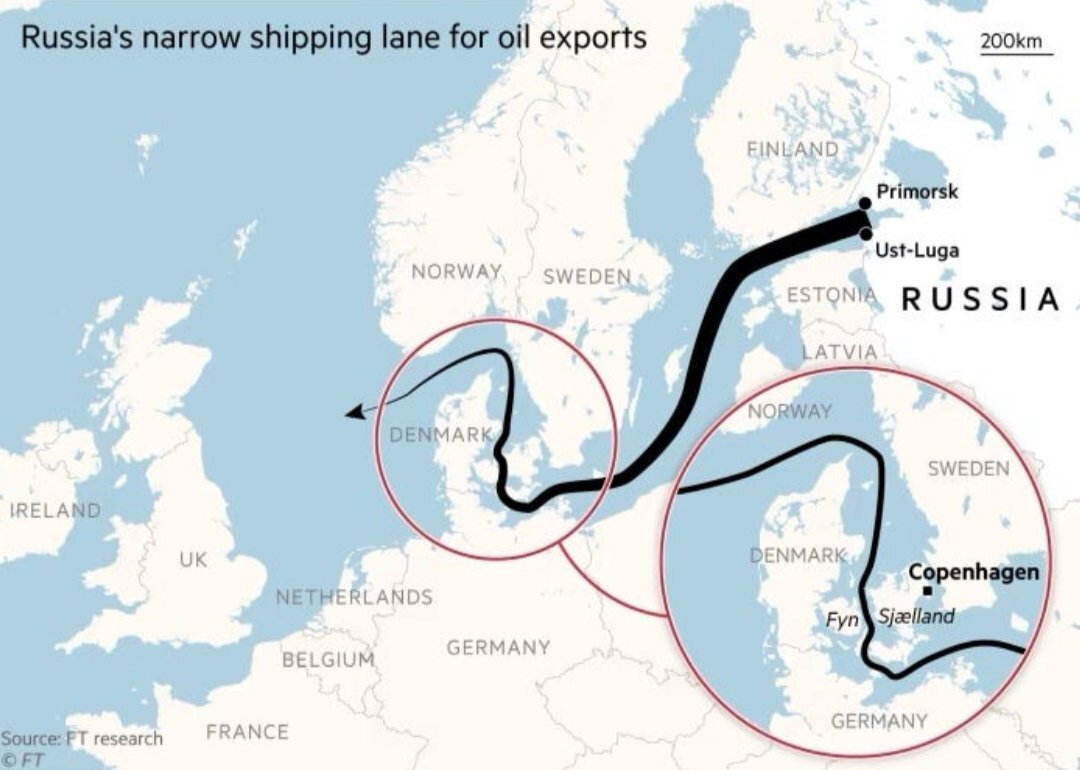
Going from east to west, with a few precious exceptions at the far eastern end at St. Petersburg and occupied Königsberg, the Baltic Sea is not just a NATO lake; NATO controls the gate. Finland, Estonia, Latvia, Sweden, Poland, Germany, Denmark, and Norway—all NATO members, and yet as we are in the 4th year of the Russo-Ukrainian War of 2022 and all the sanctions against Russia, like a drug-addicted cop won’t bust his dealer, the path to the open seas and cash to feed its war remains wide open. However slowly, Western Europe is slowly weaning itself off of its addictions to and fear of Russia. Back in February, you can see the opening play of the latest developments. Denmark has taken its next step in cracking down on Russian-linked shadow tankers passing through its waters. The Danish Maritime Authority will carry out port state controls on tankers it deems high risk who anchor off Skagen in the far north of the country, a popular anchorage. Ships found with safety defects or not having the right papers or insurance risk being detained. Denmark has been leading littoral states around the Baltic in discussing ways to clamp down on ageing tankers carrying Russian oil, following a number of accidents and the severing of cables in the region. Russia sends about a third of its seaborne oil exports through the Danish straits with around one in three of these ships having unknown insurance. Today, some 175 tankers laden with Russian oil transit the Baltic each month, according to Craig Kennedy who runs the Navigating Russia substack. The number of vessels hit by sanctions surpassed 1,000 late last year with data from S&P Global Market Intelligence showing that more 800 of these ships do not have confirmed insurance. Moreover, the average age of sanctioned ships – 21 years – is some eight years older than the global average, adding to growing concern that the sprawling so-called shadow fleet could lead to multiple costly environmental catastrophes. Of course, this wouldn’t be a blockade. That is an act of war. However, I’ll let you sea and admiralty lawyers argue things out in comments, nations have every right to ensure the safety and proper legality of ships in their territorial waters. Ships going to and from Russian Baltic Sea ports on legitimate business meeting all safety and legal requirements should be allowed to come and go under the concept of ‘innocent passage’ as long as they comply with the coastal state’s laws concerning navigation and safety. Denmark’s Skagerrak is the gate to the Baltic. Her NATO allies should be able to generate complete maritime domain awareness of ships approaching the Skagerrak from the east outbound. Likewise, Norway and the other North Sea NATO allies should be able to generate the same in the western approaches inbound. Russia can see the pieces moving into place and is deciding to bully the Danes and NATO into not being difficult. That is why we have this. Denmark has temporarily banned civil drone flights in its airspace as it prepares to host a top European Union meeting on defense and the war in Ukraine, and after a surge of suspicious drone activity at several airports and military sites last week. The ban, which runs from Monday to Friday, aims to eliminate any risk of “hostile” drones being mistaken for legal ones or vice versa, the country’s transport minister Thomas Danielson told CNN. Several unexplained sightings of drones over civilian airports and a military base were reported in Denmark last week. The incidents forced several airports to temporarily close and disrupted travel for tens of thousands of people. Russia is not subtle in its threats. “We are currently in a difficult security situation, and we must ensure the best possible working conditions for the armed forces and the police when they are responsible for security during the EU summit,” Danish Defense Minister Troels Lund Poulsen said in a statement on Sunday. Things are building up, and the alliance is responding. …NATO is taking the potential threat from these drones seriously. The Swedish government “has just decided to task the Swedish Armed Forces with supporting Denmark with military anti-drone capabilities in connection with this week’s summits in Copenhagen,” Swedish Prime Minister Ulf Kristersson said on X Monday morning. “Specifically, this involves a unit contribution with anti-drone capabilities, so-called Counter UAS. The unit will be led by the Danish Armed Forces and contribute to their support of the Danish police operation in connection with this week’s summits.” In addition, Sweden will also “lend a handful of powerful radar systems to Denmark for a period of time,” Kristersson added. “Among the best radar systems in the world. This is Swedish engineering that we can be truly proud of. The radar systems were already sent yesterday.” … Germany has deployed the Sachsen class air defense frigate FGS Hamburg to Copenhagen, the Danish Defense Ministry (MoD) announced on Sunday. … In addition to deploying the Hamburg, Germany is also providing Denmark with “counter-small Unmanned Aircraft Systems (C-sUAS) capabilities, which utilize detection systems that employ radar, optical and acoustic technologies,” The Associated Press noted. France has deployed “35 personnel, a Fennec helicopter, and active counter-drone assets” to Denmark “in response to the recent upsurge in unidentified drone flights in Danish airspace,” the French Defense Ministry said in a statement, adding the drones were a “serious threat.” It would be helpful to have more alliance forces from non-Baltic nations move at least token forces to Denmark. The Netherlands would be on my short list. The U.S. is occupied in the Middle East and Caribbean right now. I would put the Royal Navy on that list too, but I’m not sure she has a combat capable air defense ship to send. Everyone should be looking at what to send, as the ratchet seems to be about to click. The current crisis has again pushed EU and NATO members to reassess options to counter these developments, including a complete blockade of the seas for Russian assets. Current EU, UK, and US sanctions on Russia are already impacting Putin’s revenues, but Moscow still holds access to the seas, particularly Baltic outlets. … The Baltic Sea and its gateways—including the Skagerrak, Kattegat, Danish Straits, and Øresund—are not only narrow waterways but also vital maritime arteries for commerce, energy, and communication. These routes connect Northern and Central Europe to global markets, making them strategically important. The growing threat of Russian interference in these areas is a cause for concern. … Lawful measures to block Russian access exist but have not yet been implemented. European coastal states could establish port denials, targeted sanctions, insurance and financial interdictions, and naval patrols under clear legal mandates—options that may now be discussed in Copenhagen. … To be effective, the Copenhagen Summit should adopt a layered civil-military strategy leveraging peacetime authorities such as customs, port-state control, sanctions enforcement, insurance leverage, naval presence, and monitoring. I’m not sure you will get the entire alliance to agree on much more than strongly worded letters, but there could be an alliance of the willing to take some of the steps outlined above. If you do, just make sure you properly wargame at least three aggressive ‘Red Most Dangerous Courses of Action’ during OPLAN development. Just keep in mind: if NATO does nothing more than what it is already doing, then Russia will be rewarded for its bullying. If it does more, then Russia can use this to dig in deeper and become more hostile. That can lead to a variety of dark places, but here we are. This is why you have to be careful in letting wars go on for long periods of time. They eventually drift away from the reasons they started and can morph into something completely different, and deadlier. Leave a comment Share This Substack is reader-supported. To receive new posts and support my work, consider becoming a free or paid subscriber. View the full article

-
Global Military Products will participate in the U.S. Army’s upcoming Transformation in Contact (TiC) 2.0 event with its Scorpion Light 81mm mobile mortar system, part of an ongoing effort to modernize indirect fire capabilities under the Soldier Enhancement Program (SEP). The trials, conducted under a contract with the Product Manager for Artillery Mortars and Precision […] The post U.S. Army to test new Scorpion light mortar system first appeared on Defence Blog.View the full article
-
Saab Inc. has been awarded a $46 million contract to deliver its Giraffe 1X radar systems to the U.S. Army. According to a Pentagon announcement, the contract was awarded to Saab Inc., based in East Syracuse, New York, for the procurement and delivery of Giraffe 1X radars. Bids were solicited online, with one received. Work […] The post U.S. Army buys lightweight surveillance radars from Saab first appeared on Defence Blog.View the full article