HG S2 (Intel Bot)
Members
-
Joined
-
Last visited
Never
Everything posted by HG S2 (Intel Bot)
-
The Pentagon is rapidly expanding U.S. military capabilities tied to Operation Southern Spear, a mission that began as a counter-narcotics effort but is increasingly focused on pressure against Venezuelan leader Nicolas Maduro. Images that surfaced online this week show Combat Search and Rescue and other U.S. military aircraft arriving in Puerto Rico, signaling a sharp […]View the full article
-
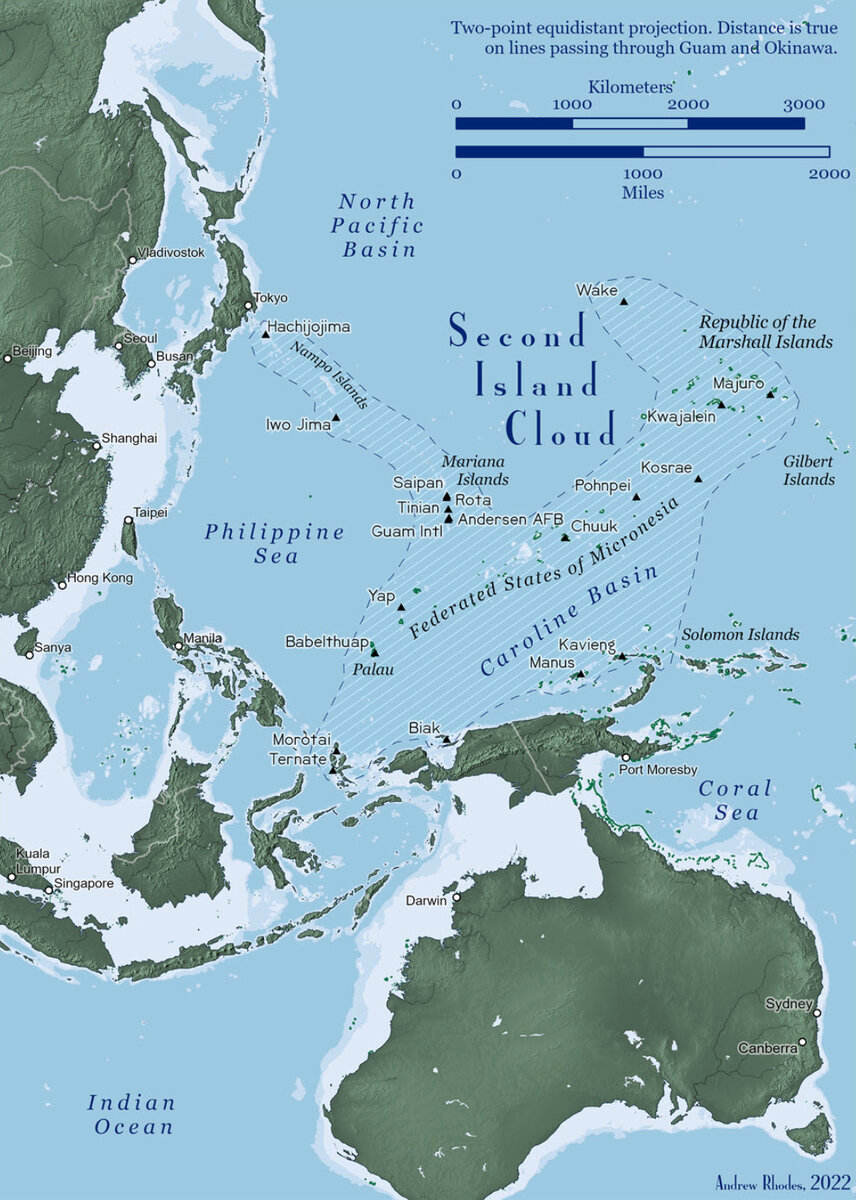
Today, let’s pick up where we left off yesterday and return to a discussion of the Western Pacific. More often than not, things devolve into a discussion of island chains. They are easy to draw and explain—and the First and Second Island Chains have become an expected understanding of the geography of the area. Is this really the best way to think about it? Are we really looking at a neat and easy chain, or something a bit more complicated, difficult, resilient, and more open to opportunity for those who understand its true nature? Do you know who Lieutenant Colonel Earl Hancock “Pete” Ellis, USMC is? You should, we all should. His life story really needs a mini-series like from team that made Netflix’s Death by Lightning, but perhaps that is for another day. The below is from the 4th Quarter 2019’s Joint Forces Quarterly by Rhodes Cartography’s own Andrew Rhodes, from an essay he wrote while a student at the U.S. Naval War College. It won the Strategic Research Paper category of the 2019 Chairman of the Joint Chiefs of Staff Strategic Essay Competition. You really should read it in full, but I want to pull out the core of the discussion of Ellis’s view of what we today call the Second Island Chain. It has convinced me that the People’s Republic of China’s strategic planners understand Ellis’s point a lot more than ours do—and they’re acting on it. In the early 20th century, the visionary Marine officer Earl “Pete” Ellis compiled remarkable studies of islands in the Western Pacific and considered the practical means for the seizure or defense of advanced bases. A century after Ellis’s work, China presents new strategic and operational challenges to the U.S. position in Asia, and it is time for Washington to develop a coherent strategy, one that will last another 100 years, for the islands of the Western Pacific. It has become common to consider the second island chain as a defining feature of Pacific geography, but when Ellis mastered its geography, he saw not a “chain,” but a “cloud.” He wrote in 1921 that the “Marshall, Caroline, and Pelew Islands form a ‘cloud’ of islands stretching east and west.” His apt description of these archipelagoes serves well for a broader conception of the islands in, and adjacent to, traditional definitions of the second island chain. A new U.S. strategy should abandon the narrow lens of the “chain” and emphasize a broader second island cloud that highlights the U.S. regional role and invests in a resilient, distributed, and enduring presence in the Pacific. … A growing body of operational literature on new concepts for combat logistics in the Pacific has developed recently, some of it hearkening back to World War II and the anchorages surveyed by the likes of Ellis.26 Expeditionary “forward arming and refueling points” at tertiary airports offer the potential of much more dynamic airpower, particularly with aircraft capable of operating from austere facilities.27 The ability to rearm combatants, and potentially even submarines from support ships in sheltered anchorages, rather than pierside at established bases, offers a new take on an old concept to regenerate naval combat power despite the Western Pacific threat environment.28 All these concepts are directly compatible with the second island cloud concept and would benefit from peacetime infrastructure investment throughout the islands.29 … Ellis’s description of an island cloud aptly captures the complexity and diversity of the key geography and provides a framework for lasting and dispersed strength—chains fail with a single weak link, but clouds are resilient. The argument for a durable commitment to the second island cloud in the 21st century is much the same as what Ellis wrote in 1913: “Once secure it will stand as a notice to all the world that America is in the Western Pacific to stay.”48 Ellis did not live to see WWII, but his understanding of the geography of the Pacific did, and it applies still today. This Substack is reader-supported. To receive new posts and support my work, consider becoming a free or paid subscriber. Share Leave a comment View the full article
-
The Royal Netherlands Air and Space Force will receive three additional NH90 NATO Frigate Helicopters (NFHs) under a new contract signed today between NHIndustries (NHI) and the NATO Helicopter Management Agency (NAHEMA), further expanding the Dutch Navy’s maritime aviation fleet. According to a press release from NHIndustries, the helicopters will be assembled by Leonardo in […]View the full article
-
I first saw this map three years ago, and it recently resurfaced in my thoughts. I remain convinced that a lot of the problem with trying to get everyone to fully understand the challenge in the Western Pacific is that to a large part, we think in a ‘north-up’ orientation. I don’t think that is all that helpful. Just a few days ago, we had another Pearl Harbor Day anniversary and we’ve all seen the maps, usually centered on Hawaii, where the Imperial Japanese Navy’s Kidō Butai comes at the Pacific Fleet from stage left off the map. Then we fought battles in the Coral Sea, Midway, and so on. To the lay eye — or to those who don’t have time to dig into the reasons — a traditional north-up map looks disjointed; things seem all over the place. No, not really. Let’s bring back that first map. For both Imperial Japan in the early-mid 20th century and Communist China today, the most important part of this map is the access to the resources in or going through the bottom-right hand corner. Today’s greatest bone of contention — not unrelated to the most important part of the map mentioned above — is Taiwan, right at the mouth of the funnel. If we need to bring a fight there, that is one hell of a fight to get there if the People’s Republic of China (PRC) wants to prepare a proper welcome for us. For the PRC, the primary military threat to plan for comes across the Pacific into a funnel that terminates at its most important SLOC. It’s the United States of America, and the US has a series of islands leading right into the heart of the PRC’s. It starts in Hawaii — Midway, Wake, Guam — and then to U.S. allies: the Philippines, Japan, and Australia. They’re planning a layered defensive fight. Their actions make that clear. Make no mistake, we may say we are going to “defend Taiwan”, but to do that we will have to fight an aggressive war across the Pacific, into the enemy’s prepared funnel. To build up real power, the US and her allies will need Japan, of course, but also Australia and the islands to her north. If you can blunt the Hawaii/Midway/Wake/Guam spear, and then take away any possible southern flanking movement by taking the string of islands from Singapore to Samoa—you can keep the American Navy on their side of the International Date Line—where, in your mind, they belong. If the PRC can prepare the battlefield in peace, then when war comes, she will be more than just a few steps ahead of your enemy and if anything else, will make any attempt to come to the Western Pacific a costly endeavor even before getting in range of Taiwan and PRC proper. That is why for a long time we have been beating the drum along with our friends Cleo Paskal, Brent Sadler, and others about the Marshall and Gilbert Islands, brave little Palau, the Caroline Islands, the Federated States of Micronesia … all those islands. The PRC can read history and look at charts too. Look at the chart again. What island do you see right between Palau and Guam? That’s right, Yap. Head 110T about 365 nautical miles from there, and you have the island of Woleai. About 1/3 of the way from Yap to Woleai, and slightly north, is Ulithi. The irreplaceable Cleo is tapping us on the shoulder again. Let me give you the 100,000 foot view. You can barely see the once overgrown Imperial Japanese airfield next to Falealop. It has been inoperable since 1992…the dawn of the Jesus Jones Era. Oops. History is back, and she’s a bit pissed. There is no reason to have an airfield there besides why the Imperial Japanese built one…for military purposes. To help control/threaten the approaches to the Western Pacific from the United States. Big difference now is that modern weapons give such bases much more of a reach. There is no industry there. No prospects for tourism on a disaggregated atoll with only 1,000 souls that would justify that airfield. Remember what Ulithi meant in the last Great Pacific War? Tick tock. China is can’t stop, won’t stop. Are we paying attention? Map credit to Rhodes Cartography. Leave a comment Share This Substack is reader-supported. To receive new posts and support my work, consider becoming a free or paid subscriber. View the full article

-
South Korean defense startup Nearthlab has successfully demonstrated its KAiDEN autonomous interceptor drone during a live fire test hosted for representatives from L3Harris Technologies. In a post shared by Chief Strategy Officer and Executive Vice President Andrew D. Kim, the company described the intercept as “flawless,” adding that the “one shot, one kill” demonstration proved […]View the full article
-
Croatia has formally signed a contract to acquire 18 CAESAR 6×6 MkII self-propelled howitzers and 15 Serval armored vehicles from French defense manufacturer KNDS, the company announced on December 9. The agreement is part of Croatia’s ongoing efforts to modernize its artillery and mechanized forces. According to a statement from KNDS France, the signing took […]View the full article
-
Rani Plaut, CEO of the Israeli aerospace startup AIR, says recent global crises have revealed a central lesson for military and civilian planners alike: “mobility is power.” In a detailed statement on the company’s vision for next‑generation aerial logistics, Plaut said uncrewed aerial systems have become essential for reconnaissance and rapid tactical response, but remain […]View the full article
-
Ukrainian assault troops have used an armed unmanned vehicle to intercept and disable a Russian armored vehicle during an attempted nighttime attack, according to a statement released by the 5th Kyiv Assault Brigade on December 10. The unit published thermal camera footage showing the Droid robotic combat system engaging an enemy MT-LB with mounted infantry […]View the full article
-
Newly surfaced footage has confirmed for the first time that Russia is operating modified Shahed‑136 one‑way attack drones—produced domestically as Geran‑2—with under‑wing payloads containing PTM‑3 anti‑tank mines. The video, recorded by a Ukrainian interceptor drone during an engagement, captures the moment a Russian drone ejects its KPТМ canisters, each containing a PTM‑3 mine, before the […]View the full article
-
The United States Air Force has awarded Northrop Grumman Systems Corporation a new ceiling contract worth up to $100 million to advance two key strike‑weapon programs: the Stand‑In Attack Weapon (SiAW) and the Advanced Anti‑Radiation Guided Missile–Extended Range (AARGM‑ER). The agreement supports both production and research and development through December 31, 2034, according to the […]View the full article
-
Oshkosh Defense has secured a $49.2 million contract to convert and deliver upgraded cargo vehicles for the United States Marine Corps, the Department of War announced. According to a release, the contract calls for Oshkosh Defense LLC of Oshkosh, Wisconsin, to convert an undisclosed number of Medium Tactical Vehicle Replacement (MTVR) Extra Long Wheelbase cargo […]View the full article
-
SIG SAUER announced on Tuesday that the Swiss Armed Forces have officially selected the P320 pistol as their new standard-issued sidearm. The decision is part of Switzerland’s broader New Generation Project aimed at modernizing core equipment for its military personnel. According to a company statement, the selection followed a rigorous competitive process conducted by Armasuisse, […]View the full article
-
MatrixSpace, a Massachusetts-based developer of compact radar systems, has announced the launch of its Portable 360 Radar, a low-power counter-drone radar system designed to rapidly deploy in diverse operational settings ranging from public event security to military environments. In a release dated December 9, 2025, MatrixSpace said the system provides 360-degree panoramic surveillance coverage for […]View the full article
-
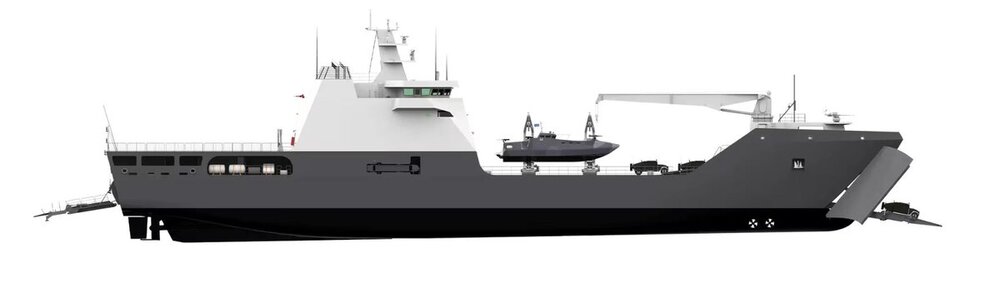
Last Friday, we got an answer to one of the questions we had after the CANX of the Constellation FFG: what next? TWZ has a good summary of the hard data in the above video. “Last month, with the concurrence of the Commandant [of the Marine Corps] and the Chief of Naval Operations, I approved the LSM design selection [of] the LST-100 landing ship transport, a roughly 4,000-ton ship with a range of more than 3,400 nautical miles that gives us the right balance of capability, affordability, and speed to field.” The baseline LST-100 design is approximately 328 feet (100 meters) long, some 52.5 feet (16 meters) wide, and can reach a top speed of 15 knots, according to Damen. It did not come out of nowhere, the Medium Landing Ship has been bouncing around for awhile as a way to make the USMC’s controversial Expeditionary Advanced Base Operations (EABO) happen. So, we don’t really have a new class of ship to “replace” the cancelled Constellation-class. No, this was supposed to happen anyway. The fact remains that we have failed, once again, to build a successful class of surface combatant since the Cold War. LCS, DDG-1000, CG(X), and now FFG-62—covering the spectrum of either a fraction of the utility they were hoped to be or never leaving the PPT. Will we get DDG(X) right? We’ll see, but until then, we shall build Arleigh Burkes until the crack of doom. The US Navy is not the first customer. The Dutch shipbuilders Damen had a proven design that the Australians picked a year ago as their “Landing Craft Heavy” to be built by Australian shipbuilder Austal in Western Australia. The Nigerians ordered theirs even earlier. The Australians expect it to, …be capable of carrying more than 500 tonnes of military vehicles and equipment – it is intended to carry six Abrams Tanks, 11 Redback Infantry Fighting Vehicles or 26 HIMARS – and will be fitted with self-defence weapons systems and Australian military communications. Expect the US Navy’s version to be almost exactly the same. The US Navy decommissioned its last LST, the USS Frederick (LST-1184) on October 5, 2002. A Newport-class tank landing ship, she came in at 4,793 displacement, 159 meters in length, a top speed of 22 knots, and a ship’s company of 213 Sailors. The prior LST class before Newport were the De Soto County-class at 3,560 tons, 136 meters in length, a top speed of 17.5 knots, and a ship’s company of 172 Sailors. The Damen LST 100 comes in at 4,000 tons, 100 meters, and a top speed of 15 knots. It is not your father’s or grandfather’s LST…but it has one thing that no one else has—it is a mature design. Yes, I know. So was the Franco-Italian FREMM that the Constellation-class came from, but perhaps we are a learning institution. Perhaps. One thing I am VERY interested in hearing more about is the manning of the Damen 100. From their website, it has a crew of <checks notes> 18. Yes, I have lots of questions about maintenance, watchstanding, endurance, etc…but let’s see what they have to say about the CONOPS for these ships. We’ll find out soon enough. …construction of the first ship expected to begin in 2026. According to current planning, this schedule would allow the first vessel to enter service in 2029. The U.S. Navy and U.S. Marine Corps foresee a requirement for about 35 ships, and to accelerate progress and limit costs they do not intend to introduce major changes to Damen’s baseline design. Adjustments are expected only where U.S. standard solutions are needed and to ensure compatibility with the equipment, armament and aircraft used by the U.S. Navy and Marine Corps. … At the time of the December announcement, an agreement was concluded for the purchase of design rights worth 3.3 million U.S. dollars. This will allow the Department of the Navy to select shipyards for each phase of the programme, covering construction, maintenance and later upgrades, with the aim of involving as many yards as possible. The LSM class is intended to enable the efficient movement of Marine Corps combat groups across the Pacific between small islands and atolls. Their technical and tactical characteristics are expected to allow safe operation in areas exposed to potential adversary weapons, complementing the larger amphibious transport docks that form the core of expeditionary groups. Again…the manning. These have to be USS as they will be going in harm’s way, will be armed, probably with a MK-46 30mm autocannon we also have on LPD-17 and DDG-1000 if I were a betting man. Could it be up-gunned to a OTO Melara 76 mm? Probably not…but one could dream. Let’s round things up to 25 Sailors in ship’s company? That ain’t a Commander command. That right there is a Lieutenant command with a LTjg XO and a couple of Ensigns with the rest enlisted personnel. 18? 25? Really? Huh. With that speed, they need to be forward based. A bunch of LT commanded ships based in The Philippines. OK. Get a good JAG for the Commodore. Darwin? Probably not Singapore. This will be interesting to see fleshed out. Now, let’s talk about program risk mitigation with DDG(X)… Leave a comment Share This Substack is reader-supported. To receive new posts and support my work, consider becoming a free or paid subscriber. View the full article
-
Turkish-built Ejder TTZA 6×6 armored personnel carriers were unveiled for the first time during a military parade held in Damascus celebrating the fall of the Assad regime, marking the public debut of the vehicles in Syrian service. The parade, staged by the new authorities in Damascus, featured multiple examples of the Ejder TTZA—short for Taktik […]View the full article
-
South Korea has finalized a new production contract for its K600 Rhino obstacle-clearing combat engineering tank, marking the first time the vehicle will be supplied directly to frontline Army units and the Republic of Korea Marine Corps. According to an announcement carried by Yonhap News, Hyundai Rotem said on December 9 that it signed a […]View the full article
-
A Russian An-22 heavy-lift military transport aircraft has crashed in the Furmanovsky district of Ivanovo Region, according to initial reports from Russian media. The incident occurred on December 9 and involved a military aircraft identified as an An-22 “Antei.” The aircraft reportedly carried seven crew members at the time of the crash. Their status remains […]View the full article
-
Nine Chinese and Russian military aircraft briefly entered South Korea’s air defense identification zone (KADIZ) on Tuesday, prompting the South Korean Air Force to dispatch fighter jets as a precautionary response, according to the country’s Joint Chiefs of Staff (JCS). The JCS said two Chinese military planes and seven Russian aircraft entered the KADIZ sequentially […]View the full article
-
The U.S. Navy has recovered an F/A‑18F Super Hornet and an MH‑60R Seahawk from the seafloor after both aircraft were lost in separate mishaps off the USS Nimitz (CVN 68) on October 26, 2025. According to the Navy, the two aircraft suffered accidents within a half‑hour of each other. The recovery operation was completed on […]View the full article
-
The U.S. Department of State has approved a potential Foreign Military Sale to the Government of Belgium for up to 240 Hellfire missiles, along with a broad package of support equipment and services, at an estimated cost of $79 million. The Defense Security Cooperation Agency (DSCA) announced that it has delivered the required certification notifying […]View the full article
-
The United States Navy has awarded Saronic a $392 million production contract to rapidly deliver drone boats under the Other Transaction Authority (OTA) framework. Secretary of the Navy John C. Phelan said nearly $200 million of that total has already been obligated, as the service pushes forward with a new model of fast-paced, open-competition procurement […]View the full article
-
The Security Service of Ukraine (SBU) has released a new recruitment video featuring a robotic dog armed with an assault rifle. The promotional clip, published this week by the SBU, includes footage from tactical training exercises in which a quadrupedal unmanned ground vehicle, resembling a robotic dog, is seen maneuvering indoors and firing a rifle. […]View the full article
-
A Ukrainian Su-27 fighter jet was lost during a combat mission on December 8 in the eastern region of the country, the Ukrainian Air Force confirmed in a public statement. “At noon on December 8, 2025, in the eastern direction, during the execution of a combat mission in a Su-27 aircraft, the senior navigator of […]View the full article
-
It has been driving me a little nuts the last couple of days, seeing all the gnashing of teeth and rending of clothes about the new National Security Strategy (NSS), not having the time to read it. I mean, come on Sal, it is only 29 pages. I promised a few people I would start the week with my thoughts on it, so after we finished our Midrats Podcast with Bryan McGrath, I decided to give it a read. Really people, take a powder. As I’ve been doing with most of the documents like this the last couple of decades here, let’s look at the word cloud: This…is actually a pretty good representation of its relative macro concerns. Before I dive in to some specifics, there are two larger points I want to make. This is not anti-NATO or anti-European: there is some incredibly irresponsible reporting and commentary about this report—specifically concerning NATO and Europe. As I will show below, you can read this as an indictment of the ruling class in Europe, the European Union, and various transnational institutions, but not of the European people or their nations. Indeed, it is just the opposite. If you care for something and respect it, you do not sit there and let it destroy itself. If someone is telling you that this is anti-NATO or anti-European, then you are dealing with one of three types: TLDR: well-meaning people who are not disposed to supporting anything President Trump is involved with simply repeated what others have written. These are also usually tender-hearted people who believe if you can’t say something nice, don’t say anything at all. Here, have a trophy. Orange Man Bad: similar to TLDR, but they did read the document. However, as their red-hot dislike of DJT is a filter for anything they read, they read everything they could into what was actually written to confirm their priors. They also see errors of their own they would prefer not to have discussed. Please move along. Bad Faith Actors: they knew what they were going to write before they even read the NSS. Trump is a Russian tool. America is bad. America is abandoning Europe. Eleventy. Style and tone is off and degrades the document: I fully accept that a product of an involved chief executive will reflect the personality and focus of the chief executive. President Trump can be…expressive, abrupt, and confrontational as only a real estate developer from Queens can be. It brought him the success he has enjoyed, but this aspect needed to be dialed back a bit for this kind of document. Real strength is demonstrated, it is not brought about by hyperbole. In places, the NSS’s verbiage and tone is just a little too, how do the kids say it…‘extra’…to the point it degrades the effectiveness a bit for many of the audiences you want to reach. There are reasons people of good faith can dislike this document root and branch, because it upends A LOT of rice bowls many people and institutions have been feeding out of for generations, but this is no more anti-NATO, anti-European, and pro-Russia than I am. There is a reason that the same people who for two decades have brought a whole series of damaging failures onto the world stage—The Balkans, Somalia, Afghanistan, Iraq, Libya—are the ones who are misrepresenting this document through an embarrassing display of hyperbole, emotion, and SSRI failures. Am I fully aligned with the NSS? Absolutely not, but on balance, I found myself nodding my head in agreement. I had no hand in the writing of this document and don’t know who did write it, but there is a lot here that regulars on the Front Porch here will recognize as vibing with my Plan Salamander for Europe that I have been describing from the start of my writing two decades ago and I started discussing with other people 30 years ago. Here is an example from 14 years ago: …withdraw all maneuver forces from Asia and Europe except for what is needed at Combined Training and Logistics Bases with our most important allies. As a former NATO staff officer who remembers his time with NATO as some of the most rewarding time I spent in uniform, has the greatest admiration for the purpose of the alliance, and looks forward to its continued service in promoting mutual defense of Western Civilization. However, I am first and foremost an American…and American power cannot be shackled to Europe. Europe in the 21st Century cannot continue to expect the USA to be its guard as it engages in vanity politics and institutional sloth. The US military needs to be nimble, expeditionary, scalable, and flexible to help Europe if needed—mostly with superior maritime and aerospace power which is our comparative advantage—but with a week’s notice, pivot anywhere else in the globe it is needed. The great challenge to the USA and her allies—which are more than NATO—is in Asia. We will fail in the Pacific in the future if we shackle ourselves to the inertia of the past in Europe. So, let’s do a quick review of the NSS. It is only 28 pages, but I’m not going to give it a full Fisking, but there are a few things I want to pull out. At the start, remember that this is a “National Security Strategy.” This is not a “National Military Strategy.” Get out your JPME I notebook for a review of the levers of national power. In the NSS you will find a little Diplomatic, a smattering of Informational, a good bite of the Military, but just as much Economic discussed. It becomes very clear early on why there was such an emotional response from the usual suspects about this document: More than anything, as outlined earlier, it is a in-your-face repudiation of the post-Cold War foreign policy establishment in DC and Brussels. It is not without some issues I would have recommended removing in addition to tone. In the opening letter by President Trump, there was the repeating of something that continues to force me to ask an uncomfortable question: We rebuilt our alliances and got our allies to contribute more to our common defense—including a historic commitment from NATO countries to raise defense spending from2 percent to 5 percent of GDP. I’m sorry, but I see no evidence we are on a glide-slope toward 5% in the USA, and very few NATO members—except perhaps Poland—will stretch to 5% if we don’t. A leader leads from the front. That would require us to move from ~2.7% to 5%. OK, this is a strategy document. How do we define that? A “strategy” is a concrete, realistic plan that explains the essential connection between ends and means: it begins from an accurate assessment of what is desired and what tools are available, or can realistically be created, to achieve the desired outcomes. A strategy must evaluate, sort, and prioritize. Not every country, region, issue, or cause—however worthy—can be the focus of American strategy. The purpose of foreign policy is the protection of core national interests; that is the sole focus of this strategy. That works. Is there continuity? In a way, yes. Not with the last few decades though, but further back. American strategies since the end of the Cold War have fallen short—they have been laundry lists of wishes or desired end states; have not clearly defined what we want but instead stated vague platitudes; and have often misjudged what we should want. After the end of the Cold War, American foreign policy elites convinced themselves that permanent American domination of the entire world was in the best interests of our country. Yet the affairs of other countries are our concern only if their activities directly threaten our interests. I think that is something that George Washington would agree with. The below is something a lot of people who have served in the post-Cold War military would agree with. Our elites badly miscalculated America’s willingness to shoulder forever global burdens to which the American people saw no connection to the national interest.They overestimated America’s ability to fund, simultaneously, a massive welfare-regulatory-administrative state alongside a massive military, diplomatic, intelligence, and foreign aid complex. They placed hugely misguided and destructive bets on globalism and so-called “free trade” that hollowed out the very middle class and industrial base on which American economic and military preeminence depend. They allowed allies and partners to offload the cost of their defense onto the American people, and sometimes to suck us into conflicts and controversies central to their interests but peripheral or irrelevant to our own. And they lashed American policy to a network of international institutions, some of which are driven by outright anti-Americanism and many by a transnationalism that explicitly seeks to dissolve individual state sovereignty. In sum, not only did our elites pursue a fundamentally undesirable and impossible goal, in doing so they undermined the very means necessary to achieve that goal: the character of our nation upon which its power, wealth, and decency were built. None of that wording should be news to anyone. This is exactly what Trump won the popular vote saying. You can argue with the answers, but you can’t say they are not asking the “Strategic Planning 101” questions. The questions before us now are: 1) What should the United States want? 2) What are our available means to get it? and 3) How can we connect ends and means in to a viable National Security Strategy? If you are wondering what we are doing in the Caribbean the last few months, you can find your answer on page 5: What are America’s core foreign policy interests? What do we want in and from the world? We want to ensure that the Western Hemisphere remains reasonably stable and well-governed enough to prevent and discourage mass migration to theUnited States; we want a Hemisphere whose governments cooperate with usa gainst narco-terrorists, cartels, and other transnational criminal organizations; we want a Hemisphere that remains free of hostile foreign incursion or ownership of key assets, and that supports critical supply chains; and we want to ensure our continued access to key strategic locations. In other words, we will assert and enforce a “Trump Corollary” to the Monroe Doctrine; It is in this section that you start to see the direct tough-love language towards Europe. Seriously, how can you call this anti-European? We want to support our allies in preserving the freedom and security ofEurope, while restoring Europe’s civilizational self-confidence and Western identity; Anti-transnational/anti-democratic institutions? Sure. Anti-European or anti-NATO? No. I really liked this last note, but I’d add one thing: space. We want to ensure that U.S. technology and U.S. standards—particularly inAI, biotech, and quantum computing—drive the world forward. This thread continues in this broad definition of ‘strength’. It isn’t just military strength. …strength can enable us to achieve peace, because parties that respect our strength often seek our help and are receptive to our efforts to resolve conflicts and maintain peace. Therefore, the United States must maintain the strongest economy, develop the most advanced technologies, bolster our society’s cultural health, and field the world’s most capable military. The return to ‘founding principles’ outlined at the birth of our republic also continues: Predisposition to Non-Interventionism – In the Declaration ofIndependence, America’s founders laid down a clear preference for non-interventionism in the affairs of other nations and made clear the basis: justas all human beings possess God-given equal natural rights, all nations are entitled by “the laws of nature and nature’s God” to a “separate and equal station” with respect to one another. For a country whose interests are as numerous and diverse as ours, rigid adherence to non-interventionism is not possible. Yet this predisposition should set a high bar for what constitutes a justified intervention. Flexible Realism – U.S. policy will be realistic about what is possible and desirable to seek in its dealings with other nations. We seek good relations and peaceful commercial relations with the nations of the world without imposing on them democratic or other social change that differs widely from their traditions and histories. We recognize and affirm that there is nothing inconsistent or hypocritical in acting according to such a realistic assess mentor in maintaining good relations with countries whose governing systems and societies differ from ours even as we push like-minded friends to uphold our shared norms, furthering our interests as we do so. The largest critics—and more often than not the most emotional—are the usual suspects in the transnational and internationalist NGO complex. This is aimed right at them. A hit dog will holler. Primacy of Nations – The world’s fundamental political unit is and will remain the nation-state. It is natural and just that all nations put their interests first and guard their sovereignty. The world works best when nations prioritize their interests. The United States will put our own interests first and, in our relations with other nations, encourage them to prioritize their own interests as well. We stand for the sovereign rights of nations, against the sovereignty-sapping incursions of the most intrusive transnational organizations, and for reforming those institutions so that they assist rather than hinder individual sovereignty and further American interests. …and hit…and hit… The United States will unapologetically protect our own sovereignty. This includes preventing its erosion by transnational and international organizations, attempts by foreign powers or entities to censor our discourse or curtail our citizens’ free speech rights, There is some of this that, to this Old Cold Warrior ear, almost sounds from the OG liberal foreign policy wish list. One should think Europeans would support this. As the United States rejects the ill-fated concept of global domination for itself, Wait…belay my last. Reagan calling. …we must prevent the global, and in some cases even regional, domination of others. I know some of you will think I am being too kind with the authors of the NSS, but cut me some slack. This is almost pulled word-by-word from the Old Salamander Book of Common Prayer: …we expect our allies to spend far more of their national Gross Domestic Product (GDP) on their own defense, to start to make up for the enormous imbalances accrued over decades of much greater spending by the United States. There are Claymore like beauties all over the place aimed at the absolute worst tendencies we see in our allies right now. We will oppose elite-driven, anti-democratic restrictions on core liberties in Europe, the Anglosphere, and the rest of the democratic world, especially among our allies. What is wrong with this? Seriously, what? As we get towards the second half of the document, we get what will be the priority. The order things are put in matters. What comes up first? Again, if you want a view of the build up in the Caribbean: A. Western Hemisphere: The Trump Corollary to the Monroe Doctrine After years of neglect, the United States will reassert and enforce the MonroeDoctrine to restore American preeminence in the Western Hemisphere, and to protect our homeland and our access to key geographies throughout the region. We will deny non-Hemispheric competitors the ability to position forces or other threatening capabilities, or to own or control strategically vital assets, in our Hemisphere. This “Trump Corollary” to the Monroe Doctrine is a common-sense and potent restoration of American power and priorities, consistent with American security interests. Our goals for the Western Hemisphere can be summarized as “Enlist and Expand.” We will enlist established friends in the Hemisphere to control migration, stop drug flows, and strengthen stability and security on land and sea. We will expand by cultivating and strengthening new partners while bolstering our own nation’s appeal as the Hemisphere’s economic and security partner of choice. As an American, I cannot argue with this at all. What comes next? Asia. One could argue it should be #1, but take #2 and run with it: The Indo-Pacific is already the source of almost half the world’s GDP based on purchasing power parity (PPP), and one third based on nominal GDP. That share is certain to grow over the 21st century. Which means that the Indo-Pacific is already and will continue to be among the next century’s key economic and geopolitical battlegrounds. To thrive at home, we must successfully compete there—and we are. President Trump signed major agreements during his October 2025 travels that further deepen our powerful ties of commerce, culture, technology, and defense, and reaffirm our commitment to a free and open Indo-Pacific. … Going forward, we will rebalance America’s economic relationship with China, prioritizing reciprocity and fairness to restore American economic independence.Trade with China should be balanced and focused on non-sensitive factors. IfAmerica remains on a growth path—and can sustain that while maintaining a genuinely mutually advantageous economic relationship with Beijing—we should be headed from our present $30 trillion economy in 2025 to $40 trillion in the 2030s, putting our country in an enviable position to maintain our status as the world’s leading economy. Our ultimate goal is to lay the foundation for long-term economic vitality.Importantly, this must be accompanied by a robust and ongoing focus on deterrence to prevent war in the Indo-Pacific. This combined approach can become a virtuous cycle as strong American deterrence opens up space for more disciplined economic action, while more disciplined economic action leads to greaterAmerican resources to sustain deterrence in the long term. And here is probably what has the Europeans so upset. They’re 3rd, on page 25 of 29, and their ruling elite is put on report. C. Promoting European Greatness American officials have become used to thinking about European problems in terms of insufficient military spending and economic stagnation. There is truth to this, but Europe’s real problems are even deeper. Continental Europe has been losing share of global GDP—down from 25 percent in 1990 to 14 percent today—partly owing to national and transnational regulations that undermine creativity and industriousness. But this economic decline is eclipsed by the real and more stark prospect of civilizational erasure. The larger issues facing Europe include activities of the European Union and other transnational bodies that undermine political liberty and sovereignty, migration policies that are transforming the continent and creating strife, censorship of free speech and suppression of political opposition, cratering birthrates, and loss of national identities and self-confidence. Should present trends continue, the continent will be unrecognizable in 20 years or less. As such, it is far from obvious whether certain European countries will have economies and militaries strong enough to remain reliable allies. Many of these nations are currently doubling down on their present path. We want Europe to remain European, to regain its civilizational self-confidence, and to abandon its failed focus on regulatory suffocation. Someone is going to have to explain to me like I am a small child, or a Golden Retriever, how ‘Promoting European Greatness’ is anti-European or anti-NATO? I’ve also heard this is pro-Russian or pro-Putin. Really, can you show me where? If this is it, that’s fairly weak cheese: It is a core interest of the United States to negotiate an expeditious cessation of hostilities in Ukraine, in order to stabilize European economies, prevent unintended escalation or expansion of the war, and reestablish strategic stability with Russia, as well as to enable the post-hostilities reconstruction of Ukraine to enable its survival as a viable state. How is it anti-Ukrainian to want to ‘enable its survival as a viable state’? Sure, the devil is in the details perhaps…but some of the people being overly dramatic are simply acting out of ignorance or bad-faith. This might be anti-European Union. OK, I’ll grant you that…but is that a bad thing given what they’ve been up to against their own people as of late? American diplomacy should continue to stand up for genuine democracy, freedom of expression, and unapologetic celebrations of European nations’ individual character and history. America encourages its political allies in Europe to promote this revival of spirit, and the growing influence of patriotic European parties in deed gives cause for great optimism. Our goal should be to help Europe correct its current trajectory. We will need a strong Europe to help us successfully compete, and to work in concert with us to prevent any adversary from dominating Europe. We can’t love Europe more than Europeans, and if they no longer love themselves, then nothing we can do in North America can save them from their fate. Can everyone at least be 80/20 with this list? Our broad policy for Europe should prioritize: Reestablishing conditions of stability within Europe and strategic stability with Russia; Enabling Europe to stand on its own feet and operate as a group of aligned sovereign nations, including by taking primary responsibility for its own defense, without being dominated by any adversarial power; Cultivating resistance to Europe’s current trajectory within European nations; Opening European markets to U.S. goods and services and ensuring fair treatment of U.S. workers and businesses; Building up the healthy nations of Central, Eastern, and Southern Europe through commercial ties, weapons sales, political collaboration, and cultural and educational exchanges; Ending the perception, and preventing the reality, of NATO as a perpetually expanding alliance; and Encouraging Europe to take action to combat mercantilist overcapacity, technological theft, cyber espionage, and other hostile economic practices. At least Europe is ahead of the Middle East again. It is in 4th place, and this quote had me thinking of T.E. Lawrence: Middle East partners are demonstrating their commitment to combatting radicalism, a trend line American policy should continue to encourage. But doing so will require dropping America’s misguided experiment with hectoring these nations—especially the Gulf monarchies—into abandoning their traditions and historic forms of government. We should encourage and applaud reform when and where it emerges organically, without trying to impose it from without. The key to successful relations with the Middle East is accepting the region, its leaders, and its nations as they are while working together on areas of common interest. And finally we have Africa in 5th. The United States should transition from an aid-focused relationship with Africa toa trade- and investment-focused relationship, favoring partnerships with capable, reliable states committed to opening their markets to U.S. goods and services. An immediate area for U.S. investment in Africa, with prospects for a good return on investment, include the energy sector and critical mineral development.Development of U.S.-backed nuclear energy, liquid petroleum gas, and liquified natural gas technologies can generate profits for U.S. businesses and help us in the competition for critical minerals and other resources. As I like to do when given the chance, I will remind everyone that as we approach mid-century, Africa will produce more disorder than can be consumed internally. There is an intersection of several factors that cannot be contained regardless of as much as people would like to avoid them: Demographics. The bleeding edge of Islam heading south. Economic growth’s inability to keep up with growing populations. Ecological damage, food insecurity, and access to clean water. Where will that relief valve be? Not North America…but as we are already seeing, Europe. The present leadership of Europe’s inability to address migration challenges will only encourage the European people to look for new leadership in new places. The American NSS is not where their concerns should be. Hold on tight. Mid-century will be a doozy. Leave a comment Share This Substack is reader-supported. To receive new posts and support my work, consider becoming a free or paid subscriber. View the full article

-
Kongsberg Defence & Aerospace has signed a new contract with the Swedish Defence Materiel Administration (FMV) to deliver PROTECTOR remote weapon stations (RWS) for use on several Swedish Army platforms, including the CV90 (local name Stridsfordon 90) infantry fighting vehicle. According to a company announcement issued on December 8, the contract is valued at over […]View the full article