HG S2 (Intel Bot)
Members
-
Joined
-
Last visited
Never
Everything posted by HG S2 (Intel Bot)
-
Thai military forces have captured multiple Chinese-made GAM-102LR guided anti-tank missile systems from Cambodian troops during fighting near Hill 677, according to recent reports from the area. According to the reports, Thai soldiers secured a significant quantity of GAM-102LR missiles after overrunning Cambodian positions on the contested high ground. The missiles are considered a modern […]View the full article
-
Cambodian military forces have captured a Thai Army BTR-3E1 armored vehicle near the Thai-Cambodian border, marking the first confirmed battlefield trophy of the latest phase of fighting between the two countries. Photos circulating on social media show soldiers from the Royal Cambodian Armed Forces posing alongside a BTR-3E1 infantry fighting vehicle after it was abandoned […]View the full article
-
United States Forces Korea have recovered an MQ-9 Reaper unmanned aircraft that went down off South Korea’s west coast last month. According to U.S. Forces Korea, the U.S. Air Force’s 8th Fighter Wing successfully located and recovered the MQ-9 Reaper from waters near Maldo Island, off the coast of Gunsan, following the Nov. 24 incident. […]View the full article
-
Chinese military pressure around Taiwan intensified again this week after a People’s Liberation Army Navy warship used politically charged language during a radio exchange with a Taiwanese aircraft, prompting a firm response from Taiwan’s Air Force and drawing widespread attention online. According to reporting by Taiwanese media and recordings shared by the long-running military monitoring […]View the full article
-
Taiwan’s domestically built Hai Kun submarine experienced a serious hydraulic system failure during sea trials, temporarily leaving the vessel without powered control of its X-shaped stern rudder and forcing sailors to rely on manual steering to avoid an accident, according to an exclusive report by Mirror Media. The incident occurred during the submarine’s second sea […]View the full article
-
South Korea’s Marine Corps is set to introduce its first vessel since the force was founded. The Marine Corps and the Defense Acquisition Program Administration said on the afternoon of the 11th that they will hold a launching ceremony for the High-Speed Combat Boat (HCB-001), named Marlin, at the Gangnam Shipyard in Saha-gu, Busan. According […]View the full article
-
The U.S. Army has completed the retirement of its legacy aerial intelligence, surveillance, and reconnaissance turboprop fleet, ending more than five decades of continuous service as it pivots toward a jet-based future built around the High Accuracy Detection and Exploitation System, or HADES. For more than 50 years, aircraft such as Guardrail, Airborne Reconnaissance Low-Multifunction […]View the full article
-
L3Harris Technologies has delivered the first production Meadowlands Counter Communications System to the U.S. Space Force Combat Forces Command’s Mission Delta 3 – Space Electromagnetic Warfare unit. According to a statement from the company, the delivery is intended to support Space Force units tasked with electromagnetic warfare missions by providing mobile jamming capabilities that can […]View the full article
-
Ukraine’s military intelligence agency said it has confirmed a strike on a Russian military transport aircraft and two radar systems in temporarily occupied Crimea, describing the operation as a targeted action against Russian military assets preparing for flight. According to a statement released by the press service of the Main Intelligence Directorate of the Ministry […]View the full article
-
Russia has carried out a missile strike on the port of Odesa, with a Turkish-operated passenger and cargo ferry reportedly among the targets, according to initial reports circulating in regional media and online sources. According to the information provided, Russian forces launched an attack using an Iskander operational-tactical missile system against port infrastructure in Odesa. […]View the full article
-
A Chinese-manufactured VT-4 main battle tank operated by the Royal Thai Army has reportedly suffered severe damage during intense frontline combat, according to information shared on a Thai-language social media page. The report states that the VT-4 tank was damaged while conducting a direct fire mission against Cambodian military positions in a heavily contested frontline […]View the full article
-
When a Marine Field Grade officer is holding a lung-dart on his official photo, you know you want to hear his story. So, what does the official USMC bio cover? Earl “Pete” Ellis was born on 19 December 1880 at Iuka, Kansas, and began his career in the United States Marine Corps in 1900 as a private. On 6 December 1901, he became a second lieutenant. Early in 1902, he left the United States, and arrived on 13 April at Cavite, Philippine Islands. In the years preceding World War I, Captain Ellis was sent out on special terrain study and intelligence service in the West Indies and at the Naval Station in Guam. Upon his return from Guam, he served as Aide-de-Camp to Major General Commandant George Barnett. On 16 March 1917, he was detached from Headquarters and ordered to Quantico, Virginia. On 25 October 1917, Major Ellis left Quantico for temporary foreign shore expeditionary service in Europe for the purpose of obtaining information concerning the methods of training troops. He sailed via the USS Von Steuben from Philadelphia, Pennsylvania, on 29 September and arrived at Brest, France on 12 November. Major Ellis returned to the United States on 9 January 1918. On 12 February 1918, he was detached to duty in the Office of Naval Operations in Washington, D.C., and on 22 May, was detached to foreign shore expeditionary service in France on the staff of General John A. Lejeune. He arrived at Brest, France, on 8 June 1918. From 18 June to 4 July, Major Ellis was assigned to duty with the 35th Division in the Wesserling Sector as an observer, and from 5 to 25 July served as Adjutant of the 64th Brigade of that division. He was attached to the 32d Division for several days during the operations of that Division in the Aisne-Marne Offensive, and during the German retreat from the Marne. On 8 August, he was detailed as Brigade Adjutant of the Fourth Marine Brigade in the Pont-a-Mousson Sector, north of Nancy, France. On 28 August, he was promoted to temporary rank of Lieutenant Colonel, the rank to be effective as a 1 July. He participated in the St. Mihiel (Champagne) Offensive (12-16 September 1918) and in the Meuse-Argonne (Champagne) Offensive 29 September - 10 October 1918) including the attack on and capture of Blanc Mont, and in the Meuse-Argonne Offensive 31 October to 11 November 1918). On 17 November 1918, Ellis was among those who commenced the march to the Rhine River, crossed the Rhine on 13 December 1918, and into the Coblenz Bridgehead Area, Germany. Lieutenant Colonel Ellis was awarded the French Croix de Guerre with Gold Star, and was cited by the Marshall of France commanding French Armies of the East as follows: “From the 2nd to the 10th of October, 1918, near Blanc Mont, Lieutenant Colonel Ellis has shown a high sense of duty. Thanks to his intelligence, his courage and hi energy, the operations that this Brigade (Fourth Brigade, Second Division) took part in, have always been successful.” He was awarded the decoration of Chevalier of the Legion of Honor by the President of the French Republic, and the U.S. Army Citation Certificate by the Commanding General of the American Expeditionary Forces. On 25 July 1919, Colonel Ellis sailed from Brest, France, aboard the USS George Washington, arrived at Hoboken, New Jersey, on 3 August 1919, and joined the Marine Barracks, Quantico, Virginia, on 9 August. In November, 1919, Colonel Ellis joined Headquarters Marine Corps, and shortly thereafter was sent to Santo Domingo as Brigade Intelligence Officer. Upon completion of his duty with the Second Marine Brigade, San Domingo (from April to 11 December 1920), Colonel Ellis again joined Headquarters Marine Corps. On 11 November 1920, he was awarded the Navy Cross by the President of the United States: “For exceptionally meritorious and distinguished service. As Adjutant, Fourth Brigade Marines, he displayed utter disregard of personal hardship and danger, energetic application and an unfailing devotion to the duties of his office. He has ever shown himself ready for any emergency, even when he has been without sleep or rest for several days and nights at a time. His keen analytical mind, quick grasp of intricate problems, resourcefulness, decision and readiness to take prompt action on important questions arising during the temporary absence of the Brigade Commander within the Brigade, have contributed largely to the success of the Brigade, rendered his services invaluable and won for him the high esteem and complete confidence of the Brigade Commander.” Colonel Ellis died at the age of 43 at Parao (Palau), Caroline Islands on 12 May 1923, and his remains were returned to the United States for burial. He had died at the moment when his last and greatest military-intelligence task was almost complete. For fifteen years he had studied the development of Japanese power in the Orient. He had come to certain conclusions and he had not been reticent about voicing them. Requesting to be sent out to Latin America and Japan on intelligence missions, Colonel Ellis was granted a leave of absence from Headquarters Marine Corps and in the next few years, he visited Australia, Philippine Islands, and Japan. He studied methods and formulated war plans for the Marine Corps in the event that the Japanese should strike. In 1920 he foretold the course of the war in the Pacific and that Japan would strike the first blow with a great deal of success. He also reported what the success would be and planned the action necessary for Japan’s defeat. Twenty-one years later, his prophecies became reality. I’ve been informed there’s a treasure trove of his documents at the Naval War College archives. Most of it is hidden in boxes or in forgotten periodicals stashed hither and yon. It is a shame, as the more I read of him the more I want to hear. Just looking at the above, you might not agree with my comments yesterday: His life story really needs a mini-series like the one from the team that made Netflix’s Death by Lightning, but perhaps that is for another day. …but go over to wikipedia, and you get a broader view of a great man haunted by a demon. On February 9, 1914, Ellis and the Advance Base Force embarked to New Orleans for a possible deployment to Mexico because of tensions in the area. Barnett was slated to succeed Biddle as commandant, and selected Ellis for special assignment as a member of a Joint Army-Navy Board committee that studied the defenses of Guam and made recommendations for improvements at the outbreak of World War I.[2] Upon arrival on Guam, Ellis was assigned as the committee’s secretary and aide-de-camp, and assumed the duties of chief of police, registrar of the civil government, and Intelligence officer. While on Guam, Ellis conducted a simulated attack with a small group of men across the reef at Orote Point, which demonstrated the ability of men in boats to carry out an amphibious attack and capture artillery.[1] Ellis’s health began to deteriorate during this assignment, and his medical records attributed his illnesses to alcohol abuse.[13] … On November 25, 1919, Ellis reported for staff duty at Headquarters Marine Corps. On New Year’s Day, he was admitted to the hospital, and diagnosed with depression, delirium tremens, and neurasthenia, all symptoms of acute alcohol abuse. He later traveled to Ray, Arizona, where he remained on convalescent leave for three weeks.[1] …On April 9, 1921, Ellis submitted a pro forma request to the commandant to conduct a clandestine reconnaissance mission to the Central Pacific to examine the Marshall and Caroline Islands.[26] His request indicated that he expected to travel as a civilian and to provide an undated resignation that would enable the Marine Corps to deny knowledge of his actions if necessary.[26] (In fact, the Marine Corps did not use the letter of resignation, and retained Ellis on its roll of active officers until he died. At the time of his death, Ellis was listed in payroll and personnel records as being on “extended leave,” a status the commandant had directed his staff to use.)[26] Shortly after he submitted his request he suffered another occurrence of neurasthenia; after recovering he asked to resume the intelligence mission in the Pacific.[26] On May 4, 1921, Assistant Secretary of the Navy Theodore Roosevelt Jr. approved the request as the acting Secretary of the Navy.[27] Ellis left the hospital the same day, and reported to Headquarters Marine Corps to finish making arrangements.[26] … Ellis was soon hospitalized in Manila due to acute nephritis, an inflammation of the kidneys. After his discharge, he departed for Yokohama, Japan aboard SS President Jackson so he could arrange for a visa and travel authorization that would permit him to visit the mandated Caroline and the Marshall Islands.[1] Ellis continued drinking heavily, which apparently caused him to disclose his mission to civilians, including the physicians who treated him when he was hospitalized again for neurasthenia on September 1, 1922. The local naval attaché issued Ellis orders to return home on the next available ship;[28] Ellis ignored them, which essentially made him absent without leave (AWOL)[29], cabled Marine Corps Headquarters for a draft of one thousand dollars he could receive at a local bank, and departed for Saipan. Upon arrival aboard NBK Lines Kasuga Maru, he debarked at the Tanapag Harbor, and checked into a hotel in Garapan with the intention of scouting the Mariana Islands, which Japan was using as a central hub for their activities in Micronesia.[1] The Office of Naval Intelligence was able to track his whereabouts by his withdrawals from the special bank account they established to fund his covert activities.[30] As Ellis continued his intelligence gathering mission and heavy drinking, he attracted the attention of the Japanese authorities, who began to keep track of his movements and activities. A friend, Kilili Sablan, suggested that Ellis check out of the hotel and live with the Sablan family. Ellis traveled around Saipan for several weeks, and produced detailed maps and charts. On December 3, 1922, he boarded the ship Matsuyama Maru to travel to the Carolines, Marshalls, Yap, and the Palaus. Upon arrival, he checked into a hotel in Koror, and again boarded the Matsuyama Maru, intending to travel to Truk; Ellis was unable to survey this island because Japanese authorities denied him passage, which was an indication that they remained suspicious of him. During a trip from Kusaie, Ellis became ill aboard the Matsuyama Maru and was hospitalized in Jaluit by missionary Jesse “Mother” Hoppin who assigned her student Benjamin Lajipun to be Ellis’ houseboy. After his recovery in January 1923, he continued to survey the Marshalls, Kwajalein, Ponape, Celebes, and New Guinea aboard the copra-collecting sailboat Caroline Maru. Ellis slept on deck and took copious notes charting the reefs and inventorying local facilities, populations, and products. Japanese officials assigned Dr. Uichi Ishoda to watch Ellis on these voyages, and during a storm which nearly capsized Caroline Maru Ellis demonstrated a knowledge of seamanship which caused Ishoda to conclude Ellis was a naval officer. While staying on Koror, he met a teenage Palauan woman named Metauie, who became his wife.[1] His friends attempted to keep him from drinking, but by then, he had a coterie of native boys who would obtain his alcohol for him. He continued to drink excessively, and his health continued to deteriorate. On May 12, 1923, he was unable to obtain any alcoholic beverages as the result of his friends attempting to keep him sober, and he unsuccessfully looted the home of his friend William Gibbons in search of drink. Aware of Ellis’s condition, the Japanese police had two bottles of whiskey delivered to him; he consumed them both, and died later the same day from the effects of excessive alcohol intake.[2] I think we all know great people who were haunted by some chemical demon—drink, pills, a needle…but they still managed to accomplish great things until the inevitable caught up with them. You always have to wonder, what could they have done if they had gotten clean? Here is yet another book I need to add to my library, Pete Ellis: An Amphibious Warfare Prophet, 1880-1923. Leave a comment Share This Substack is reader-supported. To receive new posts and support my work, consider becoming a free or paid subscriber. View the full article

-
Northrop Grumman, working with the U.S. Air Force, has completed a key flight test of the Stand-in Attack Weapon, or SiAW, validating the missile’s safe separation from an F-16 aircraft, the company announced. According to a press release from Northrop Grumman, the separation test was conducted recently and focused on confirming flight safety and aerodynamic […]View the full article
-
A United States Air Force B-52 Stratofortress has completed a ferry flight to Edwards Air Force Base, California, following installation of a new radar as part of the B-52 Radar Modernization Program, the Air Force announced. According to a release from Secretary of the Air Force Public Affairs, the aircraft flew from Boeing’s facility in […]View the full article
-
The Netherlands has signed a contract to acquire new short-range air defense systems designed to protect the country against drones, marking a further step in strengthening national and military air defense capabilities. According to a news release dated Dec. 11, the Dutch Ministry of Defense signed the contract in Soesterberg for the procurement of Skyranger […]View the full article
-
The Pentagon is rapidly expanding U.S. military capabilities tied to Operation Southern Spear, a mission that began as a counter-narcotics effort but is increasingly focused on pressure against Venezuelan leader Nicolas Maduro. Images that surfaced online this week show Combat Search and Rescue and other U.S. military aircraft arriving in Puerto Rico, signaling a sharp […]View the full article
-
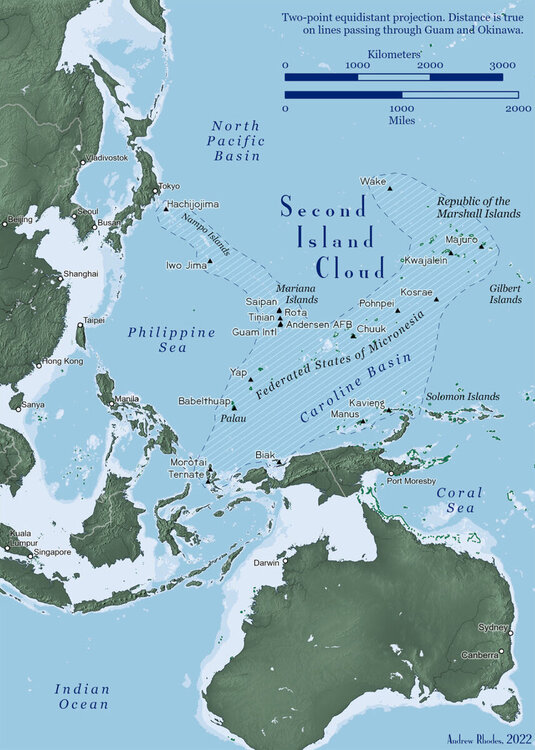
Today, let’s pick up where we left off yesterday and return to a discussion of the Western Pacific. More often than not, things devolve into a discussion of island chains. They are easy to draw and explain—and the First and Second Island Chains have become an expected understanding of the geography of the area. Is this really the best way to think about it? Are we really looking at a neat and easy chain, or something a bit more complicated, difficult, resilient, and more open to opportunity for those who understand its true nature? Do you know who Lieutenant Colonel Earl Hancock “Pete” Ellis, USMC is? You should, we all should. His life story really needs a mini-series like from team that made Netflix’s Death by Lightning, but perhaps that is for another day. The below is from the 4th Quarter 2019’s Joint Forces Quarterly by Rhodes Cartography’s own Andrew Rhodes, from an essay he wrote while a student at the U.S. Naval War College. It won the Strategic Research Paper category of the 2019 Chairman of the Joint Chiefs of Staff Strategic Essay Competition. You really should read it in full, but I want to pull out the core of the discussion of Ellis’s view of what we today call the Second Island Chain. It has convinced me that the People’s Republic of China’s strategic planners understand Ellis’s point a lot more than ours do—and they’re acting on it. In the early 20th century, the visionary Marine officer Earl “Pete” Ellis compiled remarkable studies of islands in the Western Pacific and considered the practical means for the seizure or defense of advanced bases. A century after Ellis’s work, China presents new strategic and operational challenges to the U.S. position in Asia, and it is time for Washington to develop a coherent strategy, one that will last another 100 years, for the islands of the Western Pacific. It has become common to consider the second island chain as a defining feature of Pacific geography, but when Ellis mastered its geography, he saw not a “chain,” but a “cloud.” He wrote in 1921 that the “Marshall, Caroline, and Pelew Islands form a ‘cloud’ of islands stretching east and west.” His apt description of these archipelagoes serves well for a broader conception of the islands in, and adjacent to, traditional definitions of the second island chain. A new U.S. strategy should abandon the narrow lens of the “chain” and emphasize a broader second island cloud that highlights the U.S. regional role and invests in a resilient, distributed, and enduring presence in the Pacific. … A growing body of operational literature on new concepts for combat logistics in the Pacific has developed recently, some of it hearkening back to World War II and the anchorages surveyed by the likes of Ellis.26 Expeditionary “forward arming and refueling points” at tertiary airports offer the potential of much more dynamic airpower, particularly with aircraft capable of operating from austere facilities.27 The ability to rearm combatants, and potentially even submarines from support ships in sheltered anchorages, rather than pierside at established bases, offers a new take on an old concept to regenerate naval combat power despite the Western Pacific threat environment.28 All these concepts are directly compatible with the second island cloud concept and would benefit from peacetime infrastructure investment throughout the islands.29 … Ellis’s description of an island cloud aptly captures the complexity and diversity of the key geography and provides a framework for lasting and dispersed strength—chains fail with a single weak link, but clouds are resilient. The argument for a durable commitment to the second island cloud in the 21st century is much the same as what Ellis wrote in 1913: “Once secure it will stand as a notice to all the world that America is in the Western Pacific to stay.”48 Ellis did not live to see WWII, but his understanding of the geography of the Pacific did, and it applies still today. This Substack is reader-supported. To receive new posts and support my work, consider becoming a free or paid subscriber. Share Leave a comment View the full article
-
The Royal Netherlands Air and Space Force will receive three additional NH90 NATO Frigate Helicopters (NFHs) under a new contract signed today between NHIndustries (NHI) and the NATO Helicopter Management Agency (NAHEMA), further expanding the Dutch Navy’s maritime aviation fleet. According to a press release from NHIndustries, the helicopters will be assembled by Leonardo in […]View the full article
-
I first saw this map three years ago, and it recently resurfaced in my thoughts. I remain convinced that a lot of the problem with trying to get everyone to fully understand the challenge in the Western Pacific is that to a large part, we think in a ‘north-up’ orientation. I don’t think that is all that helpful. Just a few days ago, we had another Pearl Harbor Day anniversary and we’ve all seen the maps, usually centered on Hawaii, where the Imperial Japanese Navy’s Kidō Butai comes at the Pacific Fleet from stage left off the map. Then we fought battles in the Coral Sea, Midway, and so on. To the lay eye — or to those who don’t have time to dig into the reasons — a traditional north-up map looks disjointed; things seem all over the place. No, not really. Let’s bring back that first map. For both Imperial Japan in the early-mid 20th century and Communist China today, the most important part of this map is the access to the resources in or going through the bottom-right hand corner. Today’s greatest bone of contention — not unrelated to the most important part of the map mentioned above — is Taiwan, right at the mouth of the funnel. If we need to bring a fight there, that is one hell of a fight to get there if the People’s Republic of China (PRC) wants to prepare a proper welcome for us. For the PRC, the primary military threat to plan for comes across the Pacific into a funnel that terminates at its most important SLOC. It’s the United States of America, and the US has a series of islands leading right into the heart of the PRC’s. It starts in Hawaii — Midway, Wake, Guam — and then to U.S. allies: the Philippines, Japan, and Australia. They’re planning a layered defensive fight. Their actions make that clear. Make no mistake, we may say we are going to “defend Taiwan”, but to do that we will have to fight an aggressive war across the Pacific, into the enemy’s prepared funnel. To build up real power, the US and her allies will need Japan, of course, but also Australia and the islands to her north. If you can blunt the Hawaii/Midway/Wake/Guam spear, and then take away any possible southern flanking movement by taking the string of islands from Singapore to Samoa—you can keep the American Navy on their side of the International Date Line—where, in your mind, they belong. If the PRC can prepare the battlefield in peace, then when war comes, she will be more than just a few steps ahead of your enemy and if anything else, will make any attempt to come to the Western Pacific a costly endeavor even before getting in range of Taiwan and PRC proper. That is why for a long time we have been beating the drum along with our friends Cleo Paskal, Brent Sadler, and others about the Marshall and Gilbert Islands, brave little Palau, the Caroline Islands, the Federated States of Micronesia … all those islands. The PRC can read history and look at charts too. Look at the chart again. What island do you see right between Palau and Guam? That’s right, Yap. Head 110T about 365 nautical miles from there, and you have the island of Woleai. About 1/3 of the way from Yap to Woleai, and slightly north, is Ulithi. The irreplaceable Cleo is tapping us on the shoulder again. Let me give you the 100,000 foot view. You can barely see the once overgrown Imperial Japanese airfield next to Falealop. It has been inoperable since 1992…the dawn of the Jesus Jones Era. Oops. History is back, and she’s a bit pissed. There is no reason to have an airfield there besides why the Imperial Japanese built one…for military purposes. To help control/threaten the approaches to the Western Pacific from the United States. Big difference now is that modern weapons give such bases much more of a reach. There is no industry there. No prospects for tourism on a disaggregated atoll with only 1,000 souls that would justify that airfield. Remember what Ulithi meant in the last Great Pacific War? Tick tock. China is can’t stop, won’t stop. Are we paying attention? Map credit to Rhodes Cartography. Leave a comment Share This Substack is reader-supported. To receive new posts and support my work, consider becoming a free or paid subscriber. View the full article

-
South Korean defense startup Nearthlab has successfully demonstrated its KAiDEN autonomous interceptor drone during a live fire test hosted for representatives from L3Harris Technologies. In a post shared by Chief Strategy Officer and Executive Vice President Andrew D. Kim, the company described the intercept as “flawless,” adding that the “one shot, one kill” demonstration proved […]View the full article
-
Croatia has formally signed a contract to acquire 18 CAESAR 6×6 MkII self-propelled howitzers and 15 Serval armored vehicles from French defense manufacturer KNDS, the company announced on December 9. The agreement is part of Croatia’s ongoing efforts to modernize its artillery and mechanized forces. According to a statement from KNDS France, the signing took […]View the full article
-
Rani Plaut, CEO of the Israeli aerospace startup AIR, says recent global crises have revealed a central lesson for military and civilian planners alike: “mobility is power.” In a detailed statement on the company’s vision for next‑generation aerial logistics, Plaut said uncrewed aerial systems have become essential for reconnaissance and rapid tactical response, but remain […]View the full article
-
Ukrainian assault troops have used an armed unmanned vehicle to intercept and disable a Russian armored vehicle during an attempted nighttime attack, according to a statement released by the 5th Kyiv Assault Brigade on December 10. The unit published thermal camera footage showing the Droid robotic combat system engaging an enemy MT-LB with mounted infantry […]View the full article
-
Newly surfaced footage has confirmed for the first time that Russia is operating modified Shahed‑136 one‑way attack drones—produced domestically as Geran‑2—with under‑wing payloads containing PTM‑3 anti‑tank mines. The video, recorded by a Ukrainian interceptor drone during an engagement, captures the moment a Russian drone ejects its KPТМ canisters, each containing a PTM‑3 mine, before the […]View the full article
-
The United States Air Force has awarded Northrop Grumman Systems Corporation a new ceiling contract worth up to $100 million to advance two key strike‑weapon programs: the Stand‑In Attack Weapon (SiAW) and the Advanced Anti‑Radiation Guided Missile–Extended Range (AARGM‑ER). The agreement supports both production and research and development through December 31, 2034, according to the […]View the full article