HG S2 (Intel Bot)
Members
-
Joined
-
Last visited
Never
Everything posted by HG S2 (Intel Bot)
-
Northrop Grumman, working with the U.S. Air Force, has completed a key flight test of the Stand-in Attack Weapon, or SiAW, validating the missile’s safe separation from an F-16 aircraft, the company announced. According to a press release from Northrop Grumman, the separation test was conducted recently and focused on confirming flight safety and aerodynamic […]View the full article
-
A United States Air Force B-52 Stratofortress has completed a ferry flight to Edwards Air Force Base, California, following installation of a new radar as part of the B-52 Radar Modernization Program, the Air Force announced. According to a release from Secretary of the Air Force Public Affairs, the aircraft flew from Boeing’s facility in […]View the full article
-
The Netherlands has signed a contract to acquire new short-range air defense systems designed to protect the country against drones, marking a further step in strengthening national and military air defense capabilities. According to a news release dated Dec. 11, the Dutch Ministry of Defense signed the contract in Soesterberg for the procurement of Skyranger […]View the full article
-
The Pentagon is rapidly expanding U.S. military capabilities tied to Operation Southern Spear, a mission that began as a counter-narcotics effort but is increasingly focused on pressure against Venezuelan leader Nicolas Maduro. Images that surfaced online this week show Combat Search and Rescue and other U.S. military aircraft arriving in Puerto Rico, signaling a sharp […]View the full article
-
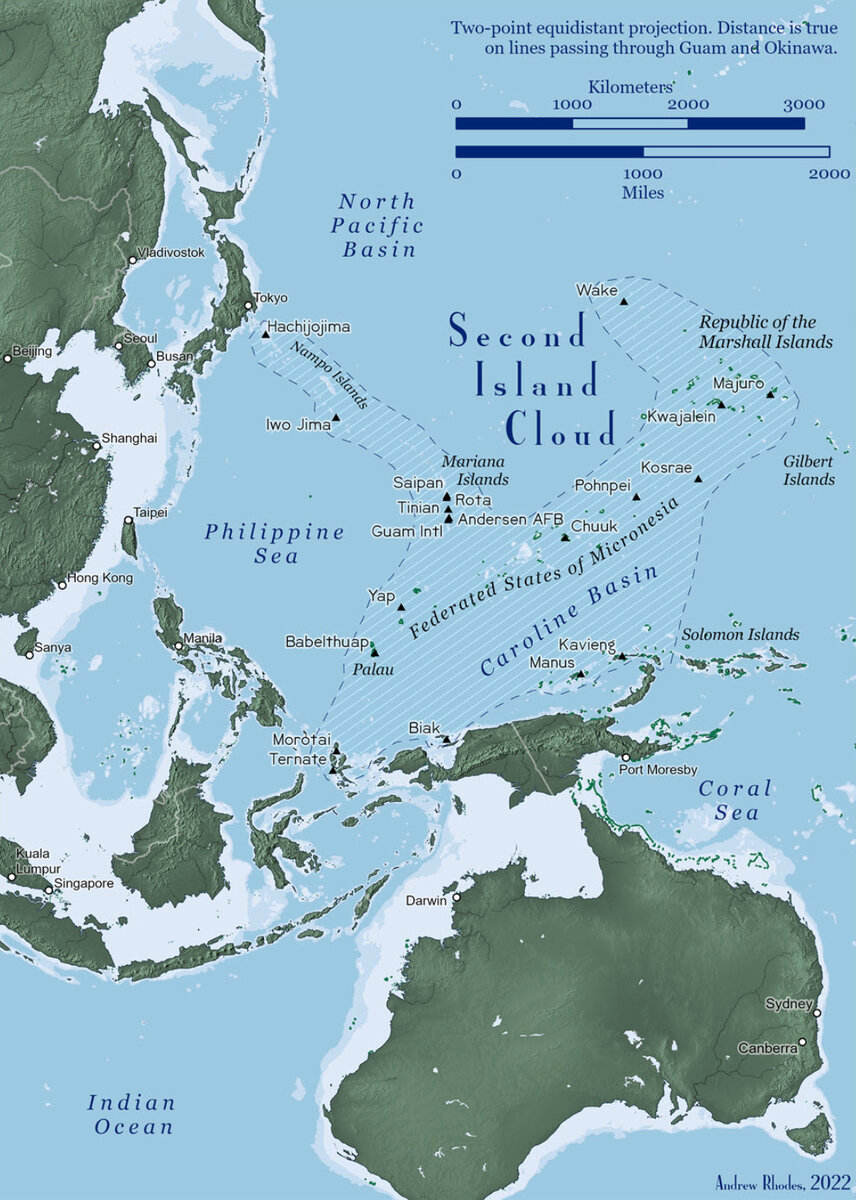
Today, let’s pick up where we left off yesterday and return to a discussion of the Western Pacific. More often than not, things devolve into a discussion of island chains. They are easy to draw and explain—and the First and Second Island Chains have become an expected understanding of the geography of the area. Is this really the best way to think about it? Are we really looking at a neat and easy chain, or something a bit more complicated, difficult, resilient, and more open to opportunity for those who understand its true nature? Do you know who Lieutenant Colonel Earl Hancock “Pete” Ellis, USMC is? You should, we all should. His life story really needs a mini-series like from team that made Netflix’s Death by Lightning, but perhaps that is for another day. The below is from the 4th Quarter 2019’s Joint Forces Quarterly by Rhodes Cartography’s own Andrew Rhodes, from an essay he wrote while a student at the U.S. Naval War College. It won the Strategic Research Paper category of the 2019 Chairman of the Joint Chiefs of Staff Strategic Essay Competition. You really should read it in full, but I want to pull out the core of the discussion of Ellis’s view of what we today call the Second Island Chain. It has convinced me that the People’s Republic of China’s strategic planners understand Ellis’s point a lot more than ours do—and they’re acting on it. In the early 20th century, the visionary Marine officer Earl “Pete” Ellis compiled remarkable studies of islands in the Western Pacific and considered the practical means for the seizure or defense of advanced bases. A century after Ellis’s work, China presents new strategic and operational challenges to the U.S. position in Asia, and it is time for Washington to develop a coherent strategy, one that will last another 100 years, for the islands of the Western Pacific. It has become common to consider the second island chain as a defining feature of Pacific geography, but when Ellis mastered its geography, he saw not a “chain,” but a “cloud.” He wrote in 1921 that the “Marshall, Caroline, and Pelew Islands form a ‘cloud’ of islands stretching east and west.” His apt description of these archipelagoes serves well for a broader conception of the islands in, and adjacent to, traditional definitions of the second island chain. A new U.S. strategy should abandon the narrow lens of the “chain” and emphasize a broader second island cloud that highlights the U.S. regional role and invests in a resilient, distributed, and enduring presence in the Pacific. … A growing body of operational literature on new concepts for combat logistics in the Pacific has developed recently, some of it hearkening back to World War II and the anchorages surveyed by the likes of Ellis.26 Expeditionary “forward arming and refueling points” at tertiary airports offer the potential of much more dynamic airpower, particularly with aircraft capable of operating from austere facilities.27 The ability to rearm combatants, and potentially even submarines from support ships in sheltered anchorages, rather than pierside at established bases, offers a new take on an old concept to regenerate naval combat power despite the Western Pacific threat environment.28 All these concepts are directly compatible with the second island cloud concept and would benefit from peacetime infrastructure investment throughout the islands.29 … Ellis’s description of an island cloud aptly captures the complexity and diversity of the key geography and provides a framework for lasting and dispersed strength—chains fail with a single weak link, but clouds are resilient. The argument for a durable commitment to the second island cloud in the 21st century is much the same as what Ellis wrote in 1913: “Once secure it will stand as a notice to all the world that America is in the Western Pacific to stay.”48 Ellis did not live to see WWII, but his understanding of the geography of the Pacific did, and it applies still today. This Substack is reader-supported. To receive new posts and support my work, consider becoming a free or paid subscriber. Share Leave a comment View the full article
-
The Royal Netherlands Air and Space Force will receive three additional NH90 NATO Frigate Helicopters (NFHs) under a new contract signed today between NHIndustries (NHI) and the NATO Helicopter Management Agency (NAHEMA), further expanding the Dutch Navy’s maritime aviation fleet. According to a press release from NHIndustries, the helicopters will be assembled by Leonardo in […]View the full article
-
I first saw this map three years ago, and it recently resurfaced in my thoughts. I remain convinced that a lot of the problem with trying to get everyone to fully understand the challenge in the Western Pacific is that to a large part, we think in a ‘north-up’ orientation. I don’t think that is all that helpful. Just a few days ago, we had another Pearl Harbor Day anniversary and we’ve all seen the maps, usually centered on Hawaii, where the Imperial Japanese Navy’s Kidō Butai comes at the Pacific Fleet from stage left off the map. Then we fought battles in the Coral Sea, Midway, and so on. To the lay eye — or to those who don’t have time to dig into the reasons — a traditional north-up map looks disjointed; things seem all over the place. No, not really. Let’s bring back that first map. For both Imperial Japan in the early-mid 20th century and Communist China today, the most important part of this map is the access to the resources in or going through the bottom-right hand corner. Today’s greatest bone of contention — not unrelated to the most important part of the map mentioned above — is Taiwan, right at the mouth of the funnel. If we need to bring a fight there, that is one hell of a fight to get there if the People’s Republic of China (PRC) wants to prepare a proper welcome for us. For the PRC, the primary military threat to plan for comes across the Pacific into a funnel that terminates at its most important SLOC. It’s the United States of America, and the US has a series of islands leading right into the heart of the PRC’s. It starts in Hawaii — Midway, Wake, Guam — and then to U.S. allies: the Philippines, Japan, and Australia. They’re planning a layered defensive fight. Their actions make that clear. Make no mistake, we may say we are going to “defend Taiwan”, but to do that we will have to fight an aggressive war across the Pacific, into the enemy’s prepared funnel. To build up real power, the US and her allies will need Japan, of course, but also Australia and the islands to her north. If you can blunt the Hawaii/Midway/Wake/Guam spear, and then take away any possible southern flanking movement by taking the string of islands from Singapore to Samoa—you can keep the American Navy on their side of the International Date Line—where, in your mind, they belong. If the PRC can prepare the battlefield in peace, then when war comes, she will be more than just a few steps ahead of your enemy and if anything else, will make any attempt to come to the Western Pacific a costly endeavor even before getting in range of Taiwan and PRC proper. That is why for a long time we have been beating the drum along with our friends Cleo Paskal, Brent Sadler, and others about the Marshall and Gilbert Islands, brave little Palau, the Caroline Islands, the Federated States of Micronesia … all those islands. The PRC can read history and look at charts too. Look at the chart again. What island do you see right between Palau and Guam? That’s right, Yap. Head 110T about 365 nautical miles from there, and you have the island of Woleai. About 1/3 of the way from Yap to Woleai, and slightly north, is Ulithi. The irreplaceable Cleo is tapping us on the shoulder again. Let me give you the 100,000 foot view. You can barely see the once overgrown Imperial Japanese airfield next to Falealop. It has been inoperable since 1992…the dawn of the Jesus Jones Era. Oops. History is back, and she’s a bit pissed. There is no reason to have an airfield there besides why the Imperial Japanese built one…for military purposes. To help control/threaten the approaches to the Western Pacific from the United States. Big difference now is that modern weapons give such bases much more of a reach. There is no industry there. No prospects for tourism on a disaggregated atoll with only 1,000 souls that would justify that airfield. Remember what Ulithi meant in the last Great Pacific War? Tick tock. China is can’t stop, won’t stop. Are we paying attention? Map credit to Rhodes Cartography. Leave a comment Share This Substack is reader-supported. To receive new posts and support my work, consider becoming a free or paid subscriber. View the full article

-
South Korean defense startup Nearthlab has successfully demonstrated its KAiDEN autonomous interceptor drone during a live fire test hosted for representatives from L3Harris Technologies. In a post shared by Chief Strategy Officer and Executive Vice President Andrew D. Kim, the company described the intercept as “flawless,” adding that the “one shot, one kill” demonstration proved […]View the full article
-
Croatia has formally signed a contract to acquire 18 CAESAR 6×6 MkII self-propelled howitzers and 15 Serval armored vehicles from French defense manufacturer KNDS, the company announced on December 9. The agreement is part of Croatia’s ongoing efforts to modernize its artillery and mechanized forces. According to a statement from KNDS France, the signing took […]View the full article
-
Rani Plaut, CEO of the Israeli aerospace startup AIR, says recent global crises have revealed a central lesson for military and civilian planners alike: “mobility is power.” In a detailed statement on the company’s vision for next‑generation aerial logistics, Plaut said uncrewed aerial systems have become essential for reconnaissance and rapid tactical response, but remain […]View the full article
-
Ukrainian assault troops have used an armed unmanned vehicle to intercept and disable a Russian armored vehicle during an attempted nighttime attack, according to a statement released by the 5th Kyiv Assault Brigade on December 10. The unit published thermal camera footage showing the Droid robotic combat system engaging an enemy MT-LB with mounted infantry […]View the full article
-
Newly surfaced footage has confirmed for the first time that Russia is operating modified Shahed‑136 one‑way attack drones—produced domestically as Geran‑2—with under‑wing payloads containing PTM‑3 anti‑tank mines. The video, recorded by a Ukrainian interceptor drone during an engagement, captures the moment a Russian drone ejects its KPТМ canisters, each containing a PTM‑3 mine, before the […]View the full article
-
The United States Air Force has awarded Northrop Grumman Systems Corporation a new ceiling contract worth up to $100 million to advance two key strike‑weapon programs: the Stand‑In Attack Weapon (SiAW) and the Advanced Anti‑Radiation Guided Missile–Extended Range (AARGM‑ER). The agreement supports both production and research and development through December 31, 2034, according to the […]View the full article
-
Oshkosh Defense has secured a $49.2 million contract to convert and deliver upgraded cargo vehicles for the United States Marine Corps, the Department of War announced. According to a release, the contract calls for Oshkosh Defense LLC of Oshkosh, Wisconsin, to convert an undisclosed number of Medium Tactical Vehicle Replacement (MTVR) Extra Long Wheelbase cargo […]View the full article
-
SIG SAUER announced on Tuesday that the Swiss Armed Forces have officially selected the P320 pistol as their new standard-issued sidearm. The decision is part of Switzerland’s broader New Generation Project aimed at modernizing core equipment for its military personnel. According to a company statement, the selection followed a rigorous competitive process conducted by Armasuisse, […]View the full article
-
MatrixSpace, a Massachusetts-based developer of compact radar systems, has announced the launch of its Portable 360 Radar, a low-power counter-drone radar system designed to rapidly deploy in diverse operational settings ranging from public event security to military environments. In a release dated December 9, 2025, MatrixSpace said the system provides 360-degree panoramic surveillance coverage for […]View the full article
-
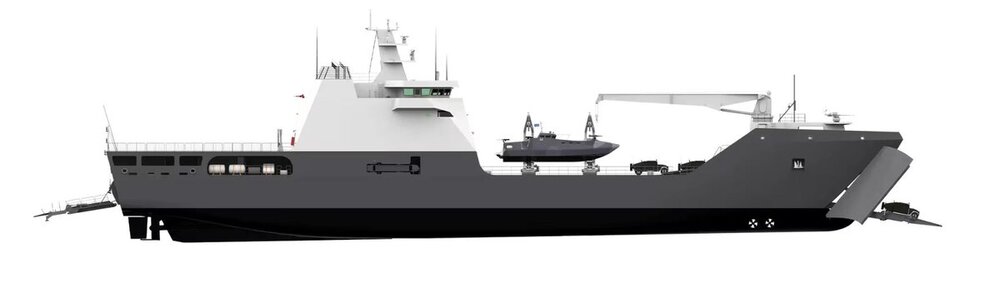
Last Friday, we got an answer to one of the questions we had after the CANX of the Constellation FFG: what next? TWZ has a good summary of the hard data in the above video. “Last month, with the concurrence of the Commandant [of the Marine Corps] and the Chief of Naval Operations, I approved the LSM design selection [of] the LST-100 landing ship transport, a roughly 4,000-ton ship with a range of more than 3,400 nautical miles that gives us the right balance of capability, affordability, and speed to field.” The baseline LST-100 design is approximately 328 feet (100 meters) long, some 52.5 feet (16 meters) wide, and can reach a top speed of 15 knots, according to Damen. It did not come out of nowhere, the Medium Landing Ship has been bouncing around for awhile as a way to make the USMC’s controversial Expeditionary Advanced Base Operations (EABO) happen. So, we don’t really have a new class of ship to “replace” the cancelled Constellation-class. No, this was supposed to happen anyway. The fact remains that we have failed, once again, to build a successful class of surface combatant since the Cold War. LCS, DDG-1000, CG(X), and now FFG-62—covering the spectrum of either a fraction of the utility they were hoped to be or never leaving the PPT. Will we get DDG(X) right? We’ll see, but until then, we shall build Arleigh Burkes until the crack of doom. The US Navy is not the first customer. The Dutch shipbuilders Damen had a proven design that the Australians picked a year ago as their “Landing Craft Heavy” to be built by Australian shipbuilder Austal in Western Australia. The Nigerians ordered theirs even earlier. The Australians expect it to, …be capable of carrying more than 500 tonnes of military vehicles and equipment – it is intended to carry six Abrams Tanks, 11 Redback Infantry Fighting Vehicles or 26 HIMARS – and will be fitted with self-defence weapons systems and Australian military communications. Expect the US Navy’s version to be almost exactly the same. The US Navy decommissioned its last LST, the USS Frederick (LST-1184) on October 5, 2002. A Newport-class tank landing ship, she came in at 4,793 displacement, 159 meters in length, a top speed of 22 knots, and a ship’s company of 213 Sailors. The prior LST class before Newport were the De Soto County-class at 3,560 tons, 136 meters in length, a top speed of 17.5 knots, and a ship’s company of 172 Sailors. The Damen LST 100 comes in at 4,000 tons, 100 meters, and a top speed of 15 knots. It is not your father’s or grandfather’s LST…but it has one thing that no one else has—it is a mature design. Yes, I know. So was the Franco-Italian FREMM that the Constellation-class came from, but perhaps we are a learning institution. Perhaps. One thing I am VERY interested in hearing more about is the manning of the Damen 100. From their website, it has a crew of <checks notes> 18. Yes, I have lots of questions about maintenance, watchstanding, endurance, etc…but let’s see what they have to say about the CONOPS for these ships. We’ll find out soon enough. …construction of the first ship expected to begin in 2026. According to current planning, this schedule would allow the first vessel to enter service in 2029. The U.S. Navy and U.S. Marine Corps foresee a requirement for about 35 ships, and to accelerate progress and limit costs they do not intend to introduce major changes to Damen’s baseline design. Adjustments are expected only where U.S. standard solutions are needed and to ensure compatibility with the equipment, armament and aircraft used by the U.S. Navy and Marine Corps. … At the time of the December announcement, an agreement was concluded for the purchase of design rights worth 3.3 million U.S. dollars. This will allow the Department of the Navy to select shipyards for each phase of the programme, covering construction, maintenance and later upgrades, with the aim of involving as many yards as possible. The LSM class is intended to enable the efficient movement of Marine Corps combat groups across the Pacific between small islands and atolls. Their technical and tactical characteristics are expected to allow safe operation in areas exposed to potential adversary weapons, complementing the larger amphibious transport docks that form the core of expeditionary groups. Again…the manning. These have to be USS as they will be going in harm’s way, will be armed, probably with a MK-46 30mm autocannon we also have on LPD-17 and DDG-1000 if I were a betting man. Could it be up-gunned to a OTO Melara 76 mm? Probably not…but one could dream. Let’s round things up to 25 Sailors in ship’s company? That ain’t a Commander command. That right there is a Lieutenant command with a LTjg XO and a couple of Ensigns with the rest enlisted personnel. 18? 25? Really? Huh. With that speed, they need to be forward based. A bunch of LT commanded ships based in The Philippines. OK. Get a good JAG for the Commodore. Darwin? Probably not Singapore. This will be interesting to see fleshed out. Now, let’s talk about program risk mitigation with DDG(X)… Leave a comment Share This Substack is reader-supported. To receive new posts and support my work, consider becoming a free or paid subscriber. View the full article
-
Turkish-built Ejder TTZA 6×6 armored personnel carriers were unveiled for the first time during a military parade held in Damascus celebrating the fall of the Assad regime, marking the public debut of the vehicles in Syrian service. The parade, staged by the new authorities in Damascus, featured multiple examples of the Ejder TTZA—short for Taktik […]View the full article
-
South Korea has finalized a new production contract for its K600 Rhino obstacle-clearing combat engineering tank, marking the first time the vehicle will be supplied directly to frontline Army units and the Republic of Korea Marine Corps. According to an announcement carried by Yonhap News, Hyundai Rotem said on December 9 that it signed a […]View the full article
-
A Russian An-22 heavy-lift military transport aircraft has crashed in the Furmanovsky district of Ivanovo Region, according to initial reports from Russian media. The incident occurred on December 9 and involved a military aircraft identified as an An-22 “Antei.” The aircraft reportedly carried seven crew members at the time of the crash. Their status remains […]View the full article
-
Nine Chinese and Russian military aircraft briefly entered South Korea’s air defense identification zone (KADIZ) on Tuesday, prompting the South Korean Air Force to dispatch fighter jets as a precautionary response, according to the country’s Joint Chiefs of Staff (JCS). The JCS said two Chinese military planes and seven Russian aircraft entered the KADIZ sequentially […]View the full article
-
The U.S. Navy has recovered an F/A‑18F Super Hornet and an MH‑60R Seahawk from the seafloor after both aircraft were lost in separate mishaps off the USS Nimitz (CVN 68) on October 26, 2025. According to the Navy, the two aircraft suffered accidents within a half‑hour of each other. The recovery operation was completed on […]View the full article
-
The U.S. Department of State has approved a potential Foreign Military Sale to the Government of Belgium for up to 240 Hellfire missiles, along with a broad package of support equipment and services, at an estimated cost of $79 million. The Defense Security Cooperation Agency (DSCA) announced that it has delivered the required certification notifying […]View the full article
-
The United States Navy has awarded Saronic a $392 million production contract to rapidly deliver drone boats under the Other Transaction Authority (OTA) framework. Secretary of the Navy John C. Phelan said nearly $200 million of that total has already been obligated, as the service pushes forward with a new model of fast-paced, open-competition procurement […]View the full article
-
The Security Service of Ukraine (SBU) has released a new recruitment video featuring a robotic dog armed with an assault rifle. The promotional clip, published this week by the SBU, includes footage from tactical training exercises in which a quadrupedal unmanned ground vehicle, resembling a robotic dog, is seen maneuvering indoors and firing a rifle. […]View the full article