


HG S2 (Intel Bot)
Members
-
Joined
-
Last visited
Never
Everything posted by HG S2 (Intel Bot)
-
Documents circulating on social media suggest that Russia’s Progress helicopter plant may have evaluated the possible production of Ka-52M attack helicopters for a foreign customer, with online speculation pointing to potential interest from China. The documents have not been independently verified, but they appear to be internal correspondence from Arsenyev Aviation Company Progress, the Russian […]View the full article
-
As Ajay Patel outlines in his white paper, …the United States Navy’s Constellation-class frigate program (was) not as a case of technical failure or flawed contracting, but as a breakdown in sustained stewardship over a sound acquisition construct. The program was conceived to adapt a mature, serially produced parent design; expand the U.S. surface-combatant industrial base; and impose cost discipline through a fixed-price structure that depended on preserving design stability and commonality. That construct remained coherent through early execution and even through extraordinary external disruption during the Covid-19 pandemic. The program did not fail because it proved infeasible. It became vulnerable when the continuity of senior ownership eroded. During a narrow period between mid-2022 and mid-2023, the program’s central premise—reliance on a proven parent design to control risk, cost, and schedule—was no longer actively defended as directed changes accumulated to comply with historical Navy shipbuilding specifications. Absent deliberate reconstitution of that premise, contractual and technical alignment degraded, and the program’s recovery pathways narrowed. … What ultimately undermined the Constellation class program was not insufficient compliance, but the Navy’s subsequent pursuit—particularly within NAVSEA—of near-total clean sheet design specification conformance after contract award. That shift displaced the program’s foundational premise, transforming a heritage-based adaptation into a de facto new-design effort without a corresponding reset of cost, schedule, or governance. His paper is worth a full read. It isn’t short, but it is worth your time. Indeed, Plankholding members of the Front Porch know, the need to have a proper frigate is something we have been discussing in these spaces for—literally two decades. The path that became FFG(X) was first recommended here over a decade and a half ago. No need to replow that field. New readers can research here and at the OG Blog themselves if needed. The Flight-I grey-hulled cutter—really an FF and not an FFG—does not answer the bell for a proper multi-mission frigate with a primary focus on anti-submarine warfare (ASW). ASW is a perishable skill at the tactical, operational, and strategic level. You cannot just rely on submarines, aviation, or surface to do it properly. You need high readiness in all three warfare areas to do it properly. For those of us who have done no-kidding non-permissive ASW working with all three at once—it is science, art, and ballet. Yes, the Arleigh Burke DDGs are great ASW platforms…but they have a higher and best use. We need that ASW frigate. That requirement cannot change. Let’s go back to the Constellation Class FFG. Remember, it was supposed to be an American version of the Franco-Italian FREMM that it was derived from. What are the existing FREMM up to? The “Hook’em Award” rewards Anti-Submarine Warfare (ASW) excellence. It is presented quarterly to a unit supporting U.S. Navy’s 6th Fleet (also known as US Naval Forces Europe) which has demonstrated superior ASW readiness, proficiency, and operational impact. Vice Adm. Frederick C. Turner established the “Hook ‘Em” award in December 1975 to recognize 6th Fleet’s ships, submarines, and aircraft squadrons demonstrating ASW excellence. The award was discontinued two decades later, but it was reestablished by Adm. James G. Foggo III in 2016 during his tenure as Commander, US 6th Fleet. So much sucked in the mid-1990s in the Navy. This award of excellence was presented in Naples by Commodore Doug Sattler (CTF 69) to the commander of crew B of the FREMM Aquitaine, for the performance of his unit during anti-submarine operations in the North Atlantic during the year 2025. Usually awarded to American units, this quarterly prize created in 1975 is once again given to a French unit. It thus marks the recognition of French know-how and the high degree of confidence accorded by our American partners, in a particularly strategic area for the security of allied operations in the Atlantic. The ultra-performing sensors and information processing, analysis and intervention capabilities of the FREMMs and their embarked Caïman Marine helicopter make them formidable submarine hunters. Trained and skilled, the crews of the Navy have acquired expertise to deploy them in operations. They are now recognized as among the best in the world. I’m sorry Xavier Vavasseur, but I was about to copy-paste about 90% of your article. Instead, I’ll just note that this was the fourth time a French FREMM won the award. You’ll need to read the article for the full details. Le sigh. Leave a comment Share This Substack is reader-supported. To receive new posts and support my work, consider becoming a free or paid subscriber. View the full article

-
American Rheinmetall recently demonstrated its Counter-Unmanned Aerial System (counter-UAS) Ultra-Short Range Air Defense solution during a live-fire event at Big Sandy Range, where the system was tested against small drone targets. The demonstration included the integration of the remote weapon station onto GM Defense’s Infantry Squad Vehicle-C (ISV-C) platform. According to information released by American […]View the full article
-
The United States Navy resumed testing of its electromagnetic railgun weapon system in February 2025 at the White Sands Missile Range in New Mexico, according to a recent review published by Naval Sea Systems Command. The renewed testing effort comes after the railgun program had largely been paused for several years due to budget constraints […]View the full article
-
The Norwegian Armed Forces scrambled two F‑35 Lightning II fighter jets to intercept and identify a Russian Ilyushin Il‑20M reconnaissance aircraft flying in international airspace off Finnmark in northern Norway. Norwegian sensors detected the aircraft around 09:30 local time, prompting a Quick Reaction Alert mission from Evenes Air Station. The interception occurred as NATO conducts […]View the full article
-
The United States Navy has awarded a $19.5 million contract modification to General Dynamics Bath Iron Works to continue engineering and technical support for the Navy’s Zumwalt-class destroyers, according to a contract announcement. Most of the work will take place in Bath, Maine, and is scheduled to run through March 2027. The contract allows the […]View the full article
-
Germany has overtaken China to become the world’s fourth-largest arms exporter, according to a new global weapons transfer report released by the Stockholm International Peace Research Institute (SIPRI). The annual assessment reviews major conventional weapons transfers worldwide during the 2021–2025 period and shows Germany moving ahead of China in total export volume. The shift reflects […]View the full article
-
A Latvian defense company has presented its UNHUMAN unmanned ground vehicle (UGV) during the Griffin Tech Days 2026 exercises hosted by Finnish Special Forces at the Rovajärvi Training Area in northern Finland. The robotic vehicle was demonstrated in genuine Arctic conditions northeast of Rovaniemi, where temperatures dropped to –27°C. The UNHUMAN UGV, developed by Latvia-based […]View the full article
-
U.S.-based iRocket announced the successful completion of a test flight of its iRX-100 missile integrated with a launcher supplied by Arnold Defense, confirming the system’s compatibility and operational performance. The company said the missile reached Mach 2 and traveled approximately six kilometers during the demonstration, validating its use with Arnold Defense’s launcher platform. According to […]View the full article
-
REGENT Craft announced on March 11 that it has begun its 2026 sea trial campaign for the Viceroy Seaglider prototype and the autonomous Squire Seaglider drone at the company’s headquarters in North Kingstown, Rhode Island. The testing program is part of an effort to validate a new category of high-speed maritime vehicles designed for both […]View the full article
-
Germany-based Quantum Systems on March 11 announced a partnership with Daimler Truck aimed at developing unmanned military logistics vehicles with the MOSAIC Ground Autonomy Kit. The announcement was made during the LogNet 2026 conference in Koblenz, where the companies outlined plans to integrate autonomous driving and teleoperation technologies into military truck platforms. According to Quantum […]View the full article
-
U.S. Central Command on March 11 released new video footage showing strikes against Iranian weapons systems during the ongoing Operation Epic Fury, highlighting attacks on missile and drone-related assets across Iran. The command said the campaign has already affected Iran’s ability to launch attacks. The release of the footage comes as U.S. military officials seek […]View the full article
-
Life is short. There is so much to learn with so little time. So many great men with so many stories—and yet, there stand their stories in the library, keys to understanding, just waiting for fate to grant you more time. There are some names that wander in and out of your reading. Often just for humorous moments like learning their nickname. For instance, a U.S. Army general known to his men as, of all things, “Old Iron Tits.” Of course, I’m speaking of General Matthew Ridgway, USA. /img/missing-image.pngA grenade, a first aid kit and … is that a battle ascot? Anyway, back to topic. I mostly remember his advice about Vietnam. He was instrumental in keeping us out in the Eisenhower administration, but with the war engaged a decade later and Johnson looking for a way out, he advised—properly—that losing an unwise and unpopular war was even worse than starting one. I’ll let that sit, but let’s shift to a different subject he was strong on. The last year or so there has been a lot of talk about what General or Flag Officers should or should not do. What they “should” agree or disagree with. What has been lacking in this discussion is a a review of leaders who have found themselves in this position over and over and over in their career—all the way to the very highest levels. I recently ran into Conrad C. Crane’s article from May, 2021 in the U.S. Army War College’s Parameters, titled Matthew Ridgway and the Value of Persistent Dissent. “civilian authorities must scrupulously respect the integrity, the intellectual honesty, of its officer corps. Any effort to force unanimity of view, to compel adherence to some political-military ‘party line’ against the honestly expressed views of responsible officers . . . is a pernicious practice which jeopardizes rather than protects the integrity of the military profession.” Ridgway elaborated on this position in later pages. “I learned early in my career that it is not enough, when great issues are involved, to express your views verbally and let it go at that. It is necessary to put them down in writing, over your signature. In that way they become part of the historical record.” Ridgway believed civilian leaders had the authority to disagree with military advice and take a different course, but he also believed they should bear the responsibility for any outcomes. He condemned “a deliberate effort to soothe and lull the public by placing responsibility where it did not rest, by conveying the false impression that there was unanimous agreement between the civilian authorities and their military advisers.” … Here Ridgway was specifically referring to his open disagreements with the Eisenhower administration on its New Look defense policies, which led to his tenure as chief of staff of the Army lasting only two years. As he also stated in his memoir, “Under no circumstances, regardless of pressures from whatever source or motive, should the professional military man yield, or compromise his judgment for other than convincing military reasons.” He applied similar logic to his treatment of directives from his military superiors. In 1966, Ridgway gave an address at the US Army Command and General Staff College in which he counseled the assembly about opposition to orders. He acknowledged military services properly deal harshly . . . with failure to carry out orders in battle. . . . Yet when faced with different situations from those anticipated, as well as in the transition from plans to orders, there sometimes comes the challenge to one’s conscience, the compelling urge to oppose foolhardy operations before it is too late, before the orders are issued and lives are needlessly thrown away. Ridgway asserted the hardest decisions to make were “those involved in speaking your mind about some harebrained scheme which proposes to commit troops to action under conditions where failure seems almost certain, and the only results will be the needless sacrifice of priceless lives. . . . For a battle commander to ever condone the unnecessary sacrifice of his men is inexcusable.” Quoting General George C. Marshall, he observed, “ ‘It is hard to get men to do this, for this is when you lay your career, perhaps your commission, on the line.’ ” For Ridgway, it did not matter if the “harebrained scheme” came from civilian or military leaders. In his 1966 address, Ridgway cited two examples where he battled to stop “needless sacrifice[s]” while commanding the 82nd Airborne Division in Italy. In one case, he opposed a proposed attack by his division across the Volturno River, over open ground with enemy fire from both flanks and the front, which he considered a suicide mission with only a small chance of success. He initially discussed his opposition with General Lucien Truscott of the 3rd Infantry Division, who agreed with Ridgway’s assessment. Following that discussion, Ridgway took his complaints to his corps commander, and then to the Army commander, before finally getting the operation cancelled. And opposition based on best military judgment did not cease just because a decision had been made to execute the operation. In the second example, Ridgway’s division received orders to drop on Rome in September 1943 for Operation Giant II, in support of landings in Salerno. General Sir Harold Alexander, 15th Army Group commander, told Ridgway he should expect ground forces to link up with him “in three days—five at the most.” Assumptions included light opposition despite six German divisions near the city, and help from the Italians who were ready to sever their alliance with Germany. Ridgway was appalled. The mission would place his division outside the range of supporting fighters and dive-bombers. Moreover, he knew ground forces would never reach the city in time to save his soldiers from a dreadful mauling. While his troops continued to prepare for the operation, Ridgway mounted his campaign to stop it. He reached out to a strong proponent of the operation, General Walter Bedell Smith, then chief of staff for the theater commander, General Dwight D. Eisenhower. Bedell Smith recommended Ridgway approach Alexander. While he did not cancel the drop, Alexander did approve the dispatch of a clandestine delegation, led by Ridgway’s artillery commander Brigadier General Maxwell Taylor, to Rome to assess Italian preparations. Taylor was horrified by what he found and sent four cables supporting cancelling the operation, the last one mere hours before the first aircraft were to take off. By this time, Eisenhower had received further intelligence about the lack of Italian capability and readiness, and after Taylor’s last message, Alexander sent an order to Ridgway cancelling Operation Giant II. But no acknowledgment was received. Eisenhower ordered Brigadier General Lyman Lemnitzer, Alexander’s American deputy, to deliver the cancellation order personally to Ridgway by air. Sixty-two transports were already circling the airfield at Licata when Lemnitzer arrived, and he started frantically shooting flares to get everyone’s attention. The takeoffs stopped, Lemnitzer landed, and he found Ridgway wearing his parachute, preparing to climb into a C-47. Ridgway had spent the day reconciling himself to an operation that would destroy his division, after his failed attempts to dissuade his leadership from this course of action. Immediately, Ridgway recalled paratroopers in the air, while the rest were returned to their bivouacs. “Exhausted and relieved, Ridgway stumbled into a tent where one of his officers sat trembling on a cot. Ridgway poured two drinks from a whiskey bottle, and as darkness fell and calm again enveloped Licata South, they sat slumped together, silent but for the sound of their weeping.” Give Conrad’s article a full read. As for Ridgway, I need to read his book. Leave a comment Share This Substack is reader-supported. To receive new posts and support my work, consider becoming a free or paid subscriber. View the full article

-
The United States Army has placed new orders for MAWL-X1 and DAGIR-V1 weapon-mounted laser systems from B.E. Meyers & Co., the company confirmed in a press release. The contract includes more than 1,000 MAWL-X1 units already delivered in 2025 and an additional order of more than 1,000 MAWL-X1 and DAGIR-V1 systems scheduled for delivery in […]View the full article
-
UK-based SYOS Aerospace said on March 11, 2026, that its SA200 heavy-lift uncrewed helicopter has completed endurance trials and fully autonomous mission testing, clearing the aircraft for serial production. The company confirmed that the SA200 UAV successfully demonstrated autonomous take-off and landing from a moving platform during the final trials. The milestone comes as militaries […]View the full article
-
Ukraine’s BlueBird Tech has developed a new close-range counter-drone device known as the Chipa net gun, designed to intercept first-person-view (FPV) attack drones at short distances on the battlefield. The system fires a specially designed net that opens in mid-air and entangles the drone’s propellers, stopping it before impact. The Ukrainian company said the device […]View the full article
-
The Czech Army has begun testing its first CV90 MkIV infantry fighting vehicle in Sweden, placing the new armored platform through demanding trials in harsh Nordic terrain and winter conditions. The official X account of the Czech Army confirmed that the vehicle is undergoing extensive testing designed to verify that the platform meets the military’s […]View the full article
-
U.S. Marines with Weapons Company, Battalion Landing Team 3/6, 22nd Marine Expeditionary Unit (Special Operations Capable), recently employed the Vector unmanned aerial system during UAS operations at Camp Santiago in Puerto Rico in support of United States Southern Command missions aimed at disrupting illicit trafficking and safeguarding the homeland. Germany-based defense technology company Quantum Systems […]View the full article
-
Aerostat platforms—often seen as an archaic technology that many readers associate with the Second World War—are gaining renewed relevance on the battlefield in Ukraine as they combine with drones and modern reconnaissance systems. In a war shaped by unmanned aircraft, electronic warfare, and rapidly evolving battlefield technology, these tethered platforms are finding a new role […]View the full article
-
The United States Department of War is moving to integrate the Patriot Advanced Capability-3 Missile Segment Enhancement (MSE) interceptor onto U.S. Navy destroyers equipped with the Aegis combat system, according to defense budget documents and reporting by Inside Defense. The plan directs $65 million in fiscal year 2026 reconciliation funding to support integration of the […]View the full article
-
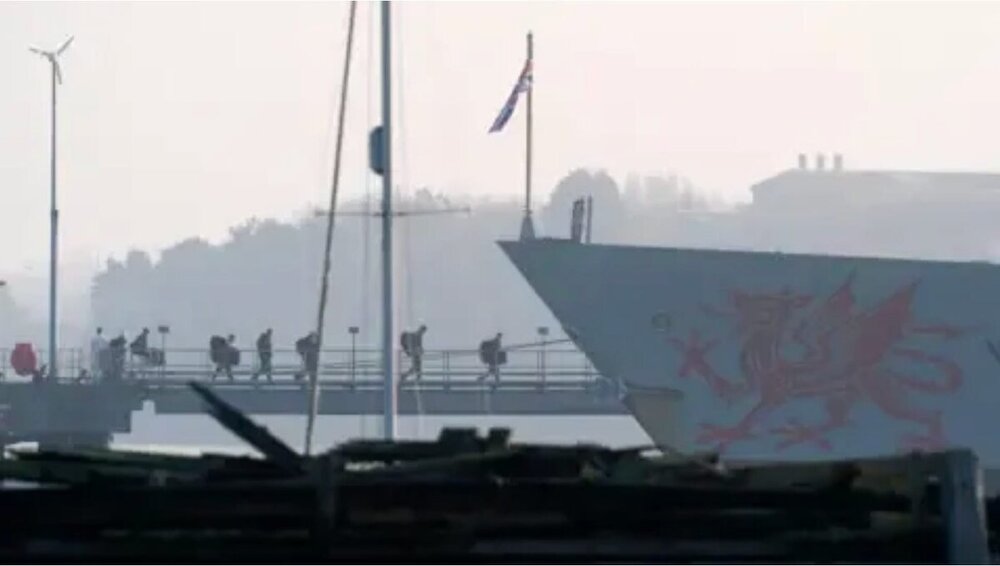
You have to be careful about assumptions, especially those you grew up with that are comforting, convenient, and once seemed so real, so solid, that they just were part of the landscape. They just, were. For over a century, there was one jewel in the special relationship between the United States of America and her mother country, Great Britain. That jewel was the Royal Navy. From the convoys and battleship divisions of the Great War, to Five Inch Friday off the Al Faw almost 90 years later, we always knew that there was another highly capable navy out there we could rely on—the Royal Navy and her Commonwealth. During the interbellum, when the U.S. Navy was on par with the Royal Navy, we knew our friend was strong. Even when we passed her strength as WWII bled her white, we still knew the power she brought to sea. She knew her existence was only secured by a strong navy. She’d never abandon that, would she? During the Cold War, she fought with us sometimes and demurred at others—but regardless, we knew that the closer you came to the North Atlantic, you were in her waters. Regardless of what happened, from the GIUK Gap, north—she would have it covered with our allies, or would be right next to us. From Gibraltar in the west to Cyprus in the east, for centuries no movement was seen or could pass without wondering where the Royal Navy was. Well within living memory, she could sortie a fleet all on her own and retake her territory from a hostile power. That was then. This is now. Let’s put their domestic political issues of today to the side for a moment, and just look at where they are—and where they will be for quite a while. U.S. reality of securing the open seas are a long way from the vanity of denial and delusion such as Mike Mullen’s 1,000 Ship Navy. Even if we have reliable partners, nations have agency. Even if our closest ally of the last century does have the desire to come to our aid at sea—what can she bring? We need to stop pretending we have a Royal Navy we knew in our youth or even that of two decades ago. No, we have something altogether different. Something shrunken. Something weaker. Something that is, in the end, really sad. A symptom of a nation who has lost an enthusiasm for herself or even an understanding of her national interest and led by a ruling class that seems uninterested in stewardship. The state of the Royal Navy—a condition that took decades of neglect to manifest into its form today and will take decades to repair if there is ever the will to do so—has become, as navies can often do, a symbol of the state of the nation it serves. There is a lesson here, not just for the United States, but all nations who consider themselves a naval power. If you fail over and over to properly fund, develop, train, and support your navy, you can coast for quite awhile on the inertia of the hard work and investment of prior generations, but eventually that exhausts itself, and you are left with the husk of your own creation. Yes, I’m looking at you, DC. A token of this problem has revealed itself in all its saddest manifestation. Behold HMS Dragon. Preparations are continuing to get HMS Dragon ready to sail to help protect British troops in Cyprus with confirmation that the earliest she will leave Portsmouth is Wednesday (March 11). The Type 45 destroyer is this afternoon (March 9) at the Portsmouth Upper Harbour Ammunition Facility, and according to tomorrow’s shipping movements she is due to be moved to BOWS S berth in the afternoon. The Royal Navy has said that she will depart some time this week. As previously reported by The News, the government confirmed on March 3 that the UK would be sending the Portsmouth-based warship, one of the Royal Navy’s six Type 45 air defence destroyers, after RAF Akrotiri on Cyprus was hit by a drone. This graphic from The Daily Mail is helpful in understanding not just how small the Royal Navy has become, but how few of its warships are even ready to go to war. If you’re looking for a further fleshing out of the issue, Thomas C. Theiner has a sad tale of woe. Two destroyers and three frigates. HMS Duncan just came back from exercises and for reasons unknown is a worse option than waiting for HMS Dragon to finish fitting out. This is simply one thing: humiliation. The sovereign British bases on Cyprus were attacked by Iran…and the response…well…sigh. Richard the Lionhearted conquered the island first in 1191 just so he could get a break from seasickness on the way to the Crusades (one of my favorite historical maybes), and the British negotiated oversight from the Ottomans in 1878 only to annex it outright in 1914…and yet…well…sigh…the French will have to do it with an assist of the Spanish (!), Italians, and Dutch. One would be hard pressed to find a nation’s ruling elite in the modern era who has so completely failed in the stewardship of their nation’s security. There are rumors that HMS Prince of Wales may be ready for a deployment soon, but there are not enough ships to properly escort her. The Royal Navy will have to go begging to allies. We covered the French deployment yesterday. Yes, as we discussed, it is not sustainable and I’d be curious about their individual unit readiness, but it is a signifiant fleet going to sea. This is not unknown in the United Kingdom. I think, more than most, Jacob Rees-Mogg, outlines the issues well from inside their lifelines. This is a deep-rooted failure of the state to recognize what its duty is. A final postscript to this point, and it isn’t a happy one. It is a very American one. I have great affection for our European allies. I served with them for years. I raised my children in their nations during their most formative years. I will always rise to ask my nation to help them in their times of trouble—but I also have to be realistic towards my own nation’s security requirements. In the next few years, we may very well see this century’s high water mark for European military capabilities, especially at sea. For some, that high water mark is already behind us. Most of our traditional European allies have exhausted their desire to be involved in other people’s conflicts—even when on their doorstep. They no longer concern themselves with larger issues, their ruling elite only concerned with petty social signaling or, increasingly, bending national efforts toward their own personal wealth building. Their deathbed demographics combined with suicidal migration policies have condemned them to a mid-century (which starts in four years for those keeping track) that will be marked by growing sectarian strife, fraying social cohesion, cultural disintegration, and political upheaval. They will be focused on internal challenges with collapsing welfare states, and the resulting movements toward renationalization and subsequent sovereignty conflicts—hot and cold. Whatever the future holds for the U.S. and her friends in the Middle East, the Indo-Pacific, or the Western Hemisphere—we should not expect much of any help from Europe of any significance. In many cases it may not be that they don’t want to, it will simply be that they can’t. Leave a comment Share This Substack is reader-supported. To receive new posts and support my work, consider becoming a free or paid subscriber. View the full article
-
The United States Army has approved the M111 Offensive Hand Grenade for Full Material Release, clearing the weapon for operational use and marking the first new lethal hand grenade approved for service since 1968. The decision allows the Army to begin replacing the aging Mk3A2 grenade series, which has remained in limited use due to […]View the full article
-
The United States has begun relocating Patriot and THAAD missile defense assets from South Korea to the Middle East, according to South Korean media reports. South Korean President Lee Jae-myung acknowledged the movement of United States Forces Korea (USFK) air defense equipment during a cabinet meeting, stating that the redeployment reflects U.S. military requirements tied […]View the full article
-
Iran has used a modified version of its Shahed-101 loitering munition, featuring structural changes and an electric propulsion system, according to reporting cited by the Ukrainian defense outlet Militarnyi. The development reflects ongoing evolution of Iranian one-way attack drones, which have been used in regional conflicts and in Russia’s war against Ukraine. Analysts say design […]View the full article
-
British radar manufacturer Blighter said on March 9 that it signed a contract to supply its ground surveillance radar systems and AI-assisted software to an undisclosed Eastern European army for border protection missions. The agreement will see the company deliver its B400 series ground surveillance radars together with the BlighterNexus AI-assisted software platform, which will […]View the full article