HG S2 (Intel Bot)
Members
-
Joined
-
Last visited
Never
Everything posted by HG S2 (Intel Bot)
-
U.S. Army engineers with the 809th Multi-Role Bridge Company (MRBC), 15th Engineer Battalion, 7th Engineer Brigade, conducted a major river-crossing exercise at the 7th Army Training Command’s Grafenwoehr Training Area in Germany, testing the unit’s ability to deploy quickly and support mobility operations across Europe’s challenging terrain. The 809th MRBC deployed to a designated training […] The post U.S. troops practice rapid bridge deployment in Europe first appeared on Defence Blog.View the full article
-
As strategic competition intensifies in the High North, the United States and its allies are stepping up efforts to strengthen defense cooperation and deterrence in one of the world’s most strategically vital regions. From September 9–12, more than 40 senior military leaders, policymakers, and experts from across the Arctic convened virtually for the 2025 High […] The post U.S. and allies push new defense initiatives in High North first appeared on Defence Blog.View the full article
-
The U.S. State Department has approved a potential $705 million foreign military sale to Australia for M142 High Mobility Artillery Rocket Systems (HIMARS). According to a notification delivered by the Defense Security Cooperation Agency (DSCA) to Congress, the Australian government has requested 48 M142 HIMARS launchers, along with resupply vehicles, trailers, training rockets, communication systems, […] The post Australia to buy 48 HIMARS launchers in $705 million deal first appeared on Defence Blog.View the full article
-
The UK Royal Air Force (RAF) has signed a multi-year enterprise agreement with ST Engineering Antycip to expand its use of advanced simulation technology. The agreement builds on a long-standing collaboration between the RAF and Antycip, Europe’s leading provider of simulation and virtual training solutions. It brings the company’s simulation expertise and the MAK ONE […] The post UK Royal Air Force to build unified synthetic training network with Antycip first appeared on Defence Blog.View the full article
-
The U.S. military has selected Zone 5 Technologies as one of two companies to participate in its Counter NEXT program, an initiative launched by the Defense Innovation Unit (DIU) to rapidly field new systems capable of shooting down or disabling hostile drones — a growing threat in conflicts from Eastern Europe to the Red Sea. […] The post Zone 5 interceptor selected by Pentagon for counter-drone program first appeared on Defence Blog.View the full article
-
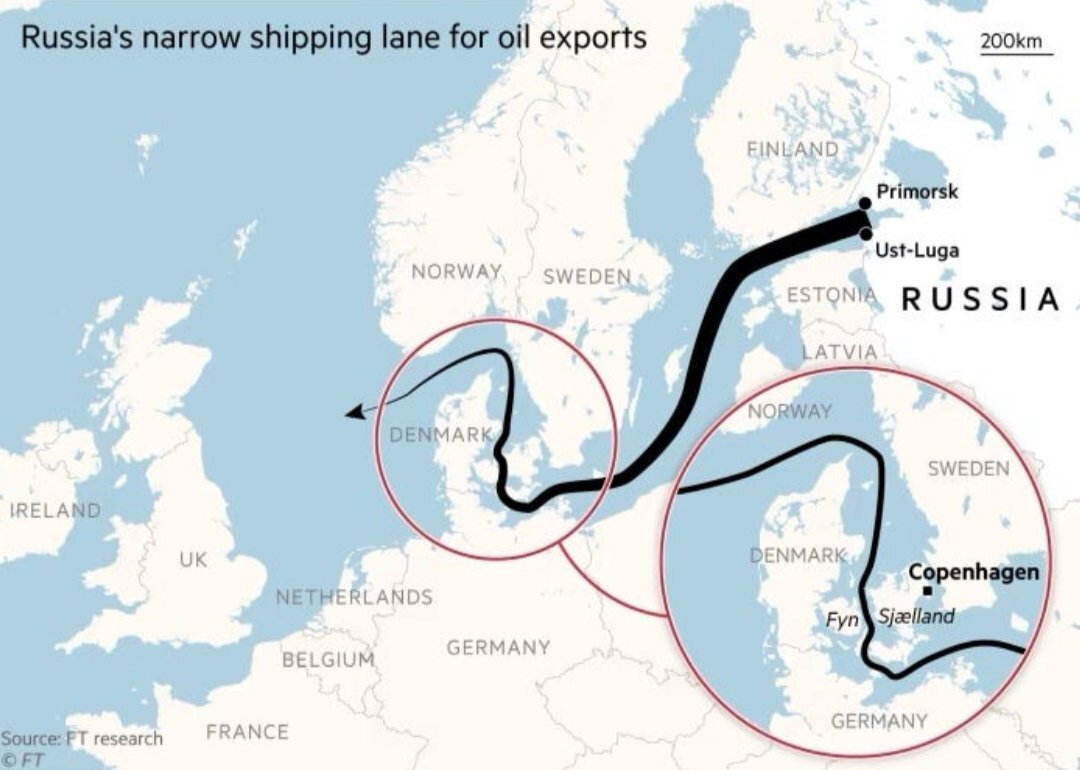
Going from east to west, with a few precious exceptions at the far eastern end at St. Petersburg and occupied Königsberg, the Baltic Sea is not just a NATO lake; NATO controls the gate. Finland, Estonia, Latvia, Sweden, Poland, Germany, Denmark, and Norway—all NATO members, and yet as we are in the 4th year of the Russo-Ukrainian War of 2022 and all the sanctions against Russia, like a drug-addicted cop won’t bust his dealer, the path to the open seas and cash to feed its war remains wide open. However slowly, Western Europe is slowly weaning itself off of its addictions to and fear of Russia. Back in February, you can see the opening play of the latest developments. Denmark has taken its next step in cracking down on Russian-linked shadow tankers passing through its waters. The Danish Maritime Authority will carry out port state controls on tankers it deems high risk who anchor off Skagen in the far north of the country, a popular anchorage. Ships found with safety defects or not having the right papers or insurance risk being detained. Denmark has been leading littoral states around the Baltic in discussing ways to clamp down on ageing tankers carrying Russian oil, following a number of accidents and the severing of cables in the region. Russia sends about a third of its seaborne oil exports through the Danish straits with around one in three of these ships having unknown insurance. Today, some 175 tankers laden with Russian oil transit the Baltic each month, according to Craig Kennedy who runs the Navigating Russia substack. The number of vessels hit by sanctions surpassed 1,000 late last year with data from S&P Global Market Intelligence showing that more 800 of these ships do not have confirmed insurance. Moreover, the average age of sanctioned ships – 21 years – is some eight years older than the global average, adding to growing concern that the sprawling so-called shadow fleet could lead to multiple costly environmental catastrophes. Of course, this wouldn’t be a blockade. That is an act of war. However, I’ll let you sea and admiralty lawyers argue things out in comments, nations have every right to ensure the safety and proper legality of ships in their territorial waters. Ships going to and from Russian Baltic Sea ports on legitimate business meeting all safety and legal requirements should be allowed to come and go under the concept of ‘innocent passage’ as long as they comply with the coastal state’s laws concerning navigation and safety. Denmark’s Skagerrak is the gate to the Baltic. Her NATO allies should be able to generate complete maritime domain awareness of ships approaching the Skagerrak from the east outbound. Likewise, Norway and the other North Sea NATO allies should be able to generate the same in the western approaches inbound. Russia can see the pieces moving into place and is deciding to bully the Danes and NATO into not being difficult. That is why we have this. Denmark has temporarily banned civil drone flights in its airspace as it prepares to host a top European Union meeting on defense and the war in Ukraine, and after a surge of suspicious drone activity at several airports and military sites last week. The ban, which runs from Monday to Friday, aims to eliminate any risk of “hostile” drones being mistaken for legal ones or vice versa, the country’s transport minister Thomas Danielson told CNN. Several unexplained sightings of drones over civilian airports and a military base were reported in Denmark last week. The incidents forced several airports to temporarily close and disrupted travel for tens of thousands of people. Russia is not subtle in its threats. “We are currently in a difficult security situation, and we must ensure the best possible working conditions for the armed forces and the police when they are responsible for security during the EU summit,” Danish Defense Minister Troels Lund Poulsen said in a statement on Sunday. Things are building up, and the alliance is responding. …NATO is taking the potential threat from these drones seriously. The Swedish government “has just decided to task the Swedish Armed Forces with supporting Denmark with military anti-drone capabilities in connection with this week’s summits in Copenhagen,” Swedish Prime Minister Ulf Kristersson said on X Monday morning. “Specifically, this involves a unit contribution with anti-drone capabilities, so-called Counter UAS. The unit will be led by the Danish Armed Forces and contribute to their support of the Danish police operation in connection with this week’s summits.” In addition, Sweden will also “lend a handful of powerful radar systems to Denmark for a period of time,” Kristersson added. “Among the best radar systems in the world. This is Swedish engineering that we can be truly proud of. The radar systems were already sent yesterday.” … Germany has deployed the Sachsen class air defense frigate FGS Hamburg to Copenhagen, the Danish Defense Ministry (MoD) announced on Sunday. … In addition to deploying the Hamburg, Germany is also providing Denmark with “counter-small Unmanned Aircraft Systems (C-sUAS) capabilities, which utilize detection systems that employ radar, optical and acoustic technologies,” The Associated Press noted. France has deployed “35 personnel, a Fennec helicopter, and active counter-drone assets” to Denmark “in response to the recent upsurge in unidentified drone flights in Danish airspace,” the French Defense Ministry said in a statement, adding the drones were a “serious threat.” It would be helpful to have more alliance forces from non-Baltic nations move at least token forces to Denmark. The Netherlands would be on my short list. The U.S. is occupied in the Middle East and Caribbean right now. I would put the Royal Navy on that list too, but I’m not sure she has a combat capable air defense ship to send. Everyone should be looking at what to send, as the ratchet seems to be about to click. The current crisis has again pushed EU and NATO members to reassess options to counter these developments, including a complete blockade of the seas for Russian assets. Current EU, UK, and US sanctions on Russia are already impacting Putin’s revenues, but Moscow still holds access to the seas, particularly Baltic outlets. … The Baltic Sea and its gateways—including the Skagerrak, Kattegat, Danish Straits, and Øresund—are not only narrow waterways but also vital maritime arteries for commerce, energy, and communication. These routes connect Northern and Central Europe to global markets, making them strategically important. The growing threat of Russian interference in these areas is a cause for concern. … Lawful measures to block Russian access exist but have not yet been implemented. European coastal states could establish port denials, targeted sanctions, insurance and financial interdictions, and naval patrols under clear legal mandates—options that may now be discussed in Copenhagen. … To be effective, the Copenhagen Summit should adopt a layered civil-military strategy leveraging peacetime authorities such as customs, port-state control, sanctions enforcement, insurance leverage, naval presence, and monitoring. I’m not sure you will get the entire alliance to agree on much more than strongly worded letters, but there could be an alliance of the willing to take some of the steps outlined above. If you do, just make sure you properly wargame at least three aggressive ‘Red Most Dangerous Courses of Action’ during OPLAN development. Just keep in mind: if NATO does nothing more than what it is already doing, then Russia will be rewarded for its bullying. If it does more, then Russia can use this to dig in deeper and become more hostile. That can lead to a variety of dark places, but here we are. This is why you have to be careful in letting wars go on for long periods of time. They eventually drift away from the reasons they started and can morph into something completely different, and deadlier. Leave a comment Share This Substack is reader-supported. To receive new posts and support my work, consider becoming a free or paid subscriber. View the full article

-
Global Military Products will participate in the U.S. Army’s upcoming Transformation in Contact (TiC) 2.0 event with its Scorpion Light 81mm mobile mortar system, part of an ongoing effort to modernize indirect fire capabilities under the Soldier Enhancement Program (SEP). The trials, conducted under a contract with the Product Manager for Artillery Mortars and Precision […] The post U.S. Army to test new Scorpion light mortar system first appeared on Defence Blog.View the full article
-
Saab Inc. has been awarded a $46 million contract to deliver its Giraffe 1X radar systems to the U.S. Army. According to a Pentagon announcement, the contract was awarded to Saab Inc., based in East Syracuse, New York, for the procurement and delivery of Giraffe 1X radars. Bids were solicited online, with one received. Work […] The post U.S. Army buys lightweight surveillance radars from Saab first appeared on Defence Blog.View the full article
-
The Russian military is reintroducing horseback units to the battlefield, turning to centuries-old tactics. According to Russian media reports, newly formed cavalry units riding actual horses were observed during training exercises with assault troops from the 9th Motor Rifle Brigade of the Russian Armed Forces. The initiative was launched by the commander of the “Shtorm” […] The post Russia trains cavalry units for battlefield operations first appeared on Defence Blog.View the full article
-
Russian forces are converting Chinese-made all-terrain vehicles into remotely operated battlefield systems, including cable-laying platforms and logistics carriers, as they seek to reduce troop exposure and adapt commercial technology for use in the war against Ukraine. Troops from the 36th Guards Combined Arms Army of the “Vostok” grouping are now fielding a remote-controlled fiber-optic cable-laying […] The post Russia converts Chinese “golf carts” into battlefield robots first appeared on Defence Blog.View the full article
-
The Pentagon announced that Maryland-based defense contractor Mistral Inc. has been awarded a $982 million contract to supply lethal unmanned systems to the U.S. Army. According to the Department of War, Mistral Inc., headquartered in Bethesda, was awarded the hybrid cost-no-fee and firm-fixed-price contract to “provide Lethal Unmanned Systems.” Work locations and funding will be […] The post U.S. Army buys kamikaze drones in nearly $1 billion contract first appeared on Defence Blog.View the full article
-
The Pentagon announced Monday that Raytheon has been awarded a $5.04 billion contract to supply the U.S. Army with its Coyote missile system, a combat-proven counter-drone weapon designed to intercept and destroy unmanned aerial threats, including drone swarms. According to the Department of War, Raytheon Co. of Tucson, Arizona, was awarded a cost-plus-fixed-fee contract for […] The post Pentagon awards $5B deal to Raytheon for Coyote drone interceptors first appeared on Defence Blog.View the full article
-
German defense company Rheinmetall has been commissioned to supply a large volume of artillery ammunition to an Eastern European customer under a U.S. government program, underscoring the growing transatlantic demand for heavy munitions amid the ongoing conflict-driven rearmament push in Europe. As a subcontractor to Global Military Products (GMP), a U.S.-based defense supplier awarded a […] The post U.S. taps Rheinmetall to supply artillery shells for Eastern Europe first appeared on Defence Blog.View the full article
-
European missile manufacturer MBDA has signed a production contract with Italy’s National Directorate of Naval Armaments for the TESEO MK2/E, a new-generation anti-ship missile that will become a core weapon system aboard the Italian Navy’s future surface fleet. The agreement covers the supply of TESEO MK2/E missiles, which will be deployed on new naval platforms […] The post MBDA to deliver new anti-ship missiles for Italy first appeared on Defence Blog.View the full article
-
Canadian armored vehicle giant Roshel has released new video footage offering a rare look inside its production facilities, underscoring its growing role as a key supplier of advanced armored platforms to government agencies, law enforcement, and allied militaries around the world. The company, headquartered in Ontario, operates more than 400,000 square feet of manufacturing space […] The post Roshel offers rare glimpse inside its production facilities first appeared on Defence Blog.View the full article
-
The Israel Defense Forces (IDF) have introduced a new logistics unit designed to deliver supplies, transport equipment, and even detonate enemy infrastructure — all without putting soldiers in harm’s way. The unit, named “Taltan,” integrates drones, robotic vehicles, and autonomous platforms into its operations to support troops in challenging environments. Created just four months ago, […] The post Israel deploys drone unit to supply frontline forces first appeared on Defence Blog.View the full article
-
Israel’s Elbit Systems Ltd. announced it has been awarded a contract worth approximately $120 million to supply its Hermes 900 unmanned aerial system (UAS) to an international customer for long-range maritime surveillance operations. The company described the deal as part of growing global demand for advanced unmanned capabilities as nations seek to strengthen their intelligence, […] The post Elbit sells Hermes 900 drone to mystery customer first appeared on Defence Blog.View the full article
-
Ukrainian troops have carried out an unconventional special operation on the Kharkiv front — evacuating a cat from near the line of contact using a ground robotic vehicle. The unusual mission, conducted by the “Khartia” Brigade, highlights the growing use of unmanned ground systems (UGVs) in Ukraine not only for combat tasks but also for […] The post Ukrainian troops use ground robot to rescue cat from frontline first appeared on Defence Blog.View the full article
-
Ukraine expects to receive additional fighter jets from its Western partners in the near future, including Swedish Gripens, French Mirages, and American F-16s, a senior defense official has confirmed. The deliveries, once completed, will mark a new stage in Kyiv’s efforts to modernize its air force and strengthen its ability to counter Russian air superiority. […] The post Ukraine to receive Gripen fighter jets first appeared on Defence Blog.View the full article
-
Ukraine launched a precision missile strike on a key defense enterprise in Russia’s Bryansk region, targeting a facility that plays a critical role in supplying components for the Kremlin’s missile and drone programs. According to Ukrainian naval officials, the strike was carried out using the domestically produced Neptune missile, marking another attack on the infrastructure […] The post Ukraine launches missile strike on key Russian defense plant first appeared on Defence Blog.View the full article
-
Ukrainian forces have shot down a Russian Mi-8 transport helicopter with a kamikaze drone, marking only the second time such a strike has been successfully carried out since the start of the full-scale invasion. According to Militarnyi, the shootdown occurred on the morning of September 29, 2025, when an FPV drone from the 1st Battalion […] The post Ukrainian FPV drone shoots down Russian Mi-8 helicopter first appeared on Defence Blog.View the full article
-
One topic I didn’t expect us to dive into on yesterday’s Midrats with Dean Cheng was the growing nuclear capability of the People’s Republic of China (PRC). Once the show was over, I figured I needed to pull Rebeccah Heinrichs’s article from Friday up from my ‘read later’ tab. She gives a solid review of the state of play and offers three suggestions, two of which I generally endorse, and the third a firm non-concur. First, let’s review the table she sets. Just three years ago, China denied it was rapidly building up its nuclear arsenal. In 2022, Fu Cong, then the director-general of the Chinese Foreign Ministry’s arms control department (now China’s permanent representative to the United Nations), told reporters that China was maintaining only a minimum deterrent necessary to defend itself. …China will probably use its new fast breeder reactors and reprocessing facilities to produce plutonium for its nuclear weapons. Just like when China said it was keeping a minimum deterrent and a no-first-use policy, it was lying about this. Chinese officials claimed that these technologies are for peaceful purposes. The least shocking news on the planet: China lies. Next we will be assured that none of the 123,000 graduate students at our top research institutions out of the 277,398 Chinese students in the U.S. are connected to the CCP’s security services. At least the professionals knew what was going on. Four years ago, then Stratcom Commander Adm. Charles Richard publicly warned that it is more useful to watch what the Chinese are doing than what they were claiming. China was amid what he called a “strategic breakout.” … Because of this, Adm. Richard concluded that, while it was impossible to know exactly how Xi Jinping might think about the purpose of the nuclear force, “what matters is they are building the capability to execute any plausible nuclear employment strategy – the last brick in the wall of a military capable of coercion.” Any successful act of coercion relies on a nation’s adversary believing that it has the capability and willingness to attack. And Beijing is working on a force to convince Washington of that. Not only is China building a large and diverse nuclear arsenal that can reach U.S. ships, bases and allies, it is mixing its nuclear and conventional weapons on dual-capable systems. And China’s strategic nuclear breakout is leading up to the time when U.S. officials have assessed China may try to take Taiwan by force (2027). Like many parts of the U.S. military, our nuclear forces have been living off the fumes of the solid work of previous generations. As we engaged ourselves in fruitless imperial policing actions in Central and Southwest Asia, the parts of our military that would be needed for the China that was rising to greet the U.S. (remember, I started the Long Game series 21 years ago on the OG Blog and continued it here. The ‘Long Game” is now.) So, what should we do? Rebeccah has three suggestions. One, fully modernize the program of record by replacing its nuclear delivery systems; modernizing its warheads as well as U.S. nuclear command, control, and communications; and recapitalizing the nuclear enterprise infrastructure. I could not agree more, but as I outlined back in July, I’m not a fan of zombie-like, trading in a 1967 Dodge Dart Swinger for a 2023 model. It is nostalgic, I understand…but it isn’t 1967 again. I would much rather accept risk there and redirect funds from the ICBMs and gravity bombs toward more flexible and modern options with our heavy bombers and SSBN, but read the July post for details. No need to repeat it here. What I will do is nod to the only defense of retaining them that I will agree is worth the argument: their existence forces other nuclear powers to direct a significant portion of their nuclear weapons towards destroying them. Keep them as the ‘sacrificial anode’ of nuclear war. OK, perhaps. Her second. Two, formally terminate the New Strategic Arms Reduction Treaty (START) with Russia, which expires in February 2026. Russia announced during its invasion of Ukraine that it would no longer abide by the treaty’s accounting requirements. 100%. We live in a drastically different world. Coasting with a comfortably foolish regards to the Cold War Era Intermediate Nuclear Forces treaty until President Trump finally exited it years ago, put us on the back foot in the Western Pacific. Anyone advising keeping START is simply living in the past. Third is where a firm non-concur comes in. Three, bolster theater nuclear deterrence in the Pacific by speeding up the delivery of the Sea-Launched Cruise Missile (SLCM-N), a program President Trump initiated during his first term. The first Trump administration explained that it was adding this “prudent” option to enhance “the flexibility and diversity of U.S. nuclear capabilities… by signaling to potential adversaries that their limited nuclear escalation offers no exploitable advantage.” No. Just plain no. I explain in detail at my post from almost a year ago. Read it here. Heck, I wrote about it first two years ago. You can read that too if you wish. For the last few years, I have had people tell me, “I know people who will tell you how wrong you are. There are a few scenarios where…”— and, no. I know the arguments, and I dismiss them out of hand, especially because they drift into the ‘limited nuclear exchange’ theories. I outlined my thoughts on that back in February. Since when have The Smartest People in the Room™ correctly predicted the opening moves of any conflict in the last seventy years? They can’t get the big moves right, why expect they’ll get the ‘vignette’ right? They appear to have sold Rebeccah and perhaps I’m wrong, but I don’t think so. Not that it is a bad weapon, to the contrary I’d love to wargame it in ‘end of the world’ games for a week, but is it a smart weapon to invest limited resources in over other requirements? We are not going to spend 10% of our GDP on defense. We will be lucky if we can maintain 3%. We cannot afford nice-to-haves that fit a limited number of exquisite vignettes when we have exceptionally limited numbers of conventional weapons to fight the actual wars right in front of us. Listening to the nuclear theorists and being hypnotized by their over-engineered theories is what had the U.S. unready for the conventional wars in Korea and Vietnam. Rebeccah does offer something towards the end that I would like to substitute for her third recommendation. …the next generation bomber, the B-21, will be instrumental for deterring China and assuring allies. And as its older cousin, the B-2, showed off against the illicit Iranian nuclear program in Operation Midnight Hammer, stealth bombers are a threat to the most deeply buried targets inside enemy territory. The Air Force plans to produce 100 B-21s, but adding a second production line and doubling the production output would be wise. This would also bring down the cost per item while delivering a powerful deterrent that the president can use across geographic theaters. I have called for a minimum of 200 B-21. I have heard others argue for 400. I can make that argument too. These are dual-use weapons systems that we can use for what is by orders of magnitude more likely to call on the U.S. military—conventional war. I don’t think we can afford to fully modernize the Cold War Triad, but we could, and must, build a credible nuclear deterrence force to more than address the challenge from China, Russia, and the tertiary powers. We could do even more by running the last of the China doves out of DC. Rebeccah’s is not one, but she known where the last ones are hiding. Her last point should be plastered on every DC Metro station. China claims that it has a minimum deterrent, follows a no-first-use policy and uses nuclear technology for peaceful purposes. None of that is true. For the sake of peace, the United States should boost the credibility of its nuclear deterrence accordingly – and fast. Hey…we can just do things. This Substack is reader-supported. To receive new posts and support my work, consider becoming a free or paid subscriber. Share Leave a comment View the full article

-
For decades, while the rest of the world’s powers have distracted and tangled themselves with wars of choice and blunder, the People’s Republic of China has been watching, learning, and building. To what end? Returning to Midrats to discuss this and more will be Dean Cheng. You can listen live here, today from 5-6 pm Eastern. If you are reading this after the show, refresh the Substack page later Sunday evening for all the podcast links. Dean Cheng, Senior Advisor, United States Institute of Peace; Non-resident Senior Fellow, Potomac Institute for Policy Studies; Non-resident Fellow, George Washington University Space Policy Institute. He recently retired after 13 years with the Heritage Foundation, where he was a senior research fellow on Chinese political and security affairs, and wrote on various aspects of Chinese foreign and defense policy. Prior to joining the Heritage Foundation, he was a senior analyst with the China Studies Division (previously, Project Asia) at CNA from 2001-2009. Before joining CNA, he was a senior analyst with Science Applications International Corporation (SAIC) from 1996-2001. From 1993-1995, he was an analyst with the US Congress’ Office of Technology Assessment in the International Security and Space Division, where he studied the Chinese defense industrial complex. He is the author of the book Cyber Dragon: Inside China’s Information Warfare and Cyber Operations (NY: Praeger Publishing, 2016), as well as a number of papers and book chapters examining various aspects of Chinese security affairs. Leave a comment Share This Substack is reader-supported. To receive new posts and support my work, consider becoming a free or paid subscriber. View the full article

-
Italian firearms manufacturer Fabarm S.p.A. has introduced a new variant of its widely used STF/12 shotgun specifically configured for counter-drone missions. The STF/12 Compact XL Range 22″, presented as a specialized upgrade of the platform already fielded by the German Bundeswehr as the Mehrzweckflinte 5 (MZF 5), is engineered to engage fast, low-flying aerial targets […] The post Italy’s Fabarm launches extended-range shotgun for drone defense first appeared on Defence Blog.View the full article
-
Japan’s Ground Self-Defense Force (GSDF) is planning a major organizational restructuring, with two new large-scale formations expected to be established in fiscal year 2026. According to media reports, the plans include elevating the existing 15th Brigade on Okinawa to a division and consolidating the JGSDF’s elite special operations units into a dedicated brigade. The restructuring […] The post Japan to reorganize army structure with new large-scale formations first appeared on Defence Blog.View the full article