HG S2 (Intel Bot)
Members
-
Joined
-
Last visited
Never
Everything posted by HG S2 (Intel Bot)
-
The last two FbFs, we’ve looked at some of our favorite stories about auxiliary cruisers and armed merchantmen, and I almost added a third this week, but then I saw that it was just 15 months or so ago that I posted the story about the Komoran and HMAS Sydney—so that is too soon for a repeat. However, I recently heard a side story about that last battle that had missed my scan before. It may seem an unusual story for FbF, which is usually a story of incredible ships, crews, or individuals—but it still rings true. I offer for your consideration Able Seaman Thomas Welsby Clark, Royal Australian Navy. Every navy is full of such men. Clark was born in Brisbane on 28 January 1920. He enlisted in the Royal Australian Navy on 23 August 1940, and was trained as a submarine detector at HMAS Cerberus and on HMAS St Giles. Clark joined Sydney's crew on 19 August 1941, and was promoted to Able Seaman several days later. He was newly engaged at the time of Sydney's sinking. He was considered lost at sea along with the entire crew of Sydney, but he was just waiting for the future to find him. During the late afternoon of 6 February 1942, 79 days after Sydney sank, lookouts on Christmas Island spotted an object out at sea.[10] Initially thought to be a Japanese submarine, closer inspection from a pilot boat found it was a Carley float with a dead person inside. The float was then towed ashore.[10] With the island at risk of invasion, the deceased was quickly examined by the harbour master, the medical officer and the man in charge of the radio station. The body was buried in an unmarked grave near Flying Fish Cove.[11][12] The examiners wrote reports that were later destroyed when Japanese forces occupied Christmas Island. They would later recreate these reports from memory.[12][13] An inquest was not convened until mid-February and had not concluded when evacuation began on 17 February in anticipation of Japanese forces occupying the island on 23 March. It is unknown if the doctor on Christmas Island had performed an autopsy as no report of him doing so was found.[14] … A preliminary examination in 1942 by the island’s medical officer, Dr J. Scott Clark, found that the deceased was a tall young adult male caucasoid.[15] The remains were partly decomposed, the eyes, nose and all of the flesh from the right arm were missing and believed to have been consumed by fish or birds.[16] According to the Harbour Master, Captain J. R. Smith, the body was clothed in a blue boilersuit which had been bleached white by exposure, with four plain press studs from neck to waist.[16] However, J. C. Baker, who was in charge of the radio station at Christmas Island, stated that the boilersuit was white.[14] The body was not carrying dog tags or personal effects. A shoe was found beside the body, which Clark did not believe belonged to the dead man.[10] Later recollections of the shoe varied with Clark stating that it was “probably branded “CROWN BRAND PTY 4”, although he had some doubts about “CROWN” and “4”. Captain Smith recalled a canvas shoe of a brand named “McCOWAN PTY” or “McEWAN PTY”, which carried symbols representing a crown and/or a broad arrow. A sergeant with the party who recovered the raft later contradicted the finding of a shoe, instead stating that a ‘pair of boots’ were found on the raft.[17] In Smith’s opinion, the life raft was a naval Carley float, which had come from Sydney.[3] The wooden decking was manufactured and branded with the word “PATENT” while the metal framework was branded “LYSAGHT DUA-ANNEAL ZINC. MADE IN AUSTRALIA” inside.[18] The float had been damaged by gun or shellfire, with shrapnel embedded in the outer covering. The underside was covered with barnacles and other marine growth, indicating that it had been at sea for some time.[3] … The 1998 Joint Standing Committee for Foreign Affairs, Defence and Trade inquiry into the loss of Sydney recommended that attempts be made to find the grave, in order to exhume the body and acquire DNA for comparison with the next of kin of the crew of Sydney. This would determine if the unknown sailor was from the cruiser.[22] The RAN searched the graveyard during August and September 2001 to no avail until a second search in October 2006 found the body.[23][24] The body was found in an unusually-shaped coffin, which appeared to have been constructed around it as the body was buried "with legs doubled under at the knee." That was same position it had been in when found on the raft, possibly due to mummification. Press studs and small fragments of clothing were found in the coffin.[25] Following an autopsy and sampling from the body for identification, the remains of the still unknown sailor were reburied in the Commonwealth War Graves section in the Geraldton Cemetery in Western Australia with full military honours on 19 November 2008.[26][27] … Brain trauma caused by a shell fragment of German origin was identified as the cause of death.[28][29] Bruce Billson (the Minister Assisting the Minister for Defence) reported that a piece of shrapnel struck the front of the skull and lodged in the left forehead. On first examination, it was thought that the fragment might have been a bullet but this hypothesis was later rejected. In addition to this injury, the pathologist identified a second major skull injury of bone loss on the left side, above and behind the left earhole. This injury was believed to have occurred around the time of death. The analysis also identified multiple rib fractures, but it is unknown whether these occurred around the time of death or long after death with the settling of the grave. No other shrapnel or projectiles have been found elsewhere in the remains.[29] He had shrapnel in his forehead, along with another head wound. Multiple broken ribs perhaps as well…but he made it into a raft. Here is where the Sydney was sunk. It is a 1,000 nautical miles from there to Christmas Island. That was this Sailor’s final underway. In 2021, DNA testing identified the remains as those of Clark. The identity was revealed at the Australian War Memorial on 19 November 2021, the 80th anniversary of the battle.[1][34][2] Clark is the only member of Sydney's crew known to have reached a life raft.[1] The one survivor. How long did he survive afloat? How close did he get to rescue, if ever? Don’t know. The sea holds its secrets—full of stories we will never know. And here is he, finally at rest with a visit by his nephew. So many families have lost loved ones at sea, never knowing their fate. To bring closure for some…hard to put a price on that, but it is a duty we owe them all. This Substack is reader-supported. To receive new posts and support my work, consider becoming a free or paid subscriber. Share Leave a comment View the full article

-
The United States Navy on Tuesday awarded General Electric Aerospace a $1.42 billion contract modification to supply 277 T408-GE-400 turboshaft engines for Marine Corps CH-53K heavy-lift helicopters, finalizing multiple production lots through 2032. According to the Naval Air Systems Command, the agreement “definitizes Lots Nine and 10 and adds scope for Lots 11-13,” covering engine […]View the full article
-
The U.S. State Department has approved Denmark’s request to purchase AGM-114R Hellfire missiles and related equipment in a potential foreign military sale valued at $45 million, the Defense Security Cooperation Agency said on Thursday. According to the agency, Denmark requested up to 100 AGM-114R missiles, along with three Captive Air Test Missiles, six M299 launchers, […]View the full article
-
Russia launched its Oreshnik Intermediate-range ballistic missile (IRBM) against Ukraine late on January 8, hitting an area near Lviv close to the European Union and NATO border. The Air Force of the Armed Forces of Ukraine said the nationwide alert began at 11:30 p.m. after they detected ballistic launches from Russia’s Kapustin Yar range. According […]View the full article
-
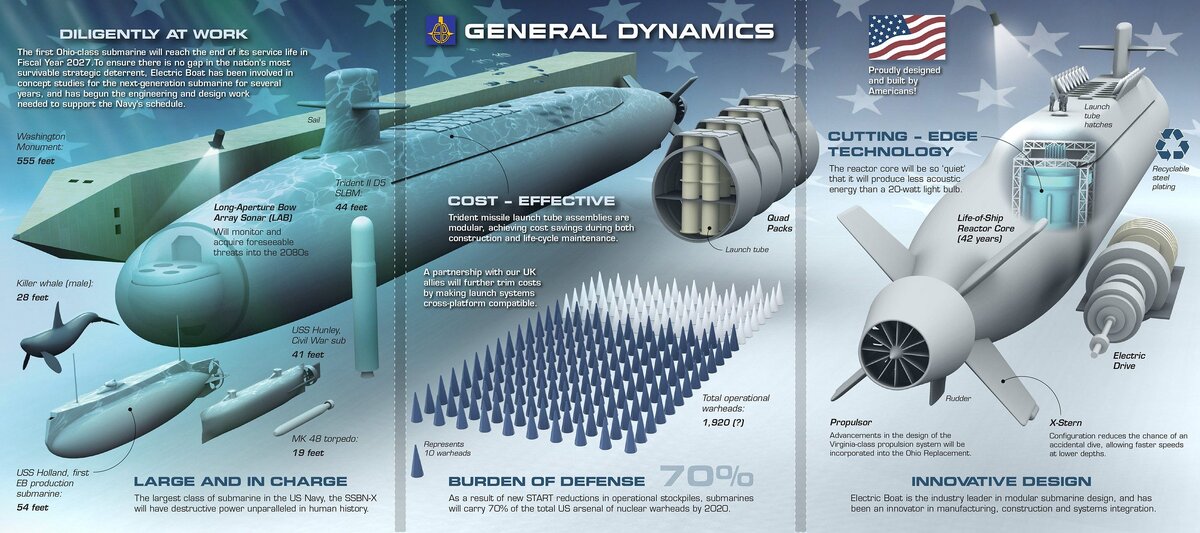
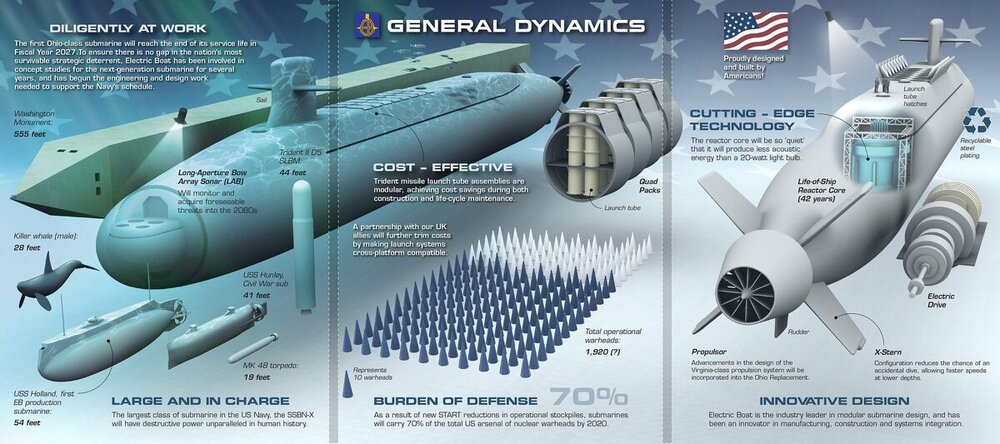
Just look at that big, beautiful girl! We just finished a pre-record Midrats Podcast with Mike Gallagher, Head of Defense at Palantir and Matt Babin, Head of Shipbuiding and Naval Programs at Palantir that will be published this upcoming Sunday evening. (BTW, if you do not already subscribe to the Midrats Podcast, now is the time to do so to make sure you don’t miss this great interview). Towards the second half of the show, Matt mentioned, I cannot drive past the Washington Monument without thinking like that is smaller than a Columbia class sub. Like if you took one out of the water and you stood it on its end, it is taller than that monument. First thing that came to mind was that there had to be a graphic of that somewhere…and here it is. So, if you ever wonder why our new SSBN costs so much ($9-10 billion a hull), Just look at it. What a Shield Maiden to the apocalypse she is. Leave a comment Share This Substack is reader-supported. To receive new posts and support my work, consider becoming a free or paid subscriber. View the full article
-
SummaryIn this episode, the host discusses the recent military operations related to Venezuela, focusing on the successful takedown of sanctioned tankers and the implications for U.S. naval strategy. The conversation also shifts to the defense budget under the Trump administration, exploring the need for increased military spending in light of national … Read more View the full article
-
United States forces used Navy EA-18G Growler electronic attack aircraft during the January 3 strike on Venezuela, employing high-power jamming to disable multiple layers of the country’s air-defense network. The action was first acknowledged through statements from Venezuelan military personnel who reported that radar systems “were blinded” minutes before precision weapons struck their sites. According […]View the full article
-
A United States Navy MQ-4C Triton long-range intelligence aircraft conducted an extended surveillance mission over the Caribbean Sea on 8 January after departing Naval Station Mayport, according to publicly available flight-tracking data. The aircraft, identified as MQ-4C Triton number 169659 and flying under the callsign BLKCAT6, operated for roughly ten hours in international airspace north […]View the full article
-
United States President Donald Trump announced that he has directed the federal government to raise the 2027 military budget target from $1 trillion to $1.5 trillion, framing the increase as necessary “for the Good of our Country” during what he described as a period of “very troubled and dangerous times.” Trump made the statement in […]View the full article
-
United States forces conducted a strike in Venezuela on January 3 using the AGM-154C-1 Joint Stand-Off Weapon, after local authorities released images showing debris from the precision-guided glide munition at one of the impact sites. According to photographs published by Venezuelan officials, identifiable fragments of an AGM-154C-1 were found after the January 3 attack. The […]View the full article
-
Ukraine’s Defense Forces have received a Latvian-made FOG unmanned surface vessel after the system was purchased and sent to Ukraine by the Latvian charity foundation Ziedot.lv. According to reporting by Militarnyi, the foundation funded the acquisition through donations from Latvian citizens and private companies. As noted by Ziedot.lv, the FOG platform was fully designed and […]View the full article
-
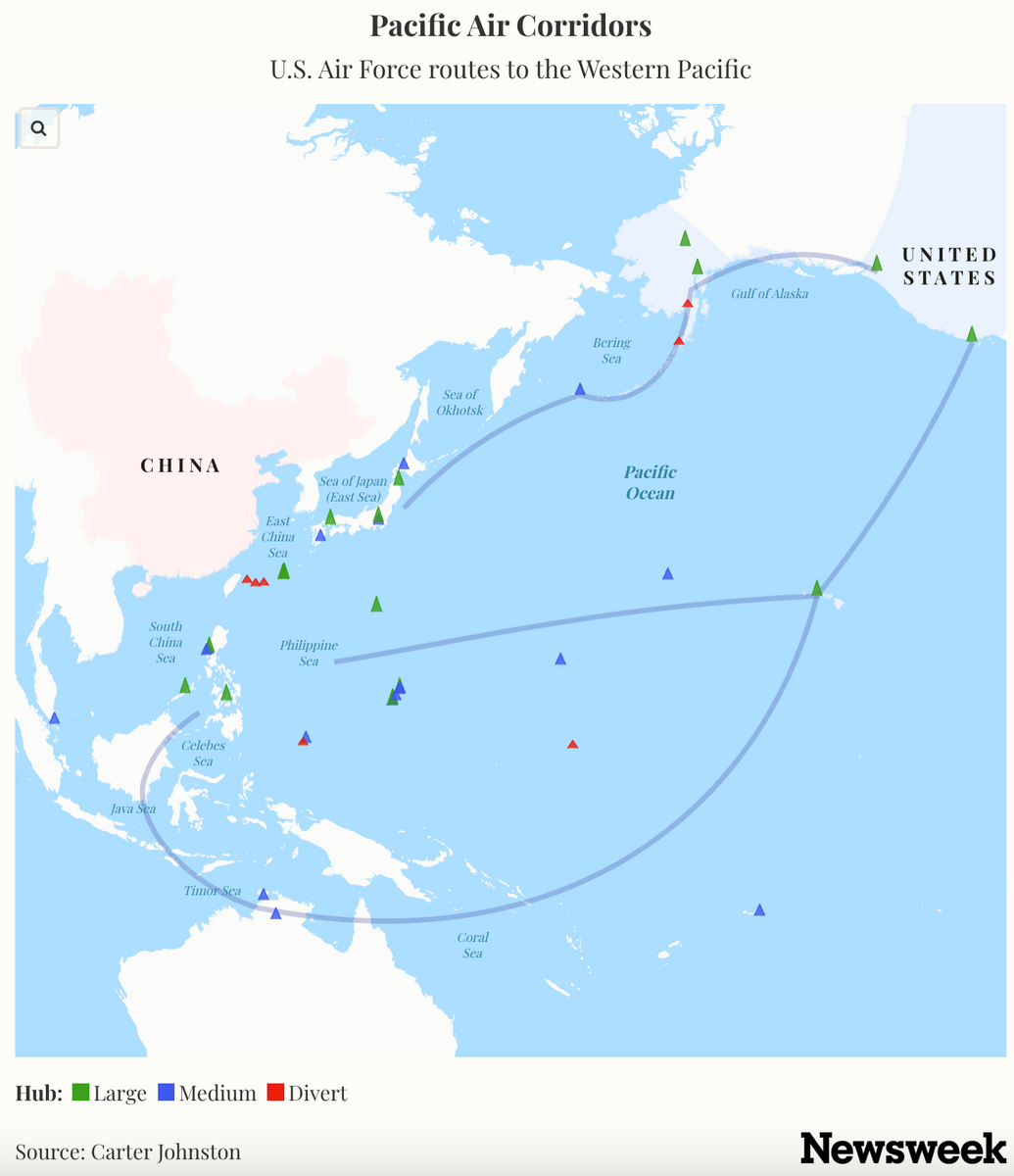
Like I said in Monday’s post, Having a wide variety of inefficient and underutilized bases and facilities scattered around is a feature, not a bug. The future is unknown and an impatient lover. Do not test, taunt, or take her for granted. Reactivate more bases. Smart people in hard jobs with limited resources are doing their best to improve the odds in the place we have neglected almost as much as the Caribbean, the Pacific. Via Carter Johnson in a superb article in Newsweek: Across sleepy and remote islands in the Pacific, U.S. military engineers are working around the clock to revive strategically important airstrips that American troops first built under fire over 70 years ago during World War II. The reconstruction effort is being led by a designated office within the U.S. Air Force, whose Agile Combat Employment, or ACE, doctrine has identified dozens of airfields that will be used to house and launch fighter jets, aerial refuelling tankers and weapons during a war with China. A trilateral force of the Navy, Marine Corps and Air Force is now converging with a single goal in mind: re-establish a presence on the airfields once used to deliver decisive combat power for the United States during the last great power war. Yes, this is a good and necessary thing…a topic we have long covered here and over at the Midrats Podcast. As always, let’s head to the chartroom: There is a lot more to add, especially in the Southwest Pacific where the People’s Republic of China has been so busy as of late. What would be helpful here is an overlay of those places where we can do maintenance and resupply—where we are working on it—and where we used to be able to do so. By the way, anyone have an update on Manus? Adak? The whole-of-military effort to prepare the Pacific theater across 12 time zones, dozens of countries, and millions of square miles all serves to prepare U.S. forces for what could be, Capt. Thomas H. Healy, commanding officer of Navy Reserve Center Great Lakes, said at a Pearl Harbor anniversary luncheon in December, reflecting on the impact of the attack on U.S. naval power during World War II. Leaders of the Navy Reserve anticipate 50,000 call-ups within 30 days of a war with China over Taiwan. Command Master Chief Petty Officer Robert W. Lyons of the Navy Reserve Forces Command emphasized the need to avoid another Pearl Harbor-style attack, and said the revitalization of critical airfields across the Pacific would serve the role of avoiding one. I’d love to see the UICs we plan on sending those 50K to. I would also like to offer that I hope someone has a plan to at least double that number by reaching into the retired ranks to fill positions. I’ve already volunteered to be OIC of Naval Support Activity Yap, so put me on the list. I’m in the same shape as I was when I left active duty in 2009. The pic at the top is Tinian, in case you’re wondering. North Field, an abandoned airfield on Tinian Island in the Northern Marianas, will serve as one of the new hubs complementing Andersen Air Force Base in Guam, where Northwest Field has also been rebuilt for the Marine Corps. Both locations will serve alongside dozens of additional spoke airfields in the second island chain and wider Pacific region as major sources of combat power generation that once delivered war materials during last century’s fight against Japan. At its height in World War II, North Field was home to over 230 B-29 Superfortress bombers across four active runways, operating as the largest airfield in the world at the time. Eighty years later, engineering units from the Navy, Air Force and Marine Corps are working to restore North Field’s runways, taxiways, and parking areas to its 1945-era specifications while modernizing the airfield’s facilities for state-of-the-art aircraft including large cargo planes, advanced fifth-generation jets and unmanned wingman fighters. All I can think of is logistics. We don’t have enough tankers—air or sea—to sustain the fight. We need so much, yesterday. Give the full article a read. Good stuff. h/t Jon.Leave a comment Share This Substack is reader-supported. To receive new posts and support my work, consider becoming a free or paid subscriber. View the full article

-
U.S. European Command has confirmed that U.S. agencies, supported by the U.S. Department of War, seized the Russia-flagged crude-oil tanker Marinera — formerly Bella 1 — in the North Atlantic following a federal warrant issued for violations of U.S. sanctions. According to a statement from U.S. European Command, the operation was carried out by the […]View the full article
-
The U.S. Army unveiled the early prototype of its new M1E3 main battle tank on January 6 during preparations for the Detroit Auto Show, releasing the first official imagery and confirming that testing will begin in early 2026. According to a statement posted by U.S. Army – Speed to Delivery, the prototype was developed “with […]View the full article
-
The United States Air Force moved multiple special operations support aircraft north along the coast of the United Kingdom today, as three U-28A Draco intelligence and reconnaissance aircraft were tracked heading toward the North Sea amid rising tensions over the Russian-flagged crude oil tanker Marinera. Aircraft spotters observed U-28A aircraft using the callsigns AGREE32, AGREE34, […]View the full article
-
Video footage published on Facebook shows United States Air Force CV-22B Osprey aircraft from the 7th Special Operations Squadron conducting fast-rope and rescue training at RAF Fairford in the United Kingdom. The aircraft, stationed at RAF Mildenhall, carried out the drills using standard special-operations procedures. According to OSINTdefender, the training activity involved fast-rope insertion teams […]View the full article
-
Russia has revealed a new set of battlefield tactics for its tank units, describing coordinated maneuvers that pair armored vehicles with unmanned aerial systems in ongoing combat operations, according to statements released by the Russian Ministry of Defense and the state corporation Rostec. The Ministry said frontline units now employ a two-tank method in which […]View the full article
-
The Defense Advanced Research Projects Agency (DARPA), the Pentagon’s research and technology arm, released a new program solicitation on January 6, 2026, for the Frosty effort to develop technology that enables new radar-based sensing modes in the Arctic environment. The notice invites industry to submit proposals by January 30, 2026, for solutions that improve detection […]View the full article
-
The United States Navy has issued a new Sources Sought Notice seeking industry input for low-cost Small Unmanned Aircraft Systems intended for the United States Marine Corps, publishing the request on January 6, 2026, through Naval Air Systems Command (NAVAIR). The announcement invites companies to submit detailed information on commercially available sUAS platforms with First […]View the full article
-
The United States Army has issued updated solicitation materials for a new second-source supplier to manufacture 5.56mm, 7.62mm, and .50 caliber ammunition, releasing revised documentation. The updated announcement was published on January 6, 2026, extending the proposal deadline and issuing new guidance on production requirements. According to the notice, Amendment 0001 moves the proposal submission […]View the full article
-
The United States Navy has awarded Raytheon a $29 million contract modification to expand production tooling and test equipment for the Standard Missile-6 (SM-6) program. According to contract details released by Naval Sea Systems Command, the award covers new supplier special tooling and special test equipment needed to increase output of the SM-6 All Up […]View the full article
-
It would be an understatement to say that I am not all that pleased with where we are in January 2026 with the Greenland question. This would not have been the productive path I would have recommended because, in the end, this is a very serious issue. Sure, in the first few months of 2025, the meme-ish nature of it all was fun and funny…but only to a point. In 2026, Denmark is not going to sell or otherwise transfer Greenland to the USA like they did with the now-U.S. Virgin Islands a bit more than a century ago. However, before we go further, if you have a knee-jerk reaction to support or oppose anything or any topic because DJT is involved, please repress that feeling until at least the end of the post. It isn’t productive, enlightening, or good for your health—so give it a rest for a bit until we are done, then you can carry on as before. Next, let’s do as we should in most things: let’s go to the chartroom. Object Zero’s crayon work on the Arctic Institute’s map is superb to illustrate that point. The Europeans have whipped themselves into an almost comical lather over it all. Having lived with their NATSEC nomenklatura for years, I’m not shocked. They tend to be very narrowly read, get their ideas about the USA from NYT, WaPo, and the usual suspects in East Coast Universitlandia and their nomenklatura is worm-ridden with the same people who opposed Cold War NATO efforts to counter the Soviet Union’s militarism and every anti-USA trend of the fiscal quarter, etc. Unhelpful has been an almost gleeful approach to triggering these people who never thought DJT would come back to power, and from 2020-24 acted like it. Behind that triggering and, at least from this side of the pond, trolling, is a very serious security concern in the high north that Greenland is, literally, right in the middle of. The great circle route from Russia’s nuclear weapon delivery platforms all go over the high Arctic over or around Greenland. It isn’t just Russia. Here is the great circle route from the center of Iran to the center of CONUS: Then you have the natural resources of Greenland being utilized by China and Russia. Yes, yes. I know. There is a better way. It isn’t as fun. It is slow, it is frustrating, but it is doable. Denmark is a small nation of almost 6 million souls in a space of land about 2/3 the size of West Virginia. In the last year she finally started spending her fair share on defense, but even before then, she had been a solid ally. She already lets us have bases there. If we need more we can sell it—along with Canada—as part of mutual defense. When it comes to keeping Russia and China at a distance, in backrooms we can work deals and twist Danish elbows. We won’t get all we want, but we should be able to get 80%. I don’t get antagonizing the Danes like this. I think it is unnecessary and counterproductive. $0.02. Yes, I would love to have American ownership of Greenland, but that isn’t a realistic option right now…especially after the last year. What we can have—if the Danes will let us—is expanded presence on the island as needed. I really wish that were what we were trying to do. Maybe we are, but we are not doing it in a productive way, and to be blunt, it is moving things in the wrong direction. It is time to try a different track. It won’t be as fun, but it has a better chance for success than the present plan. In the end, if maximizing Greenland’s geography for North American security is as serious as we say, we would change course. h/t NJ5.Leave a comment Share This Substack is reader-supported. To receive new posts and support my work, consider becoming a free or paid subscriber. View the full article

-
India publicly showcased its new Suryastra multiple launch rocket system during rehearsals for the Army Day parade in Jaipur, marking the first public appearance of the indigenous long-range rocket artillery platform. The system was displayed on a wheeled launcher carrying two 370mm Predator Hawk missiles and four 306mm extended-range rockets, highlighting its ability to fire […]View the full article
-
The United States Air Force has continued intensive reconnaissance flights near Venezuela’s coastline, deploying RC-135V/W intelligence aircraft over the Caribbean at activity levels comparable to those recorded in early January, according to open flight tracking data and regional monitoring reports. On the latest mission, an RC-135W Rivet Joint aircraft, tail number 64-14848, operated from Homestead […]View the full article
-
The United States Navy has awarded Collins Aerospace a $20.3 million contract modification to produce and deliver three high-power transmit set modernization kits for the E-6B “doomsday plane,” according to a Department of the Navy contract announcement. The award was issued to Rockwell Collins Inc., operating as Collins Aerospace Government Systems, under a firm-fixed-price and […]View the full article