
All Activity
Today
-
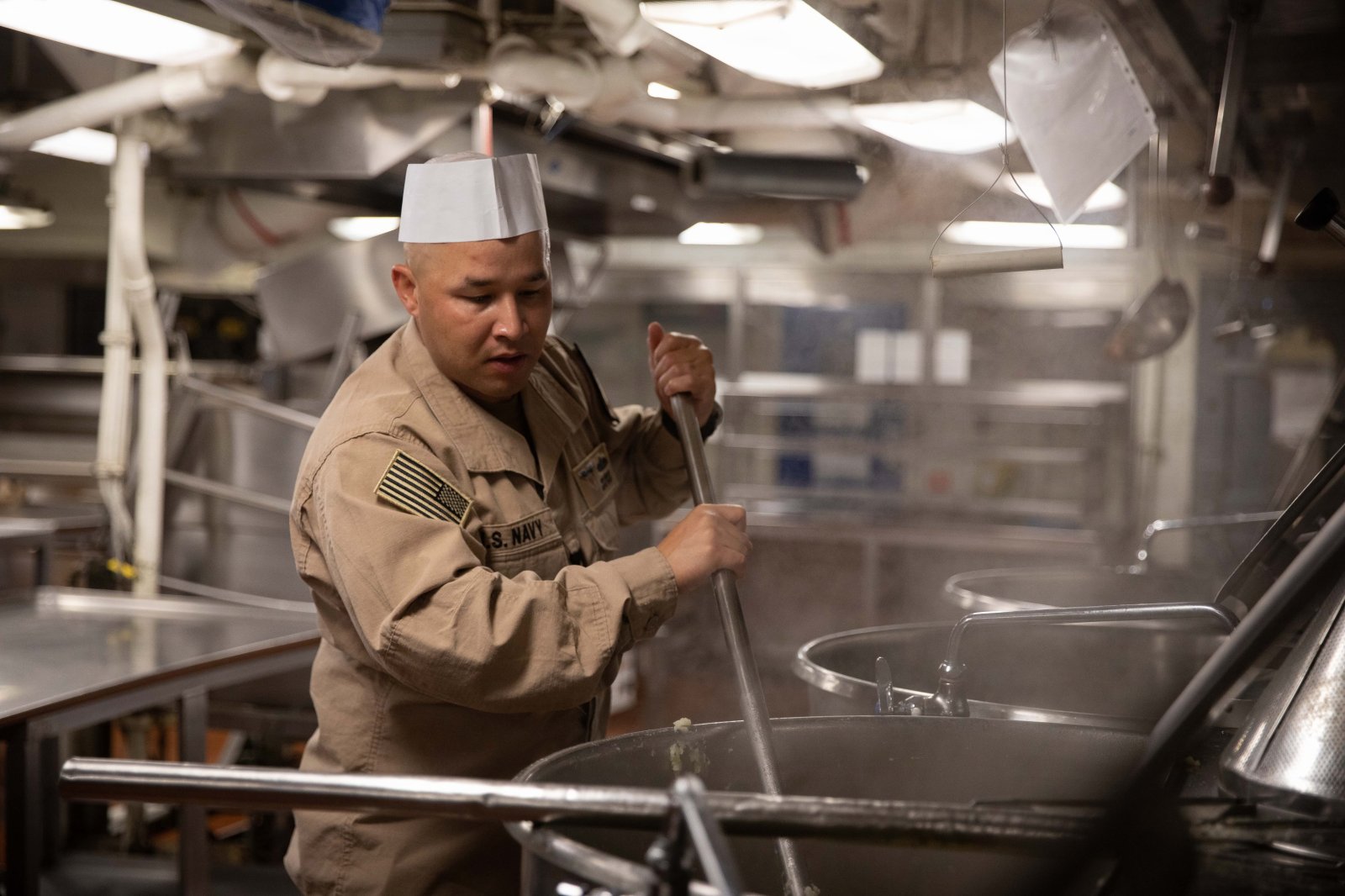
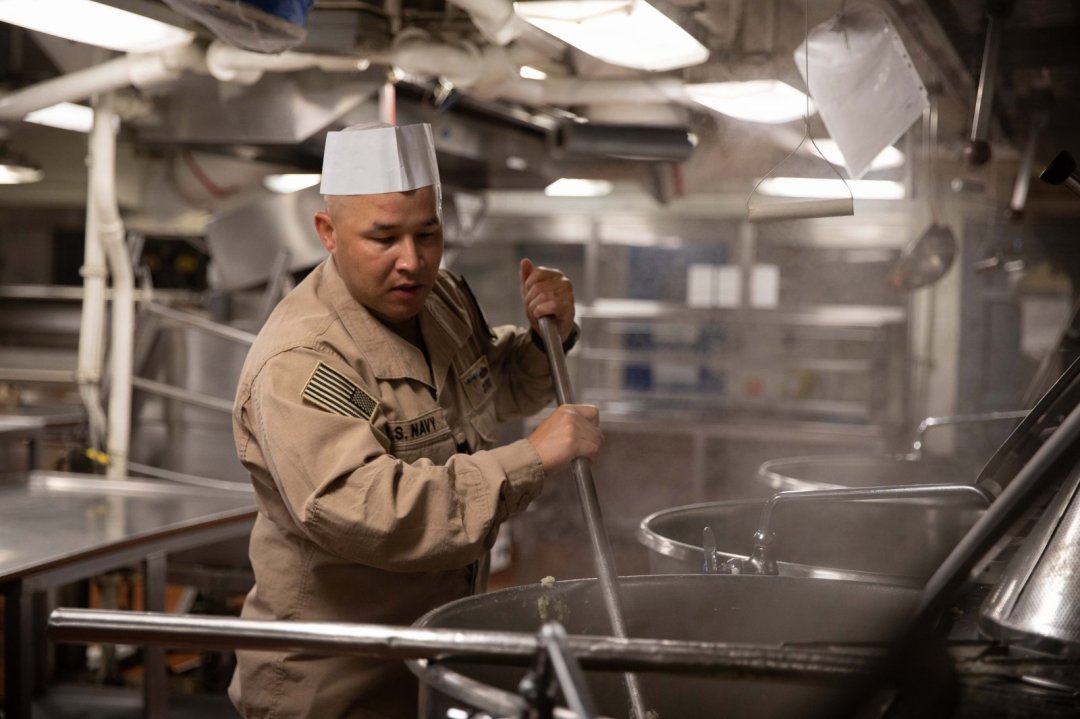
Happy Thanksgiving to everyone on this very American and very important holiday. As I remember the Thanksgivings I spent overseas, away from family, I also think of those who followed me. For some Sailors, this is their first Thanksgiving away from extended family. For others, it may be their first Thanksgiving experience altogether. And there are plenty somewhere in between. This year, we’ve seen an exceptional number of ships and their crews deploy for more than six months, with many gone for almost a year. In the coming year, many more will follow as the world’s demand for our ships once again outstrips the supply. For those who have been gone so long, this Thanksgiving will be especially meaningful. For those newly deployed, their thoughts may already be turning to “next year.” All around the fleet, the Navy’s Culinary Specialists are doing their best to put together the best Thanksgiving dinner possible. Always be nice to your CS, but especially today. BZ. U.S. Navy Chief Culinary Specialist Dom Kenner prepares a Thanksgiving meal aboard Nimitz-class aircraft carrier USS Carl Vinson (CVN 70), Nov. 23, 2026. Carl Vinson is currently pierside in its homeport of San Diego. (U.S. Navy photograph by Mass Communication Specialist 3rd Class Graham Lasser)This Substack is reader-supported. To receive new posts and support my work, consider becoming a free or paid subscriber. Share Leave a comment View the full article
-
AAR 2006 Paracel SITREP 71 +++ SPOILER ALERT+++ Opening up my orders it seems quite simple and straight forward, I have support of the nice quiet and lethal Seawolf SSN to clear my path, I merely have to follow the predesignated course through international waters. I decide that my escorting SSN can afford to slow to creep, still 19 kts is a good match for my own cruising speed and her ears will be that much sharper. Straight out Seawolf picks up three unknown subsurface contacts on passive sonar. She alters course and heads slightly obliquely towards the nearest and we launch one helo to help investigate. Our second helo is sent out to conduct ASW sweeps ahead. Just 30 secs later Seawolf picks up something more interesting, two surface contacts which are suspected to be significantly further out than the subs which we continue to investigate. One by one they are Ided as ‘biologicals’ The biologicals come in and out of detection during the next half hour in which a third surface contact, proximate the other two, appears on Seawolf’s screens at about the same time as two more sub contacts that don’t match up with the biologicals. Seawolf heads towards the closest new sub contact finally IDed as an enemy Kilo II and within our torpedo distance, firing one then turning to head toward the second unknown new sub contact fires a second. Meanwhile a Seahawk has set off to investigate the second sub contact too. We get a solid fix and ID – a Han Type 91 class SSN. Both Seawolf and the Seahawk fire two torpedoes each with the helo staying in contact and Seawolf backing away to take up station between us and the surface ships. At 09.36.42 the Han is hit by Seawolf’s first torpedo and is sinking. Perhaps the sinking of the two subs scared off the biologicals, contact with them has been lost but gradually a firm picture of the three suface ships is produced, steaming together DDGs and an escort undoubtedly sent to oppose our legal transit. Seawolf has positioned herself well, before the enemy seemingly has detected us, or atleast before having a solid enough contact to launch an attack, she has been able to let loose a salvo of torpedos, two for each of the closest two ships and about ten minutes later two for the third. 10:51:26 The Wuhu 536 unit ZX000, a Jianghu III Type 053/1 class, is sinking! 10:56:59 The Taizhou 138 unit ZV000, a Taizhou (956EM) class, is sinking! 11:15:47 The Jinan 152 unit ZU000, a Luyang II Type 052C class, is sinking All turns quiet with nothing but the Woody Island Radar and the occasional sound of the biological contacts … then the alarms on Bulkeley shatter the afternoon peace 13:24:00 New contact: 00M Missile contact from ABS Bulkeley DDG84 at a bearing of 22 degrees Method: INFRARED Some how no missiles hit. Seawolf and a Seahawk both vector off on a bearing from us of 22 degrees searching for a suspected third sub. It takes only seven minutes and Seawolf has a passive sonar blip at 16 degrees, and heads in for more information soon IDing it as an enemy Shang Type 093. Half an hour later the range is good and two torpedo are fired and at 14.14.57 the Type 93 is sinking. An hour later we note we have met our minimum required time on station and a further three hours on have fully completed the mission, time to cruise back to port. [StoresConsumed - Blue] Blue Weapon=Tally Mk48 Mod6 ADCAP=11 Mk46 Mod5ASW=2 [StoresConsumed - Red] Red Weapon=Tally C-801 (YJ-82) SSM=4 [Kill Detail Red Side ] Kilo II Pr636M/Submarine=1 Han Type 091/Submarine=1 Jianghu III Type 053/1/Ship=1 Ka-28 Helix A 96/Helicopter=1 Taizhou (956EM)/Ship=1 Luyang II Type 052C/Ship=1 Shang Type 093 06/Submarine=1 [Kill Summary Red Side ] Ships:=3 Submarines:=3 Helicopters:=1 No Blue side losses Time spent: Session 1 Game Start=21 Nov 2006, 05:00:00 GameTimeDuration ThisSession=6Hrs44 Mins TotalGameTimeDuration=6Hrs44Mins GameTimeToGO=17 Hrs: 15 Mins Session End RealTime=24/11/2026 21:23:32 RealTimeDuration ThisSession=0:43:05 ==== ===== Session 2 Game Start=21 Nov 2006, 11:44:01 GameTimeDuration ThisSession=6Hrs30 Mins TotalGameTimeDuration=13Hrs14Mins GameTimeToGO=10 Hrs: 45 Mins Session End RealTime=25/11/2026 21:14:40 RealTimeDuration ThisSession=0:18:51 That was quite fun, it was the second turn I did as side blue, the first I got no biologicals and I misjudged distance to the surface ships for my choppers and lost both. Red side, second go, here I come
-
Ukraine has formally expressed interest in receiving between 10 and 20 Eurofighter Typhoon fighter jets that Italy plans to retire from its air force, and the two governments are already negotiating, Italian daily La Repubblica reported. According to the paper, the government of Prime Minister Giorgia Meloni is not considering suspending the government-to-government talks on […]View the full article
-
The U.S. Army’s first Dark Eagle hypersonic missile battery is now fully fielded and ready for combat, nearly three years after the original target date, the service’s top weapons buyer for long-range fires said. “It is fully fielded. It is ready to go,” Lt. Gen. Frank Lozano, the Army’s Program Acquisition Executive for Fires, told […]View the full article
-
Japan has taken delivery of its first batch of Terra B1 interceptor drones, about three months after signing a mass-production contract, according to Tokyo-based maker Terra Drone. The company said in a statement that it had built a domestic production line for the drone and completed delivery to Japan’s Acquisition, Technology and Logistics Agency (ATLA), […]View the full article
-
A German battery-powered drone has flown a measured 100-meter course at 727 km/h (452 mph), averaged over runs in both directions, setting a new world speed record for electric flight, its maker Quantum Systems said Thursday. The Munich-based company said its Apex Recordhunter set the mark at a military base in Germany, which it did […]View the full article
-
The U.S. State Department has approved a possible $621.9 million sale of F-16 sustainment equipment to Ukraine, paid for entirely by Belgium, Denmark, the Netherlands and Norway. The package covers “Cartridge Actuated Device/Propellant Actuated Devices; lab equipment; and transportation support,” according to a congressional notification dated Nov. 25. Ukraine will use JUMPSTART money from the […]View the full article
-
The U.S. Navy has awarded RTX’s Pratt & Whitney a $2.53 billion contract to keep the F135 engine running across the global F-35 fleet for another year. That’s roughly $925 million more than the deal it replaces. The undefinitized contract action, awarded without competition, covers “global unit- and depot-level maintenance, repair, engineering, logistics, software sustainment,” […]View the full article
-
The U.S. Navy has awarded Northrop Grumman $1.13 billion to build three more test aircraft for the E-130J Phoenix II. The C-130J-based plane will take over the service’s submarine communications relay mission from the aging E-6B Mercury. The cost-plus-incentive-fee modification exercises options for “three E-130J system demonstration test articles and initial spares,” according to a […]View the full article
-
Russian state television has given a rare look at the long-delayed Su-75 Checkmate stealth fighter, not on a runway but on a screen inside the aircraft plant that is supposed to build it. The footage, aired by a regional state broadcaster on its Rossiya 24 Khabarovsk channel, shows workers at the Yuri Gagarin Komsomolsk-on-Amur Aircraft […]View the full article
Yesterday
-
Britain’s Royal Air Force is moving aircraft into hangars and hardened shelters at night to protect them from possible drone attacks, The Times and Sky News reported Wednesday. Troops have also been tasked with putting up Kevlar anti-drone nets, like those used in Ukraine, around jets that have to stay in the open, according to […]View the full article
-
Ukraine’s military intelligence says it destroyed a rare Russian aerospace surveillance complex in Russia’s Smolensk region that could spot cruise missiles and hard-to-detect aircraft up to 2,500 km (1,550 miles) away. The Defense Intelligence Directorate, known as HUR, said Wednesday that its long-range strike operators hit the complex, known by its Russian abbreviation MRIK-VKO. HUR […]View the full article
-
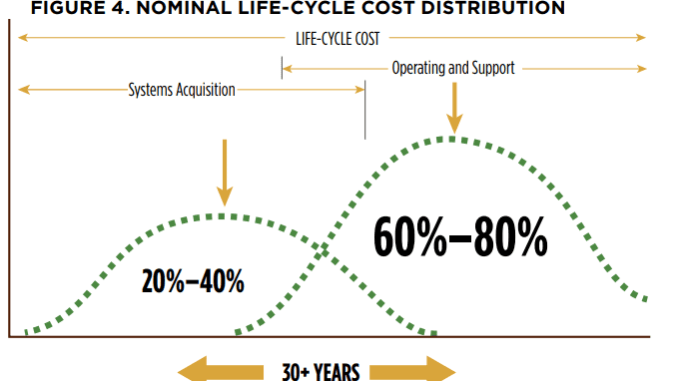
Earlier this week, in a conversation with L. Todd Wood, toward the end, we talked a bit about the challenge of producing sufficient weapons at scale, and the Primes’ reluctance to change in response to the post-post-Cold War realities of preparing for the Long War. Earlier this month, I had two conversations that gave me a little more insight into the broader maintenance and readiness issues with the F-35. Not just the bespoke software, but its parts issues and significant contractor support to keep them operational. When it comes to paying for the military we want to meet our national requirements, we focus a bit too much on unit cost. While important, I don’t think unit cost is the most important when you keep some systems for half a century. We are not talking about life-cycle costs enough. There must be something in the air, because in the same slice of the national security pie, Eric Lofgren at Acquisition Talk made a critical observation that provided a bit of validation of what many of us have seen. Once DoD moved to monolithic winner-take-all platforms, industry’s incentive was to create high cost maintenance procedures to get the system through development and into production on time. Sustainment costs then grew until roughly 50-70% where renewed emphasis was put on modernization. It becomes militarily, industrially, and politically unpalatable for even more funds to go into sustainment. As a result, readiness figures started to decline as a “pressure relief valve.” It didn’t use to be this way. The following isn’t a perfect proxy (e.g., missing Military Personnel costs), but in 1963 RDT&E + Procurement titles were 67% of the budget and O&M was just 34%. In 2021, acquisition fell to 46% and O&M rose to 54%. Yes, yes, yes…systems are more complicated, I guess…but how much of that complication is due to poor design? Not all systems have the same cost breakdown. I could do a post on each one of those lines, but let’s hit the big pixels: Age matters: The last KC-135 came off the production floor before I was even born six decades ago. C-5Bs were maintenance nightmares when I was a JO. Our C-17s are being flown WAY past their expected usage rates…and nothing new is being built. As anyone who owns a bit of mechanical equipment knows, maintenance is burdensome…and good luck finding some spare parts. When you do, they’re expensive. Lots of moving parts flying in formation are expensive: Helos and Ospreys. I think that speaks for itself. Missiles are not durable goods: While you can store gun ammo for years, really decades, without doing anything to them, missiles require care. As we saw with Acting Secretary of the Navy Hung Cao’s hearing in the Senate recently, missiles like TLAM will expire. Many have jet engines; all have batteries, after a while some electronic components degrade, etc. We’re being lied to about drones: We’ve discussed this before, but in addition to their higher loss rate, UAS are not cheap to maintain. Cheap to buy, but not cheap to operate—at least how we are designing and operating them now. On that note, These systems actually have high sustainment costs. That’s partially because they have low acquisition costs (besides Global Hawk/Triton), and also because they require numerous operators and ground equipment. I’m still a fan of UAS, but—as we’ve discussed here before—we need to have a more mature discussion of why they are good to have in the mix. Cost ain’t it. I like Figure 4. Might be nice to see one for each system, but this is what should be briefed. Here’s some hope for the future. If you do a simple log-linear regression on the percent of acquisition costs, the forecast is that by 2050, acquisition share of budget will fall from 46% to 37%, and by 2080 it will fall to just 29%. Of course, there is no reason to believe that this trend will persist in the same way. Indeed, it should start to flip. But it is rather surprising how linear the decline in acquisition share has been. As any Sailor will tell you, you get what you inspect. We need a lot more scrutiny on lifecycle costs, and even better, reports on how trends have changed compared to expectations at 5 years and 10 years after initial acquisition. If we do, smart people with hard jobs will work to mitigate that. The Primes may not like that loss of income stream, but that’s OK. Leave a comment Share This Substack is reader-supported. To receive new posts and support my work, consider becoming a free or paid subscriber. View the full article
-
Ukraine says it hit five Russian warplanes, including three MiG-31 jets that carry Kinzhal hypersonic missiles, in strikes on Savasleyka air base deep inside Russia on Nov. 24 and overnight into Wednesday. Ukraine’s General Staff said on X that three MiG-31s and two Su-34 fighter-bombers were hit and “will be unable to fly for some […]View the full article
-
Raytheon has won a U.S. Navy agreement to move its design for the Nuclear-Armed Sea-Launched Cruise Missile, or SLCM-N, out of early concept work and into a focused development phase, the company said Nov. 24. The deal is an Other Transaction Authority agreement, a contracting route the Pentagon uses for prototype work. Under it, Raytheon’s […]View the full article
-
Chinese troops showed Type 96A main battle tanks and other military vehicles to Cambodia’s defense minister on Wednesday as the largest Golden Dragon exercise yet opened at Ream Naval Base, the Chinese-funded port on Cambodia’s southern coast. Photos from the opening show the tank displayed for Gen. Tea Seiha, Cambodia’s deputy prime minister and minister […]View the full article
-
NASA has sent three research aircraft, including a four-engine P-3 Orion, to southeast Iowa as the U.S. Army prepares to blow up nearly 5 tons of unstable explosive at the Iowa Army Ammunition Plant, the agency said late Tuesday. The P-3 Orion, the turboprop the U.S. Navy flew for decades as a submarine hunter, and […]View the full article
-
China’s low-cost alternative to Russia’s T-90 tank has surfaced in desert camouflage, in an unverified photo shared on the Chinese social media platform Weibo. The tank is a Soviet-era T-72 rebuilt by Chinese defense company Norinco with a new turret and armor. The Defence Blog described it last year as a budget alternative to Russia’s […]View the full article
-
The U.S. Air Force has ordered 15 more KC-46A Pegasus tankers from Boeing in a $2.82 billion contract modification. By previously reported counts, the order fills the last slots available under the 2011 tanker contract. The U.S. Department of War announced the award Nov. 24. It covers “15 KC-46A Lot 13 production aircraft” plus “G081, […]View the full article
Last week
-
Great!
-
Poland and the United Kingdom signed an intergovernmental agreement on Tuesday that opens the way to developing CAMM-MR, a new air defense missile meant to reach beyond 100 km (62 miles), Poland’s Armament Agency said in a statement. Magdalena Sobkowiak-Czarnecka, a secretary of state at Poland’s Ministry of National Defence, signed for Warsaw. Luke Pollard, […]View the full article
-
Boeing has received a $197.3 million order modification to buy more MH-47G special operations helicopters for U.S. Special Operations Command, according to a Department of War contract announcement Monday. The firm-fixed-price order covers “procurement of MH-47G rotary wing aircraft,” the announcement said. It didn’t say how many helicopters the money will buy or whether they’ll […]View the full article
-
Canada’s air force has sketched out a future fighter fleet built around the F-35 and Canadian-made combat drones, and it doesn’t mention the Swedish Gripen at all, according to a discussion paper obtained by CBC News. The paper is called “Project Arrow.” The broadcaster reported Tuesday that it’s circulating within the Department of National Defence […]View the full article
-
The Pentagon is in talks with General Motors, Ford and other manufacturers about helping mass-produce military drones, The Wall Street Journal reported on Tuesday, citing people familiar with the matter. Under the arrangement being discussed, the companies would supply parts to drone makers, such as engines, actuators, sensors and lidar, according to the report. GM […]View the full article
-
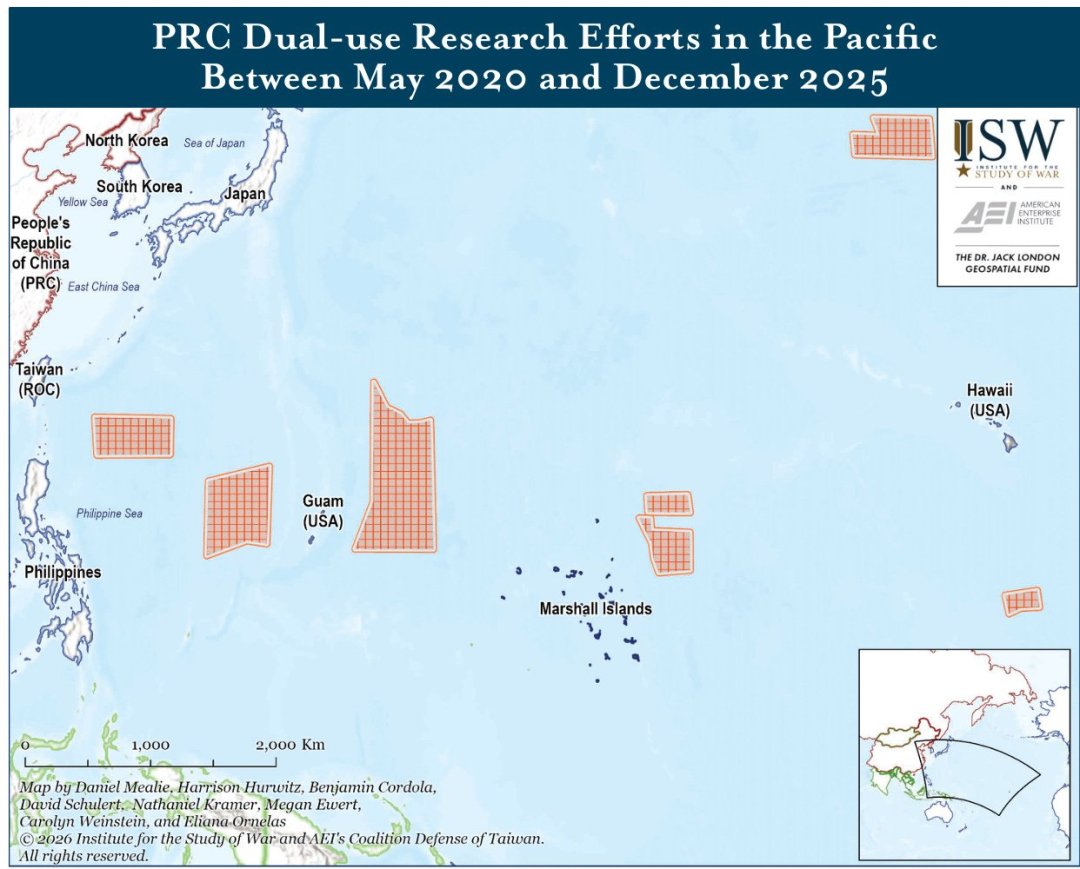
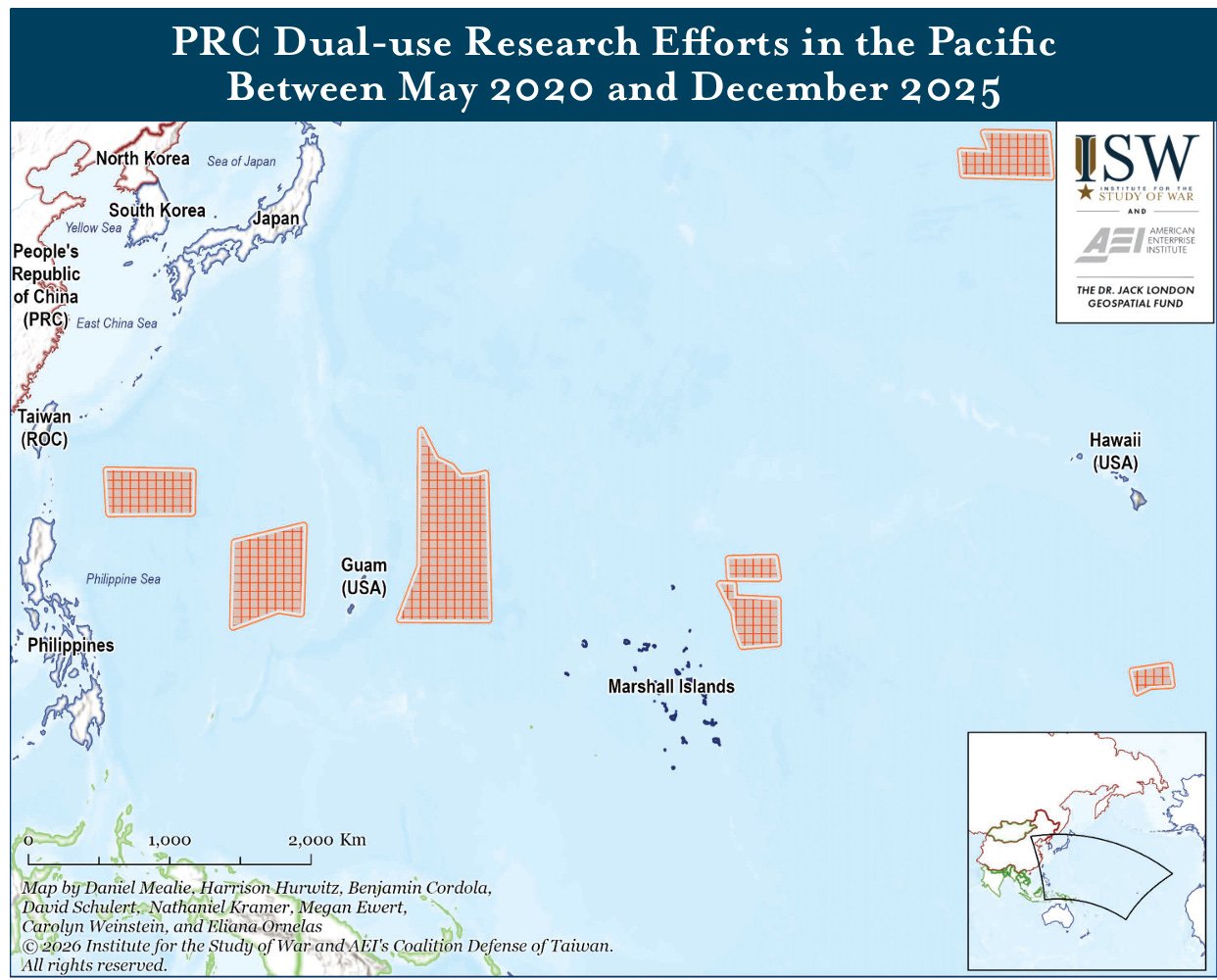
Jackson Karas and Alison O’Neil from the Institute for the Study of War and Alexis Turek from the American Enterprise Institute have put out a useful report titled, Surveil, Project, Divide: China’s “Guerrilla” Framework to Reshape the Pacific. Notice I called it, ‘useful.’ That does not mean that it is neither ‘bad’ nor ‘good’, it is just that—as you can see in its title—it is all wrapped around one of the least useful prisms people are trying to use to understand, explain, and offer solutions to the challenge of the People’s Republic of China (PRC) in the Pacific: guerrilla warfare, insurgency, and in response, counter-insurgency. Yes, yes, yes, I understand the ethos of the People’s Liberation Army and its mythology…but that does not mean I am forced to see the problem through their warped lens. I’m sorry, but no. This COIN backwash from GWOT has limited utility for really understanding what is going on in the Pacific. Trying to sound fresh and new is not helpful at all. This is a hard problem that will not be solved by trying to be clever. It will only be solved by hard work. To the contrary of those pushing a clever concept, what we are seeing is simply a modern manifestation of what has been done by global powers at sea against their rivals for centuries—if not thousands of years. Just as Mahan or Corbett won’t give you a secret key to understanding or solving problems, seeing aspects of land-based guerrilla warfare and insurgencies and applying them to a maritime challenge is not magic either. Should you understand these aspects? Absolutely, but don’t try to wrap your investigation and attempted explanation of possible solutions in them as a prime construct. It is just…embarrassing at best, or a version of buzzwordism at worst. That being said, Karas and O’Neil produced a superior project that brings together the most important threats and developments west of Wake. That is why it is useful and I recommend reading it. Just don’t get too excited about the ‘guerrilla’ pitch. The best part of the work is in its maps. I’m not going to pull too much text from it—as you and I both might tire of the marketing push of “guerrilla”, but here’s a solid outline of their argument There are several key areas where PRC maritime thinking has attempted to move beyond Mahan, however, particularly in its approach to sea power in the Western Pacific and Oceania. The PRC has attempted to formulate a theory of “guerrilla” maritime strategy that combines overt military development with covert political and economic influence to gradually undermine the United States’ ability to establish sea control in key areas of the Pacific, eschewing the Mahanian emphasis on decisive battle and a superior surface fleet. The PRC’s guerrilla strategy seeks to undermine US sea control in the Pacific and create favorable conditions for a PRC effort to seize Taiwan. The PRC conducts manifold influence operations in the Pacific; however, many of which serve diverging objectives and may fall outside the scope of this analysis. This paper aims to synthesize the activities that are most critical to the mission of sea control in the Pacific and that will have the greatest influence on a PRC-US conflict over Taiwan. This paper aims to demonstrate that the PRC — in many ways — understands such a conflict to have already begun through the prism of PRC guerrilla warfare at sea. Were the German U-boat campaigns in WWI and WWII ‘guerrilla warfare at sea’? Sure, I could make that argument, but it would be silly. No, they were just another chapter in the history of commerce raiding. I won’t repeat this argument more because I want to get to the charts. To make my point, here is what the PRC has been studying and what we need to spend more time studying at the Pentagon and Foggy Bottom: The Pacific is no longer an American lake where our forces can move about without worry. The below is an optimistic map. Luganville is just one spot in a whole constellation of PRC influence across the Southwest Pacific. If not blunted now, we should all understand their potential in a decade. I’d also encourage you to notice that Luganville is well south of the furthest advance the Japanese made in the last Great Pacific War. It is roughly halfway between Guadalcanal and the U.S. early-WWII rear-area headquarters in Nouméa, New Caledonia. The below isn’t so much research as it is part of a proper Intelligence Preparation of the Battlefield (IPB). Take out your JPME notes, folks…but for those who don’t have them: The Four-Step IPB Process Define the operational environment: Identify the area of operations, area of influence, and area of interest, along with relevant domains and characteristics that affect friendly, threat, and neutral forces. Describe environmental effects: Assess how terrain (such as avenues of approach, obstacles, and key terrain), weather, and civil considerations impact both friendly and threat operations. Evaluate the threat: Analyze threat doctrine, organization, capabilities, tactics, and vulnerabilities—often using doctrinal templates and threat models. Determine threat courses of action (COAs): Synthesize environmental effects and threat evaluations to project likely and most dangerous enemy COAs, helping identify named areas of interest and decision points. Guam occupies the same place in the PRC’s strategic thinking that Pearl Harbor did in the Imperial Japanese Navy’s. They are not hiding the ball in any way, shape, or form. If you are wondering what that little block is to the far east of the chart above—oh, my sweet, sweet summer child—that is athwart the great-circle route from San Diego to Australia. The square in the upper-right hand corner? That is along the great circle route to Japan. So, I am sorry if I am hurting the feelings of well-meaning, smart, well-credentialed people doing the best they can, but let us speak as adults. Stop trying to repackage things to make them sound profound or to suggest that you have a new insight. You don’t. Your great insight is that you are identifying and addressing a critical shortfall that those who came before you let fester. You are starting to see the importance of strategic stewardship, and that is good enough. Lean in with that. Less clever. More direct. This is a known challenge, and it will have to be solved as it has been most successfully solved in the past: Be so ready for it, and possess such power, that it never happens. People will wonder what all the worry and bother was about, because nothing happened. Of course it didn’t. The action taken because of the worry and bother kept war from happening. War comes anyway and you have the brute power, and the understanding of the battlespace, your enemy, and yourself, to ensure that you, the nation you serve, and its allies win. The end of the report just made me mad. The PRC’s guerrilla strategy proceeds from an internal acknowledgment of weakness. The PRC aims to avoid direct engagements across the spectrum of conflict with the United States. The United States can utilize tactical engagements, such as increasing diplomatic engagement with small Pacific Island states or countering PRC armed civilian aircraft to counter the PRC’s guerrilla efforts. The United States can ensure that the PRC’s erosion efforts can never transition, forcing the PRC to either abandon its aggressive objectives or risk open war with a superior adversary on unfavorable terms. The future of the Pacific is being written, and US action or complacency will determine whether this future serves the CCP’s goals or curbs its aggressive intentions. The PRC is not “weak.” This is not 2002. Almost all successful wars use the indirect approach, but that does not make it armed conflict that will, in the end, be decided by engagement. The assumptions about power and intent outlined here borders on hubris…and as such, is incredibly dangerous if put in the wrong ear. Here let me edit this. The PRC’s guerrilla strategy proceeds from an internal acknowledgment of weakness. The PRC aims to avoid direct engagements across the spectrum of conflict with the United States. The United States can utilize tactical engagements, such as increasing diplomatic engagement with small Pacific Island states or countering PRC armed civilian aircraft to counter the PRC’s guerrilla efforts. The United States can ensure that the PRC’s erosion efforts can never transition, forcing the PRC to either abandon its aggressive objectives or risk open war with a superior adversary on unfavorable terms. The future of the Pacific is being written, and US action or complacency will determine whether this future serves the CCP’s goals or curbs its aggressive intentions. Yes. Cut steel. Reindustrialize. Diversify. Homeshore. Simplify supply chains and vendors. Diversify the defense industrial base beyond the primes. Overweight on our comparative advantage in maritime and aerospace power. Reinvigorate relationships with medium regional powers. Conduct additional purges of those responsible for mismanagement at the Department of State. There’s your action. As a final note, if you would like to dive in further, we discussed this challenge here on May 2021, July 2022, February 2025. The two recent Midrats Podcast episodes on it were in June 2021 with Alex Grey, …and August 2025 with Cleo Paskal. h/t Brent.Leave a comment Share This Substack is reader-supported. To receive new posts and support my work, consider becoming a free or paid subscriber. View the full article