All Activity
Past hour
-
pqvuhfdj joined the community
Today
-
U.S. Army infantry soldiers have fired Spike NLOS long-range missiles from a light, air-droppable utility vehicle for the first time, completing 17 engagements in a three-day live-fire demonstration at Dugway Proving Ground, Utah, Lockheed Martin said. All of the shots were launched from an Infantry Squad Vehicle – Utility, or ISV-U, a version of the […]View the full article
-
bvusbzxf joined the community
-
vhwqtegq joined the community
-
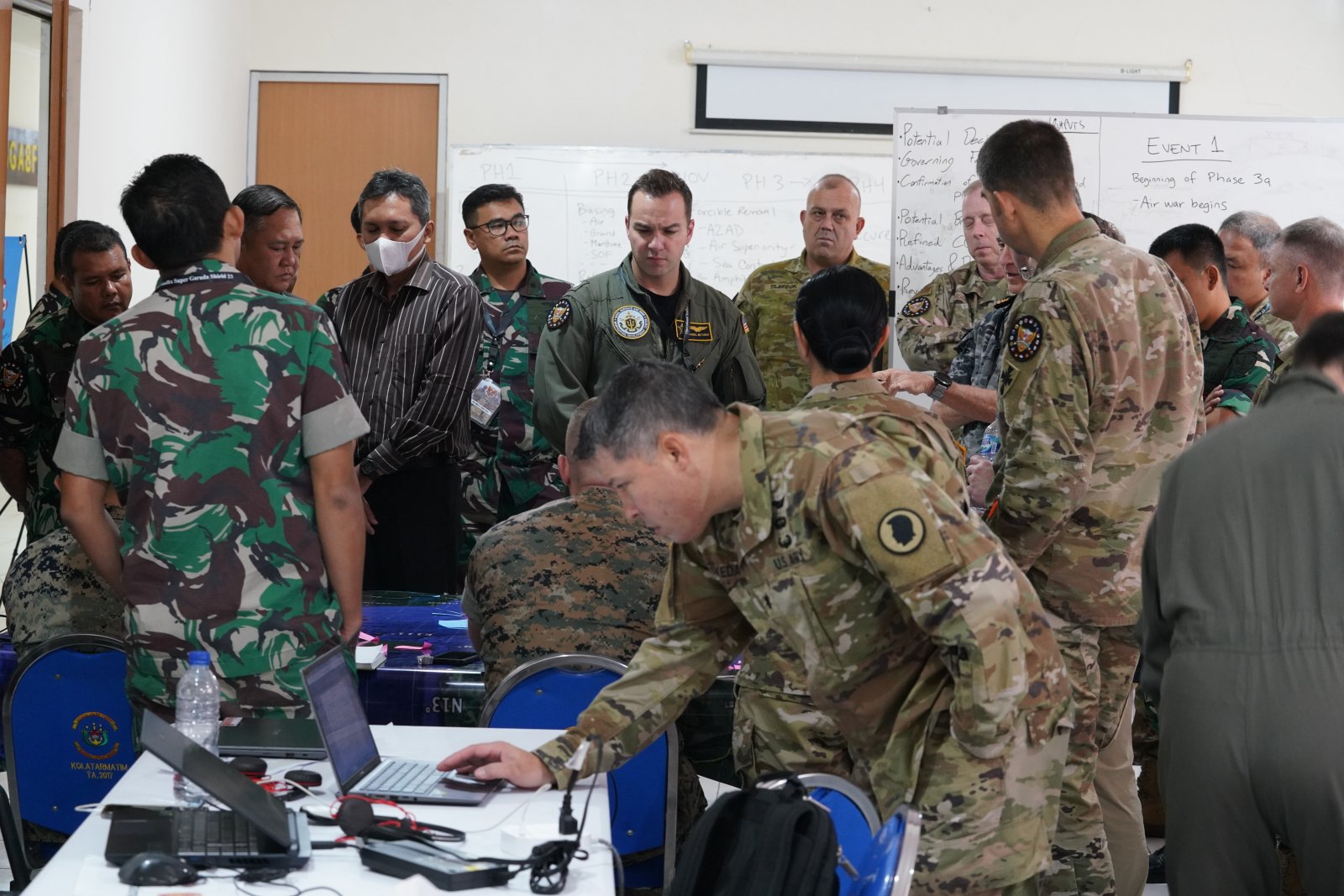
For those in the business, one of the most triggering phrases you can read or hear is some pogue out there saying, ‘Well, we have wargamed this, and…’ and then you wait to see if you have a reasonable follow-on, or some cringe-inducing abuse of the military art. Way too many people are abusing war games for the wrong purposes. Everyone wants a national security 8-Ball to tell them the future, and some look to war games to hear what they want to hear. When you see that, it’s a tell. That person/institution does not understand what they are talking about. In the latest Naval War College Review, Charles Edward Gehrke has a simply outstanding article everyone needs to take a few minutes to read, What War Games Actually Teach—Threat Recognition, Not Prediction. From war gaming’s earliest institutional adoption, it has been repeatedly evaluated as though it were a forecasting instrument or a decision aid at best and a surrogate for empirical proof at worst. Each of these expectations imposes criteria that war games are structurally unsuited to meet. The resulting recurring cycle of enthusiasm, disappointment, and rediscovery has accompanied war gaming for more than a century. There is the core of the problem and where too many people go off the rails when it comes to the use and utility of war games. As is true with many things in life, trying to force something to meet your unrealistic desires always leads to tragedy. The rough part is that, in the national security arena, the consequences run the spectrum from death to an existential danger to the nation. You have to nip this in the bud whenever it comes up, regardless of how powerful the person or institution behind these desires may be. The enduring value of war gaming is neither prediction nor optimization. Its primary product is something simultaneously more modest and more profound: the cultivation of threat recognition under conditions of uncertainty. War games are incapable of telling either participants or their respective services what will happen in the future. What they actually can do is to put participants in situations that simulate danger effectively and communicate to them why these situations appear dangerous. And then it can train them to anticipate ways in which others will respond to similar real-world dangers. In doing so, war games train participants to recognize how threats are perceived, interpreted, and acted on by all parties operating with incomplete information and under intense time pressure. Training and testing, not predicting. This misunderstanding has consequences. Many of the recurring debates around war gaming—including debates over rigor, realism, bias, and usefulness—stem from evaluating games against criteria that the games were never designed to satisfy. When war games are judged primarily as forecasting tools, they will almost always disappoint. When they are assessed as decision engines, they will appear indeterminate. When they are expected to produce consensus, they will seem inconclusive. Only when they are understood as instruments for revealing cognitive and institutional blind spots do their contributions become more clear and more durable. Bingo. You are looking for intersections of individual factors, constraints, restraints, and perspectives. The next bit had me grin some, as it reminded me of hearing many an exasperated voice ask, ‘Did anyone war game this?’ The measure of a successful war game, therefore, is not whether it got the future right, but whether it revealed previously unrecognized threat perceptions, challenged embedded assumptions, or clarified the role of judgment in environments in which calculation alone is insufficient. Controlling variables is what makes war games so valuable. You are testing ideas, concepts, factors. When someone walks in with a goal to use and abuse a war game to validate their idea or worldview, a well-run war game will crack open the weaknesses for all to see. On the flip side, a poorly run or unethically run war game can lead to disaster. You have to realize their base nature. War games do not operate like analytic models. They are not closed systems, nor are they designed to be. They do not attempt to isolate variables to measure their individual effects. Instead, they deliberately entangle political, military, economic, and human factors in ways that resist clean separation, but resemble the real world. The resulting complexity is a defining feature. It reflects the reality that strategic decision-making rarely unfolds in environments in which variables can be controlled or outcomes cleanly attributed. They are not just good for testing ‘things.’ Indeed, their greatest utility is testing people. A war game’s most consequential outputs are not quantitative results at all. They are moments of surprise, confusion, or disagreement. A player discovers that an adversary behaves in ways that feel irrational or escalatory. A familiar course of action produces unintended consequences. A strategy that appears sound in briefing slides unravels once it encounters resistance. These moments are indicators that previously unexamined assumptions have been exposed. Thinking. Imagination. Cognitive flexibility. Character. Oh, you can find them in a war game. Treating war games as predictive tools, therefore, creates a category error. It asks games to function like models while ignoring the features that distinguish them. Human judgment and adversarial adaptation are not sources of noise to be eliminated. They are the very phenomena that war games are designed to bring to the surface. Evaluating games by their ability to suppress these dynamics in the service of prediction misunderstands their purpose. This demand for prediction also obscures the reason that war gaming has endured for more than a century—despite repeated failures to get the future right. If prediction were the standard, war gaming would have been abandoned long ago. Time and again, games have failed to anticipate specific wars, campaigns, and outcomes. Yet institutions continue to invest in them, not because of inertia or sentimentality, but because games provide forms of insight that cannot be generated through analysis alone. … It bears repeating that the insights generated by this process are not always answers to specific questions. War games do not resolve debates or produce definitive conclusions. Instead, they refine mental models. Participants leave with a clearer sense of which assumptions are fragile, which signals are ambiguous, and which aspects of a problem space they had previously taken for granted. These adjustments are subtle but consequential. They shape how future information will be interpreted and how future decisions will be framed. In this way, war gaming contributes to professional development in a manner that is difficult to replicate through other methods. It teaches participants how their thinking changes under pressure and how the recognition of threat influences judgment when certainty is unavailable. It does not teach them what to think. These lessons are not tidy. They are not easily summarized. But they are precisely the lessons that strategic leaders most need to learn. I’ve always found that a well-run war game’s superpower is its brutal effectiveness at revealing weak and convenient planning assumptions. We are all familiar with fragile egos and too-clever-by-half CONOPS that too many people love far too much. They exist because they have never been challenged—the classic ‘fragile vignette’ used to promote the latest White Elephant or 72-hour war. In real strategic environments, outcomes are rarely predictable in the face of even small changes. Decisions hinge on interpretation rather than certainty. Signals are incomplete, intentions are inferred, and actors continuously adjust their behavior in response to what they believe others might do. Institutions act on beliefs that are formed under pressure, shaped by prior experience, and constrained by organizational context. Perfect information is something institutions want in these circumstances, but it is rarely something that they have. A tool that purports to produce reliable, predictable outcomes in such an environment risks misleading its users. The next part of Gehrke’s article is chicken soup for my soul—an ode to ambiguity. Organizations prefer clarity, alignment, and decisiveness. Ambiguity is associated with risk of failure. And yet strategic leaders routinely operate in environments where clarity is unavailable and alignment is provisional. The ability to function effectively under such conditions is not innate—it must be practiced. War gaming provides a controlled environment in which this practice can occur. The stakes are simulated, but the cognitive demands are real. Participants experience the pressure of making decisions without full understanding of the situation. They confront the consequences of misinterpretation, overreaction, and hesitation. They observe how uncertainty can amplify perceived threats and drive escalation even, or perhaps especially, in the absence of deliberate intent. No other form of professional military education reproduces this. Lectures and readings can describe uncertainty, but they cannot reproduce its effects on judgment. Analysis can account for risk, but it does so after the fact. War games, by contrast, immerse participants in uncertainty as games unfold, forcing them to grapple with uncertainty in real time. When properly applied, ambiguity helps future-proof a war game. A clever person/institution cannot over-prepare for ambiguity. A weak intellect cannot rely on a staff to cover for its inability to adjust to the unexpected, the grey, the vague. I really started to nod my head at the next word he spent some time on: humility. Especially in the last few years, we’ve visited the concept of humility as a force multiplier, hubris, mindsets, and arrogance. A well-run war game can ferret out them all. Postgame discussion fosters cognitive humility. Participants learn that their interpretations of threat are not universal and that reasonable professionals can arrive at different conclusions when faced with the same information. They also learn that their own perceptions are shaped by role, experience, and institutional context. War gaming further structures these perceptions in ways that make the warfighter as effective as possible under the wartime conditions of ambiguity that war games seek to emulate, but perceptions must be examined if they are to be refined. To be examined they must first be made clear. … By cultivating cognitive humility at both the individual and institutional levels, war gaming strengthens the capacity for adaptation. Institutions that can recognize the limits of their own collective assumptions are better prepared to adapt to surprise and ambiguity. In this way, war gaming contributes not only to professional education but to institutional resilience. … Humility does not imply indecision or restraint for its own sake. It simply reflects an awareness of the conditions under which strategic decisions are made and the cognitive processes that govern them. Leaders who have practiced operating under uncertainty are better equipped to act decisively when clarity is unavailable. Institutions that have examined their own assumptions are more resilient when confronted with novelty or disruption. The question, then, is not whether war games can tell us what will happen. It is whether they can help us see ourselves, our institutions, and our adversaries more clearly before hostilities unfold. By that measure, war gaming’s value is not only defensible; it is indispensable. Amen. Read the full thing. Leave a comment Share This Substack is reader-supported. To receive new posts and support my work, consider becoming a free or paid subscriber. View the full article

-
A U.S. Navy P-8A Poseidon maritime patrol aircraft flew off Bulgaria’s Black Sea coast near the ports of Varna and Burgas, a week after Russian drone attacks sank a cargo ship and damaged another in the area, flight tracking data shows. Tracking data published by the flight monitoring Itamilradar, using Flightradar24 data, shows the Boeing […]View the full article
-
Ukrainian drone operators playing the enemy in a U.S. Army training exercise in Germany caused about 70% of an American armored brigade’s casualties in the first three days, according to an account by the brigade’s own commander and staff. The figures come from an article in Military Review, the U.S. Army’s professional journal, written by […]View the full article
-
Epirus’ Leonidas high-power microwave weapon, which knocks out drones by frying their electronics, has been added to the Pentagon’s online counter-drone marketplace, making it easier for U.S. military units and other federal agencies to buy the system. The California-based company said Leonidas met the criteria for inclusion in the Counter-UAS Marketplace run by Joint Interagency […]View the full article
-
hsswlzth joined the community
-
German drone maker Quantum Systems says its Apex Recordhunter, a battery-powered experimental drone, flew at 777 km/h (483 mph) in a record attempt this week, faster than any battery-electric drone has flown before and well above the speed of Russia’s jet-powered attack drones. Martin Karkour, the company’s chief revenue officer, announced the run, saying the […]View the full article
-
British aircraft maker Skyfly Technologies has raised $10 million to turn its two-seat electric vertical takeoff aircraft into Longbow, a hybrid-electric cargo drone designed to carry 200 kg (440 pounds) more than 640 km (400 miles) and take off from ships, fields or forward bases without a runway. The seed round, announced on Oct. 20, […]View the full article
-
Swedish-Estonian boatbuilder Cross Water wants to turn the military rigid inflatable boat into a plug-and-play platform, with drones, sensors and mission equipment that lock onto the deck in minutes and software that will eventually let the same hull run by remote control or on its own. The company, which also trades as XW Production, builds […]View the full article
-
mzbbulyd joined the community
-
dgbsslhl joined the community
-
China’s military said it tracked and monitored the U.S. Navy littoral combat ship USS Charleston (LCS 18) after the vessel sailed near Sabina Shoal, a disputed feature in the Spratly Islands that both China and the Philippines claim, early on Oct. 20, 2026. The People’s Liberation Army Southern Theater Command Navy said in a statement […]View the full article
-
zcdzplwm joined the community
-
The U.S. military has used HAARP, the giant research antenna field in Alaska long at the center of conspiracy theories, as the transmitter for an experimental radar that detected aircraft beyond the horizon by bouncing signals off the upper atmosphere. Military personnel, scientists and international partners carried out the live-fly test from Sept. 7 to […]View the full article
-
The U.S. Air Force has awarded a $332.8 million contract to help its cyber defenders collect, store and analyze network data where it is gathered, so the information can be shared across the military’s common cyber warfare system instead of sitting in separate tools. Enlighten IT Consulting, a Columbia, Maryland-based subsidiary of shipbuilder and defense […]View the full article
-
Lithuania is putting U.S.-made AN/TPS-77 Multi-Role Radars into service to watch its airspace, with the truck-mounted Lockheed Martin systems feeding real-time data into NATO’s integrated air and missile defense network, the country’s Ministry of National Defence said. Lithuania is buying three of the radars under a Foreign Military Sales contract worth about $52.6 million that […]View the full article
-
weonampj joined the community
-
vqbwxook joined the community
-
Lockheed Martin will upgrade the giant assembly stations where F-35 stealth fighters are joined together at Europe’s only F-35 factory in Cameri, Italy, a plant that now builds jets not just for Italy but for the Netherlands, Poland and Switzerland. The work is covered by a $9.4 million contract modification announced by the U.S. Department […]View the full article
Yesterday
-
NATO plans to buy six portable kits that can jam satellite navigation signals and the radio links drones use for control and video, so its trainers can expose ships, aircrews and drone operators to realistic interference during exercises. Headquarters Supreme Allied Commander Transformation, the alliance command in Norfolk, Virginia, that leads NATO’s training and modernization […]View the full article
-
The U.S. Air Force Research Laboratory wants industry to build and fly a combined-cycle rotating detonation rocket engine, a type of propulsion that runs on a continuous chain of explosions, as a step toward cheap, high-speed weapons that could be built in large numbers. The lab’s Rocket Propulsion Division at Edwards Air Force Base, California, […]View the full article
-
Cummings Aerospace has fired two of its 3D-printed Hellhound S3 jet-powered drones from a launcher mounted on a utility vehicle, with a single operator using one handheld controller to send both on separate autonomous missions, the company said. The test took place on Aug. 25, 2026, at the Pendleton UAS Range in Oregon, where an […]View the full article
-
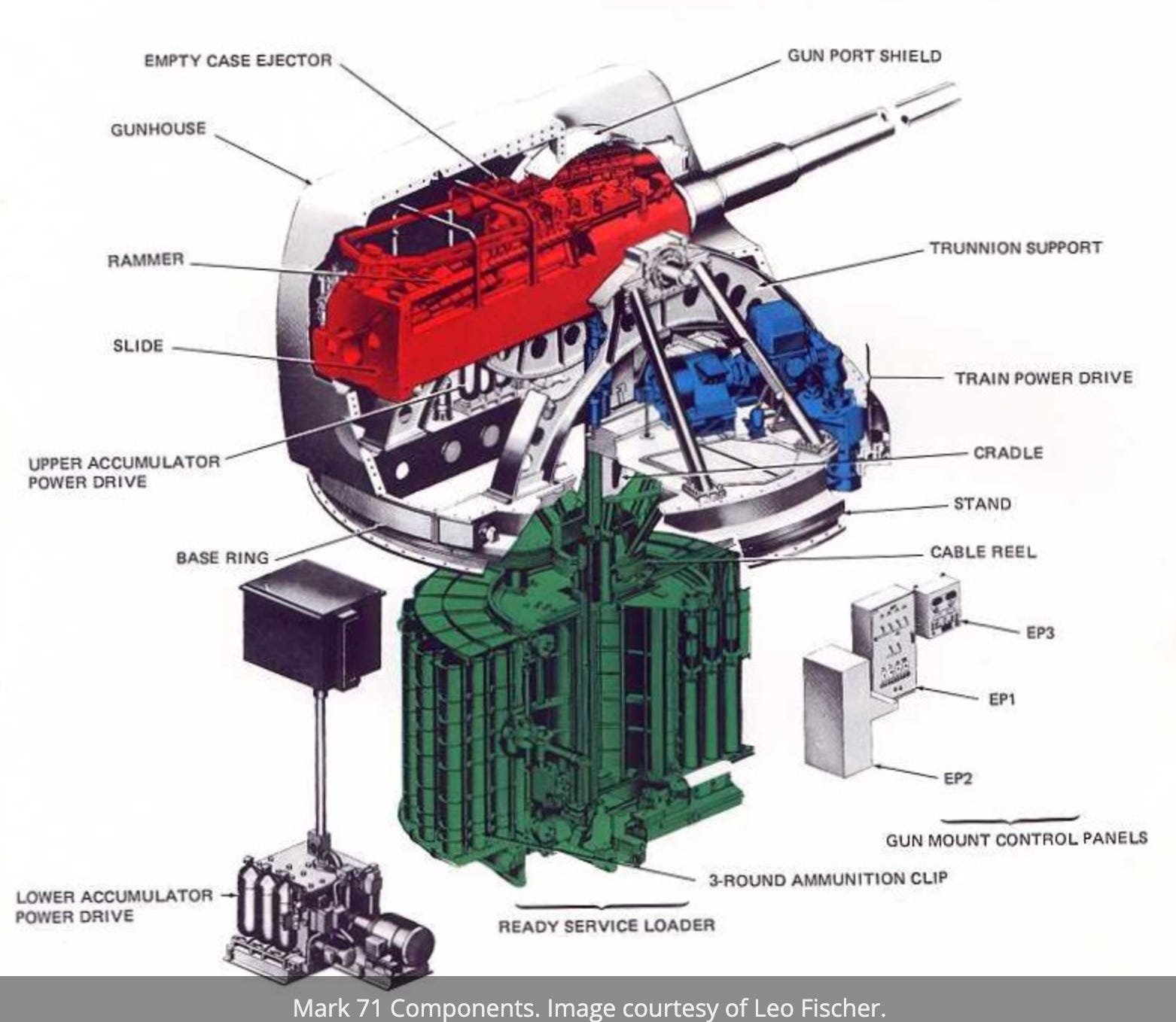
This is a Monday where those of us on the Front Porch will just nod our heads a bit and grin in that way that only the confidently smug can smile. You know one of my regular statements, and it does not matter if we are talking aircraft, surface ships, or ground forces (I give a pass to submarines): When war comes, you will quickly realize that not only do you not have enough guns, but the ones you do have are too small in caliber. Let’s go back 18 years or so for a couple of quotes from, well, me. First, from April 09, 2008’s post, It always comes back to the gun..., People always try to get rid of the gun - but the cold hard facts of the reality of thousands of years of combat remind you that in the end - it is all about F=MA. You are going to need a gun. Bigger the better. Go ahead and plan for it and save yourselves blood and treasure in the long run. Next from October 27, 2008’s, Launching the Counter Revolution at Sea, You do not have enough or large caliber enough gunfire available to engage targets at sea and ashore. Come on everyone…say it with me…but this time with an upbeat vigor… Eventually everyone goes SalamanderReally, I should never have to cover my own bar tab. The lessons of the last year are clear. The ‘too much military fiction, not enough military history’ missile cult and the big-fleet-engagement-only, vignette-addicted crowd warped ship designs toward too few weapons options. Accountants love it; warfighters are frustrated by it. The low-end threat can still sink you. There are tools here, but often the best that could be found at peace was a manned crew-served .30 or .50. Some success was found where we needed to be: larger manned and crew served auto-cannons. Remember how everyone was so excited about 20mm, 25mm, or—gasp-n-swoon—30mm chain guns as secondary and tertiary batteries? Well, sit down. More is better. With the growing threat of attacks by small unmanned aircraft systems on the battlefield, Northrop Grumman is pitching gun-based air defense systems designed to take down waves of aerial threats. At the Association of the United States Army’s annual convention, Northrop showed off its newest 50mm Gun-Based Air Defense system dubbed the Raid Hunter and the latest iteration of the M230. Both systems are part of Northrop’s patented Bushmaster Chain Guns, a collection of medium-caliber, vehicle-mounted machine guns that operate using an external power source…. According to the specs sheet, the system relies on AI targeting and precision-guided 50mm ammo, which proximity fuzes detonate near a target. … Modeled after the M230 gun for Apache attack helicopters, the M230 Link Fed Dual Feed Bushmaster Chain Gun, or M230LF, can be mounted to an assortment of vehicles, ranging from 4x4s to large ground vehicles to patrol boats. But what’s special about it is that it can use two feed paths, which allow operators to switch between standard proximity-fuzed 30x113mm rounds for countering drones and high-explosive, dual-purpose rounds for armored targets. It’s not just for counter-drone work; you should see what that can do to surface ships that make the mistake of getting in range. Not that there is anything wrong with a good 30mm chain gun. Those will fit in places where 50 mm and larger guns just can’t squeeze in. We also love ‘ole Ma-Deuce. In the military version of a Turducken, what if we mounted a .50 cal on top of a 30mm? Mark 38 Mod 4: a 30mm Bushmaster II cannon with a .50 caliber machine gun on top The video below on this beautiful creature should be labeled NSFW, but we’re going to show it anyway. Like we discussed six months ago in Up-arm the Fleet? With What?, the argument has been won. We need to be arming our warships and auxiliaries to the point that the manpower people are crying, ‘Too much!’—then add on a couple more mounts. I know it, you know it, and now it appears that Congress and OPNAV got religion on it as well in the last few years. Welcome to the party, folks! Glad to have you. Now, do you have time to talk for a moment about our lord and savior, the MK-71? Leave a comment Share This Substack is reader-supported. To receive new posts and support my work, consider becoming a free or paid subscriber. View the full article
-
The U.S. Army has placed a second order for the FD-1, a drone interceptor that a single soldier can set up and launch in under two minutes, from Florida-based Mountain Horse Solutions, less than a year after the system first came to the service’s attention. The order was issued on Oct. 8 by the U.S. […]View the full article
-
France has ordered several hundred more MX-10 DAMOCLES kamikaze drones from KNDS France and Delair, and the quadcopter munition has won its first export customer, Luxembourg, which signed a contract worth just over 1.6 million euros ($1.8 million) for an initial capability. The French Ministry of the Armed Forces activated an optional tranche of its […]View the full article
-
Russian forces have released video of an FPV drone striking one of Ukraine’s largest uncrewed ground vehicles, a Protector, while it was hauling logs near Orikhiv in Ukraine’s Zaporizhzhia region. The footage, shared by Russian channels, shows the drone hitting the vehicle’s cargo bed. The front of the Protector, where its control and communications equipment […]View the full article
-
Russian state defense conglomerate Rostec has described its T-80BVM main battle tank as an “assassin,” claiming the gas turbine-powered vehicle is quiet and well camouflaged enough to make fast, unnoticed flanking moves on the battlefield. In a promotional statement, Rostec said the modernized tank can play several roles: a “steel battering ram” that breaks through […]View the full article
-
Ukrainian troops have flown a wounded soldier off the front line with a heavy multirotor drone, in what the unit that organized the mission called the world’s first aerial evacuation of a casualty from the battlefield. The operation was carried out by the unmanned ground systems company of Ukraine’s 92nd Separate Assault Brigade, working with […]View the full article
-
From the Australian ABC news service https://www.abc.net.au/news/2026-10-19/ghost-shark-fleet-aerial-drones-sea-mines-defence/107283746?utm_source=abc_news_web&utm_medium=content_shared&utm_campaign=abc_news_web&utm_content=link
-
Israel’s Elbit Systems has won a contract worth about $235 million to supply PULS rocket artillery launchers and EXTRA-MR precision-guided rockets to an unnamed European country, along with additional rocket artillery platforms and integrated logistics support, the company said. Elbit did not identify the customer or say how many launchers and rockets the deal covers, […]View the full article
-
A U.S. Army soldier has been spotted assembling a Stork reconnaissance drone, built by Czech-Ukrainian company U&C UAS, during a major training exercise in Germany, showing the battle-tested design in American hands. The U.S. Army released the image from Combined Resolve 27-01 at the Hohenfels Training Area, part of the Joint Multinational Readiness Center in […]View the full article