
All Activity
Today
-
Poland and the United Kingdom signed an intergovernmental agreement on Tuesday that opens the way to developing CAMM-MR, a new air defense missile meant to reach beyond 100 km (62 miles), Poland’s Armament Agency said in a statement. Magdalena Sobkowiak-Czarnecka, a secretary of state at Poland’s Ministry of National Defence, signed for Warsaw. Luke Pollard, […]View the full article
-
Boeing has received a $197.3 million order modification to buy more MH-47G special operations helicopters for U.S. Special Operations Command, according to a Department of War contract announcement Monday. The firm-fixed-price order covers “procurement of MH-47G rotary wing aircraft,” the announcement said. It didn’t say how many helicopters the money will buy or whether they’ll […]View the full article
-
Canada’s air force has sketched out a future fighter fleet built around the F-35 and Canadian-made combat drones, and it doesn’t mention the Swedish Gripen at all, according to a discussion paper obtained by CBC News. The paper is called “Project Arrow.” The broadcaster reported Tuesday that it’s circulating within the Department of National Defence […]View the full article
-
The Pentagon is in talks with General Motors, Ford and other manufacturers about helping mass-produce military drones, The Wall Street Journal reported on Tuesday, citing people familiar with the matter. Under the arrangement being discussed, the companies would supply parts to drone makers, such as engines, actuators, sensors and lidar, according to the report. GM […]View the full article
-
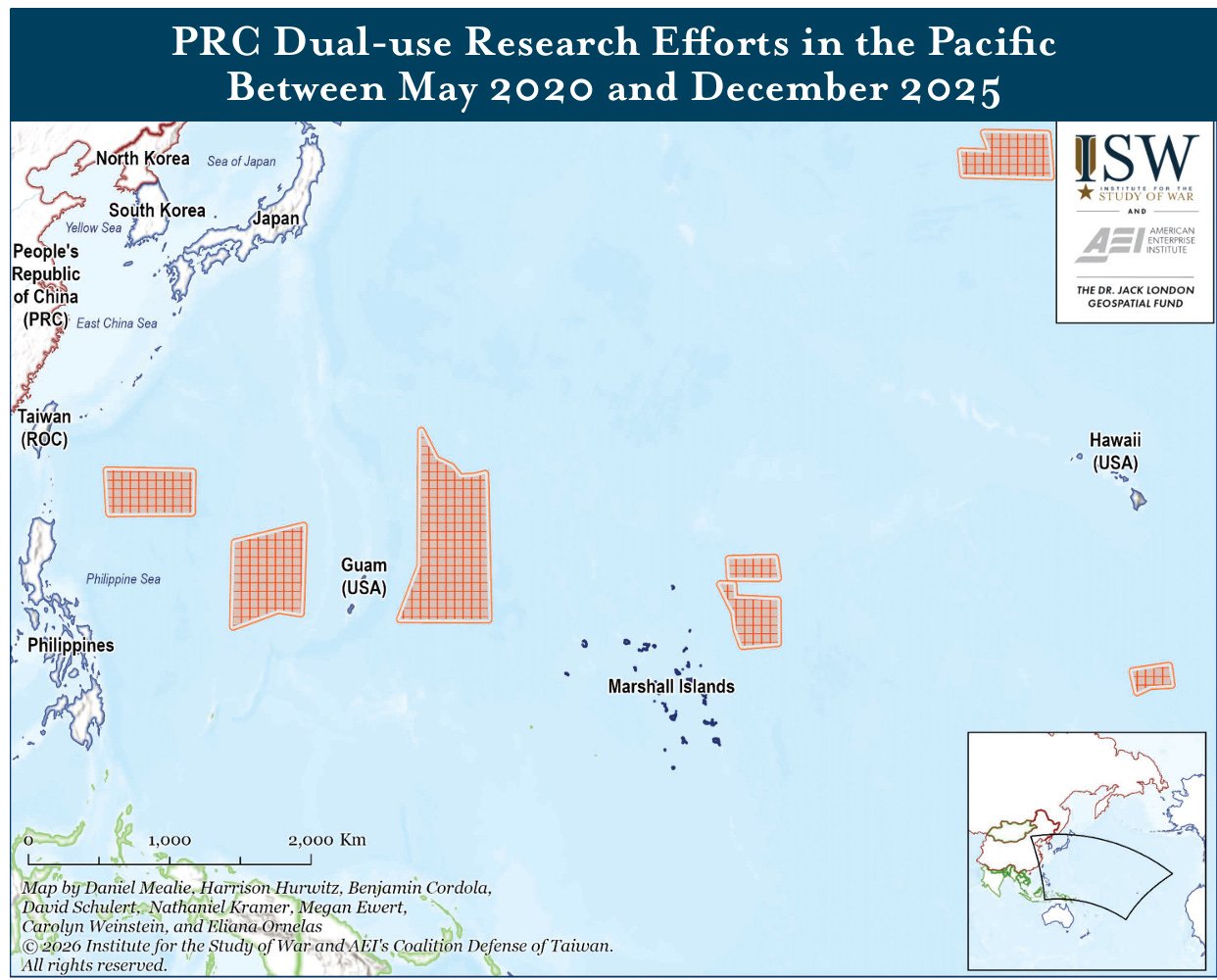
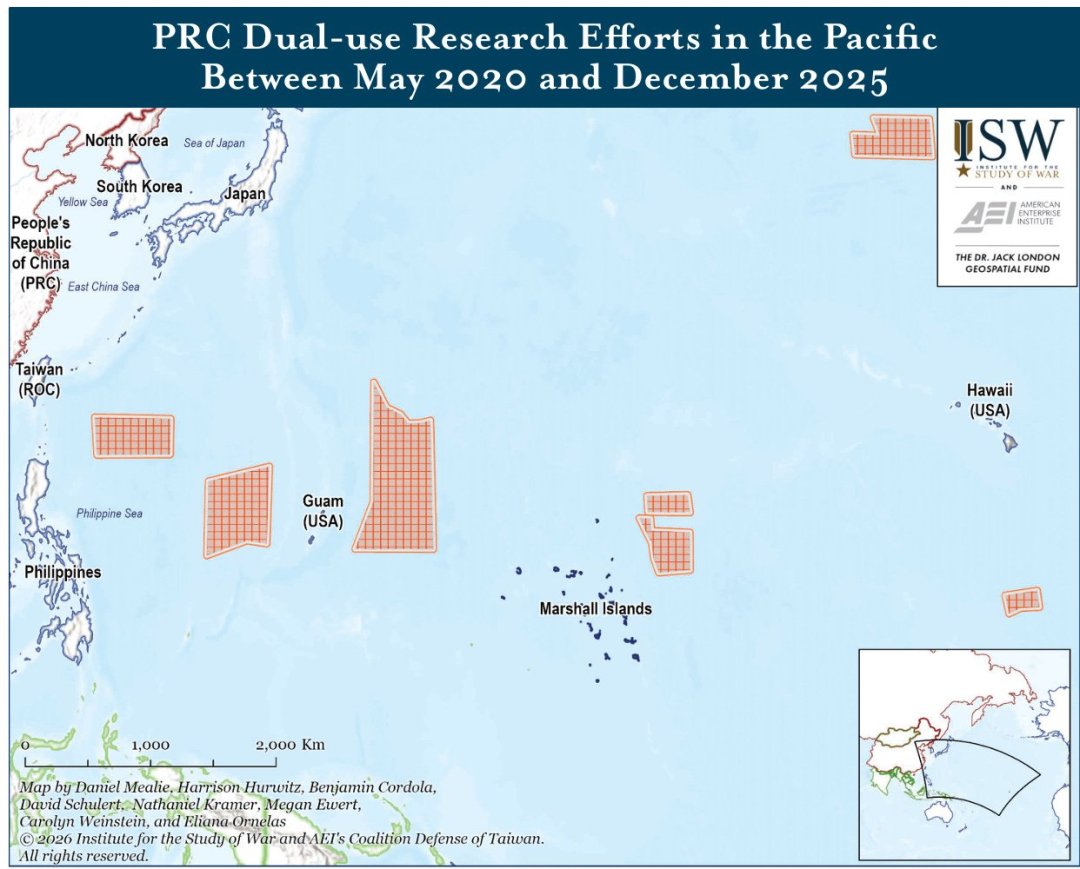
Jackson Karas and Alison O’Neil from the Institute for the Study of War and Alexis Turek from the American Enterprise Institute have put out a useful report titled, Surveil, Project, Divide: China’s “Guerrilla” Framework to Reshape the Pacific. Notice I called it, ‘useful.’ That does not mean that it is neither ‘bad’ nor ‘good’, it is just that—as you can see in its title—it is all wrapped around one of the least useful prisms people are trying to use to understand, explain, and offer solutions to the challenge of the People’s Republic of China (PRC) in the Pacific: guerrilla warfare, insurgency, and in response, counter-insurgency. Yes, yes, yes, I understand the ethos of the People’s Liberation Army and its mythology…but that does not mean I am forced to see the problem through their warped lens. I’m sorry, but no. This COIN backwash from GWOT has limited utility for really understanding what is going on in the Pacific. Trying to sound fresh and new is not helpful at all. This is a hard problem that will not be solved by trying to be clever. It will only be solved by hard work. To the contrary of those pushing a clever concept, what we are seeing is simply a modern manifestation of what has been done by global powers at sea against their rivals for centuries—if not thousands of years. Just as Mahan or Corbett won’t give you a secret key to understanding or solving problems, seeing aspects of land-based guerrilla warfare and insurgencies and applying them to a maritime challenge is not magic either. Should you understand these aspects? Absolutely, but don’t try to wrap your investigation and attempted explanation of possible solutions in them as a prime construct. It is just…embarrassing at best, or a version of buzzwordism at worst. That being said, Karas and O’Neil produced a superior project that brings together the most important threats and developments west of Wake. That is why it is useful and I recommend reading it. Just don’t get too excited about the ‘guerrilla’ pitch. The best part of the work is in its maps. I’m not going to pull too much text from it—as you and I both might tire of the marketing push of “guerrilla”, but here’s a solid outline of their argument There are several key areas where PRC maritime thinking has attempted to move beyond Mahan, however, particularly in its approach to sea power in the Western Pacific and Oceania. The PRC has attempted to formulate a theory of “guerrilla” maritime strategy that combines overt military development with covert political and economic influence to gradually undermine the United States’ ability to establish sea control in key areas of the Pacific, eschewing the Mahanian emphasis on decisive battle and a superior surface fleet. The PRC’s guerrilla strategy seeks to undermine US sea control in the Pacific and create favorable conditions for a PRC effort to seize Taiwan. The PRC conducts manifold influence operations in the Pacific; however, many of which serve diverging objectives and may fall outside the scope of this analysis. This paper aims to synthesize the activities that are most critical to the mission of sea control in the Pacific and that will have the greatest influence on a PRC-US conflict over Taiwan. This paper aims to demonstrate that the PRC — in many ways — understands such a conflict to have already begun through the prism of PRC guerrilla warfare at sea. Were the German U-boat campaigns in WWI and WWII ‘guerrilla warfare at sea’? Sure, I could make that argument, but it would be silly. No, they were just another chapter in the history of commerce raiding. I won’t repeat this argument more because I want to get to the charts. To make my point, here is what the PRC has been studying and what we need to spend more time studying at the Pentagon and Foggy Bottom: The Pacific is no longer an American lake where our forces can move about without worry. The below is an optimistic map. Luganville is just one spot in a whole constellation of PRC influence across the Southwest Pacific. If not blunted now, we should all understand their potential in a decade. I’d also encourage you to notice that Luganville is well south of the furthest advance the Japanese made in the last Great Pacific War. It is roughly halfway between Guadalcanal and the U.S. early-WWII rear-area headquarters in Nouméa, New Caledonia. The below isn’t so much research as it is part of a proper Intelligence Preparation of the Battlefield (IPB). Take out your JPME notes, folks…but for those who don’t have them: The Four-Step IPB Process Define the operational environment: Identify the area of operations, area of influence, and area of interest, along with relevant domains and characteristics that affect friendly, threat, and neutral forces. Describe environmental effects: Assess how terrain (such as avenues of approach, obstacles, and key terrain), weather, and civil considerations impact both friendly and threat operations. Evaluate the threat: Analyze threat doctrine, organization, capabilities, tactics, and vulnerabilities—often using doctrinal templates and threat models. Determine threat courses of action (COAs): Synthesize environmental effects and threat evaluations to project likely and most dangerous enemy COAs, helping identify named areas of interest and decision points. Guam occupies the same place in the PRC’s strategic thinking that Pearl Harbor did in the Imperial Japanese Navy’s. They are not hiding the ball in any way, shape, or form. If you are wondering what that little block is to the far east of the chart above—oh, my sweet, sweet summer child—that is athwart the great-circle route from San Diego to Australia. The square in the upper-right hand corner? That is along the great circle route to Japan. So, I am sorry if I am hurting the feelings of well-meaning, smart, well-credentialed people doing the best they can, but let us speak as adults. Stop trying to repackage things to make them sound profound or to suggest that you have a new insight. You don’t. Your great insight is that you are identifying and addressing a critical shortfall that those who came before you let fester. You are starting to see the importance of strategic stewardship, and that is good enough. Lean in with that. Less clever. More direct. This is a known challenge, and it will have to be solved as it has been most successfully solved in the past: Be so ready for it, and possess such power, that it never happens. People will wonder what all the worry and bother was about, because nothing happened. Of course it didn’t. The action taken because of the worry and bother kept war from happening. War comes anyway and you have the brute power, and the understanding of the battlespace, your enemy, and yourself, to ensure that you, the nation you serve, and its allies win. The end of the report just made me mad. The PRC’s guerrilla strategy proceeds from an internal acknowledgment of weakness. The PRC aims to avoid direct engagements across the spectrum of conflict with the United States. The United States can utilize tactical engagements, such as increasing diplomatic engagement with small Pacific Island states or countering PRC armed civilian aircraft to counter the PRC’s guerrilla efforts. The United States can ensure that the PRC’s erosion efforts can never transition, forcing the PRC to either abandon its aggressive objectives or risk open war with a superior adversary on unfavorable terms. The future of the Pacific is being written, and US action or complacency will determine whether this future serves the CCP’s goals or curbs its aggressive intentions. The PRC is not “weak.” This is not 2002. Almost all successful wars use the indirect approach, but that does not make it armed conflict that will, in the end, be decided by engagement. The assumptions about power and intent outlined here borders on hubris…and as such, is incredibly dangerous if put in the wrong ear. Here let me edit this. The PRC’s guerrilla strategy proceeds from an internal acknowledgment of weakness. The PRC aims to avoid direct engagements across the spectrum of conflict with the United States. The United States can utilize tactical engagements, such as increasing diplomatic engagement with small Pacific Island states or countering PRC armed civilian aircraft to counter the PRC’s guerrilla efforts. The United States can ensure that the PRC’s erosion efforts can never transition, forcing the PRC to either abandon its aggressive objectives or risk open war with a superior adversary on unfavorable terms. The future of the Pacific is being written, and US action or complacency will determine whether this future serves the CCP’s goals or curbs its aggressive intentions. Yes. Cut steel. Reindustrialize. Diversify. Homeshore. Simplify supply chains and vendors. Diversify the defense industrial base beyond the primes. Overweight on our comparative advantage in maritime and aerospace power. Reinvigorate relationships with medium regional powers. Conduct additional purges of those responsible for mismanagement at the Department of State. There’s your action. As a final note, if you would like to dive in further, we discussed this challenge here on May 2021, July 2022, February 2025. The two recent Midrats Podcast episodes on it were in June 2021 with Alex Grey, …and August 2025 with Cleo Paskal. h/t Brent.Leave a comment Share This Substack is reader-supported. To receive new posts and support my work, consider becoming a free or paid subscriber. View the full article
-
Russia’s state aircraft maker calls the Su-57 Felon its “main” combat jet. One of the country’s best-known pro-Kremlin military aviation bloggers says that if the stealth fighter vanished from the war tomorrow, “nobody will notice.” The blogger runs the Telegram channel Fighterbomber and has been identified as Ilya Tumanov. He posted the rebuttal to fresh […]View the full article
-
Ukrainian soldiers who trained in Germany are now crewing Rheinmetall’s Lynx infantry fighting vehicles with a frontline brigade, Ukraine’s Ground Forces said, after Berlin handed over a batch of the tracked armored vehicles. The 18th Army Corps announced on social media that the vehicles had joined the 21st Separate Mechanized Brigade. “The newest Lynx infantry […]View the full article
-
Another of your fun scenarios Enrique. Thanks much. Before posting up a report I'll have another couple of plays as I think my very quick win playing red side was mostly luck.
-
A robot vehicle working with British troops in Kenya spotted targets and sent them straight into the British Army’s AI-enabled targeting network, cutting the time from detection to strike by a factor of 10, its maker said Tuesday. ARX Robotics said it is the first company to integrate an uncrewed ground vehicle, or UGV, into […]View the full article
-
Germany’s next anti-submarine frigates will carry Israeli-designed electronic warfare gear meant to detect incoming threats and jam them, Elbit Systems announced. Elbit’s German subsidiary, Elbit Systems Deutschland, won a contract from shipbuilder TKMS to supply its Aqua Marine naval electronic warfare suite for the German Navy’s F128 frigates. The work will run over five years, […]View the full article
-
Russia’s Kalashnikov Concern says it has finished a state contract for SV-98 sniper rifles, a bolt-action weapon it says is widely used by Russian troops fighting in Ukraine. The company announced on November 23 that it had completed the contract for “high-precision 7.62 mm SV-98 sniper rifles.” It said delivery of the rifle, “widely used […]View the full article
-
Ekklios joined the community
-
More than 240 F-15C/D Eagle fighters are sitting in storage in the Arizona desert, and a retired U.S. Air Force general says the United States should find out how many could be flying over Ukraine. Retired Lt. Gen. David Deptula made the case in an opinion column published Monday. He wrote that Washington should assess […]View the full article
Yesterday
-
Three Russian cargo ships escorted by one of Moscow’s newest frigates have been crawling along the coast of Tunisia for days, according to an open-source ship tracker. Two days ago, Ukraine said it sank a Russian corvette in Libya. The account SONARROW, which follows naval movements, posted Monday that the convoy “has been moving very […]View the full article
-
A Ukrainian-built interceptor drone has destroyed a Geran-5 K5-K, a weapon widely reported as Russia’s newest jet-powered attack drone but classed by Ukrainian intelligence as a small cruise missile. Quantum WIY Industries, a German-Ukrainian joint venture, said its SPYS interceptor brought down the Geran-5 K5-K “during combat testing in Ukraine.” The company called it “another […]View the full article
-
A driverless version of the U.S. Army’s Armored Multi-Purpose Vehicle, or AMPV, is due for its first demonstration in February 2027. The part that lets it drive itself is an upgrade to the transmission it already uses, according to supplier RENK America. RENK America said on November 19 that it is working with BAE Systems […]View the full article
-
A backpack-sized Israeli spy drone flew 16 km (10 miles) out and back on a single flight without any external antennas, its maker said Monday. The company called it a new all-time range record. Aero Sentinel announced the flight of its SeniX tactical surveillance drone in a post by chief marketing officer Ofir Avram. He […]View the full article
-
Israel Aerospace Industries reported a record $35.6 billion order backlog on Monday and urged the government to settle a Defense Ministry debt that the state-owned company put at “billions of shekels.” The maker of the Arrow missile-defense system said net income rose 37% to $663 million in the first nine months of 2026, from $484 […]View the full article
-
U.S. drone maker Powerus is offering to turn boats that militaries already own into crewless drone carriers. Its maritime conversion, called Blue Sky Horizon, adds launch rails on the bow for long-range drones. The company described the system in a post on Monday. “We convert hulls people already own, which is faster and cheaper than […]View the full article
-
An oxygen rebreather built to let combat divers swim without trailing bubbles has passed a U.S. Navy safety review, its maker said Monday. German safety company Dräger announced that the oxygen version of its LAR 8000 combat diving rebreather is now on the U.S. Navy’s Authorized for Navy Use (ANU) list. According to the company, […]View the full article
-
As we reviewed almost a year ago, commerce raiding is something the Ukrainians should be doing to the maximum degree they can muster. The Ukrainians are in an existential fight for their right to self-determination. They have centuries of precedent on the right to—indeed the obligation to their people to—find every Russian-related ship on the high seas and sink or capture it. Let the lawyers and academics argue over it until the crack of doom, but don’t let that stop Ukraine from doing what it must. They don’t seem to be asking for permission anyway. This weekend, the Ukrainians have again struck well beyond the Black Sea to put down a marker: if you are a Russian ship, you are fair game. Back in June, Steregushchiy-class corvette Boikiy was struck while in dry dock in St. Petersburg. The weekend started a bit further down the Baltic, with the Russian military logistics ship Sparta II coming under attack in the Gulf of Finland on November 21. That same day, the Russian naval base in Baltiysk, Kaliningrad—known by cultured people as Pillau)—came under attack—though I have not seen any solid reports of damage. On the other side of Europe, across the Mediterranean to the port of Benghazi, the Ukrainians sank a sister ship of the Steregushchiy-class corvette Boiskiy hit in June, this time the Merkury. That is two of the nine completed ships of the class. The before and after pics tell the story well. I’m assuming it was a surface attack drone. It amazes me that, toward the year of our Lord two thousand and twenty-six, every warship is not bristling with crew-served weapons and remote weapon stations ranging from 7.62mm to 40mm to counter this threat alone, and not just warships.. The Russian cargo ship ASCALON (IMO 9198226) was struck by a surface attack drone off Benghazi, Libya as well this weekend. The up-close video is…something. The ship was seen last month loading Russian military equipment, including armored personnel carriers, infantry fighting vehicles and military trucks, at the Russian naval base in Baltiysk. Yes, that Baltiysk. This is another opportunity to remind everyone that we are well past the time that we need to arm the auxiliaries. If a ship is involved in military-related activity, it is a good target, a fair target, and a ship that will be targeted.. It must have the ability to defend itself. No excuse. As well-graphed by , the love child of low-reason Obama-Era NATO and Hillary Clinton, the MaxMaxistan that is modern-day Libya, is a unique sideshow, with one group out of Misrata in the Ukrainian camp and the Russians in the Benghazi camp. Libya has become another arena for the Russia-Ukraine conflict, with the two sides developing relationships with opposing Libyan power centers. Russia: Operates primarily through General Khalifa Haftar's Libyan National Army in eastern and southern Libya. Ukraine: Reportedly operates through the Tripoli-based Government of National Unity in western Libya, including Misrata. In effect, Russia has access to eastern Libyan airfields and ports, and Ukraine has access to western Libyan facilities. For those of us with an attention span greater than a house fly, that brings an ironic grin. Today’s alignment is almost an inversion of 2011: In 2011, Benghazi and the east were part of the anti-Gaddafi rebellion that the EU, NATO, and Obama supported. Today, those same people are broadly supporting Russia. Tripoli and the west were the Gaddafi regime’s home territory, though Misrata was not pro-Gaddafi. Today, the former Gaddafi stronghold supports Ukraine with European and Turkish backing as well. To add to the irony, Russia, which had abstained from the UN Security Council resolution authorizing intervention in 2011, now has a substantial military relationship with the eastern Libyan power structure that emerged from the post-Gaddafi civil wars. The whole thing is probably best explained by some damn butterfly in Brazil. Regardless, Bravo Zulu to the Ukrainians. More. Further. This Substack is reader-supported. To receive new posts and support my work, consider becoming a free or paid subscriber. Share Leave a comment View the full article
-
Russia has torn down two mess halls, two barracks and more than a dozen vehicle and maintenance halls at its most important army base near Finland, and new construction has started in their place. The work shows in satellite images obtained by Finland’s public broadcaster. The base is in Kamenka, on the Karelian Isthmus, about […]View the full article
-
A Turkish twin-cannon ship defense system shot down a fast jet-powered drone off Türkiye’s northern coast, and its operator only had to press one button. ASELSAN released video of the test on Monday. The company said its GÖKDENİZ, the naval version of the KORKUT land-based air defense system, “detected, tracked, engaged and destroyed” a moving […]View the full article
Last week
-
Eastern Libya’s government says a Russian ship docked at the Benghazi naval base was most likely hit by unmanned vehicles before dawn on Sunday. It’s the first official confirmation that the blast at the port struck a Russian vessel. The government, which is based in Benghazi and led by Osama Hammad, said in Statement No. […]View the full article
-
A Russian Navy missile corvette caught fire after a large explosion in the Libyan port of Benghazi and is “almost certainly destroyed,” according to a report by naval analyst H I Sutton published Sunday. Sutton provisionally identified the warship as the Merkury, a Project 20380 Steregushchiy-class corvette. He said the ship had been in Benghazi […]View the full article
-
A French-supplied Mirage 2000 fighter shot down a Russian jet-powered attack drone with its built-in cannon, according to footage released by Ukraine’s Air Force. The Air Force published the video with a short caption. “Shooting down a jet-powered UAV with the aircraft cannon of a Mirage 2000 fighter. Thank you to the pilot for the […]View the full article