All Activity
Today
-
equnhlnu joined the community
-
Russian forces dropped 8,016 guided aerial bombs on Ukrainian positions in October, an 11% fall from September’s record, the monitoring project Oko Gora said in a post summarizing the month. The figure works out to an average of 259 bombs a day and is the first monthly decline after a long climb through the summer. […]View the full article
-
Two Polish defense companies have agreed to work together on the wheeled chassis for 155mm self-propelled howitzers that Poland plans to build under license from Ukraine. PK MIL, part of the PONAR Wadowice group, and SZCZĘŚNIAK Pojazdy Specjalne of Bielsko-Biała signed a memorandum of understanding to select and adapt chassis for the systems, the companies […]View the full article
-
Poland has delivered more Rosomak 8×8 armored vehicles armed with the ZSSW-30 unmanned turret and Spike anti-tank missiles to the Land Forces Training Ground Center in Poznań, where they will be used to train soldiers from mechanized units, the country’s Armament Agency said on social media. The agency said the delivery is the next stage […]View the full article
-
Counter-drone missile maker Perseus Defense has released video of one of its small, low-cost interceptors climbing into the sky and hitting a hovering multirotor drone, which the company’s chief executive described as the first time an “attritable” missile has shot down a drone. Jason Cornelius, co-founder and CEO of the Texas-based company, posted the eight-second […]View the full article
-
Siemens Mobility and Lufthansa Technik Defense plan to build a hospital train for the German armed forces and NATO allies that could carry more than 150 wounded or sick patients, including those needing intensive care, the two companies said on Nov. 3. The companies signed a memorandum of understanding ahead of the Berlin Security Conference […]View the full article
-
Japanese satellite-servicing company Astroscale and German space firm OHB have signed a memorandum of understanding to explore working together on technology to protect satellites and other infrastructure in orbit, with a focus on linking Astroscale’s British subsidiary with OHB in Germany. The two companies announced the agreement on Oct. 28 at the German Embassy in […]View the full article
-
vrjwagfy joined the community
-
Auriga Space, a California company building electromagnetic launch technology, wants to fix one of the slowest steps in developing American hypersonic weapons: testing their materials and parts on the ground. Instead of a rocket-powered sled racing down steel rails, its Prometheus accelerator uses an electric linear motor to push a magnetically levitated test article through […]View the full article
-
ceaeuaqs joined the community
-
vyfruhgi joined the community
-
wavjzfev joined the community
-
ombhcdhr joined the community
-
tdlmtakw joined the community
-
udtkqyfy joined the community
-
qqghthdj joined the community
Yesterday
-
rjbcoggu joined the community
-
Kazakhstan has taken delivery of its second Airbus A400M Atlas heavy military transport aircraft, completing a two-plane order the Central Asian country placed in 2021, the Kazakh Defense Ministry said on Nov. 2. The aircraft flew from Airbus’ A400M final assembly line in Seville, Spain, to Almaty, where it joins the Air Defense Forces, Kazakhstan’s […]View the full article
-
The U.S. Navy’s top officer, Chief of Naval Operations Adm. Daryl Caudle, got a close look at Blackbeard, the new air-launched hypersonic strike missile that the Navy is preparing to arm its F/A-18E/F Super Hornets with, during a visit to Naval Air Station Patuxent River in Maryland on Oct. 28, the U.S. Navy said. Caudle […]View the full article
-
The Pentagon’s Office of Strategic Capital has agreed to lend up to $450 million to Neros, the California maker of the Archer attack drone, to build drones and their key parts in the United States, the Department of War announced on Nov. 2. Neros said it will put $165 million of its own equity into […]View the full article
-
The U.S. military has deployed high-energy laser weapons around President Donald Trump’s Mar-a-Lago estate in Palm Beach, Florida, as part of a counter-drone shield set up at the request of the Secret Service, a military spokesperson told the directed-energy news outlet Laser Wars. Laser Wars identified one of them in an Oct. 31 photo as […]View the full article
-
Luxembourg-based satellite company Hydrosat is developing a high-resolution heat-sensing satellite capability called Nyktòs that governments can task to photograph specific targets day or night, the company announced on Nov. 2, aiming the service at NATO members and other allies that want their own space-based intelligence. Nyktòs will use mid-wave infrared sensors, which detect heat rather […]View the full article
-
The U.S. Navy has taken delivery of the 1,000th Evolved SeaSparrow Missile Block 2, the ship-defense interceptor built for a 12-nation NATO consortium, after doubling the number delivered in just over a year. The Navy’s NATO SEASPARROW program office, known as PMX-312, said the program reached its 500th Block 2 delivery in June 2025. It […]View the full article
-
The U.S. Army has flown a mid-sized drone powered by a 3D-printed rotary engine that runs on jet fuel, the Army Research Laboratory announced, wrapping up a multiyear research program aimed at giving future unmanned aircraft more range, power and endurance. The engine drives a generator in a series-hybrid system, meaning it produces electricity for […]View the full article
-
Leonardo DRS will supply the power, cooling and vehicle integration hardware for the U.S. Army’s first production laser weapon, after AeroVironment picked the company as a subcontractor on the Enduring-High Energy Laser program, DRS announced on Nov. 2. The work supports AeroVironment’s production of its LOCUST X3, a 30-kilowatt laser designed to shoot down small […]View the full article
-
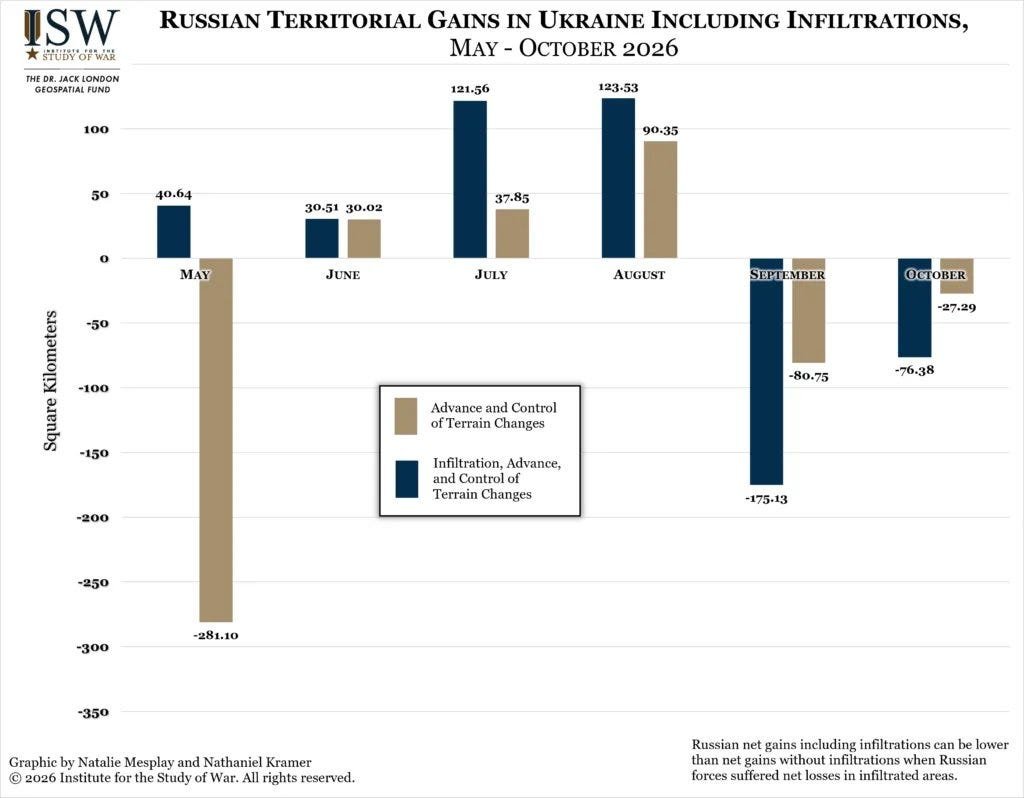
A grinding war can devolve into almost a tidal environment. Lines move forward and then back. Cycle. Then you have to wait for a moment. Two months is not a breakthrough, but given Russia’s efforts over the summer, Ukraine’s wee gains should cause one to pay closer attention. While most Americans after Labor Day have been focused on the election, the Iran War and the “issues” from Paris to Warsaw, as the Russo-Ukrainian War of 2022 approaches its 5th Anniversary next winter, ISW’s latest Campaign Assessment has some hard facts for Team Russia to ponder. Russian forces lost ground on the battlefield in October 2026 for the second month in a row. ISW has observed evidence to assess that Russian forces consolidated positions or seized 139.85 kilometers but lost 167.14 square kilometers of territory in Ukraine in October 2026 for a net loss of 27.29 square kilometers. That is an average pace of -0.88 square kilometers per day. Russian forces only made gains in Sumy and Zaporizhia oblasts, while losing territory in all other sectors of the frontline, including their priority objective of Donetsk Oblast. Russian forces also lost ground in October when accounting for Russian infiltrations into areas over which Russian forces have not gained control, with Russian forces suffering a net loss of 76.38 square kilometers in such areas for an average pace of -2.46 square kilometers per day. Russian forces seized 10 settlements totaling 5.86 square kilometers, but Ukrainian forces liberated or cleared Russian infiltrators from 11 settlements with an area of 3.24 square kilometers. This has been an almost static front for a very long time. Russia—on paper at least—should have won this war long ago, and that’s the problem. She entered the war with approximately 3.3 times Ukraine's population base and nine times its nominal economic resources. There are some things in war you cannot quantify…so you need to be very careful before starting one. On paper, Vietnam and Afghanistan should not have been a problem for the U.S.A., but we got our a55 handed to us each time. As we’ve discussed from the beginning of the conflict, Russia started with war with a bad plan that came through a series of optimism filters. From missile cruisers to the SU-57 to their newest tanks, none of their high-profile weapons have been able to close the deal. Plucky Ukraine continues to deliver the undeliverable. Russian forces suffered their highest monthly losses of the war thus far in October 2026, paying a growing price for their territorial losses. I continue to remind myself that I cannot fully understand the Russian—or Ukrainian—mindset from my comfortable seat in North America, and that I should not make predictions. I won’t, but I will comment on what we are all seeing on the ground. How does Russia continue to sell this to their people? The only thing that is going for them is that Ukraine’s supporters in NATO Europe seem to be distracted by their own burning cities and tottering welfare states to do much more to help. In North America, there is no desire to support Ukraine more than the Europeans want to support them, if that. After all, it is their back yard and Uncle Sam has more pressing concerns in the Pacific. So, the Pontic Steppe is about to enter another winter of war, more than it saw in WWII, with little progress on either side, just more death. More and more, I think this is becoming a rather strange war of will. All wars are about ‘will’, really, but in this one, both sides are holding their lines +/- as if they are waiting for some tangentially related political crisis to cause one side or the other’s military to just, well, walk away. Who quits first before some damn foolish thing happens that pulls more nations into the fight? Leave a comment Share This Substack is reader-supported. To receive new posts and support my work, consider becoming a free or paid subscriber. View the full article
-
North Defence Group has shown new images of its unmanned ground vehicle, a compact electric or hybrid robot built to haul more than 1,000 kg (2,200 pounds) of gear for frontline troops, follow soldiers on its own and carry counter-drone weapons, as the British-Luxembourg company prepares it for NATO trials in Switzerland. The company said […]View the full article
-
Russia has banned exports of benzene, toluene, xylenes and phenol for three months, saying it needs to keep its own factories supplied with the industrial chemicals, the government announced on Nov. 2. The ban, signed by Prime Minister Mikhail Mishustin, covers coal-derived and petroleum benzene, toluene, ortho-xylene, para-xylene and phenol shipped outside the Eurasian Economic […]View the full article
-
Russia expects to reach a deal to sell Pantsir-S1 air defense systems to Azerbaijan, the head of Russia’s arms export regulator said, in a sign that military trade between Moscow and Baku is picking up again after a year-long diplomatic rupture. Dmitry Shugaev, director of the Federal Service for Military-Technical Cooperation, said on Russian state […]View the full article
-
Israel’s Defense Ministry has signed a 15-year contract with Elbit Systems worth about 600 million shekels, or roughly $192 million, to build and run a training and simulation center for the Israel Defense Forces Artillery Corps as it brings the new Roem self-propelled howitzer and Lahav rocket launcher into service. The ministry’s Directorate of Defense […]View the full article
-
Japan tracked four Chinese navy ships moving through the Miyako Strait between Okinawa and Miyako Island over two days, with one destroyer pair heading back into the East China Sea and another heading out into the Pacific, the Joint Staff of Japan’s Defense Ministry said in a post on Nov. 2. On Nov. 1, a […]View the full article
-
A photo of Russia’s new Filin cruise missile sitting on a ground launcher with a solid-fuel booster strapped under its fuselage has surfaced for the first time, Ukrainian defense outlet Militarnyi reported, showing how Russia gets the low-cost missile into the air. The booster fires first to accelerate the missile off the launcher and into […]View the full article
-
I've not yet time to test it, but sembles interesting. Fighter Pilot, an apparent free game inspired in Avalon Hill's Fighter Pilot, doesn't need download (I think up to 3 groups of 2 planes by side, with up ot 4 different types present, apparently also only jet fighters): https://games.forkpotato.com/fighterpilot/
Last week
-
When one of the world’s most advanced, high-technology militaries, that, even with a relatively low level of spending, still has one of the most capable forces on the planet, decides that it will double its spending…it gets attention. When that power is one of America’s best friends, it generates smiles. That may be too broad a description, but for those in the national security arena looking beyond the Russo-Ukrainian War and events in Southwest Asia, this is one of the most important developments of the last few years. Where is Japan going? Returning to the Midrats Podcast this Sunday from 5–6 p.m. LIVE to discuss this will be Jack McCain. You can join us LIVE at this link with access to the show chat. Jack McCain is a former U.S. Navy helicopter pilot and the CEO of McCain Advisory, a Japan-based firm helping companies navigate Japanese politics, business, and government relations. Now based in Japan, his work focuses on strengthening U.S.–Japan ties through business partnerships, defense cooperation, and emerging technology. He brings both a security perspective and a personal commitment to understanding the country he now calls home. He is also a member of the McCain Institute Board. Leave a comment Share This Substack is reader-supported. To receive new posts and support my work, consider becoming a free or paid subscriber. View the full article

-
An RAF Protector RG1 remotely piloted aircraft has flown its first operational missions in UK airspace, giving the Royal Navy more than 10 hours of surveillance over the English Channel while warships tracked the Russian frigate Neustrashimy, the UK Ministry of Defence said. The unarmed Protector flew alongside military and civilian air traffic while the […]View the full article