




Linebacker
A Harpoon Commanders Edition (HCE) scenario for the Indochina Battleset and the HCCW database (HCCW-110319 or later).
This scenario is designed for play by the BLUE side only.
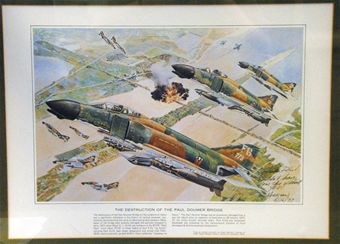
Disrupting the critical flow of men and materiel south was a primary objective of the US Air Force throughout the Vietnam war. Lacking good road and highway links, the North relied heavily on its railroad to support its offensive. Despite repeated and systematic bombing by the Americans against the rail network, however, the North had become quite adept at making rapid repairs and building bypasses. It seemed the craters were filled in and the new track was laid almost as quickly as American jets faded out of sight. One of the most critical parts to escape heavy damage was the Paul Doumer Bridge over the Red River, just northeast of Hanoi. Four of the major railways met here. It had thus far been off limits to the bombing campaign, but in Summer 1967, President Johnson finally agreed to a list of targets that would include the Paul Doumer Bridge. The list was a critical component of Operation Rolling Thunder, Phase IV.
The bridge was no easy target, however, being somewhat of an engineering marvel, not to mention being heavily defended. The first serious attempt at dropping the bridge came on 11 August 1967, when a large force of F-105D Thunderchiefs carrying 3000 lb bombs were sent north. Hammering the bridge with over 90 tons of explosives, they managed to drop three spans and brought all truck and rail traffic into Hanoi to a halt. Inside two months, however, the North Vietnamese had put the bridge back into operation. On 25 October the F-105s struck again, and again knocked out the bridge. Within a month, it was back up. Twice more in December the F-105s dumped bombs on the bridge and inflicted more damage. The North Vietnamese began to compensate by building a pontoon bridge downriver, but this too was struck by a Navy Intruder. Nearly 400 more tons of bombs were dropped on the Paul Doumer Bridge before President Johnson halted the bombing campaign in the North in late 1968.
The reprieve gave the enemy just what it needed: time to repair the bridge and bolster the defences around it. It was not until Spring 1972, under the auspices of Operation Linebacker, that US Air Force jets returned to try and finally bring down the Paul Doumer Bridge once and for all. This time they brought a new weapon, the smart bomb.
What's New in Version 03/21/2011 01:19 PM
Released
No changelog available for this version.