



All Activity
Today
-
Ukraine’s Independence Day parade in Kyiv on August 24 included a new naval drone, the MV11, from the Ukrainian company UFORCE. It is the largest vessel yet built in the company’s MAGURA family, an unmanned surface vessel line credited with helping push Russia’s Black Sea Fleet back from Ukrainian waters. The parade marked the first […]View the full article
-
Rows of black, Shahed-shaped airframes stretch across a production floor in newly released footage marking Ukraine’s Independence Day, offering the clearest public look yet at how many Behemoth “mid-range” one-way attack drones the country is now building at once. The video shows dozens of the drones mounted on wooden and metal stands, wingtip to wingtip, […]View the full article
-
AIM-424 “Malice” Very Long-Range Air-To-Air Missile Emerges From The Shadows (Updated) (The War Zone)
-
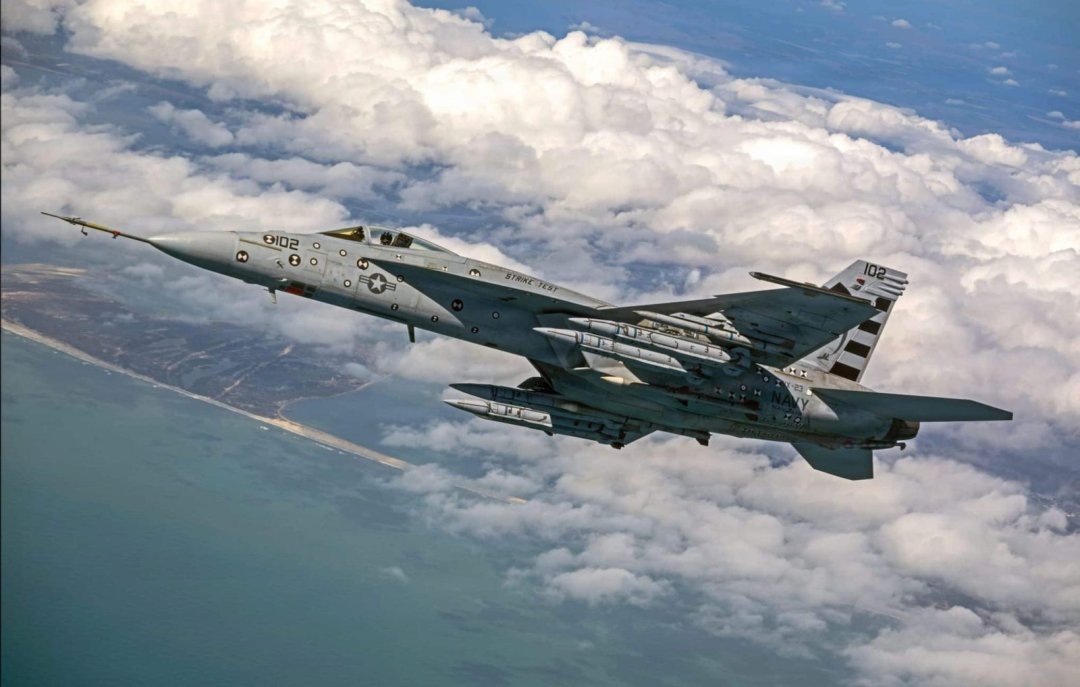
Back during the previous Cold War, we knew that range was life. We had a heavy fighter in the F-14 built around a beast (for its day) of an air-to-air missile, the AIM-54C Phoenix with its 99.4 nautical mile (nm) range. A few years ago, we found a stopgap with a modified SM-6 called the AIM-174B Gunslinger, but it wasn’t quite what we needed in the long term—though it did get us 150+ nm. Via Carter Johnson at Naval News: The U.S. Navy’s newest air-to-air missile, the AIM-424 Malice…is capable of hitting targets over 250 nautical miles (463 kilometers) away, leveraging a 13.5″ diameter and aerodynamic profile that appears to have been built for range. That range would exceed estimates of all currently known Chinese air-to-air missiles that have widely been recognized as major threats to U.S. airpower in the Pacific. …and it has a proper name we can call it: “Malice”. Excellent. The Navy’s official announcement couldn’t help itself. “The Department of the Navy is developing the AIM-424 Long Range Air-to-Air Missile (LRAAM), a next-generation missile intended to strengthen fleet defense and maintain a decisive air-domain overmatch against advanced threats. Also known as Malice, the LRAAM directly supports the Department’s contribution to integrated deterrence by increasing range, lethality, and combat effectiveness for Marine and Naval Aviation forces that are defending our fleets, our interests, and our homeland. Further details regarding specific capabilities and deployment timelines remain classified to protect operational security.” Bleh. Too many Bullsh1t Bingo words. And threw in an unpronounceable acronym. Someone keep the engineers away from communicating with humans, please. Here’s the real sexy part. The broad range of aircraft include the U.S. Air Force’s sixth-generation F-47 and the U.S. Navy’s F-35C, F/A-18, and potentially the F/A-XX. At least one captive-carry flight test was disclosed in the Navy’s image release, dating back to April 2026. A fit test on an F-35 appears to have been conducted earlier this month in August. Internal carry, as per the pic. Of course, I’m getting a bit greedy. I’d like to know if it has—in theory, of course—an anti-satellite capability. Can it be configured as an anti-radiation missile for SEAD? Can we adjust its programming so it can be used in an anti-surface mode? I know, I know. Patience…patience… Leave a comment Share This Substack is reader-supported. To receive new posts and support my work, consider becoming a free or paid subscriber. View the full article
-
Ukraine held what organizers described as the world’s first military parade composed entirely of unmanned systems on August 24, 2026, marking the country’s Independence Day with a display of ground, naval, and aerial drones instead of traditional manned formations. Dozens of ground robotic systems moved down Kyiv’s main street, built for logistics, reconnaissance, and combat […]View the full article
-
Europe’s defense industry has faced a growing series of fires, explosions and deliberate attacks in 2026, many of them affecting companies that manufacture weapons, ammunition, drones or other equipment for Ukraine. Western intelligence sources increasingly view the incidents as part of a Russian campaign intended to disrupt military supply chains, intimidate manufacturers and test how […]View the full article
-
French drone maker Cavok UAS is developing a containerized launch system designed to deploy swarms of its Skydart5 interceptor drones, an effort flagged by Counter Unmanned Systems on X after Cavok UAS described the concept. Cavok UAS, based in Sainte-Menehould in France’s Marne region, posted a schematic image of the dispenser alongside a description of […]View the full article
-
The Royal Navy’s Dreadnought-class submarines share a missile compartment design, a nuclear propulsion technology exchange, and the same missile as the U.S. Navy’s Columbia class, according to a Congressional Research Service assessment cited by the UK Defence Journal. Both submarine programs are now past the point of no return. All four British boats, HMS Dreadnought, […]View the full article
-
Austal USA delivered LCU 1710 to the U.S. Navy on August 14, 2026, the first vessel completed under the Navy’s LCU 1700-class program and the first steel-hulled ship the shipbuilder has ever delivered to the service. Austal USA, based in Mobile, Alabama, has built its Navy business primarily on aluminum vessels, including Independence-variant littoral combat […]View the full article
-
Ukraine has mounted interceptor drone launchers on a Mi-8 helicopter, with footage of the system shown in President Volodymyr Zelensky’s Independence Day address, Militarnyi reported. The footage shows an interceptor launching from beneath one of the helicopter’s hardpoints, using simple metal launch rails mounted under the airframe. The drone is likely controlled either from inside […]View the full article
-
Russian officials say a volunteer air defense unit in Kursk Region shot down a Ukrainian FP-5 Flamingo cruise missile using machine-gun fire during an overnight attack this weekend, an unusual claim for a weapon Russia has typically engaged with surface-to-air missile systems. Kursk Region Governor Aleksandr Khinshtein said the intercept happened overnight Saturday into Sunday, […]View the full article
-
Shipbuilders at BAE Systems Australia laid the keel of NUSHIP Hunter on August 24, 2026, marking the formal start of hull assembly on the first ship in Australia’s Hunter class frigate program. The ceremony took place at the Osborne Naval Shipyard in South Australia. Minister for Defence Industry Pat Conroy and Chief of Navy Vice […]View the full article
-
The European Commission approved €6.1 billion ($7.12 billion) in new defense procurement funding for Ukraine on August 24, 2026, the same day Ukraine marked its Independence Day. The money covers air and missile defense systems, missiles, ammunition and radars. Commission President Ursula von der Leyen tied the timing directly to the war. “On Ukraine’s Independence […]View the full article
Yesterday
-
For me, it is funny but serious that the phrase I started saying in 2019 that we were going to keep building Arleigh Burke DDGs “until the crack of doom” has turned into prophecy. With the anticipated death of DDG(X) and FFG-62, the Burkes are about the only game in town. That fact naturally flows into a point we have raised here and on the Midrats Podcast for the last couple of decades: How are we going to conduct repair and maintenance under combat conditions should we find ourselves in a fight west of the International Date Line? Well, we’ve got the perfect intersection of both issues for the next episode of Midrats. This RAND Report from May caught my eye: The Arleigh Burke–class guided missile destroyer, commonly known as a DDG-51, is the primary surface combatant vessel of the U.S. Navy. These ships—designed to operate in contested environments—are likely to sustain widespread battle damage from diverse attacks should a conflict develop in the Indo-Pacific region. The prevalent nature of this damage would give rise to the greatest demand for ship repair that the Navy has experienced since World War II. To evaluate requirements for and potential issues with a significant demand for salvaging and repairing battle-damaged destroyers, the authors conducted a tabletop exercise on August 13–14, 2025, with participants from the United States and allied nations in the Indo-Pacific. The participants were split into four groups, and each group represented U.S. and allied stakeholders who would be involved in the repairs. The report is titled, Battle Damage Repair for Arleigh Burke–Class Destroyers: Tabletop Exercise Results. Our guest is one of the authors of the report, Bradley Martin. You can listen at this link, or via the Spotify widget below. Bradley Martin is a senior policy researcher at RAND. He retired from the Navy as a surface warfare Captain after 30 years of service, including four command tours. In addition to his operational tours, Martin served on the staff of U.S. Forces Japan, on the OPNAV staff as an operations analyst, and, most recently, as the Navy coordinator for participation in Joint Staff and OSD requirements and resources forums. His subspecialties included operations research, operational logistics, and strategic planning. His work at RAND focuses on Navy force structure and capabilities, supply chain security and resilience, and national security strategy. Prior to joining the Navy, he achieved a doctorate in political science from the University of Michigan, while working as a research assistant for the Correlates of War Project. Show LinksBattle Damage Repair for Arleigh Burke–Class Destroyers Repair CFT Brief for JTEG Forum on “Expeditionary Repair” CDR Erich C. Schwarz, USN, July 2022 SummaryIn this episode, we explore the insights from a recent tabletop exercise on naval repair capabilities and strategic challenges in the Indo-Pacific, featuring Captain Brad Martin. We discuss the importance of organic repair assets, the vulnerabilities of fixed bases, and the need for adaptable logistics in wartime scenarios. Chapters00:00: Introduction to the tabletop exercise and its significance 04:02: What makes a successful tabletop exercise and team composition 09:01: Key findings: surprises and vulnerabilities in naval repair 15:03: The importance of organic repair capabilities and their current gaps 21:03: Lessons from history: Cold War to modern challenges 27:11: The impact of logistics, parts, and industrial base on wartime readiness 34:01: Geopolitical considerations and the role of partner nations 40:09: The need for mobile, flexible repair assets in contested environments 50:05: Concluding thoughts: preparing for a prolonged conflict Leave a comment Share This Substack is reader-supported. To receive new posts and support my work, consider becoming a free or paid subscriber. View the full article

-
A Ford F-250 that can drive itself carried a shotgun-armed drone-killing turret onto a live-fire range at Fort Bragg on August 18, 2026, the latest test in a U.S. Army program built to get engineers out of the blast radius during breaching operations. The vehicle, tested at Range 63 as part of Project Sandhills 2.0, […]View the full article
Last week
-
The U.S. Navy has awarded Zone 5 Technologies a $65 million contract to build a maritime strike variant of its AGM-188 Rusty Dagger cruise missile under a new program aimed at fielding low-cost precision weapons for the U.S. and its allies. The award is an Other Transaction Agreement, a contracting mechanism the Pentagon uses to […]View the full article
-
Kongsberg has signed a contract worth NOK 1.1 billion, about $118.4 million, to supply additional PROTECTOR RS4 Remote Weapon Systems to General Dynamics Land Systems-Canada for the Canadian Army’s Armoured Combat Support Vehicle program. The Norwegian defense company said the deal is a follow-on order building on previous RS4 deliveries for the same program. Kongsberg […]View the full article
-
Supacat has opened a new production facility at its headquarters in Devon, England, naming the building after company co-founder Nick Jones. The British vehicle manufacturer said Maj. Gen. Chris King cut the ribbon at the opening, which the company described as marking the launch of a facility expansion. Supacat did not disclose the size of […]View the full article
-
The U.S. Marine Corps Warfighting Laboratory has completed technical acceptance of the first Ancillary Surface Craft prototype, moving the roughly 150-foot vessel into a new phase of testing at Quantico, Virginia, the laboratory said in a release. The ASC is a roll-on/roll-off landing craft designed to carry personnel, equipment, and fuel directly onto unimproved shorelines, […]View the full article
-
The U.S. Marine Corps has awarded Accrete a contract to deliver an artificial intelligence platform designed to track and analyze narratives across social media, broadcast outlets, and messaging platforms in near real time. The contract covers Argus for Cognitive Advantage, a system built on Accrete’s Knowledge Engine platform. Accrete describes Knowledge Engines as tools that […]View the full article
-
The v1.10 Public Beta for Command: Modern Operations is now live (as of 12 August).
-
Historical Review of Nuclear Submarine Design and Production in Russia (by Christopher P. Carlson)
-
Houthi media released footage this week showing a Rajum quadcopter dropping a munition onto a Royal Saudi Land Forces M1A2S Abrams main battle tank at a forward position in Marib, Yemen, followed by an explosion and a fire that engulfed the vehicle. The video has not been independently verified, and neither the Saudi-led coalition nor […]View the full article
-
Ukraine’s military intelligence agency, the Main Directorate of Intelligence, known as HUR, said Friday that Russia has built a secret military complex of biological laboratories on an island in the Tver region, where it experiments with dangerous viruses and other pathogens on behalf of the armed forces. HUR identified the facility as the “Center for […]View the full article
-
No more complaining about a long Sea & Anchor detail. What a great story about a frigate ... and three hurricanes. Read the full thing, but here is how it starts; THE 24-gun frigate H.M.S. Experiment was built in 1740 by Henry Bird of Rotherhithe. She sailed on her maiden voyage on 21 July 1740 from Spithead to join Vice-Admiral Vernon’s squadron in the West Indies. Her captain was James Rentone, who had piloted Vernon’s squadron into Portobello Harbour and had been given the honour of bearing the news of Vernon’s victory to the king. George II had rewarded him with a present of 200 guineas and the promise of a 6o-gun ship. Under his command H.M.S. Experiment had nearly completed her passage to the West Indies when she received her first taste of what a hurricane could do. By her reckoning she was in latitude 16° 34’ N, longitude 43° 04’, west of Madeira. Her log reads: Saturday 30 August 1740 The first part fresh gales and squally, the latter a very hard Gale of wind at NNE and NE with a great swell from the ESE. At 6 p.m. took all the reefs in the topsails, furld the foretopsail, bunted the courses, brought too under main topsail and got down the topgallant yards: at 1 a.m. handed maintops’!, lower’d the main and foreyards and reef’d the courses: at daybreak the gale continued increasing and, having no hopes of its breaking, about r o a.m. cut away the topmasts to save the lower masts: soon after the mizon mast went away at the lower part of the hounds: the sea made a breach over the ship and we kept one pump constantly going, the wynch of the other being broke render’d it useless: lost one of the swivell guns over board by the fall of the foretop mast and had one of the lower studding sail booms wash’d away and severall other things of the deck harness, barr’l with beef 45 pd. and sev’l casks. Sunday 31 August 1740 The first part a violent storm of wind from NE to East with a very great sea making a breach over us, the latter part the gale somewhat abated: at 4 a.m. the foresail being split in pieces cut him away from the yard and lost most part of the canvas: at 8 a.m. bent a new foresail and set the reef’ d courses. On that afternoon her company raised a jury maintopmast and let the reefs out of the courses. On the next day they got up a fire-boom for a foretopmast and a maintopgallant yard for a topsail yard. At daybreak on 3 September they sighted Antigua and sailed into English Harbour. There Captain Rentone delivered the Duke of Newcastle’s letters to General Mathews and wrote to the Admiralty a description of the hurricane which adds a little to the log-book entry. I made a great deal of water, my comings being very low and the tarpaulings, tho’ double battened, being insufficient to keep it from getting down in a very great quantity for 14 hours which the gale continued without the least intermission and one of my pumps disabled by the wynch breaking so that I had but one to depend on and that almost constantly going and if the gale had continued many hours longer, the least increase of water would have made it very difficult to save the ship. Hat tip Society for Nautical Research.Leave a comment Share This Substack is reader-supported. To receive new posts and support my work, consider becoming a free or paid subscriber. View the full article


