All Activity
Today
-
The U.S. Navy is looking for companies that can help it build a new torpedo that aircraft and drones could launch from far away to hit enemy submarines, according to a notice posted publicly this week. The Naval Air Systems Command, working on behalf of the Navy’s Strike Weapons Program Office, is calling the effort […]View the full article
-
Navier’s N30 Quanta-D hydrofoil vessel completed a round of testing with U.S. Department of War customers last week, running mission profiles in front of special operations evaluators, the company said. The San Francisco Bay Area maritime technology company said the exercise, called Technical Experimentation 26-3, tested the boat’s performance in real mission scenarios. Navier did […]View the full article
-
Splash Industries has introduced a new mission module for its Typhoon uncrewed surface vessel that lets operators launch one-way aerial drones from the boat, the company said Monday. The module, called the Airstrike Pack, allows operators to deploy the aerial assets with the press of a button through Splash’s own command and control software, Splash […]View the full article
-
British company ZeroUSV said it has demonstrated the autonomous deployment of two smaller surface drones from its Oceanus12 uncrewed surface vessel, during trials conducted in Plymouth, England. The Oceanus12, a 12-meter uncrewed surface vessel, deployed two Oshen C-Star drones during the trial. ZeroUSV described the demonstration as a world first, showing how one autonomous surface […]View the full article
-
The U.S. Army has ordered another $51 million worth of Switchblade 600 loitering munitions from AeroVironment, the company announced Wednesday. The delivery order covers additional Switchblade 600 Block 2 systems and also includes Switchblade 600 Block 1 systems tied to a Foreign Military Sale for an unnamed U.S. ally. It was issued under the Army’s […]View the full article
-
Cambridge Pixel will show its software for uncrewed and autonomous surface vessels at SMM 2026, a maritime trade fair running September 1-4 in Hamburg, Germany. The UK-based company will set up at Hall B1, Stand 321, where it plans to demonstrate radar, camera and sensor processing modules used for tracking, data fusion, display, control, recording […]View the full article
-
A European company plans to build a $233 million explosives and warhead factory in Latvia, a NATO ally that sits just 175 miles (280 km) from Russia’s border, in a project aimed at closing a supply gap that has left Europe dependent on outside sources for the raw materials behind its weapons. Wolfram Europa announced […]View the full article
-
The U.S. Army is preparing to select a new infantry fighting vehicle that will replace the Bradley after more than 40 years in service and serve as the backbone of the Army’s armored formations for decades to come. Known as XM30, the program has two finalists, General Dynamics Land Systems and American Rheinmetall Vehicles, both […]View the full article
-
Y Combinator-backed startup IMPACT Drones says it built a working prototype of its high-speed interceptor drone, called SABLE, in two weeks, according to posts by the company’s two co-founders on social media. Jasper Lortije, whom the company lists as CEO, and Alessandro Fiume, listed as founder, both posted about the prototype this week. IMPACT Drones […]View the full article
-
More than 2,500 government, industry and academic representatives gathered in Novi, Michigan, August 11-13 for the 18th annual Ground Vehicle Systems Engineering and Technology Symposium, where U.S. Army Combat Capabilities Development Command Ground Vehicle Systems Center leaders outlined how the command is using integrated experimentation to speed new technology toward soldiers, according to a DEVCOM […]View the full article
-
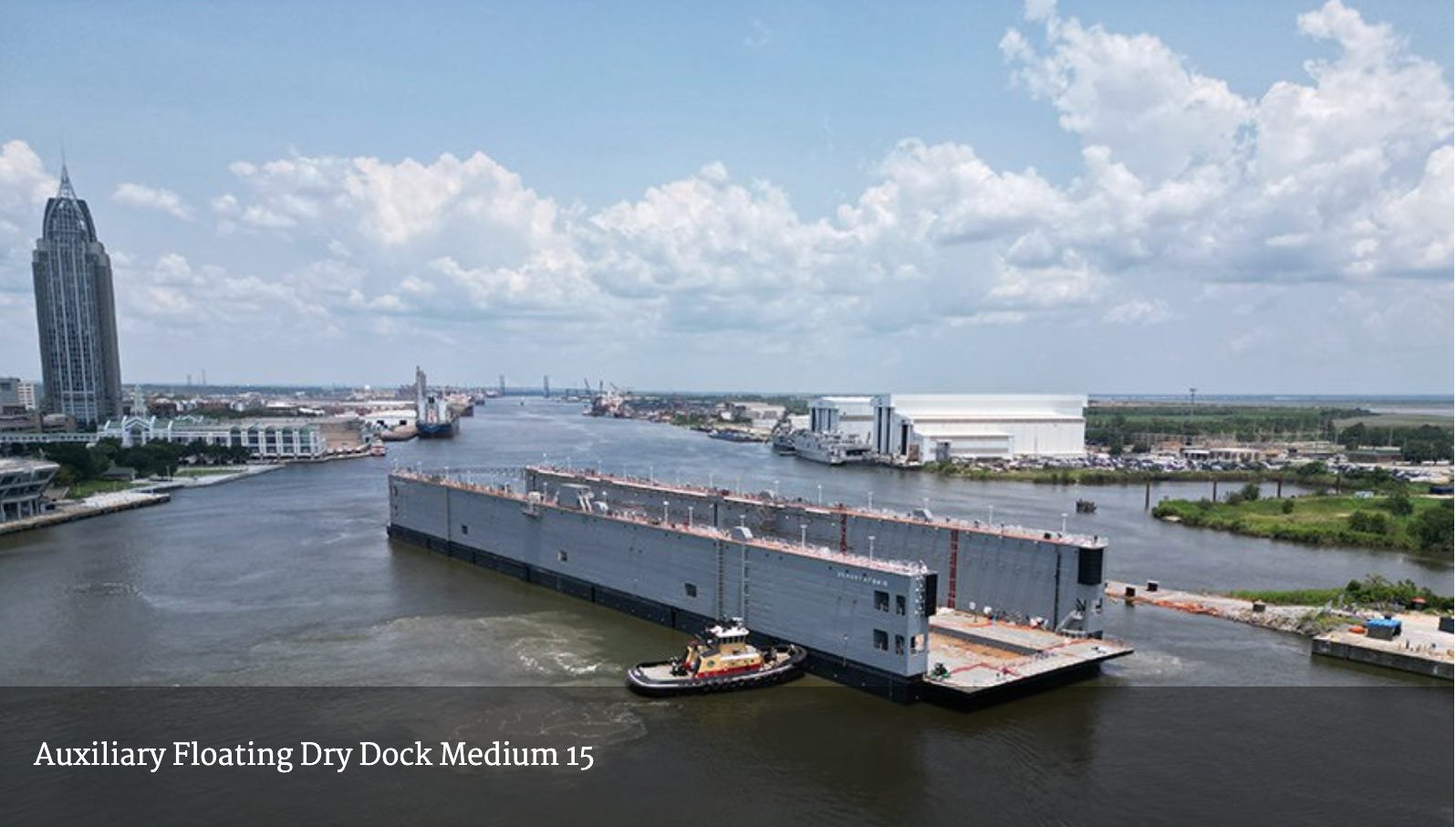
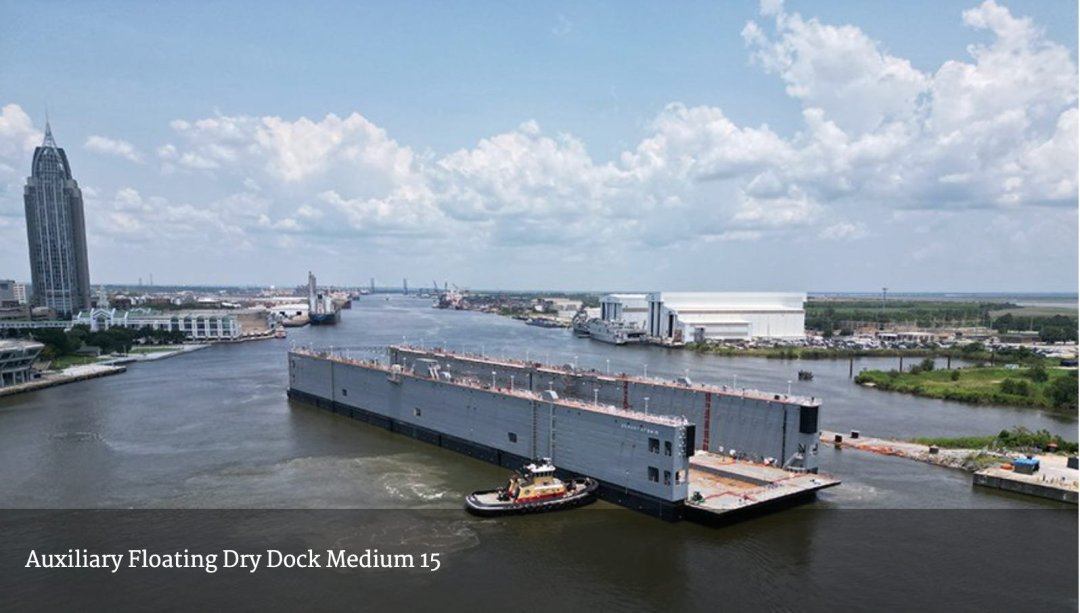
Four decades. Austal USA launched the Navy’s Auxiliary Floating Dry Dock Medium (AFDM) 15 on July 28. This is the first AFDM built in over 40 years and the largest vessel launched into the Mobile Channel to date. At 12,000 tons, 694 feet long and with a deck working area of 90,800 square feet, AFDM is the largest vessel launch Austal USA’s test and activation team has coordinated and executed in the company’s 26-year history. Let’s look at those stats again: Displacement: 12,000 tons Length: 694 feet Lifting capacity: 18,000 tons Armament: none For reference, a Flight III Arleigh Burke DDG is 509.5 feet and weighs 9,700 tons. She is now the only AFDM the Navy has. Just one. A single point of failure. When it comes to this segment of the “unsexy but important” part of maritime power, AFDM are not the big boys. That category belongs to what we now call Auxiliary Floating Docks, Big (AFDBs) that were built in WWII. Some still live on in other roles today, 80 years later, but none of them are working for the U.S. Navy. What can an AFDB handle? Let’s use USS AFDB-2 as an example of her type—which has an interesting story we’ll get back to down-post. Displacement: 38,500 tons Length: 927 feet Capacity: 90,000 tons Armament 14 × 40 mm (1.6 in) guns 14 × 20 mm (0.79 in) guns Never forget that names mean things. AFDBs have not always been called that. They were first called Advanced Base Sectional Docks (ABSDs). Someone decided to rename them, and with that, they avoided the question, “Advanced Base? What advanced base?” Of course, in the last Great Pacific War when the American Navy was contested at sea, a foundational capability, in line with what we discussed on the last Midrats Podcast was being able to do maintenance, in volume, forward, in an expeditionary manner. Now it is time to get ready for that war. We do not need one AFDM on the West Coast praying no one looks at her sideways and that someone pulls heavy lift ships out of a hat to bring damaged ships to her. No. We need a lot of AFDMs. We should also consider if we need need AFDBs as well, ones that you can pull a 1,106-foot, 100,000-ton Ford CVN onto if needed. If you have a battle damaged CVN, focusing on the “N” here, wouldn’t the prudent thing to do is to have another option besides, “Tow the holed and listing girl for a few weeks to Pearl and then we’ll evaluate her…” Think about it. Whatever more we buy, they need to be designed to be forward, and they need at least a rudimentary ability to defend themselves against air and surface attack by the entire menagerie of attack drones we know will be hunting the open Pacific. As Winston said: Don't argue the matter. The difficulties will argue for themselves. We’ve been there before. We will need to be there again. For almost criminal reasons, our new AFDM are specifically designed to “…operate in benign threat environments“. Read it yourself on the last page. I smell accountants and non-battleminded budget trolls behind this foolishness. We know that we have to be able to repair forward or we will not win a war against the People’s Republic of China’s navy should we find ourselves at war in the next few years west of the International Date Line. We have allowed those tasked with stewardship of our maritime power to hand-wave this way in the hope that war will not come. Almost criminal. In the last Great Pacific War, the great anchorage at Ulithi came under attack, twice. ABSD-2 and ABSD-4 both came under attack in 1945 while in the harbor at Manus Island. ABSD-2 ate a torpedo. If we are serious about fighting…and winning…the next Great Pacific War, we will build more floating dry docks, larger ones, and we shall arm them and take them where they are needed—in harm’s way. Oh, and we should properly name them as well. We should make ABSDs great again. Words mean things. They focus the mind. We expect them to be in an Advanced Base. It is in their name. And they’re going to be armed, so they shall be USS. They shall be commanded by Engineering Duty Officer Captains. There. We can do this. History will not wait for us. Cut steel. Leave a comment Share This Substack is reader-supported. To receive new posts and support my work, consider becoming a free or paid subscriber. View the full article
Yesterday
-
The AC-130J Ghostrider is one of the most heavily armed aircraft in the U.S. military, a modified cargo plane converted into a gunship that circles slowly overhead and rains down precision fire on ground targets. It carries a 30 mm cannon, a 105 mm howitzer, and a mix of guided bombs and missiles, all controlled […]View the full article
-
Poland may be preparing to buy around a dozen Airbus A400M Atlas heavy transport aircraft through the European Union’s SAFE defense financing mechanism, according to Polish defense analyst Jarosław Wolski, who cited unnamed sources in an August 25 post on X. Wolski wrote that the numbers he has heard range from 8 to 15 aircraft, […]View the full article
-
Sen. Richard Blumenthal toured a Ukrainian drone production line in Kyiv and said the country is manufacturing “thousands” of attack drones every day, offering a rare on-the-record look from a sitting U.S. lawmaker at the scale of Ukraine’s wartime drone industry. Blumenthal named the company as SkyFall, a Ukrainian defense technology firm, in a post […]View the full article
-
Satellite images showing a stealth fighter-shaped object at a former Chinese airport turn out to depict a fire-fighting trainer mock-up, according to Chinese aerospace analyst Andreas Rupprecht. Rupprecht made the assessment in an August 25 post on X, sharing images that show Chinese military firefighters conducting a live training exercise around the mock-up, including one […]View the full article
-
Austria’s Bundesheer received its first modernized Ulan infantry fighting vehicle and Leopard 2A4 tank at a handover ceremony in Großmittel on August 25, Austria’s Ministry of Defense announced. Defense Minister Klaudia Tanner attended the event. The modernization program is part of a broader force-development plan the ministry calls Aufbauplan ÖBH 2032+. Work on the armored […]View the full article
-
CIA Director John Ratcliffe flew to Moscow for meetings on August 25, CBS News reported, citing multiple sources. The trip explains the previously unexplained flight of a U.S. Air Force C-17A Globemaster III that landed at Vnukovo International Airport near Moscow that morning after departing Riga, Latvia. The Kremlin said it had “no information” about […]View the full article
-
Russia’s Baltic Fleet has fitted several of its warships with improvised netting and irregular camouflage patterns as makeshift protection against drone strikes, according to footage circulating from a recent fleet exercise. The images show at least three vessels equipped with different combinations of netting, deformation-pattern paint and other visual countermeasures on their bridges, radar housings […]View the full article
-
The general director of a Russian state-backed drone development center was arrested and jailed on fraud charges, according to Russian outlets reporting August 25. Yevgeny Grigoryev, head of the TulaDrone Research and Production Center, was detained in Tula and ordered held for two months by a court on August 14, according to the local outlets […]View the full article
-
The U.S. Army awarded General Dynamics Land Systems a $54,281,616 contract to provide sustainment support for the Stryker vehicle fleet, the Department of War announced August 24. The cost-plus-fixed-fee, indefinite-delivery/indefinite-quantity contract covers field-level maintenance, field service representative support and fielding activities. The contract specifically applies when interactive electronic technical manuals and logistics products have not […]View the full article
-
The U.S. Army awarded Hardwire LLC a $99 million contract to develop advanced processing methods for metallic armor, the Department of War announced August 24. The contract runs through Phase III of the Small Business Innovative Research program and has an estimated completion date of August 23, 2031. Army Contracting Command at Aberdeen Proving Ground, […]View the full article
-
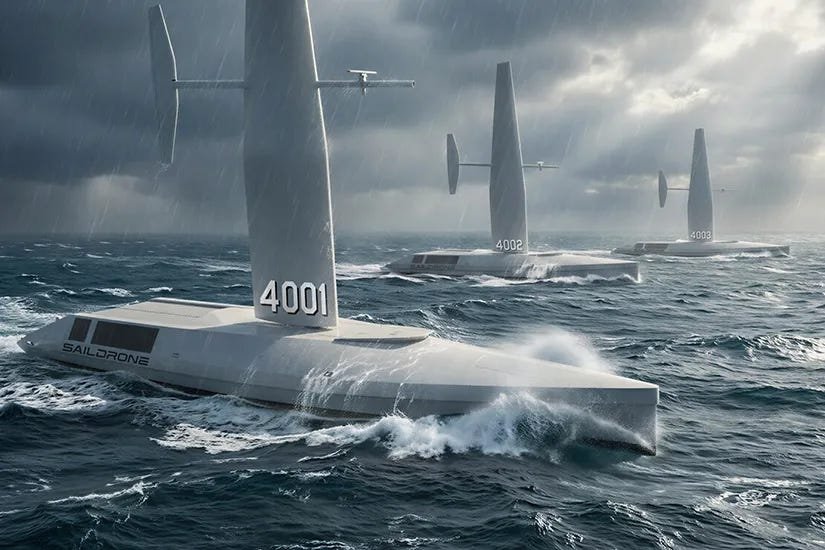
Earlier this year, I got a quick brief on the upscaled version of Saildrone’s surface unmanned system, which has a solid dozen years of proven performance at sea. I will admit, I was not fully sold when the program first started with the 7-meter Explorer’s deployment to CENTCOM a half dozen years ago, but they’ve proven their utility. Now, let me put some figures in front of you: Displacement: 457 metric tons Length: 53 meters Speed: 20 knots That sounds like a pretty big drone, doesn’t it? Well, it isn’t. That is a WWII-era PC-461-class submarine chaser. There’s your reference point in size, and from my seat, mission. What are the figures for Saildrone’s Spectre? Displacement: 250 metric tons Length: 52 meters Speed: 30 knots A lot lighter, but the Spectre does not carry weapons and does not have to house and sustain a crew of 65. What do they propose to do with it? It can be configured for a variety of missions, but anti-submarine warfare is what caught my eye. Saildrone is also working with Thales to integrate the Combined Active Passive Towed Array Sonar-4 (CAPTAS) Variable Depth Sonar on Spectre. This project expands on previous Office of Naval Research-funded work, integrating Thales Australia’s BlueSentry array on the Saildrone Surveyor. CAPTAS is the tail they are planning to put on the truncated FFG-62 frigates. They are making a compact version for drones like the Spectre. Saildrone has already played around with Thales Australia’s BlueSentry array and the TB29 thin-lined towed array, so this looks to be low-risk—though I have my usual concerns about security/reachback/bandwidth/fidelity loss…but these can be—and from what I’ve been able to glean in open-source, mitigagted. Now, if you have not already thought of SURTASS and T-AGOS…then shame on you. Now, CAPTAS on a drone may not be as “special” as what SURTASS and T-AGOS bring to the game…and we don’t need to go into those details on this net…however…FF(X) Flight I does not have a 21st-century ASW capability. The oceans are big. The Russian submarines are few but sporty. The People’s Republic of China’s submarines are not as sporty but are many. The challenges and requirements Jerry Hendrix and friends outlined in 2017 still apply…and can be transposed to other areas of the world. ASW is a numbers game. The oceans are big. More ‘good’ tails in the water pretty soon beat a few ‘perfect’ tails that may or may not be available at some point in the out-years. Yes, they’re unarmed, but I’m not all that worried about the “attack” part of the locate-track-attack chain. We have decades of multi-platform ASW prosecutions, with one dissimilar unit handing off contact or directing an attack on a target based on information gained from another. Our friend Mr.T’sHaircut can do it in his sleep. The Maritime Gods of the Copybook Headings gave us and our allies the P-8A Poseidon for a reason. The Spectre hulls are being built by our friends at Fincantieri Marinette Marine up north, and the composite wing by American Magic Services in Pensacola, so we have a good blue-gray combo. This is good. Let’s get a half-dozen in the water sooner rather than later. Get them to VACAPS, mark off some waterspace, and challenge the geeks from Groton to try to transit from point-A to point-B. Place bets. It’s all for fun and freedom…let’s see what they can do. This Substack is reader-supported. To receive new posts and support my work, consider becoming a free or paid subscriber. Leave a comment Share View the full article
Last week
-
Ukraine’s Independence Day parade in Kyiv on August 24 included a new naval drone, the MV11, from the Ukrainian company UFORCE. It is the largest vessel yet built in the company’s MAGURA family, an unmanned surface vessel line credited with helping push Russia’s Black Sea Fleet back from Ukrainian waters. The parade marked the first […]View the full article
-
Rows of black, Shahed-shaped airframes stretch across a production floor in newly released footage marking Ukraine’s Independence Day, offering the clearest public look yet at how many Behemoth “mid-range” one-way attack drones the country is now building at once. The video shows dozens of the drones mounted on wooden and metal stands, wingtip to wingtip, […]View the full article
-
AIM-424 “Malice” Very Long-Range Air-To-Air Missile Emerges From The Shadows (Updated) (The War Zone)