All Activity
Today
-
gkorjreq joined the community
-
qtibfurm joined the community
-
Some posts are just sad to write, but they are often the ones you need to write. It is no fun watching a friend intentionally and deliberately destroy themselves for no reason. I guess it is time to pick up the conversation we had back in March and June. When I first saw this, I thought, ‘This is reporting from The Sun. Just tabloid trash.’ Not a single submarine commander passed the legendary Perisher course last year. … Only three were selected to attempt it, with two failing at the simulator stage. Surface ships fared little better with less than ten officers passing the command qualification known as CQ2. The Navy needs 35 passes a year to sustain its sea commands. Sources say the only reason the shortage has not affected operations is because so many ships have been scrapped or stuck in port for repairs. But no, it isn’t. Navy Lookout and others with very reliable track records are on it too. Senior naval sources told Defence Eye that the Royal Navy has not run a Submarine Command Course, which qualifies officers to take command of its submarines, since December 2024. The course, popularly known as ‘The Perisher’, dates back to World War One and is famous for its high standards and realistic training exercises. It has long been considered the ‘gold standard’ of submarine officer training, with navies from around the world sending officers to participate in the course. For the past two years, the Royal Navy Astute-class fleet has been hit by a series of breakdowns and a long maintenance backlog. This year alone, it has only been able to put one boat, HMS Anson, to sea for a four month-long cruise to Australia. Since she returned to Devonport naval base for repairs in May no Astute boats have been recorded as going to sea. With no boats available for operational tasking, it is not a surprise that training has had to be put on the back burner by the Royal Navy. The naval source briefed Defence Eye on the status of the Perisher Course in response to criticism from Australia, that the UK was unable to generate trained personnel to operate its submarines to meet its commitments under the AUKUS deal. “Since [December 2024], three officers have successfully qualified for command through allied submarine command courses, including programmes delivered by Norway and Australia,” said the source. He suggested that the Royal Navy submarine availability crisis was soon to turn a corner, commenting, that “the next UK Perisher Course is due to commence next month, with a further candidate scheduled to undertake the Norwegian course in January.” What submarines the British do have don’t get much underway time. You can’t be the best at something—or at least moderately competent—if you don’t actually do it. I don’t fault those who failed. There is no serious person who thinks there is the political or economic ability right now for a serious recovery in British military capability at sea or ashore, regardless of who gives what speech. How much further can it fall? Things can always get worse, but all the wiggle room is gone. Most are familiar with the rolling train wreck that is the once exemplary British submarine industrial capability. Even their closest Commonwealth allies have concerns. The admittedly challenged US submarine industrial base will have to carry the AUKUS load. All of Britain’s traditional allies and partners over the last century assumed that, should war come, they could rely on even a diminished Royal Navy to come over the horizon to help. That time is long past. Everyone needs to reconsider that assumption. Though Britain may have the desire at some point, it just doesn’t have the ability to provide anything more than token assistance from here on out. On paper, the Royal Navy today has 10 submarines: six SSN and four SSBN. Only a small fraction of those are combat-ready or could be made combat-ready in a reasonable time. The US Navy today has 81 submarines: 53 fast attack submarines, 14 ballistic-missile submarines and four guided-missile submarines. In the mid-1980s, at the height of the Cold War, the Royal Navy had 32+/- submarines: 4 SSBN 28 SSN and SSK patrol submarines. At the same time, the US Navy had roughly 138 submarines: 37 SSBN 97 SSN 4 SSK The Royal Navy’s relative collapse is shocking. Since the mid-1980s, the US Navy’s submarine force has shrunk to 59% of its 1985 level. The Royal Navy’s submarine force has shrunk to 31% of its 1985 level. Today, the Royal Navy should have at least five more submarines in service if they paced the US Navy’s post-Cold War drawdown. Back to the Perisher course. Here’s the BBC documentary on it from 1985. There were enough people in the course to have a proper dinner. Now? Sad. Behold the land where giants once tread—the Royal Navy Midshipman Salamander remembers. Share Leave a comment This Substack is reader-supported. To receive new posts and support my work, consider becoming a free or paid subscriber. View the full article

-
A Russian Su-30SM fighter jet crashed during a training flight in the Chernyakhovsk district of Russia’s Kaliningrad region, coming down between the villages of Timofeyevka and Zelyony Bor, and both pilots ejected before impact. The two crew members were injured and taken to a military hospital, and Russian outlets published the first details of the […]View the full article
-
wswjctqe joined the community
-
tmognlcl joined the community
-
A heavy-lift cargo drone built by BAE Systems subsidiary Malloy Aeronautics has shot down several one-way attack drones with laser-guided rockets during a Pentagon experiment in Florida, firing one rocket after another without having to land and reload. The modified aircraft, known as the TRV-150, carried a three-pod launcher loaded with BAE Systems’ APKWS rockets […]View the full article
-
Russia’s United Aircraft Corporation is looking at artificial intelligence and other new software to speed up the design of future aircraft and cut the cost of developing new versions of existing ones, the state-owned planemaker said in a statement on its social media. UAC, which builds nearly all of Russia’s military and civil aircraft, from […]View the full article
-
Türkiye is preparing to deploy military personnel to Saudi Arabia under the new joint defense pact it signed with the kingdom and Pakistan, and the government will send a deployment mandate to the Turkish parliament once lawmakers ratify the agreement, Reuters reported. Ankara has already submitted the pact, known as the Mecca Joint Defense Agreement, […]View the full article
-
A tracked ASCOD cargo carrier from General Dynamics European Land Systems has appeared at Spain’s Atlas 26 counter-drone exercise fitted with launch containers for ARMMO’s Bandit-X interceptor drones, turning the armored logistics vehicle into a mobile platform for hunting enemy drones. A screengrab from video shared by Spanish defense watcher ArmaduraXXI shows the ASCOD-based heavy […]View the full article
-
Indian defense startup Apollyon Dynamics has released the first photos of its Nightshade Mk-2, a new jet-powered drone that the Hyderabad-based company is developing as a successor to the Nightshade it unveiled earlier this year. Co-founder and CEO Jayant Khatri shared an image of the aircraft lying on a hangar floor next to a team […]View the full article
-
Ukraine’s Defense Minister Evgeniy Khmara and Commander-in-Chief Mykhailo Drapatyi met a Lockheed Martin delegation led by Orlando Sanchez Jr., president of Lockheed Martin Aeronautics, to press for steady weapons deliveries, more PAC-3 interceptors for Patriot and wider F-16 maintenance across Ukraine, the Ukrainian Defense Ministry said. The talks centered on the F-16, which the ministry […]View the full article
-
The Ottawa Police Service’s tactical unit has added a Roshel Senator armored vehicle fitted with a hydraulic assault ramp that can lift officers to second-floor windows and rooftops in seconds, giving Canada’s capital the same Canadian-built armored vehicle that Ukraine has used in large numbers on the battlefield. U.S. manufacturer Patriot3 announced that its LIBERATOR […]View the full article
-
Britain has now received seven Challenger 3 prototype tanks for trials, with an eighth in the final stages of build, as the British Army works to prove the design of its next main battle tank before full production begins, UK Defence Journal reported. Defence minister Luke Pollard gave the figures in a written answer in […]View the full article
-
The German Army has received its first heavy-lift cargo drone, with the 131st Supply Battalion in Bad Frankenhausen, Thuringia, taking delivery of an uncrewed aircraft from Portuguese manufacturer TEKEVER to test how drones can haul equipment and supplies to troops in the field. The Bundeswehr in Thuringia announced the handover on Oct. 13, describing it […]View the full article
-
The U.S. Air Force plans to grow its fighter force to 1,509 combat-coded jets by 2035, with the F-35 becoming its most numerous fighter and the new F-47 taking over from the F-22, under a revised force structure plan the service sent to Congress on Oct. 16. Lt. Gen. David Tabor, deputy chief of staff […]View the full article
-
cjqiqbph joined the community
-
A French Mirage 2000D ground-attack jet crashed late on Oct. 20 near the village of Rogéville in Meurthe-et-Moselle, in eastern France, as it was returning from a mission, killing at least one of its two crew members, while rescuers continue searching for the second. The French Air and Space Force said the accident happened at […]View the full article
-
Lockheed Martin is promoting the idea of a special version of the F-16 fighter built around Ukraine’s needs, with longer range, a new AESA radar and stronger air defense capabilities, sources at the company told The Defence Blog. The idea is being floated as the U.S. defense giant expands its work with Kyiv, and it […]View the full article
-
The U.S. Navy has selected Radiant to install its Kaleidos nuclear microreactor at Naval Weapons Station Crane in Indiana, putting a commercial company in charge of the service’s first shore-based advanced reactor, which the Department of War wants running no later than September 2028. Radiant announced the selection on Oct. 20, about six weeks after […]View the full article
-
Ukrainian drones have destroyed a Russian 9K515 Tornado-S heavy multiple launch rocket system in occupied Kherson Oblast, hitting the launcher with several different kamikaze drones in succession in a strike carried out by the Prymary unit of Ukraine’s Defense Intelligence (HUR), which released the footage on Oct. 20. OSINT analyst Dominik geolocated the strike to […]View the full article
-
Armored vehicles built by Emirati manufacturer Streit Group have been spotted again in Russian service, this time with Gyurza, the special rapid response unit (SOBR) of Rosgvardia’s Main Directorate for the Moscow region, which was photographed operating a Cobra-LAMV 4×4. The light armored vehicle is built on a Toyota Land Cruiser chassis and marketed by […]View the full article
-
L3Harris Technologies opened a new solid rocket motor plant in Camden, Arkansas, on Oct. 20 that is built to double its production of motors for the U.S. Army’s Guided Multiple Launch Rocket System, the company said in a statement. GMLRS is the precision rocket fired from HIMARS and M270 launchers, and the new site, which […]View the full article
-
Britain will send Royal Air Force Typhoon fighter jets to Saudi Arabia to shoot down Houthi missiles and drones aimed at Saudi cities and critical infrastructure, the UK Defense Ministry said on Oct. 20. CNN reported that the jets will fly defensive counter-air missions over the kingdom, and a spokesperson for the prime minister’s office […]View the full article
-
Airbus has delivered the third A330 Multi Role Tanker Transport to Spain, completing the three-aircraft order the Spanish Ministry of Defense placed in 2021. The company announced the handover on X, and Spanish media reported that the ceremony took place on Oct. 20 at its plant in Getafe, outside Madrid. The tanker will join the […]View the full article
-
Armenia’s Defense Minister Suren Papikyan toured Czech aircraft maker Aero Vodochody on Oct. 20 and said L-39 Skyfox jet trainers will soon be flying with Armenia’s armed forces. The country’s Ministry of Defense published a photo series from the visit showing Papikyan with the new aircraft, which can also fly light attack missions. “These marvels […]View the full article
-
Japan’s Air Self-Defense Force scrambled fighter jets 442 times between April 1 and Sept. 30, about two-thirds more than the 265 scrambles in the same period last year, according to Joint Staff Office figures reported by USNI News. The rise came as Chinese and Russian military aircraft flew near Japan far more often, and the […]View the full article
-
kvfhfwhk joined the community
-
Stephen R joined the community
-
kydupwxh joined the community
-
njrbgagb joined the community
Yesterday
-
nwskogac joined the community
-
U.S. Army infantry soldiers have fired Spike NLOS long-range missiles from a light, air-droppable utility vehicle for the first time, completing 17 engagements in a three-day live-fire demonstration at Dugway Proving Ground, Utah, Lockheed Martin said. All of the shots were launched from an Infantry Squad Vehicle – Utility, or ISV-U, a version of the […]View the full article
-
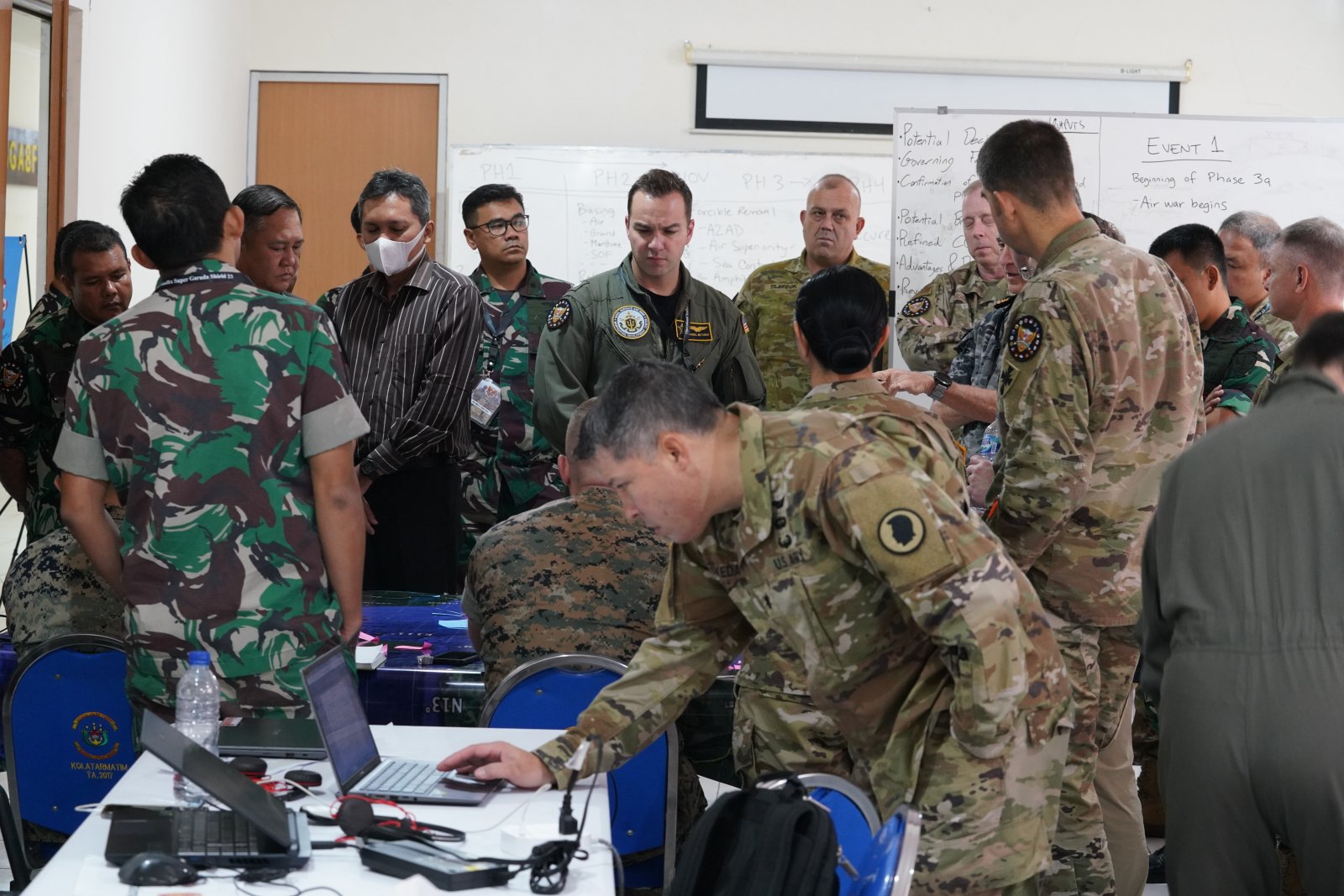
For those in the business, one of the most triggering phrases you can read or hear is some pogue out there saying, ‘Well, we have wargamed this, and…’ and then you wait to see if you have a reasonable follow-on, or some cringe-inducing abuse of the military art. Way too many people are abusing war games for the wrong purposes. Everyone wants a national security 8-Ball to tell them the future, and some look to war games to hear what they want to hear. When you see that, it’s a tell. That person/institution does not understand what they are talking about. In the latest Naval War College Review, Charles Edward Gehrke has a simply outstanding article everyone needs to take a few minutes to read, What War Games Actually Teach—Threat Recognition, Not Prediction. From war gaming’s earliest institutional adoption, it has been repeatedly evaluated as though it were a forecasting instrument or a decision aid at best and a surrogate for empirical proof at worst. Each of these expectations imposes criteria that war games are structurally unsuited to meet. The resulting recurring cycle of enthusiasm, disappointment, and rediscovery has accompanied war gaming for more than a century. There is the core of the problem and where too many people go off the rails when it comes to the use and utility of war games. As is true with many things in life, trying to force something to meet your unrealistic desires always leads to tragedy. The rough part is that, in the national security arena, the consequences run the spectrum from death to an existential danger to the nation. You have to nip this in the bud whenever it comes up, regardless of how powerful the person or institution behind these desires may be. The enduring value of war gaming is neither prediction nor optimization. Its primary product is something simultaneously more modest and more profound: the cultivation of threat recognition under conditions of uncertainty. War games are incapable of telling either participants or their respective services what will happen in the future. What they actually can do is to put participants in situations that simulate danger effectively and communicate to them why these situations appear dangerous. And then it can train them to anticipate ways in which others will respond to similar real-world dangers. In doing so, war games train participants to recognize how threats are perceived, interpreted, and acted on by all parties operating with incomplete information and under intense time pressure. Training and testing, not predicting. This misunderstanding has consequences. Many of the recurring debates around war gaming—including debates over rigor, realism, bias, and usefulness—stem from evaluating games against criteria that the games were never designed to satisfy. When war games are judged primarily as forecasting tools, they will almost always disappoint. When they are assessed as decision engines, they will appear indeterminate. When they are expected to produce consensus, they will seem inconclusive. Only when they are understood as instruments for revealing cognitive and institutional blind spots do their contributions become more clear and more durable. Bingo. You are looking for intersections of individual factors, constraints, restraints, and perspectives. The next bit had me grin some, as it reminded me of hearing many an exasperated voice ask, ‘Did anyone war game this?’ The measure of a successful war game, therefore, is not whether it got the future right, but whether it revealed previously unrecognized threat perceptions, challenged embedded assumptions, or clarified the role of judgment in environments in which calculation alone is insufficient. Controlling variables is what makes war games so valuable. You are testing ideas, concepts, factors. When someone walks in with a goal to use and abuse a war game to validate their idea or worldview, a well-run war game will crack open the weaknesses for all to see. On the flip side, a poorly run or unethically run war game can lead to disaster. You have to realize their base nature. War games do not operate like analytic models. They are not closed systems, nor are they designed to be. They do not attempt to isolate variables to measure their individual effects. Instead, they deliberately entangle political, military, economic, and human factors in ways that resist clean separation, but resemble the real world. The resulting complexity is a defining feature. It reflects the reality that strategic decision-making rarely unfolds in environments in which variables can be controlled or outcomes cleanly attributed. They are not just good for testing ‘things.’ Indeed, their greatest utility is testing people. A war game’s most consequential outputs are not quantitative results at all. They are moments of surprise, confusion, or disagreement. A player discovers that an adversary behaves in ways that feel irrational or escalatory. A familiar course of action produces unintended consequences. A strategy that appears sound in briefing slides unravels once it encounters resistance. These moments are indicators that previously unexamined assumptions have been exposed. Thinking. Imagination. Cognitive flexibility. Character. Oh, you can find them in a war game. Treating war games as predictive tools, therefore, creates a category error. It asks games to function like models while ignoring the features that distinguish them. Human judgment and adversarial adaptation are not sources of noise to be eliminated. They are the very phenomena that war games are designed to bring to the surface. Evaluating games by their ability to suppress these dynamics in the service of prediction misunderstands their purpose. This demand for prediction also obscures the reason that war gaming has endured for more than a century—despite repeated failures to get the future right. If prediction were the standard, war gaming would have been abandoned long ago. Time and again, games have failed to anticipate specific wars, campaigns, and outcomes. Yet institutions continue to invest in them, not because of inertia or sentimentality, but because games provide forms of insight that cannot be generated through analysis alone. … It bears repeating that the insights generated by this process are not always answers to specific questions. War games do not resolve debates or produce definitive conclusions. Instead, they refine mental models. Participants leave with a clearer sense of which assumptions are fragile, which signals are ambiguous, and which aspects of a problem space they had previously taken for granted. These adjustments are subtle but consequential. They shape how future information will be interpreted and how future decisions will be framed. In this way, war gaming contributes to professional development in a manner that is difficult to replicate through other methods. It teaches participants how their thinking changes under pressure and how the recognition of threat influences judgment when certainty is unavailable. It does not teach them what to think. These lessons are not tidy. They are not easily summarized. But they are precisely the lessons that strategic leaders most need to learn. I’ve always found that a well-run war game’s superpower is its brutal effectiveness at revealing weak and convenient planning assumptions. We are all familiar with fragile egos and too-clever-by-half CONOPS that too many people love far too much. They exist because they have never been challenged—the classic ‘fragile vignette’ used to promote the latest White Elephant or 72-hour war. In real strategic environments, outcomes are rarely predictable in the face of even small changes. Decisions hinge on interpretation rather than certainty. Signals are incomplete, intentions are inferred, and actors continuously adjust their behavior in response to what they believe others might do. Institutions act on beliefs that are formed under pressure, shaped by prior experience, and constrained by organizational context. Perfect information is something institutions want in these circumstances, but it is rarely something that they have. A tool that purports to produce reliable, predictable outcomes in such an environment risks misleading its users. The next part of Gehrke’s article is chicken soup for my soul—an ode to ambiguity. Organizations prefer clarity, alignment, and decisiveness. Ambiguity is associated with risk of failure. And yet strategic leaders routinely operate in environments where clarity is unavailable and alignment is provisional. The ability to function effectively under such conditions is not innate—it must be practiced. War gaming provides a controlled environment in which this practice can occur. The stakes are simulated, but the cognitive demands are real. Participants experience the pressure of making decisions without full understanding of the situation. They confront the consequences of misinterpretation, overreaction, and hesitation. They observe how uncertainty can amplify perceived threats and drive escalation even, or perhaps especially, in the absence of deliberate intent. No other form of professional military education reproduces this. Lectures and readings can describe uncertainty, but they cannot reproduce its effects on judgment. Analysis can account for risk, but it does so after the fact. War games, by contrast, immerse participants in uncertainty as games unfold, forcing them to grapple with uncertainty in real time. When properly applied, ambiguity helps future-proof a war game. A clever person/institution cannot over-prepare for ambiguity. A weak intellect cannot rely on a staff to cover for its inability to adjust to the unexpected, the grey, the vague. I really started to nod my head at the next word he spent some time on: humility. Especially in the last few years, we’ve visited the concept of humility as a force multiplier, hubris, mindsets, and arrogance. A well-run war game can ferret out them all. Postgame discussion fosters cognitive humility. Participants learn that their interpretations of threat are not universal and that reasonable professionals can arrive at different conclusions when faced with the same information. They also learn that their own perceptions are shaped by role, experience, and institutional context. War gaming further structures these perceptions in ways that make the warfighter as effective as possible under the wartime conditions of ambiguity that war games seek to emulate, but perceptions must be examined if they are to be refined. To be examined they must first be made clear. … By cultivating cognitive humility at both the individual and institutional levels, war gaming strengthens the capacity for adaptation. Institutions that can recognize the limits of their own collective assumptions are better prepared to adapt to surprise and ambiguity. In this way, war gaming contributes not only to professional education but to institutional resilience. … Humility does not imply indecision or restraint for its own sake. It simply reflects an awareness of the conditions under which strategic decisions are made and the cognitive processes that govern them. Leaders who have practiced operating under uncertainty are better equipped to act decisively when clarity is unavailable. Institutions that have examined their own assumptions are more resilient when confronted with novelty or disruption. The question, then, is not whether war games can tell us what will happen. It is whether they can help us see ourselves, our institutions, and our adversaries more clearly before hostilities unfold. By that measure, war gaming’s value is not only defensible; it is indispensable. Amen. Read the full thing. Leave a comment Share This Substack is reader-supported. To receive new posts and support my work, consider becoming a free or paid subscriber. View the full article

-
A U.S. Navy P-8A Poseidon maritime patrol aircraft flew off Bulgaria’s Black Sea coast near the ports of Varna and Burgas, a week after Russian drone attacks sank a cargo ship and damaged another in the area, flight tracking data shows. Tracking data published by the flight monitoring Itamilradar, using Flightradar24 data, shows the Boeing […]View the full article