All Activity
- Today
-
It was a dozen years ago that...we thought—really thought—that with the X-47B we could move from crawl to walk with large unmanned systems. From the OG Blog in July, 2017: I'm interested in how many can I physically wedge on to a carrier deck and/or hangar bay. I'll waive the flight control issue etc - but once you know how many you can actually pack in your helmet bag and carry (given tradeoffs for other aircraft etc) - then we can start to plan orbits, sorties, loss-rate mitigation, etc. Now, if there were a way to stack them like so many Pringles ..... Ponder. Of course, by the end of the year, the usual suspects killed it for all the worst reasons. We could have had over a decade more experience—probably close to two decades by now—in operating large unmanned aircraft from carriers, but alas, it did not happen. We now have a second chance. As promised on yesterday’s UNCLAS Read Board Podcast, it is time to say, “Yes. Thank you. More. Faster.” Via Diana Stancy in Breaking Defense: The Navy’s MQ-25 Stingray unmanned aerial system received the green light to move into low-rate initial production (LRIP), acting Secretary of the Navy Hung Cao said today. As part of the production decision, known as Milestone C, an LRIP Lot 1 contract for three aircraft is expected this summer, along with priced options for three Lot 2 aircraft and five Lot 3 aircraft, according to the Navy. “Unmanned refueling extends our reach against any adversary,” Cao said in a statement today. “Moving the MQ-25A Stingray to Milestone C and into production is arming our warfighters with a capability that increases the lethality of our Carrier Strike Groups. This is a decisive advantage that delivers our warfighters what they need to fight and win.” The MQ-25 will primarily conduct refueling missions for carrier air wings, freeing up the F/A-18 Super Hornet for its strike mission, and may also complete intelligence, surveillance, and reconnaissance (ISR) missions. First tanking, then ISR, and then—yes—those are two hard points. Strike. Let’s not get ahead of ourselves, however. Let’s get them to the fleet and let them experiment with them. A good solution for the fleet now is better than the perfect solution that will never show up. We can improve it as we go along, or find another platform to replace it as we work with what we’ve got…but no more wasted time. Let’s get more shadows on the ramp. Leave a comment Share This Substack is reader-supported. To receive new posts and support my work, consider becoming a free or paid subscriber. View the full article

-
GE Aerospace secured a three-year engine support contract from Boeing Defence UK to maintain the T700-GE-T701D turboshaft engines powering the British Army’s fleet of AH-64E Apache attack helicopters. The contract places a GE Aerospace field service representative permanently on-site at Wattisham Flying Station in Suffolk, the British Army’s primary Apache base, and routes engine repair […]View the full article
-
U.S. Marines demonstrated a new airborne drone relay tactic during a recent exercise, using UH-1Y Venom utility helicopters as flying command posts to extend the range and lethality of first-person view strike drones well beyond what ground operators can achieve. Marines with Marine Light Attack Helicopter Squadron 169, Marine Air Group 39, and 3rd Marine […]View the full article
-
The U.S. military gave the public its clearest look yet at AEVEX Aerospace’s Disruptor strike drone during Arcane Thunder 26, a multinational exercise that ran from April 6 to April 29, 2026, across Germany, Poland, and the United States, with the drone component tested at the National Training Center at Fort Irwin, California. Soldiers from […]View the full article
-
Russia’s Strategic Rocket Forces conducted their second successful test launch of the RS-28 Sarmat intercontinental ballistic missile on May 12, 2026, firing the weapon from a silo at Dombarovsky near Yasny in the Orenburg region and announcing the result publicly through the Russian Ministry of Defence. The test is Russia’s first publicly acknowledged Sarmat success […]View the full article
-
Ukrainian forces have tested an unusual tactic that could significantly extend the reach of the Hornet strike drone: launching it from a tethered aerostat at high altitude rather than from a ground-based catapult, a combination that Ukrainian sources claim nearly doubles the weapon’s effective range. The test, details of which circulated through Ukrainian military channels, […]View the full article
-
Canada signed two contract amendments with Lockheed Martin on May 15, committing a combined $1.15 billion to keep its CC-130J Hercules tactical transport fleet flying and modernized through the end of the decade. The first amendment, valued at $462 million, extends the current maintenance and support contract through June 2029. The second, estimated at $684 […]View the full article
-
Canada broke ground on two major military construction projects in Latvia on May 19, laying foundation stones for a rotary-wing helicopter facility at Lielvārde Air Base and accommodation buildings at both Lielvārde and Riga in a combined investment of €64 million, or approximately $70 million. The ceremony marked the latest installment in what has become […]View the full article
-
Russian Su-35 and Su-27 fighter jets repeatedly and dangerously intercepted an unarmed Royal Air Force RC-135W Rivet Joint reconnaissance aircraft operating in international airspace over the Black Sea in April 2026, the UK Ministry of Defence revealed on May 20, 2026, releasing images and video of the encounters. In the most serious incident, a Russian […]View the full article
-
The U.S. Air Force published a request for information on May 20, seeking industry proposals to design and build a new external weapons pylon for the B-52 Stratofortress bomber capable of carrying munitions up to four times heavier than anything the current hardware can handle. The notice, issued by the Air Force Life Cycle Management […]View the full article
-
The U.S. Air Force published a sources sought notice on May 20, 2026, signaling that the Long Range Standoff nuclear cruise missile program is moving toward production and that the government is now looking beyond its current sole developer to understand what industrial capacity exists across the defense industry. The notice, issued by the Air […]View the full article
-
SummaryIn this episode, Sal discusses recent congressional testimonies by Navy leaders, the MQ-25 Stingray, and the realities of directed energy weapons on ships. He emphasizes learning from past military delays, the importance of technological progress, and the significance of understanding bureaucratic growth through Parkinson’s Law. Show LinksActing S… Read more View the full article
- Yesterday
-
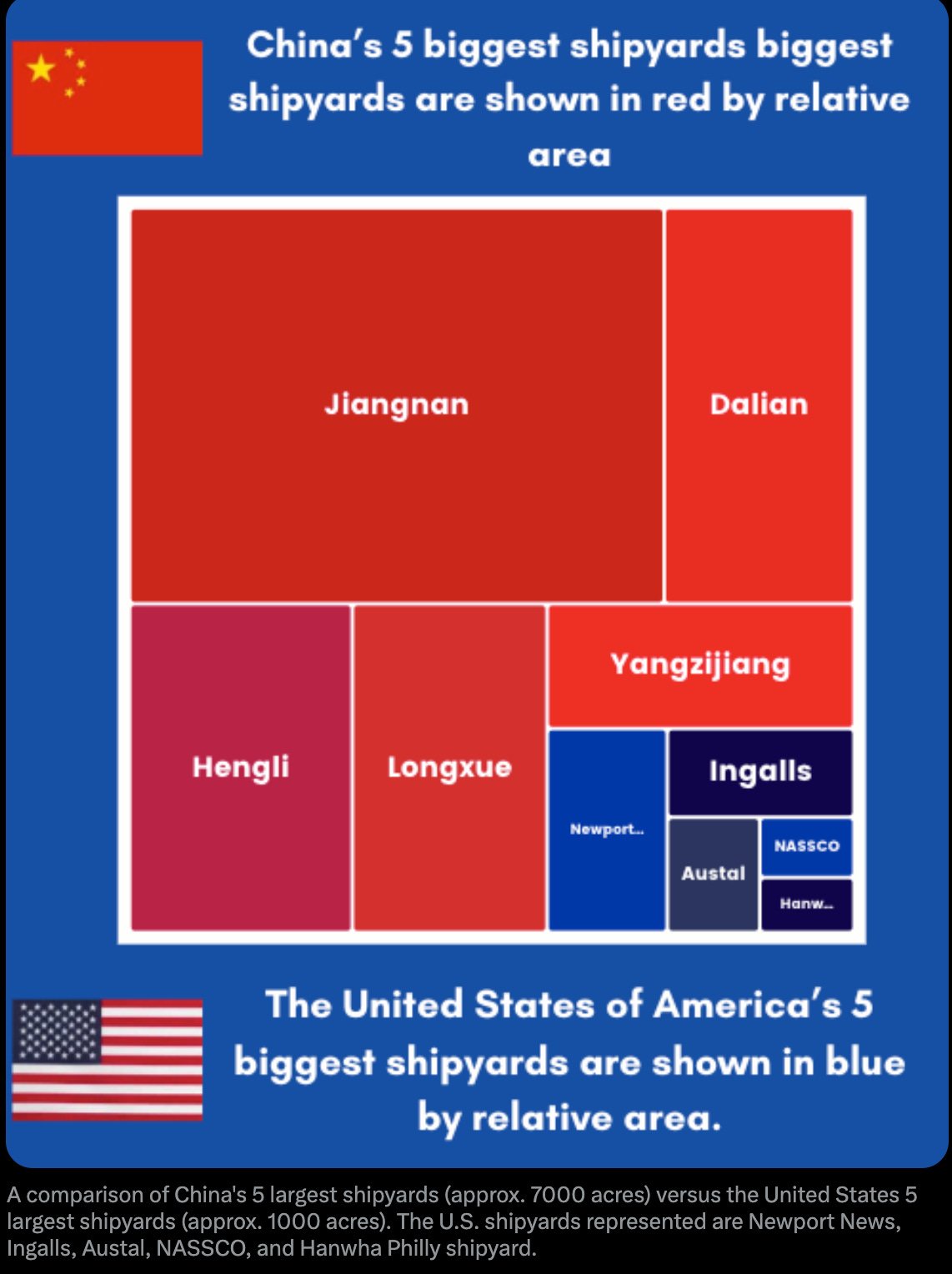
The decades-long slide into near irrelevance of the industry that led to our victory in WWII—our shipbuilding overmatch over the Axis powers—continues to receive more attention over the last couple of years. We have been “appreciating the problem” for as long as I’ve been blogg’n, and it has been a regular topic of The Long Game series we started at the OG Blog in 2004. There is a critical mass of “problem appreciation” that is beginning to resonate across the maritime sphere, but everyone is still waiting for concrete—pun intended—action. It won’t happen overnight, but one does want to see real progress. I am optimistic, but the task is as great as the generational neglect and lack of stewardship that created it by the Smartest People in the Room™. Two graphics kept popping into my mind this week: one geographic, the other industrial capacity. That is one hell of a hill to climb. We could not have won WWII if we did not start pulling our shipbuilding industry up with significant action in 1936, 38, and 40 that gave us the ships to keep both the fight and our allies alive in Europe, and the battle fleet that showed up from mid-1943 and on. Is the present team in the Executive Branch, along with its allies on this issue on both sides of the aisle in Congress, ready to make progress where others failed? This will involve land. Heavy industry. Manpower. Money. And, more importantly, a persistent mindset. We are seeing the money, and we are hearing the right things. It is all moving towards action that should begin showing results in the next couple of years, at the earliest. The best time to have done this was 20 years ago. The second best time is now. Earlier this week, we saw two examples during testimony to Congress. First, Acting Secretary of the Navy Hung Cao. Next, Secretary of Transportation Sean Duffy. Standing by. Restoring maritime power is not a partisan effort. It isn’t a political agenda. It’s national survival. Leave a comment Share This Substack is reader-supported. To receive new posts and support my work, consider becoming a free or paid subscriber. View the full article
-
-
Smart Shooter, the Israeli defense company that has turned AI-guided fire control into one of the most rapidly adopted infantry technologies of the past five years, signed a new contract with Israel’s Ministry of Defense on May 20 to supply SMASH Hopper lightweight remote-controlled weapon stations valued at approximately NIS 6.7 million ($1.8 million), with […]View the full article
- Last week
-
Russia’s United Aircraft Corporation confirmed the new Su-57 prototype’s maiden flight, with test pilot and Hero of Russia Sergei Bogdan at the controls in a sortie described by officials as proceeding normally in accordance with its test plan. Denis Manturov, Russia’s First Deputy Prime Minister, announced the milestone, describing the aircraft as a platform combining […]View the full article
-
American Rheinmetall recently brought the Marine Corps Warfighting Laboratory’s operators at Marine Corps Base Quantico, Virginia through a week-long training course on the Fieldranger Remotely Controlled Weapon Station, culminating in day and night live-fire exercises against realistic mission scenarios. The training, which drew participants from both Fleet Marine Force combat units and the Supporting Establishment […]View the full article
-
Latvia has signed a multi-year framework agreement with Origin Robotics to secure a continuous supply of BLAZE autonomous interceptor drones, and structured the deal so other European nations can plug directly into it without running their own procurement from scratch. The Latvian Cabinet of Ministers approved the first contract under the framework on April 21, […]View the full article
-
Northrop Grumman’s YFQ-48A Talon Blue autonomous combat aircraft completed its first taxi test on May 14 at Mojave, California, moving under its own power for the first time and bringing the Air Force’s third designated drone wingman prototype within striking distance of its first flight. Crane Aerospace and Electronics, part of Connecticut-based Crane Company, supplied […]View the full article
-
GE Aerospace has secured a U.S. Air Force contract to advance the preliminary design of its GE426 engine, a propulsion system built specifically for the medium-thrust class of autonomous combat aircraft the Air Force is developing to operate alongside crewed fighters. The award marks the next development milestone for a program that passed its concept […]View the full article
-
A German autonomous systems company has demonstrated what it claims is the world’s first fully automatic drone launch and recovery system capable of operating from a moving vessel without any human intervention, and unveiled the commercial product at the Combined Naval Event in Farnborough, United Kingdom. CiS, a European developer of autonomous aerial systems, announced […]View the full article
-
AimLock and FN America unveiled a joint counter-drone weapon system at SOF Week 2026 in Tampa on May 19, combining AimLock’s artificial intelligence targeting technology with one of the most widely deployed remote weapon stations in the Western military market to create a system capable of detecting, tracking, and automatically calculating firing solutions against small […]View the full article
-
Taiwan’s state defense research institute publicly unveiled its next-generation anti-armor rocket, showing off a weapon significantly more capable than what Taiwanese infantry currently carry and explicitly designed to counter the armored vehicles a Chinese amphibious invasion force would land on Taiwan’s beaches. The National Chung-Shan Institute of Science and Technology, known as NCSIST and the […]View the full article
-
BAE Systems built an armored vehicle with drone-killing capabilities in ten months and put it in front of soldiers at Fort Hood, Texas, for training — without waiting for a government contract to fund it. The AMPV-30, a version of the U.S. Army’s Armored Multi-Purpose Vehicle fitted with a 30mm cannon and a radar system […]View the full article
-
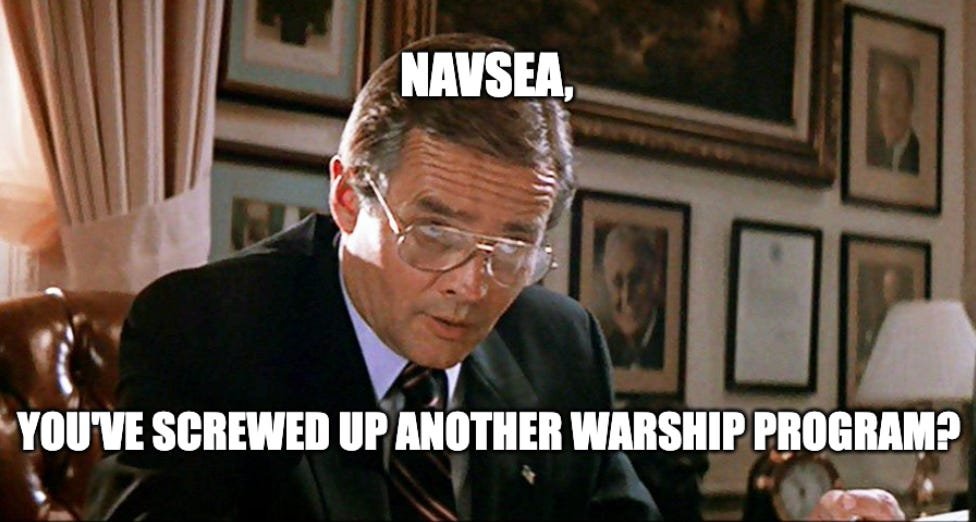
We need to talk about an unpleasant subject. I briefly mentioned it last week, and talked about it a little on the latest Midrats Podcast, but that is enough fiddling around the topic. Time to man up and address the topic head-on. I think the DDG(X) program is a dead program walking. There could be an error, as there was with BBG-1 vs. BBGN-1 in the chart, but let’s look again at the latest Shipbuilding Plan. There is no DDG(X) in the plan…just Arleigh Burke DDGs being built, as the Salamander says, until the crack of doom. In the Shipbuilding Plan, it is mentioned only once in this paragraph. The Arleigh Burke-class guided-missile destroyer (DDG 51) is the most capable surface combatant anywhere at sea, but we have reached the limits of its capacity. Even the planned DDG(X) program made undesirable capability and weapon system compromises. Our Fleet deserves and our national security requires the most comprehensive capability a surface combatant can provide, not just what we can make do with tradeoffs. The nuclear-powered Battleship is designed to provide the Fleet with a significant increase in combat power by longer endurance, higher speed, and accommodating advanced weapon systems required for modern warfare. Others have picked up on it as well. There is nothing official coming out, but I think it is clear—DDG(X) is going to be the price to get BBGN-1. If the DDG(X) ship look more promising and closer to cutting steel, perhaps it would be saved—but that did not happen. Remember my three proposed Flights of DDG(X) as a backup to BBGN-1 that I outlined last February? One way to stop that from even being an option is to take the entire class off the table. That leaves a hole in our fleet design that has to be filled. We don’t even have a “heavy frigate”. The FF(X) is a patrol frigate at best. We need a DDG, so… To the crack of doom, we shall build Arleigh Burkes. To the crack of doom. There is no other option but to keep producing a ship designed when the Soviet Union was still a threat. There’s a problem, though. This is what we’re leaving behind. Via the 2025 GAO Weapon Systems Annual Assessment: I’ll ignore the fact the image above does not have a main gun—which the last few years have proven its worth … but we are bypassing the ability to “…accommodate future capability growth…sufficient size and power margins…” that even the Flight IIA and III Arleigh Burkes simply can’t accommodate. Take a peek at the “Shakira Mod” to the USS Chung-Hoon (DDG 93) Arleigh Burke-class Flight IIA recently taken by the good people at San Diego Webcam. The Arleigh Burke is now at the muffin-top stage of modification, giving it a dorky look not seen since the Albany Class CG of the middle Cold War era. But, here we are. Perhaps it is not so much dead as in a medically induced coma? I don’t know, but we once again have proof that our Navy has not had a successful surface ship program after the Goldwater-Nichols Act of 1986 came into effect—and all the backwash that came with it. Arleigh Burke Hull-1 was commissioned on July 4th, 1991, five months before the Soviet Union fell apart and half a decade since Goldwater-Nichols was signed into law, but make no mistake: Goldwater-Nichols had no impact on the design or the program by the time it started displacing water. Ever since then, with the accretions encumbered acquisition system that our Navy and Pentagon have labored under, we have failed with every new surface combatant program we have tried. I don’t want to even add up the billions of dollars spent that resulted in nothing useful to the deployed fleet. The opportunity cost is enough to drive an honest man insane. We may very well see an Arleigh Burke DDG serve until, when, 2065 if we keep building them nine more years? Looks like it. One must do what one must, but we need to be very sober about what we are looking at. We have lost two, almost three generations of ship design progress simply because we lack the people, leadership, and bureaucracy to build warships. That has a cost. It is a primary indication of a broken institution. Do we know that? In a few years, will we talk about a cancelled BBGN-1 program too? Then what? Leave a comment Share This Substack is reader-supported. To receive new posts and support my work, consider becoming a free or paid subscriber. View the full article