All Activity
Today
-
xmcowwjs joined the community
-
msdeurvs joined the community
-
bvyqbnca joined the community
-
pooiaigh joined the community
-
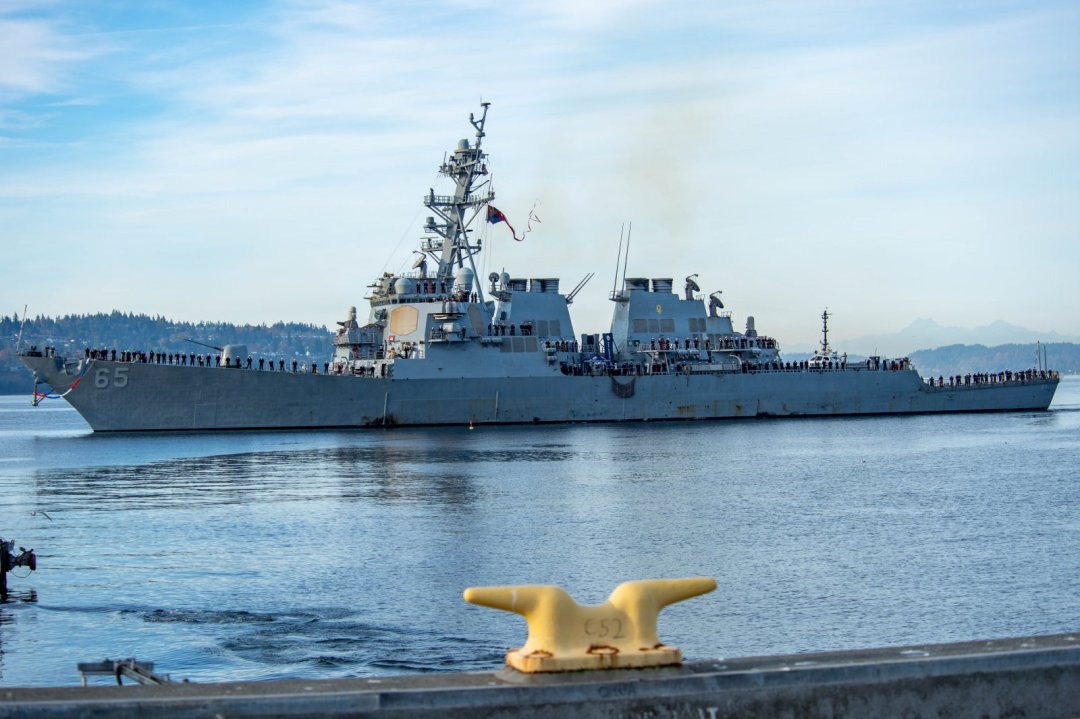
As the record shows on CDR Salamander and the Midrats Podcast, our shortage of maintenance facilities and the resulting lack of capacity have been known problems for decades. We have known that we don’t have enough capacity to meet even expected peacetime requirements, much less any flex in the system for wars at sea, large or small. As such, absolutely no one should be surprised at this or think it is a new problem. If you see anyone pretending it is either, immediately understand that person is not worth listening to. Here we are, as expected, via Diana Stancy at Breaking Defense. The US Navy expects it will take years for its fleet to recover from recent drawn out deployments, with leaders bracing for a surge in maintenance work that could strain shipyard capacity and force trade-offs between repairs and modernization. Chief of Naval Operations Adm. Daryl Caudle said Monday that the service is bracing for maintenance availabilities — particularly impacting the destroyer fleet — to snowball as some of its aircraft carriers and surface vessels return from more than 300-day long periods at sea. As a result, the Navy is weighing how to prioritize repairs, shorten some timelines and defer larger projects without pushing the service’s schedule further behind. … “The industrial base will not be able to swallow that pill, and so we’ll have to sequence that,” Kilby said during an Oct. 8 National Commission on the Future of the Navy hearing. “There’s a couple things that can happen there. I’ll defer maintenance. I’ll either squish the package into the bare minimum and not do modernization things I need to do. So that’s the bill that’s being paid there.” This year, extended deployments have pushed the Navy’s ships well beyond their typical seven-month period at sea. For example, the aircraft carrier Gerald R. Ford completed a 326-day deployment in May — shattering the aircraft carrier Abraham Lincoln’s previous record of 294 days at sea in 2019 and 2020. No, it is six months, not seven. Eric Labs, a senior analyst for naval forces and weapons at the Congressional Budget Office, said the full impact of ongoing military operations on the fleet is difficult to predict because it’s unclear how long they will continue. However, he said the Navy has historically taken “at least several years” to catch up on maintenance after previous military operations that required a surge in naval capacity. “At a general level, ships that are missing their maintenance availabilities now because of ongoing operations would have that maintenance manifest itself over the next several years,” Labs told Breaking Defense. Eric is great. While Labs said that some private maintenance shipyards that work on the Navy’s surface fleet have voiced concerns about a lack of work at present, he said they would face a hefty workload once destroyers return that would create planning and workforce challenges for both industry and the service. “The private maintenance yards in the US are undergoing a famine and then, later, will experience a feast cycle,” Labs said. “The consequence of that will depend on unique ship circumstances. It could mean some ships will need to return to sea before getting all the maintenance they need, which could just exacerbate problems in the future. Or it could mean some ships will sit idle until the maintenance can be done.” Of course, the question is—when will we stop appreciating this problem, and start taking action? We will find ourselves here again. Bradley Martin, a retired Navy captain who is now a senior policy researcher at RAND, also predicted it would take years for the fleet to recover from maintenance backlogs stemming from current operations in the Middle East. He said nearly every ship class would likely be affected, although the most acute maintenance issues could hit the destroyer fleet, given its heavy operational use in the Middle East. We are seeing good movement on new construction efforts, but what about maintenance? Modernizing existing shipyards and bringing online a new public shipyard will be a great help, but this will take years to fix, and bipartisan support to ensure it does not get strangled in the cradle. Patience and persistence are needed. Lack of both is part of what got us here, but more, faster if possible. Of note, both Labs and Martin quoted in the article above have been on the Midrats Podcast in the last year. If you have not listened to their episodes, here you go! Share Leave a comment This Substack is reader-supported. To receive new posts and support my work, consider becoming a free or paid subscriber. View the full article
-
xuvpndqt joined the community
-
Dallas-based rocket propulsion firm Firehawk has raised more than $150 million in a Series D round that values the company at more than $1.4 billion, money it will use to scale up U.S. production of rocket propellant, solid rocket motors and artillery motors, the company said on social media on Oct. 28. Private equity firm […]View the full article
-
Ukrainian drone maker Frontline Robotics flew its Linza bomber drone alongside German, Ukrainian and other unmanned air, ground and sea systems during Forward Edge 26, a two-week exercise in Germany hosted by Quantum Systems, the company said on social media. In one deployment, Quantum Systems’ Vector reconnaissance drone spotted simulated enemy drones along the route […]View the full article
-
Teledyne FLIR Defense has won a $48 million U.S. Army contract to fit Bulgaria’s new Stryker fleet with the same upgraded chemical, biological, radiological and nuclear reconnaissance sensor suite now going to U.S. Army units, the company announced on Oct. 26. U.S. Army Contracting Command at Aberdeen Proving Ground, Maryland, awarded the contract under a […]View the full article
-
Switzerland has narrowed its search for a second long-range air defense system to Israel’s Barak MX and the French-Italian SAMP/T NG, and will keep its delayed order for U.S. Patriot systems, the Swiss government decided on Oct. 28, Switzerland’s defense procurement agency armasuisse said. The Federal Council, Switzerland’s seven-member government, picked the two finalists after […]View the full article
-
Israeli company Smart Shooter has delivered the first batch of its SMASH Hopper MG remote weapon stations to an unnamed integrator in Asia, which is building them into a defense system for an Asian military to shoot down drones and engage ground targets, the company said on social media. Smart Shooter did not identify the […]View the full article
-
mopvsyxw joined the community
-
The British Army will buy a heavy wheeled recovery vehicle to tow and recover damaged Boxer armored vehicles in the field, after the Ministry of Defence dropped plans for a dedicated Boxer repair and recovery variant, Minister for Defence Readiness and Industry Luke Pollard told Parliament, UK Defence Journal reported. Pollard was answering Conservative lawmaker […]View the full article
-
Israel’s Defense Ministry Director General, retired Maj. Gen. Amir Baram, has visited Covenant, the startup behind the Anthem low-cost cruise missile, in a tour the ministry said focused on strengthening Israel’s munitions independence, expanding its production base and preserving the country’s qualitative and technological edge in the years ahead. The ministry said on social media […]View the full article
-
German defense startup ARX Robotics and Ukrainian manufacturer Roboneers have completed initial integration tests of Roboneers’ SABER remote weapon station on ARX’s GEREON unmanned ground vehicle, and plan to start fitting armed versions by the end of 2026, the companies announced on Oct. 29. The first SABER modules will be integrated in M2 and MK […]View the full article
-
Poland will soon hand Ukraine two more MiG-29 fighter jets as part of a new military aid package worth about €50 million (about $56 million), Polish daily Rzeczpospolita reported on Oct. 29, in a story quickly picked up by Ukrainian defense outlet Milarnyi. Reserve Lt. Gen. Dariusz Łukowski, director of the Polish Defense Ministry’s Strategy […]View the full article
-
The U.S. Air Force is looking for companies that can repair and sustain the Advanced Synthetic Aperture Radar System-2, or ASARS-2, the imaging radar carried by the U-2 Dragon Lady spy plane, even as the service asks Congress to retire its last U-2s by the end of fiscal 2027. The Air Force Life Cycle Management […]View the full article
-
cfaxiflg joined the community
-
Taiwan detected six Chinese military aircraft, seven People’s Liberation Army Navy ships and one Chinese official ship operating around the island in the 24 hours to 6 a.m. local time on Oct. 29, the Ministry of National Defense said on social media. Five of the six aircraft sorties entered the northern, central and southwestern parts […]View the full article
-
North Korea launched what may have been a ballistic missile at about 12:36 p.m. local time on Oct. 29, and it is presumed to have fallen near the east coast of the Korean Peninsula without reaching Japan’s territory or exclusive economic zone, Japan’s Ministry of Defense said on social media. Tokyo said Japan, the United […]View the full article
-
Norway’s Kongsberg ended the third quarter of 2026 with a record order backlog of NOK 174.2 billion (about $18.8 billion), after taking in NOK 23.3 billion (about $2.5 billion) in new orders, more than double the NOK 9.5 billion it booked in the same quarter last year. The defense group reported on Oct. 29 that […]View the full article
-
Tennessee has launched a bid to host the planned United States Space Academy, proposing a campus at the Coffee County Joint Industrial Park near Tullahoma, minutes from Arnold Air Force Base and about 60 miles (97 km) from Huntsville, Alabama. Gov. Bill Lee announced the bid on Oct. 28 alongside U.S. Sens. Marsha Blackburn and […]View the full article
-
fzngnwjl joined the community
-
akussmgi joined the community
-
SummaryIn Episode 49 of the UNCLASS Read Board Podcast, Sal reflects on voting ahead of election day, how Washington-area Navy leadership can shape civilian perceptions of the service, and why he believes demographic and fiscal pressures will reshape the postwar international order. He also revisits his “Terrible Twenties” forecast, comparing it with de… Read more View the full article
-
zpvlpvxr joined the community
Yesterday
-
Finland will buy the RGW110 heavy disposable anti-tank weapon from Germany’s Dynamit Nobel Defence to replace the APILAS launcher its soldiers have carried since the 1980s, the Finnish Army said on Oct. 28. The purchase is worth about €84.5 million (about $94 million) excluding value-added tax, and deliveries of the weapons, training equipment and instruction […]View the full article
-
Ukraine’s parliament has approved in a first reading a 2027 state budget that sets aside 4.885 trillion hryvnias (about $107.5 billion) for security and defense, equal to 43.8% of the country’s projected gross domestic product. The Verkhovna Rada passed draft budget No. 16000 on Oct. 28 with 239 votes in favor, 25 against and 26 […]View the full article
-
Japan will host a final assembly plant for the AIM-120 AMRAAM air-to-air missile after Defense Minister Shinjiro Koizumi and U.S. Secretary of War Pete Hegseth agreed on Oct. 28 to build the facility as part of joint U.S.-Japanese missile production, Nikkei reported. The two met for about 30 minutes in Cebu, the Philippines, on the […]View the full article
-
A Russian Navy intelligence-gathering ship sailed southwest through the Tsushima Strait between Japan and South Korea on Oct. 27 and 28 and headed into the East China Sea, Japan’s Joint Staff Office said. The Joint Staff identified the vessel as a Vishnya-class intelligence collection ship and released a map showing its hull number, 535. That […]View the full article
-
Belgium has started building a new maintenance center for its army’s armored vehicles in Rocourt, near Liège, where a joint venture of FN Herstal, John Cockerill Defense and Thales Belgium will repair and service the Belgian Land Component’s vehicles and their weapons under a 20-year deal. Belgian Defence Minister Theo Francken laid the foundation stone […]View the full article
-
Britain will lead development of three new sensor and effects packages for underwater drones under the AUKUS security partnership with the United States and Australia, with the systems due to be available across all three nations’ uncrewed underwater fleets from 2027, the UK Ministry of Defence said on Oct. 27. The three payloads are a […]View the full article
-
One of the more tiresome phrases one hears bandied about is usually a variation on one of these generally interchangeable themes: The International Rules Based Order Liberal International Order It is all on borrowed time. It was a vision of what was once the center-right and center-left who wanted to create a different, more humane world. Its triumph and high water mark was victory in the Cold War, but then it lost its way once the 68’ers (typified by Bill Clinton in the U.S. and Tony Blair in the UK, along with their fellow travelers in other Western nations) took power. In a series of feel-goodism project from open-borders to unchecked social spending, they eventually degraded themselves into cronyism, sectarianism, and corruption. Financially unsustainable and intellectually spent, its sputtering death rattles are there for all to see. What comes next, I don’t know—but we’re not going to like it parts of it. How much of the Old Order remains will vary from country to country, but the hangover of the errors of the last six decades will not be easy to fix without some very—from a late 20th century perspective—illiberal actions. Don’t get me wrong, I am a fan of what was attempted after WWII, but it was only effective for a quarter century or so. It had enough momentum to coast and drift another quarter century, then it started to eat itself by those who didn’t remember why it existed and what it was supposed to do. I wish the best parts of it could last forever, but our inheritance was mortgaged and can’t be paid back. That is what will lead the reset as we move into mid-century. It is that simple. The math is what it is. Across the West and the non-Western developed nations there is a similar problem. The first ingredient is one they all share, but the West has a second accelerant that is especially dangerous. We’ll get to that in a second, but let’s look at the first. All the economic models we’ve developed, in peace and war, since Adam Smith were based on a few assumptions, one of which was a proper demographic pyramid. Lots of young people coming up to take a productive role in society, advance civilization, and—in the last hundred years of the modern welfare state—help fund a growing government that cares for those who cannot care for themselves. In the West, the U.S. has one of the healthiest demographic profiles. Not great, but in the land of the blind, the one-eyed man is king. Give the chart below a look, especially at 1926 during the Roaring Twenties, and again in 1965 with LBJ’s Great Society kickofff. In the last couple of weeks, we’ve all been watching the cities in Europe—especially in France—burn. She’s not alone. Significant leftist riots have been seen in Italy and Belgium. In spite of their decades-old welfare states, the masses claim not to have enough. The gravy train is over, but no one wants to admit it. The Western Welfare State is running on inertia and political cowardice at this point, right up until the bondholders close their wallets. Yes, I include the U.S. in this, but we won’t see the collapse first. That will happen in Europe, and when the break comes, it will make the events of the last month seem like an event hosted by the Daughters of the American Revolution. It is baked into the cake. The tens of millions of unskilled, unassimilated, and unemployable illegal migrants living off national treasuries to which they have never contributed are just another accelerant to the conflagration that is coming. For the sake of brevity, let’s take one of our Western allies, Italy, as an example. As we showed the relatively healthy American demographics earlier, let’s look at the Italian one, over a shorter period. What is coming down the tracks for Italy and most of the West? These are the good old days. There is a good datapoint by Ani Chkhikvadze in the Washington Examiner titled Italians are taking to the streets, but are they honest about the problem? After decades beneath the American security umbrella, many Italians came to enjoy the luxury of regarding war as somebody else’s concern. That bargain made possible generous welfare commitments. Even with war raging in Ukraine and Russia conducting terrorist attacks across Europe, many Italians still feel the threat is distant. “I’m here because I’m anti-war,” said one protester. “The government puts a lot of money in armament and in war, but we are dying poor and nobody is doing anything.” These claims deserve closer scrutiny. In Italy, pensions, healthcare, and social protection absorb about 56% of all public spending, roughly 28% of GDP. It’s the third-highest allocation of any European Union nation. Pensions dominate the bill at about 16% of GDP, the second-highest share in the EU after Greece. In contrast, defense spending sits at roughly 2% of GDP, but far lower than the U.S. and other NATO allies would like to see. Moreover, Italy has only reached this level by counting security spending as part of its armed forces total. In Italy, pensions, healthcare, and social protection absorb about 56% of all public spending, roughly 28% of GDP. It’s the third-highest allocation of any European Union nation. Pensions dominate the bill at about 16% of GDP, the second-highest share in the EU after Greece. In contrast, defense spending sits at roughly 2% of GDP, but far lower than the U.S. and other NATO allies would like to see. Moreover, Italy has only reached this level by counting security spending as part of its armed forces total. But the basic problem is the same as that afflicting France. Namely, that with debt approaching 140% of GDP, Italy needs to cut spending, or cut spending and raise taxes. Demographics also matter here. Young Italians have good reason to feel disadvantaged by a system that devotes far more to pensions than to education, which receives roughly 4% of GDP. These outlays will only increase as Italy’s population continues to age rapidly. Rising rents and everyday expenses make life harder, even for those with jobs. But another state subsidy won’t solve the issue. The real answer is to leave more money in people’s pockets by cutting spending and taxes, and by removing heavy barriers to building homes and creating jobs. Italy knows where irresponsible fiscal management leads. What are their political options? Unlike her predecessors, Meloni has done a good job cutting back some of that expenditure and steering the budget toward balance, and ratings agencies have taken note. But rising fuel prices and protests by truck drivers, shop owners, and fishermen in the south are testing that discipline, bringing pressure from small-business owners her coalition counts among its voters. Whether discontent ultimately costs Meloni power remains uncertain. On the Left, Elly Schlein’s Democratic Party and Giuseppe Conte’s Five-Star Movement struggle to form a coherent alternative. On Meloni’s far-right, former general Roberto Vannacci’s radical Futuro Nazionale competes for conservative voters. There is plenty of competition to channel Italy’s unhappiness. Meloni is the moderate option. The left is small, but incredibly active and violent. The ‘normies’ just want order and, in a way, the effective welfare state they have always been promised—but will never be able to afford once the borrowing stops—an effective welfare state. There is no rich and fat U.S.A. that will be able to come to the rescue. The PRC will have problems of its own and, if anything, will offer only temporary help in exchange for permanent vassalage. The wheels will come off Europe first. One of the largest barriers to stopping the inevitable is the European Union (EU) and the European Commission on Human Rights (ECHR). Their ruling center-right and center-left nomenklatura created this crisis; they won’t be able to arrest it. The EU and ECHR—as they exist and function today—are largely responsible for the masses of migrants who are heavy weights around the ankles of European leaders trying to navigate the coming train wreck. The money spent on the migrant masses no one invited will have to be the first thing to go once the levee breaks. There is growing talk of action, but for now it is only talk. When action does take place, how do you think these masses and their allies will react? At the ballot box and through ‘vibrancy’ in the streets, the left relies on unassimilated migrants of the first, second, and third generations of unassimilated migrants as the shock troops of their Red-Green-Green alliance of traditional leftists, neo-pagan environmentalists, and Islamic supremacists seeking power. They need a flag. Here, I have one for them. They’ll like the construction with the communist red, environmentalist green, and Islamic green. Must credit Salamander. That is what you are seeing in the streets from Paris to Milan: a test drive of the RGG Alliance in case the normies decide to vote for someone else but them to address the problem. It is good, in a way, that most of the West’s enemies—China and Russia—have worse problems from a demographic and debt perspective. But the accelerant to disorder, and the inability of the ruling powers to stop it, are Western problems that make what is to come unavoidable—and worse than anyone would have imagined at the turn of the century. Leave a comment Share This Substack is reader-supported. To receive new posts and support my work, consider becoming a free or paid subscriber. View the full article

-
Ethiopia has taken delivery of its first 12 Russian Su-35 fighter jets and will also receive four batteries of the S-400 long-range air defense system, Prime Minister Abiy Ahmed said on social media on Oct. 28. Abiy said the jets arrived under an earlier agreement with the Russian government and a year ahead of the […]View the full article
-
Singapore-based BeeX used its ALPHA underwater drone to place explosive charges on a moored sea mine and a swinging steel target and then destroy both during a closed-door mine countermeasures demonstration in the United Kingdom, the company said on Oct. 27. The one-day event, held on Sept. 17 and hosted by British defense consultancy Copper […]View the full article