
All Activity
Today
-
jskdfbes joined the community
-
tybktghv joined the community
-
dgjtfccg joined the community
-
ykxznzng joined the community
-
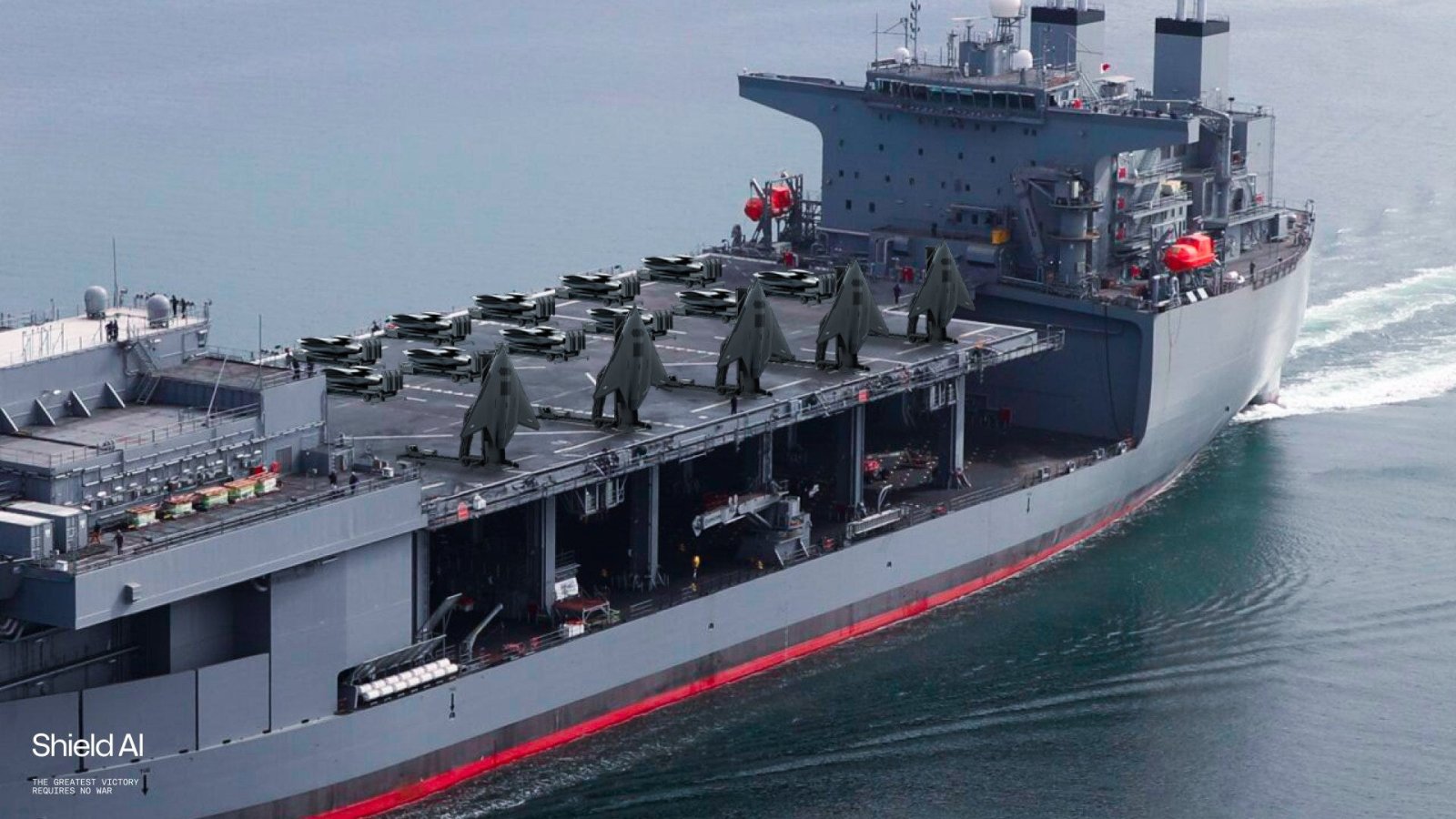
Way back even before the X-47B took off and landed on a carrier—and then was killed by the Fighter-Attack-Guy Mafia™—people would ask me what I wanted in a tactical drone. My feelings have not changed that much since—I want something designed to be stacked up like so many Pringles—or for you science fiction fans, how the Cylons in the Battlestar Galactica reboot kept their Raiders on their Basestars—ready for use in number. Sailor-proof and combat-ready. You hear the subject of “Drone Carriers” come up on a regular basis. You have to have the right drones to make it worthwhile, and if I were in charge of ship designations, they would be classified as CVQ. I’m willing to consider such, as I mentioned when I got a bit excited last April with the Portuguese Navy’s latest toy. We’ve “appreciated the problem” and delayed action for too long, so what do we do if we want to do something now as opposed to do nothing but produce PPT and bad military fiction novels for the next decade? My Cylon Raider CONOPS was based on integration with the existing carrier air wing and stealing hangar bay space, but what if we had a tactical drone that didn’t need that level of support and could operate independently of the CVN/CVW construct? As now is better than later, what would we use to carry them? Our existing carrier air wings may be maxed out, and we don’t have enough shipyard time to modify the hangar bays. We already have too few large-deck amphibs and LPDs to do the missions they already have assigned. I have no desire to wait a decade and a half for an over-budget, over-engineered dedicated drone carrier. (In its present construct, we would not be able to get what Portugal is getting through NAVSEA intact.) We’d need something we already have that could, with a few modifications, fit the bill…not unlike how we made Jeep Carriers in WWII. Perfect? No. Good enough? Absolutely. We should be moving faster more than slower. Experiment. Be prepared to fail, iterate, succeed, or, at worst, realize a lot more is needed before the concept is ready for the big show. I have an idea. Actually, other people have already found my solution, and I’m going to adopt it. First, let’s look at what drone might fit the bill. Shield AI, a specialist vying to provide the autonomy software for the Air Force’s autonomous Collaborative Combat Aircraft, has won government backing for its X-BAT drone—but not from USAF. The $50 million cash infusion comes from the Navy and the Defense Innovation Unit, which see intriguing possibilities for a jet designed to take off and land vertically from a trailer. The aircraft is powered by the same F-110 General Electric engine that powers an F-16. With an airframe smaller and lighter than the Viper, the engine can generate enough thrust for vertical takeoff and to land in a manner similar to SpaceX’s reusable rockets. First things first. Take CCA and put it at the end of the line for some option down the road. It will just slow things down. THAT software is not ready, but other software is. Let’s use what we have, and then work on what we want. For the Navy, the potential benefit of X-BAT is clear, Holmes and Penney agreed: X-BAT could launch and return to surface combatants of all kinds, not just aircraft carriers. It would give the Navy more ways to deploy airpower. Navy destroyers and amphibious ships already carry munitions and fuel, so they don’t have the logistical problems the Air Force would have in its ACE concept of operations. … Shield boasts that its Hivemind autonomy software is “the world’s best AI pilot” and has delivered “real battlefield outcomes.” But Penney noted that mission autonomy—the ability for software to execute complex air missions—is “a lot harder” than most people realize and something the Air Force is still ironing out through the CCA program. On top of that, X-BAT’s signature ability to take off and land vertically is a technically complex, though not unheard of, undertaking. Shield AI has shown it can do VTOL with its smaller V-BAT aircraft that has a propeller, but the X-BAT is as large as a fighter jet. It will need to generate large amounts of thrust to take off and be extremely responsive and stable to land. Let’s not let the perfect be the enemy of the good. Let’s not start off with a “complex air mission” with MOD-0. Sure, we’ll get there…but lets start off with something simple…a TLAM that comes back. A cruise missile delivery-to-launch-point and return. Heck, I’ll take simple ISR/ELINT etc for MOD-0. Yeah, and the concerns about the operating envelopes for landing (sea state, wind across deck, etc) will need to be worked out…I’d like to see those curves…but let’s assume it is acceptable…limited but acceptable. Where could we launch them from…where? I know you recognize the hull shape below. We have them in production. They’re the multi-tool of naval power. The Puller Class ESB. How many X-BAT can you carry? Can you store more below? They are actually a bit larger than a WWII Casablanca CVE. Together with the announcement, Shield AI has released a new rendering showing X-BAT aircraft deployed on an Expeditionary Sea Base (ESB) vessel. In August, the Navy’s PAE Aviation office said that, “to maintain maritime superiority, agility in acquisition is just as critical as the technology itself.” Preparations towards first test flightShield AI also announced on Sept. 30 the selection of Newton, Kansas, and Des Moines, Washington, as sites for the X-BAT’s production, flight testing and sustainment. … Shield AI’s signature Hivemind autonomous flight software is planned to fly the drone in environments without Satellite Navigation (SATNAV) and communication links. The F110-GE-129 has so far been tested with an Axisymmetric Vectoring Exhaust Nozzle (AVEN), while scale models of the X-BAT have undergone wind tunnel tests, wing structural stress trials and radar-cross section testing. Other videos released by the company have also shown its unique Launch and Recovery Vehicle for Tethered Flight (LRVTF) docking mechanism, developed for runway independent operation. It would be great if we could adopt a SpaceX approach to this capability instead of the NASA approach. We don’t need perfect now. Better will show up, but only after you get good with the basics. Be prepared to lose a few and celebrate the opportunity to learn when you do. Don’t overpromise and underdeliver. Assume you will need changes. Be happy with the MOD-0 or ‘A’ model, then quickly upgrade to the ‘B’ model, and so on. The future is here. All we need to do is accept it as it is. Leave a comment Share This Substack is reader-supported. To receive new posts and support my work, consider becoming a free or paid subscriber. View the full article
-
tktjsove joined the community
-
nxmigwkf joined the community
-
Anduril Industries has unveiled Steelfin, a family of surface-to-air interceptor missiles designed to shoot down cruise, ballistic and hypersonic missiles at a fraction of the cost of today’s interceptors, with flight tests set to begin next year. The company announced Steelfin on Oct. 12, the first day of the Association of the U.S. Army’s annual […]View the full article
-
Six Turkish military drones flew into Greek-claimed airspace over the Aegean Sea on Oct. 10, Greece’s Hellenic National Defense General Staff said, the latest in a run of near-daily incidents this month. The Greek military recorded eight infringements of air traffic rules inside the Athens Flight Information Region and five violations of Greek national airspace […]View the full article
-
Rental cars used by Norway’s Home Guard during a large exercise in September recorded video of soldiers, their routes and the codes they typed into military gates, according to a soldier who took part, Norwegian business daily Dagens Næringsliv reported. The cars were rented by the Norwegian Armed Forces from Hertz in Norway, which belongs […]View the full article
-
heuugqmg joined the community
-
drzlvkjs joined the community
-
The U.S. Army has received its first Mobile Tactical Cannon, a wheeled 155 mm howitzer built by Hanwha Defense USA that the service is testing as a replacement for the towed M777, less than a year after it first asked industry for proposals. Brig. Gen. Robert “RJ” Mikesh Jr., the Army’s portfolio management executive for […]View the full article
-
Korea Aerospace Industries has flown its FA-50 light combat aircraft in formation with a jet-powered drone for the first time, a test the company says is the first real manned-unmanned formation flight in South Korea. The flight took place on Oct. 8 over the sea south of Goheung, in South Jeolla Province, KAI said on […]View the full article
-
Airbus and Kratos have flown the Valkyrie uncrewed combat aircraft in Europe for the first time, a step toward offering Germany a drone wingman for its Eurofighters by 2029. The flight, announced on Oct. 12, took place at a test site in northern Europe that the companies did not name. Airbus Defence and Space CEO […]View the full article
-
Leidos has picked X-Bow Systems, a New Mexico rocket motor maker, to develop and build the booster motors for the U.S. Army’s Low-Cost Containerized Munition, a ground-launched cruise missile the Pentagon wants to buy in large numbers. X-Bow announced the selection on Oct. 12 at the Association of the U.S. Army’s annual meeting in Washington. […]View the full article
-
cidichmv joined the community
Yesterday
-
When Americans think about admirals in the Pacific in WWII, names like Nimitz, Spruance, and Halsey spring to mind. You cannot fully understand the war in the Pacific if you don’t also look at the leaders on the Japanese side—men like Yamamoto, Kurita, and Nagumo. On this week’s Midrats Podcast, we’re going to dive into the story of Admiral Yamamoto with our guest, Ronald Drabkin. We’ll tap into his research that led up to his next book, Admiral Yamamoto: The Gripping Story of the Legendary Japanese Naval Commander Who Planned and Executed the Pearl Harbor Attack. We go live at 5 p.m. Eastern. You can join us live at this link and contribute your thoughts in the show chat while you’re there. If you’re reading this after the show, check the Substack later Sunday evening for the podcast audio upload. Ronald Drabkin is a popular author of books on World War II and espionage history. He initially learned Japanese while attending a Japanese University, before starting a career at Intel and other high tech companies. He learned as an adult that his father had worked in counterintelligence for the US military. Curiosity about his father’s work drove him to do research that resulted in his first papers and book on Japanese naval intelligence. He noted that the romanticized American view of Admiral Yamamoto as a “reluctant warrior” didn’t seem accurate. Furthermore, no new biography of Yamamoto had been published in a very long time, and substantial new information was available in Japan. He has spent the last three years researching Yamamoto’s life across Japan and has even met and heard stories from Yamamoto’s family and some of his admirals, such as Kurita and Nagumo. This Substack is reader-supported. To receive new posts and support my work, consider becoming a free or paid subscriber. Share Leave a comment View the full article

-
Israel Aerospace Industries will show a new radar carried by a small tethered balloon at the Association of the U.S. Army’s annual meeting in Washington this week, aimed at giving ground forces a mobile, elevated view of low-flying drones, aircraft and other targets. The system, called POINT@AIR, puts an active electronically scanned array radar on […]View the full article
-
Cody Aerospace & Defence, a British company founded in February, has unveiled its first product, the Badger Mk1 ground-launched strike missile, along with plans for a factory to build it and a goal of replenishing stockpiles in under a year. The company announced the missile at the Apex Europe defense show in London this week. […]View the full article
-
China’s Communist Party leadership and the State Council have issued new guidelines laying out 19 measures to speed up breakthroughs in core technologies, expand the use of artificial intelligence across industry and make the country more self-reliant in science and technology, state news agency Xinhua reported on Oct. 9. The guidelines are built around what […]View the full article
-
South Korea’s military has concluded that North Korean troops deliberately planted the land mines that wounded three South Korean soldiers inside the Demilitarized Zone last month, and it has removed the remaining mines, but President Lee Jae Myung’s description of the blast as an “unfortunate accident” has drawn sharp criticism at home. The explosion happened […]View the full article
-
U.S. Army air defense crews in Germany fired live rounds at aerial targets alongside AH-64 Apache attack helicopters during Operation Skyfall II, an exercise built around sharing drone-tracking data between ground radars and aircraft. The training took place on Oct. 5 at Grafenwoehr Training Area in Bavaria, according to U.S. Army photos released from the […]View the full article
-
The Australian Army has received a second batch of HIMARS rocket launchers from the United States, two years earlier than planned and about a year after the first batch arrived, Australia’s Department of Defence said. The new launchers are going to the long-range fires regiment of the Army’s 10th Fires Brigade, based in Adelaide. Defence […]View the full article
-
A U.S. fighter jet struck and disabled a Panama-flagged cargo ship in the Gulf of Oman on Oct. 10 after its crew ignored repeated warnings and tried to break the American naval blockade of Iran, U.S. Central Command said. The jet hit the stern of the M/V Ocean Molica, also known as the Arika Sun, […]View the full article
-
The third prototype of Russia’s Yak-130M, an upgraded version of the Yak-130 jet trainer reworked to carry radar and guided weapons, has made its first flight, Russia’s United Aircraft Corporation said. The aircraft, carrying side number 137, took off from the Irkutsk Aviation Plant in Siberia with Yakovlev test pilots Oleg Mutovin and Alexander Guskov […]View the full article
-
A German environmental and human rights group has urged European leaders not to weaken sanctions on Russian energy after President Donald Trump announced a deal with Russian President Vladimir Putin for Russia to supply diesel fuel to the United States and global markets, a week before a new U.S. sanctions law on Russia reaches its […]View the full article
Last week
-
Turkish Air Force F-16 fighter jets have completed a short deployment to Latvia’s Lielvārde Air Base, where they helped guard the country’s airspace around its parliamentary elections, Latvian Defense Minister Raivis Melnis said on Oct. 9. Melnis visited the Turkish unit at the base on Friday to thank it for the deployment. The Latvian Ministry […]View the full article
-
A Ukrainian drone has destroyed a Russian Pantsir air defense system on top of a “Flakturm,” one of the purpose-built anti-aircraft towers Russia has been putting up to stop Ukrainian drones, according to new footage released by the Security Service of Ukraine’s Alpha special operations unit. The video shows the strike on the elevated platform, […]View the full article
-
Mitsubishi Heavy Industries launched Japan’s newest attack submarine, Shogei, at its Kobe shipyard on Oct. 8, the seventh boat of the Taigei class built for the Japan Maritime Self-Defense Force. The 3,000-ton diesel-electric submarine was named and floated out in a ceremony at the yard in Kobe’s Hyogo Ward. MHI will now complete outfitting of […]View the full article
-
Japanese Defense Minister Shinjiro Koizumi lodged a strong protest with Adm. Samuel Paparo, commander of U.S. Indo-Pacific Command, on Oct. 9 over the arrest of a U.S. Marine on suspicion of robbing and killing a woman on Okinawa. The two met at Japan’s Ministry of Defense in Tokyo during Paparo’s visit, the ministry said. Koizumi […]View the full article
-
Japan’s Ministry of Defense has signed a contract to buy interceptor drones from Ukrainian manufacturer SkyFall, Defense Minister Shinjiro Koizumi said, making Japan one of the first countries outside Europe to order Ukrainian drones built to shoot down Russian attack drones. Koizumi announced the deal at a press briefing but did not say which SkyFall […]View the full article
-
Turkish defense electronics maker ASELSAN has shown its GÖKALP interceptor drone destroying a target drone in mid-air by flying straight into it, in a live demonstration at the company’s Oğulbey Technology Base in Ankara. In the test, ASELSAN’s AURA radar picked up the incoming target drone and passed tracking data in real time to a […]View the full article
-
The U.S. Navy plans to have Boeing redesign parts of the computer that controls weapons and external stores on its F/A-18 and EA-18G fleet, after concluding that the current unit can no longer be supported because key components are no longer available. Naval Air Systems Command’s PMA-265, the program office for the F/A-18 Super Hornet […]View the full article