All Activity
Today
-
A small Israeli defense startup has put a mystery device through a brutal round of real-world stress testing, and the company is being unusually candid about exactly which parts still need work. Erez Defense Solutions, a company based in Hod HaSharon, a city in central Israel roughly 20 kilometers (12 miles) northeast of Tel Aviv, […]View the full article
-
A German company that makes the transmissions and propulsion systems inside tanks, armored vehicles, and warships has posted its best order intake in company history, and the surge traces directly back to militaries around the world rushing to rearm. RENK Group AG, a Germany-based manufacturer that builds gear units, transmissions, and propulsion systems for military […]View the full article
-
A rocket that has flown more than 1.7 million times in the last decade alone just got a second, third, and fourth supplier, and the Army says that redundancy could mean the difference between running out of ammunition and staying ready for whatever comes next. Firehawk Aerospace, a Texas-based rocket propulsion company, announced that the […]View the full article
-
South Korea has handed its first mass-production contract for a multipurpose military robot to Hanwha Aerospace, and the real story behind that decision has less to do with cutting-edge robotics than with a shrinking pool of young men available to serve in uniform, according to GlobalData, a data and analytics firm that tracks defense industry […]View the full article
-
Eight robotic vehicles have spent six straight days working around the clock in one of the most punishing deserts on Earth, capping off a month-long deployment, and British soldiers never had to risk their own lives to keep them running. ARX Robotics UK, a defense technology company building autonomous ground vehicles, announced it completed Project […]View the full article
-
Three Taiwanese-built drones have searched a stretch of contested airspace together, coordinated by artificial intelligence rather than a room full of human pilots, and the demonstration marks the moment Taiwan’s own defense engineers proved they can run that technology without American hand-holding. Shield AI, a California-based defense technology company, and Taiwan’s National Chung-Shan Institute of […]View the full article
-
A defense contractor’s founder just accused one of the country’s most trusted business newspapers of running a story it knew wasn’t true, and the fight broke out in full public view on social media rather than behind closed doors. Palmer Luckey, the founder of Anduril Industries, a California-based defense technology company known for building autonomous […]View the full article
-
Show LinksNatalie Winters’s report on the GOFO China Trade Heritage’s report, Theater Missile Defense Inventory: Inadequate for a U.S.–China Conflict SummarySal reflects on the current state of national security, personal relationships, and geopolitical tensions, emphasizing the importance of preparedness, understanding human motivations, and the impact o… Read more View the full article

Yesterday
-
A very strange and rather short article came out yesterday from Richard Fontaine, the CEO at the Center for a New American Security (CNAS). I shouldn’t have to say this, but I will: this isn’t personal, this is professional. I had to double-check the publication date as it just read, well, strange. But no, August 4th, 2026. Its title, Japan isn’t rearming. It’s adapting to a new era. It is something if it were written by someone else, I might ignore…but Richard isn’t just some rando anon pounding away on Substack…so here we go. In the name of all that is holy. I know Richard has been in DC a long time and is well soaked in the Beltway NATSEC miasma…but someone has to put a marker down, might as well be me. I’ll get to the substance in a minute, but let’s discuss word choice, clarity, avoiding hyperbole, and directness. Yes, even with all my inadequacy as a writer, even I feel more than comfortable “going there.” From the first time I was told to write my own FITREP in the final years of the Cold War to spending almost half my active duty career on U.S. and NATO staffs, I understand the dark art of finding the words to not say what you want to say, or worse, try to craft an alternative universe with words for whatever reason personal, professional, or to just answer the mail. I also learned that if you find a topic enthusiastically inserted into a larger article that is only tangentially or remotely related to the main topic at hand, then that is a signal of an author’s real obsession that they would prefer to write about, as opposed to what they are obliged to write about. So, we have the topic of Japan’s final stretch past the 20th century adhesions that has kept her unnecessarily off the global stage. An important topic. A serious topic. A trend we first glimpsed in the days right after the attacks of 2001. A quarter century later and well-past the summer solstice of 2026, when you look west of the International Date Line, Japan is one of the most popular nations in the Pacific rim from Taiwan to New Zealand. Even the South Koreans have softened their view of Japan, in a fashion, especially when it comes to defense issues. There are only two nations who are worried about Japanese military power, the People’s Republic of China (PRC) and North Korea. With that set, let’s dive into a few of Richard’s comments. Japan is indeed undergoing a defense revolution today, but it’s not rearmament. The SDF has for years represented an advanced, highly capable military force. While it is growing stronger, more important than the additions are what is being removed. Tokyo is systematically eliminating the self-imposed constraints that hobbled Japanese defense for decades. It is adapting to a new, more threatening Indo-Pacific security environment and greater global uncertainty. Washington should welcome and assist this transformation. Just stop. It isn’t just Richard who does this. Everyone, just stop. You know you are not speaking clearly. We know you are not speaking clearly. You know that we know that you are not speaking clearly—and yet you continue not to speak clearly and we pretend not to notice. Just stop. This got tiresome during the Age of Transformation™ and is just silly. Japan is not undergoing a “revolution.” You could say, “evolving”…maybe, but what she is doing is something I and others have been asking for over the better part of two decades: she is acknowledging that this is the 21st century—indeed we are now entering the 2nd quarter of the 21st century—and it is time that she leaves the ghosts of the mid-20th century behind and take her rightful place as a full member of the free world. She is returning. You do not have to be at “0” in order to rearm. The “Washington should” begs the question—who in Washington isn’t? Indeed, who in Washington, Canberra, Wellington, Manila, Taipei, and even Seoul and Hanoi are not generally giddy that Japan is building up her defensive capability in the face of an increasingly aggressive PRC? For decades after World War II, Japan was pacifist but certainly not unarmed. Tokyo spent, for example, a higher percentage of its GDP on defense in the 1950s than it does today. By 1989, largely as a result of the strong yen, Japan briefly had the world’s third-largest defense budget. In the early 1990s, the ground SDF was about a fifth larger than it is today, and it once had nearly twice the number of tanks it now possesses. Claims that Japan is rearming today suggests that Tokyo was unarmed in previous decades. Nothing could be further from the truth. Where to start here? Goodness, I will have to go to bullets (no pun intended): When you have the world’s 2nd to 4th largest economy, even if you spend 1% or less on defense, you will have a strong defense. Anyone who has served in the Pacific over the last half century has exercised with the Japanese. I’m still recovering from a few nights in Waikiki with their Navy in RIMPAC 2002. No serious person has ever thought Japan was unarmed, toothless, or without talent or skill. No one. In the early 1990s, every Western or Western-adjacent nation allied to the U.S. had a much larger military and an ungodly amount of tanks…then the Soviet Union evaporated, everyone thought a rising China was good for their 401K, and the Peace Dividend era did the rest. Again…no serious or informed person has thought Japan was unarmed for decades. The U.S. rearmed in the 1930s…but before 1936, we were not unarmed. This is just silly. It would be helpful if he named names here, because I have not seen it. Let’s review the graph. No one was disarmed, however, there was a difference in effort relative to the U.S. Here’s a similar graph for the U.S. over a similar timeframe. Fun historical note about the spike for both nations in the Korean War Era: everyone here does realize that Japanese contributed to the fight, lost ships and men during the Korean War, right? If not, read up. Back to the article. I am beginning to wonder, did Richard’s intern write this article? In 2022, Japan’s National Defense Strategy sounded the alarm in uncommonly direct terms. “Amid the most severe and complex security environment since the end of WWII,” it said, “Japan needs to squarely face the grim reality and fundamentally reinforce Japan’s defense capabilities.” The combination of China’s growing power projection and its aggressive foreign policy…focused minds in Tokyo. Russia’s invasion of Ukraine in 2022 further alarmed Japanese political leaders and defense planners. Suddenly the unthinkable—the forcible conquest and annexation of sovereign territory—was possible, then in Europe but perhaps tomorrow in Asia. The stimulus for Japan’s defense revolution has only increased in intensity since then. China continues to grow in military strength and ambition, and North Korea remains a stubborn and nuclear-armed provocateur. And then there is the United States, Japan’s sole ally and the guarantor of the country’s security. American reliability and focus are newly in doubt. The hyperbole, again. Once more to the bullets: The 2022 NDS did not emerge from the head of Zeus. This has been building in Japan for quite some time. Again, I vaguely remember a conversation with a JMSDF LCDR at 2am in a cloud of —well if you have been on liberty with the Japanese, you understand—on this exact topic. No one thought in January 2022 that “forcible conquest and annexation of sovereign territory” was “unthinkable”. Am I the only one around during the breakup of the Soviet Union and the Balkans’ cascading challenges during the 1990s? NATO gave me a medal for helping with the “forcible conquest and annexation of sovereign territory” after all. Has anyone besides me paid attention to Africa this century? The DC nomenklatura’s desire to find some way to throw-poo-at-DJT seeps in everywhere. America has spent a decade—and the last 18 months pissing off all sorts of Europeans—in an attempt to finally manifest Obama’s pivot to Asia to bolster our Pacific allies. The last sentence in the above quote is just out of place in the context of Japan. Wildly. “American reliability and focus are newly in doubt.“ is simply not supported by the facts when it comes to Japan. In other places, well meaning people can argue here and there, but in Japan in a security context? A silly exaggeration. Speaking of an inability to focus on the topic without finding some way to run off on a “throw-poo-at-DJT” tangent, what exactly does this disjointed and non sequitur laden paragraph have to do with the price of tea in China? The Trump administration has had an inconsistent approach to the alliance. At the operational level, the two countries have never worked together more closely. President Donald Trump oscillates between praise for Prime Minister Takaichi Sanae and criticism of Japan for ripping off the United States. The administration imposed tariffs on Japan and demanded that it raise defense spending as well as clarify its role in a Taiwan contingency. After Takaichi publicly did so, China retaliated with a raft of punitive measures that elicited mostly silence from Washington. Japan strives to focus American attention and resources on the Indo-Pacific but watches as yet another costly and inconclusive war in the Middle East absorbs Washington’s attention. A poll last year showed that more than 75 percent of Japanese did not believe the United States would defend their country. Next time I think that too often I drift off topic to the detriment of one of my posts, I will think of this paragraph and then not feel so bad about myself. Tokyo’s pursuit of a more powerful, less-constrained military serves two purposes simultaneously. Japanese leaders seek to demonstrate their value to the alliance, helping assure America’s continued commitment. But a stronger military also helps Japan hedge, both against the region’s rising threats and the possibility of U.S. inconstancy. Takaichi’s moment of domestic political dominance has freed the Liberal Democratic Party to unshackle its defense policy. And it is doing so quickly. OK, this is a good paragraph. There are a lot of things that Japan is doing almost in plain sight—and has for decades—as a hedge. The Japanese are smart. This is well known and accepted. We would do no less. The acquisition of new defense capabilities has been particularly striking. Japan has bought long-range strike weapons, including Tomahawk missiles that allow it to hit targets more than 1,000 kilometers away. It effectively has two aircraft carriers and F35 aircraft that can fly from them. Japan is developing a hypersonic glide vehicle, working on joint development of a sixth-generation fighter, and seeks nuclear-propelled submarines. As global demand for missile interceptors vastly outstrips supply, Japan is manufacturing Patriots—and selling them to the United States. If the U.S. were “inconsistent”, “inattentive”, or “unreliable”—would U.S. built and designed weapons in this paragraph and the close coordination our defense industry with theirs on product development even exist? No. Of course not. The article returns to soundness, but again, this is not revolutionary. This is just a natural return. Budgets continue to rise, and Takaichi pledged to hit the previous target—spending 2 percent of GDP on defense—two years early. Japan will be just under this figure at the end of 2026 and is sketching out future increases. Today, Japan has become the world’s tenth-biggest defense spender. The organizational framework is changing as well. Japan last year established a new Joint Operations Command that will allow for quicker, more effective decision-making and planning. In April, Japan relaxed its longstanding ban on the export of lethal weapons and has sealed a multibillion-dollar deal to sell warships to Australia. Its newly announced National Intelligence Bureau represents the first centralized intelligence agency in Japan since 1945. Japan and the United States have begun a dialogue on extended nuclear deterrence. And by the end of this year, three key strategic documents—the National Security Strategy, the National Defense Strategy, and the Defense Buildup Program—will be rewritten and reissued. Perhaps most ambitiously, Takaichi in May called for a debate on revising the Japanese constitution, ensuring that it is “updated to reflect the demands of the times.” The final paragraph almost reads as if I wrote it…except for… Above all, however, the United States should welcome Japan’s emergence as a “normal” country, one that is active not just at home but in its region and that has a defense posture and policy befitting a key American ally. Tokyo today is not rearming but relaxing the many constraints that tied down its military. Eight decades after the worst war in history, and at a time of rapid geopolitical disorder, the United States should help usher in Japan’s adaptation to a new era. Why the “should”? The U.S. has been encouraging this for a very long time. I don’t know anyone who is not a China-dove/shill who is worried about Japan’s increasing defense posture. Why the hesitancy to say they are, “rearming”? Like I started this post with, this is silly word-games. I’m sorry, but when you double defense spending in under half a decade, you are “rearming”. Heck, right now the U.S. is “rearming” to refill our already shallow magazines that have become even shallower in the last few months. So, folks help me here—what was driving Richard to write this article in a way to bob-and-weave like this? It seems like a missed opportunity that trips all over itself. What am I missing? Leave a comment Share This Substack is reader-supported. To receive new posts and support my work, consider becoming a free or paid subscriber. View the full article
-
UAE-based defense company has shown off a drone built to watch the sky nonstop, and footage of the aircraft reveals it shares its entire airframe with a hobbyist plane sold to private pilots for decades. EDGE Group, the state-owned Emirati defense conglomerate based in Abu Dhabi that builds everything from missiles to unmanned ground vehicles, […]View the full article
-
The U.S. Army Contracting Command at Redstone Arsenal in Alabama published a notice on Aug. 4, 2026, announcing its intent to award a sole-source contract, meaning a deal negotiated with only one company rather than opened up to competitive bidding, to Boeing for the production of up to 12 new AH-64E Apache attack helicopters, the […]View the full article
-
A U.S. Navy rocket team deliberately vaporized metal high above the Pacific Ocean this February, creating a plasma field in the upper atmosphere to study how that energy converts and behaves in space, and Naval Surface Warfare Center, Port Hueneme Division has now revealed new details of the previously little-known test in a recent report. […]View the full article
-
A U.S. Marine Corps division has watched an American-made interceptor drone hunt down and destroy one of its own sister drones in a live demonstration, proving out technology the Corps is about to put in the hands of ordinary infantry units within weeks. The 2nd Marine Division’s Unmanned Systems Center of Excellence completed several days […]View the full article
-
The U.S. Army has proved its most common helicopter can double as a flying missile truck, launching and steering multiple armed drones from a Black Hawk cockpit during blistering July heat testing in California’s Mojave Desert, according to a report published by Maj. Sam M. Yoo, an assistant product manager for H-60 Development and Modernization, […]View the full article
-
The drones buzzing over U.S. military bases today are often too small, too cheap, and too fast for existing radar systems to reliably catch, and the Army just placed a multimillion-dollar bet on artificial intelligence closing that gap. The U.S. Army awarded Xtremis Inc., a technology company headquartered in Washington, D.C., a contract to research […]View the full article
-
A driverless military launcher can now fire a cruise missile at a target hundreds of miles away, then be reconfigured within the same mission to shoot down an incoming enemy missile instead, all without a soldier in the driver’s seat. Raytheon, the missile and defense systems business of aerospace giant RTX, detailed that capability in […]View the full article
-
An aerospace startup has walked away from millions of dollars in Pentagon prize money days before the biggest test of its technology, and the reason has nothing to do with money. Jetoptera, an aerospace propulsion company based in Edmonds, Washington, announced it is pulling its “Project Pegasus” aircraft out of DARPA’s Lift Challenge, a nationwide […]View the full article
-
A North Korean missile unit has begun moving into western Russia and could eventually field 120 ballistic missiles and six launchers aimed at Ukraine, Reuters reported, citing an official at Ukraine’s Main Directorate of Intelligence, the country’s military spy agency also known as GUR. Andrii Cherniak, a spokesman for the agency, told Reuters that Russia […]View the full article
-
15575997708 joined the community
Last week
-
Two cavalry scouts sat inside a brand-new armored vehicle atop a hill at Fort Hood, Texas, watching a sky full of drones do reconnaissance work that used to take an hour and now takes minutes, according to a report by Gina Cavallaro, Senior Staff Writer for the Association of the U.S. Army, published July 31, […]View the full article
-
A Lithuanian drone maker has given its battle-tested reconnaissance aircraft a built-in early warning system against the exact threat that has been shooting down surveillance drones across Eastern Europe’s front lines, and the company says every unit rolling off its production line already has the upgrade installed. Unmanned Defense Systems, a Vilnius-based defense technology company […]View the full article
-
The modern battlefield no longer belongs solely to armor thickness and engine power. Drones circle overhead, electronic warfare degrades communications, and sensor networks feed commanders more data than any single operator can process in real time. Against that backdrop, two companies from opposite ends of the defense technology spectrum are betting that the next leap […]View the full article
-
A company that has spent nearly two decades building bulletproof pickup cars for warlords, mining companies, and armies across 60 countries has revealed its new robot, and it wants that robot doing everything from scouting minefields to hauling ammunition without a soldier ever climbing inside. United Arab Emirates-based TAG Dynamics, an armored vehicle manufacturer established […]View the full article
-
Ukraine’s homemade ballistic missile is close enough to its first flight that its own maker won’t say when, in an exclusive interview with The War Zone, Fire Point CEO Iryna Terekh revealed the company is now casting the engine for its FP-9 ballistic missile, a weapon designed to reach Moscow, and expects a test launch […]View the full article
-
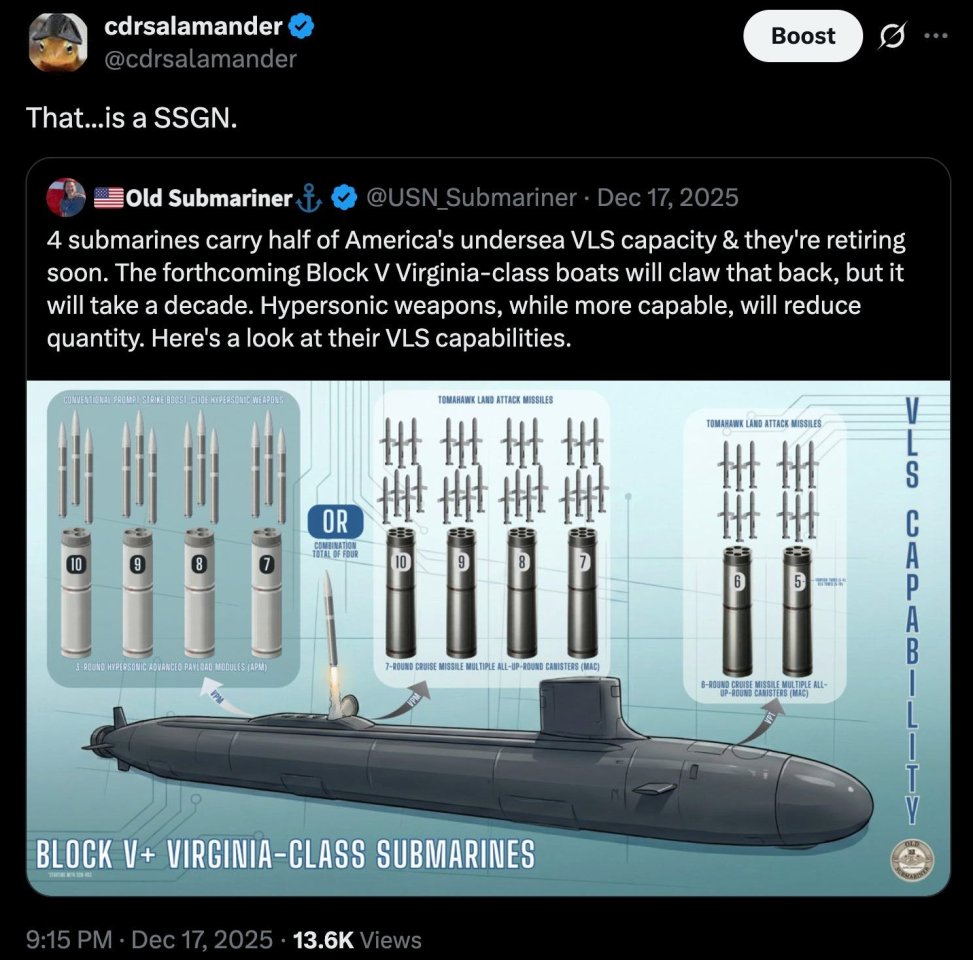
The inevitable started last week. The U.S. Navy has begun retiring its first of four Ohio class guided missile submarines, with the USS Georgia scheduled to be officially inactivated on July 31 following its return to Naval Submarine Base Kings Bay. The retirement marks the beginning of the end for the world’s most heavily armed tactical submarines, which were designed to carry 154 Tomahawk land attack cruise missiles. Their withdrawal from service is particularly notable due to a lack of a similarly heavily armed replacement for the vessels. Originally commissioned in 1984 as ballistic missile submarines to carry strategic nuclear weapons, the four ships were converted into a guided missile submarine during the 2000s to allow them to contribute to conventional war efforts. That is the rub—the VLS tubes. At a time when people are considering deploying missile barges because we knowingly undercapitalized our fleet for a Pacific fight, we are decommissioning our largest method of getting long-range precision strike in theater in mass. The very real-world experiences from Ukraine to Iran have finally forced even the most blind to see that modern warfare is neither short nor thrifty with long-range precision weapons. The Navy and its TLAM are a cornerstone to our ability to project power ashore with precision and mass. Those 154 VLS tubes carried by each of the four converted Ohios are/were essential to any CONOPS involving the People’s Republic of China in WESTPAC. The sunset of the Ohio SSGN sub-class isn’t a surprise to anyone, but those arguing for wartime effectiveness lost out time and time again to those chasing the illusion of efficiency and shifting future-risk to someone else’s PCS cycle in the “out-years.” Well Shipmate, the out-years are now. As far back as 2012, we’ve tried to remind everyone about the importance of what an SSGN brings to the table. In my perfect world, we would accept some risk on the SSBN numbers side for a few years to do the right thing along the lines of what I proposed in 2019 for the Columbia Class SSBN: Part of me would rather see 8 SSBN and 2-4 SSGN from the design, but that is just me. Those SSGN bring a lot of punch forward when needed ... and flexibility. In 2023, I put a little more detail to Plan Salamander—with a desire for even more SSGN than what I thought we needed pre-Russo-Ukrainian War of 2022. I emphasize again, on bended knee, we need a SSGN version of the Columbia SSBN and the order needs to be SSBN, SSGN, SSBN, SSGN, SSBN, SSGN, SSBN, SSGN, SSBN, SSGN, SSBN, SSGN, SSBN, SSBN, etc. I’ll accept temp risk on SSBN side #s wise, we need SSGN more. That would have given us a 16x7=112 with a full-TLAM load-out in the vertical tubes alone. Well, that wasn’t/isn’t going to happen, the nuclear autists scared everyone away by screeching, “Nuclear deterrent! Eleventy!!!” at 190 decibels. However…have you ever wanted something so bad that you start seeing any place that it might be plausible? At the end of last year, it was clear that with the next Block V Virginia SSN, someone was trying to do for SSGN what the Super Hornet guys did with the F/A-18. Get what you can, not what you want. Well, I’m not saying I manifested this designation change back in December of last year…but…if we are not going to let the perfect be the enemy of the good, then let’s call it. On Monday, we decided to change “glad” to a peppier “happy”—something that was hinted at back in May. Today, the Department of the Navy announced a decisive step to sharpen its competitive edge, reclassifying nineteen planned Virginia Class submarines equipped with the Virginia Payload Module (VPM) as guided missile submarines (SSGN). This pivotal shift clearly differentiates these advanced platforms from traditional Virginia Class fast attack submarines (SSNs), signaling a leap forward in undersea warfighting capability, lethal combat power, and global deterrence. This is truth in advertising, and brings us back to what SSGNs were at the start. Our first SSGN were really four SSGs and one SSGN of the Regulus boats of the 1950s and early 1960s. They were for land attack. The Soviet Union had dedicated SSG/SSGN during the Cold War that had dual land and surface attack role, but we got out of the game except for a handful of torpedo tube launched TLAM and the dozen VLS tubes in the Flight II and Flight III Los Angelas Class SSN and after the Cold War, the Block 1-IV Virginia Class SSN. Desert Storm broke the seal on conventional TLAM use, and that realization helped get us back in the SSGN business once the opportunity presented itself with the Ohio conversions. With those heading into history, we’ll have to make due with the Block V. What is a Block V Virginian SSN? The Block V at 460 feet is a beast. 82% the length of a Columbia SSBN (and Ohio SSBN, they’re the same length at 560 feet), and 22% longer than the previous VA Blocks. The sexy they bring to the game is the possibility of exchanging 28 TLAM for 12 Conventional Prompt Strike (CPS) missiles. American SSNs are just beasts. We no longer have nimble boats once the still-not-that-nimble-at-362 feet remaining Los Angelas Class SSN decommission. With the Block V, we won’t get our 154 VLS of the Ohio SSGN, nor my theoretical Columbia Class SSGN-mod’s 112 VLS. Nope, if we leave the Conventional Prompt Strike missiles on the beach, we’ll get 40 TLAM. TLAM that will be used for land attack…back to where SSGN’s got their start. Then again, with the Tomahawk Anti-Ship Missile (TASM) Maritime Strike Tomahawk (MST) variant returning, that also gives you a 40 MST stream attack…which will ruin any surface officer’s day. One final bitter note before I completely let go of the SSGN variant of the Columbia-class SSBN: those 16 missile tubes on the SSBN when converted to conventional SSGN would give you 16 x 3 = 48 CPS missiles. Just saying. For reference, the Russian Yasen Class SSGN can carry 32 missiles for attacks at sea or ashore. We should take what we can get. That low-point in 2029-30…it is really just criminal…but there it is. Those who are long retired made decisions that made their tour easy resulting in today’s reality that those who came after them would have to deal with the problem—but here we are. Cut steel and get to work. NB: Yes, there are torpedo tube launched Tomahawk Land Attack Cruise Missiles (TLAM), but for the sake of this article, we won’t be counting them.Leave a comment Share This Substack is reader-supported. To receive new posts and support my work, consider becoming a free or paid subscriber. View the full article
-
A defense think tank is telling the British government to reverse a decision it already made twice, warning that four of the Army’s armored infantry battalions are about to be left without any working vehicle at all, the UK Defence Journal reported, citing a new policy paper from the 878 Institute. The paper, titled Britain’s […]View the full article