All Activity
Past hour
-
tdesjict joined the community
Today
-
jojkhdxf joined the community
Yesterday
-
Anyone who matters in the national security arena is familiar with the industrial espionage waged by the People’s Republic of China (PRC) against the West—from unsecured networks to the graduate schools of our best research institutions. Most are also aware of the PRC’s penetration of our supply chains and production floors. What if they didn’t have to do that because they simply, well, owned the companies? The Chinese Communist Party is very good at using the capitalist system against itself—using access and leverage against the West in ways the PRC would never allow foreign companies to operate on its shores. Follow the money, as the saying goes. There is a lot of money moving around, and that money buys shares. If you own enough shares—as we’ve discussed before—you control who sits on the board of directors. When you control the board, you control the company. How much of a danger is this issue in the West? Returning to the Midrats Podcast this Sunday from 5-6 p.m. Eastern will be Dr. James S. Robbins. You can join LIVE at this link. If you are reading this after the show, check the Substack page later Sunday night for all the podcast links. We will use his recent article in Real Clear Defense, Beijing’s Trojan Yacht, as a starting point for our conversation. Jim serves as the Senior Vice President for Research and Business Development at IWP. He is a national security columnist for USA Today and Senior Fellow in National Security Affairs at the American Foreign Policy Council. Dr. Robbins is a former special assistant in the Office of the Secretary of Defense, and in 2007 was awarded the Chairman of the Joint Chiefs of Staff Joint Meritorious Civilian Service Award. He is also the former award-winning Senior Editorial Writer for Foreign Affairs at The Washington Times. His work has also appeared in The Wall Street Journal, National Review, and other publications. He appears regularly on national and international television and radio. Dr. Robbins holds a Ph.D. from the Fletcher School of Law and Diplomacy and has taught at the National Defense University and Marine Corps University, among other schools. His research interests include terrorism and national security strategy, political theory and military history. Dr. Robbins is the author of five books, including The Real Custer: From Boy General to Tragic Hero, This Time We Win: Revisiting the Tet Offensive, and the critically acclaimed Last in Their Class: Custer, Pickett and the Goats of West Point. Leave a comment Share This Substack is reader-supported. To receive new posts and support my work, consider becoming a free or paid subscriber. View the full article

-
The Defense Logistics Agency committed $2 billion during fiscal year 2026 to buy strategic and critical materials for the National Defense Stockpile, the U.S. government’s reserve of raw materials held for national emergencies, the agency said on November 6. The fiscal year ran from October 2025 through September 2026. DLA did not publish a list […]View the full article
-
ikddwlcc joined the community
-
Yemen’s Houthis launched a large-scale missile and drone attack on Saudi Arabia on Sunday, targeting Riyadh, the oil-rich Eastern Province and the southern border region. In the capital, the Aramco tower in the King Abdullah Financial District was damaged, witnesses said. Air raid alerts sounded in Riyadh and Najran, and in the Eastern Province cities […]View the full article
-
The U.S. Marine Corps has shown off a smaller, lighter version of the system its aviation units use to control airspace and manage air operations, the Common Aviation Command and Control System, or CAC2S. The new Small Form Factor variant was put through an operational demonstration last week, the Marine Corps’ acquisition office, Portfolio Acquisition […]View the full article
-
Hypersonica, a British-German defense company developing hypersonic strike missiles, has raised €100 million ($111.5 million) in a Series B funding round, UK Defence Journal reported. The money will go toward turning its tested HS-1 prototype into an operational long-range strike system for European militaries. The round was co-led by venture firms Lightspeed and General Catalyst, […]View the full article
-
Poland’s Łukasiewicz–PIAP research institute has sent two of its uncrewed ground vehicles, the HUNTeR and the IBIS TRANSPORT, to ALPEX 2026, a European military experiment in Switzerland that tests how robots and drones can support troops in the field, the institute said in a post. ALPEX 2026 is run by the European Defence Agency together […]View the full article
Last week
-
Russia used North Korean-made KN-23 ballistic missiles to strike a key energy facility in Ukraine overnight on November 7, Ukrainian President Volodymyr Zelenskyy said, citing preliminary data. He made the claim after a meeting on the damage from the attack and the repair work. Russia fired 36 ballistic missiles during the night, and Ukrainian air […]View the full article
-
amjeyghw joined the community
-
wgbkrzms joined the community
-
ruwjckkl joined the community
-
zjqvkuoa joined the community
-
lyhnytsd joined the community
-
The United Kingdom has put a second military satellite into orbit. Titania, a small British-built spacecraft, launched last month and will be operated by UK Space Command, the Ministry of Defence said on November 7. Titania was built in Hampshire by BAE Systems and the Defence Science and Technology Laboratory, the ministry’s research arm, under […]View the full article
-
Ukraine’s armed forces have hit two Russian Iskander ballistic missile launchers and a Pantsir-S1 air defense system in Russia’s Bryansk region, the General Staff of the Armed Forces of Ukraine said on November 7. The strike came hours after Russia fired 36 ballistic missiles and 172 drones at Ukraine overnight. Every missile was aimed at […]View the full article
-
Debris left inside the gun barrel of a Japanese Type 10 tank likely set off the April explosion that killed three soldiers during live-fire training in Oita Prefecture, the Mainichi Shimbun reported, citing Defense Ministry sources. The Japan Ground Self-Defense Force is preparing to publish the results of its investigation as early as the end […]View the full article
-
The U.S. Navy has awarded Vigor Marine a $222.5 million contract to overhaul and modernize the destroyer USS Gridley (DDG 101), taking the warship out of service for about two years after nearly back-to-back deployments to the Middle East, the Indo-Pacific and Latin America. The work, which the U.S. Navy calls a fiscal 2027 Depot […]View the full article
-
Japanese aircraft maker ShinMaywa Industries will build a new factory on Kobe Airport Island to assemble the US-2 search-and-rescue flying boat it supplies to Japan’s Ministry of Defense, the company said at its latest earnings briefing. The firm expects to invest several billion yen in the plant and aims to start operations in 2029. The […]View the full article
-
The U.S. Marine Corps has more than doubled the ceiling on its sole-source contract with Heckler & Koch for M27 Infantry Automatic Rifles. The modification adds $45.4 million and raises the maximum value of the deal from $39.2 million to $84.6 million, covering continued purchases of rifles, spare parts and associated equipment. The modification, announced […]View the full article
-
The Indian Air Force has landed an Il-76MD heavy transport aircraft at Nyoma airbase in eastern Ladakh, about 4,150 meters (13,629 feet) above sea level. The service said in a post that it was the highest-altitude landing the aircraft type has ever made anywhere in the world. The Il-76MD is a four-engine Soviet-designed airlifter that […]View the full article
-
The United States is putting more money into building artillery production that can surge in wartime, with the U.S. Army adding $105.8 million to MSM Group North America’s contract for a new 155mm shell loading complex at the Iowa Army Ammunition Plant. The modification, announced by the U.S. Department of War, raises the total value […]View the full article
-
risqtodi joined the community
-
When things are hopeless, they aren’t. When you think your war is over, it isn’t. When it appears your enemies are the masters of your fate, they’re not. If you have will, you have options. I give you General Sir Richard Nugent O’Connor, British Army. His life traces an arc from imperial height through remarkable decline. Borrowed generously from the WW2 Database: Richard Nugent O’Connor was born in the Princely State of Jammu and Kashmir, British India in 1889. His father was a major in the Royal Irish Fusiliers, and his mother was the daughter of a former governor of India’s central provinces. The first decade of his life was spent at the end of the Victorian Age in the jewel of the Empire, before he returned to Britain, as was standard for the day, to attend school. In England, United Kingdom, he attended Tonbridge Castle School in 1899 in Tonbridge, Kent; The Towers School in 1902 in Crowthorne, Berkshire; Wellington College in 1903 in Crowthorne, Berkshire; and the Royal Military College in 1908 in Sandhurst, Berkshire. He was commissioned a junior officer with the 2nd Battalion of the Cameronians regiment of the British Army in Sep 1909. In Jan 1910, he was assigned to Colchester, Essex, England for signals and rifle training. Between 1911 and 1912, he was assigned to Malta as a Regimental Signals Officer. During WW1, he served with the 7th Division, seeing action at Arras and Bullecourt in France and Piave River area in Italy, and was awarded the Military Cross, the Distinguished Service Order with Bar, and the Italian Silver Medal of Military Valor. Just take a moment to consider how you must have viewed yourself and your nation as a man of his age—a child at the end of the Victorian Age, brought to adulthood in the Edwardian Age, then forged in your 20s in the Great War, when so many of your peers never survived. After WW1, he was reverted to his permanent rank of captain. Between Apr 1919 and Dec 1919, he served as a regimental adjutant. In 1920, he attended Staff College, Camberley, Surrey, England. Between 1921 and 1924, he was a brigade major with the 5th Brigade, also known as the Experimental Brigade; in this role he tested new combined arms tactics involving traditional infantry and artillery advancing in conjunction with tanks and aircraft. Between Feb 1924 and 1925, he served as the adjutant of Cameronians regiment. Between 1925 and 1927, he served as a company commander at Sandhurst. Betwen Oct 1927 and Jan 1930, he was an instructor at the Staff College at Camberley. In 1930, he served with the 1st Battalion of The Cameronians in Egypt, then with the same unit between 1931 and 1932 in Lucknow, India. Between Apr 1932 and Jan 1935, he was attached to the War Office in London, England. In 1935, he attended the Imperial Defence College in London. In Apr 1936, he was promoted to the rank of colonel and was made a temporary brigadier to take command of the Peshawar Brigade in northwestern India. In Sep 1938, he was promoted to the rank of major general and was made the commanding officer of the British 7th Division in Palestine; he was also concurrently made the military governor of Jerusalem. In Aug 1939, the 7th Division was transferred to Mersa Matruh, Egypt, where he would be located with the European War began. And again, consider his moment in time at the dawn of the Second World War. Shortly after the Italian entry into the war in Jun 1940, O’Connor was made the commanding officer of the Western Desert Force. The Italians attacked Egypt on 13 Sep 1940, moving 60 miles into Egypt and capturing Sidi Barrani. He was promoted to the rank of lieutenant general in Nov 1940. Through Operation Compass launched in Dec 1940, however, he was able to push the Italians back into Libya, capturing large numbers of prisoners meanwhile. In early Jan 1941, the Western Desert Force was redesignated XIII Corps, and on 9 Jan he continued the offensive, capturing Tobruk on 22 Jan and then securing a surrender from a large group of surviving Italians on 7 Feb. The offensive campaign he orchestrated advanced 800 miles, captured 130,000 prisoners, captured 400 tanks, and captured 1,292 guns, all at the cost of only about 1,800 casualties (500 killed). For his achievement, he was made a Knight Commander of the Order of the Bath. In Feb 1941, after the offensive was halted due to the situation in Greece, he was made the General Officer Commanding-in-Chief the British Troops in Egypt. In March, newly arrived German General Erwin Rommel launched an offensive toward Egypt, and O’Connor moved forward to advise Lieutenant General Philip Neame on defenses. On 6 Apr, O’Connor and Neame, while travelling to their headquarters which had been withdrawn from Maraua to Timimi in Libya, were captured by a German patrol near Martuba. With most Generals, that would be the end of their war. But not O’Connor. He would spend the following two and half years as a prisoner of war, being held at Castello di Vincigliata near Florence, Italy for a large portion of that time. After failing to escape by climbing the castle walls, he was punished with a month’s solitary confinement. Although he was initially successful with his second attempt by using a tunnel he and others dug between Oct 1942 and Mar 1943, he and Major General Adrian Carton de Wiart were captured at Bologna, Italy; this resulted in another month’s solitary confinement. We’ve covered de Wiart before. Give it a read if you missed it. In Sep 1943, he made his third escape attempt while being transferred to another place of imprisonment, reaching General Harold Alexander at Bari, Italy on 21 Dec 1943. O’Connor was given command of VIII Corps in Jan 1944. With this corps, he arrived in Normandie, France on 11 Jun 1944 and directed Operation Epsom, Operation Jupiter, and Operation Goodwood. The VIII Corps was placed in reserve in Aug 1944, but he remained an unofficial adviser to Bernard Montgomery. VIII Corps played a minor role in Operation Market Garden, during which it indirectly supported the XXX Corps. In Nov 1944, he was relieved of his command of VIII Corps and was made the commanding officer of Eastern Command in India. It was said that Montgomery was not entirely pleased with O’Connor’s performance, and either made no protest when Field Marshal Alan Brooke made the transfer, or that Montgomery might have initiated this transfer himself. O’Connor’s transfer to India marked an end to his combat career. He lived until 1981. If you’re interested in the story of his escape from captivity at Vincigliata Castle, Mark Felton has written a great book on it, Castle of the Eagles: Escape from Mussolini’s Colditz. Leave a comment Share This Substack is reader-supported. To receive new posts and support my work, consider becoming a free or paid subscriber. View the full article

-
Russia’s state defense conglomerate Rostec has shown a mobile version of its Tsitadel anti-aircraft gun system, with the weapon and its sensors mounted on a truck chassis, the company said. Until now, Tsitadel had been fielded as a stationary system designed to guard fixed sites against drones. “The combat module, as well as the radar […]View the full article
-
Russia’s Defense Ministry has released footage of a Mi-28NM attack helicopter firing a small, low-cost cruise missile during combat operations in Ukraine. The missile appears to be either the S8000 Banderol or the closely related Dan-T, two jet-powered weapons that look alike and have been described both as drones and as cruise missiles. The video […]View the full article
-
The U.S. Air Force is asking Congress for $4.25 billion in its fiscal 2027 budget to buy critical spare parts for its bombers, tankers, fighters and trainers, after its own figures showed that only eight of 24 measured aircraft fleets meet supply readiness standards. The request, set out in the service’s Working Capital Fund budget […]View the full article
-
The Defense Logistics Agency plans to buy a hydraulic cylinder assembly for the U.S. Army’s CH-47 Chinook helicopter only from Boeing because the government does not have the technical data it needs to let anyone else compete, the latest example of the data gap the Pentagon’s right-to-repair push is meant to close. DLA Aviation at […]View the full article
-
The U.S. Army has awarded Amentum Services a $609 million contract to supply at least 500 full-time-equivalent contract workers to keep its depots running, the U.S. Department of War announced on Nov. 5. The firm-fixed-price contract, W911RQ-27-C-A004, lists Texarkana, Texas, home of Red River Army Depot, as the place of performance and runs through Nov. […]View the full article
-
The U.S. Navy has exercised an $11.3 million option with Integer Technologies to keep developing software that maps the underwater soundscape for submarines and undersea drones, the U.S. Department of War announced on Nov. 5. The Office of Naval Research awarded the modification, P00002 to contract N0001426C2208, for an effort called Operationalizing Marine Acoustics for […]View the full article
-
The U.S. Army has awarded 11 companies places on a contract worth up to $4.17 billion to design, build and commission new facilities at its government-owned, contractor-operated ammunition plants, the U.S. Department of War announced on Nov. 4. The firm-fixed-price contract runs through Nov. 4, 2031, and the companies will compete for each task order […]View the full article
-
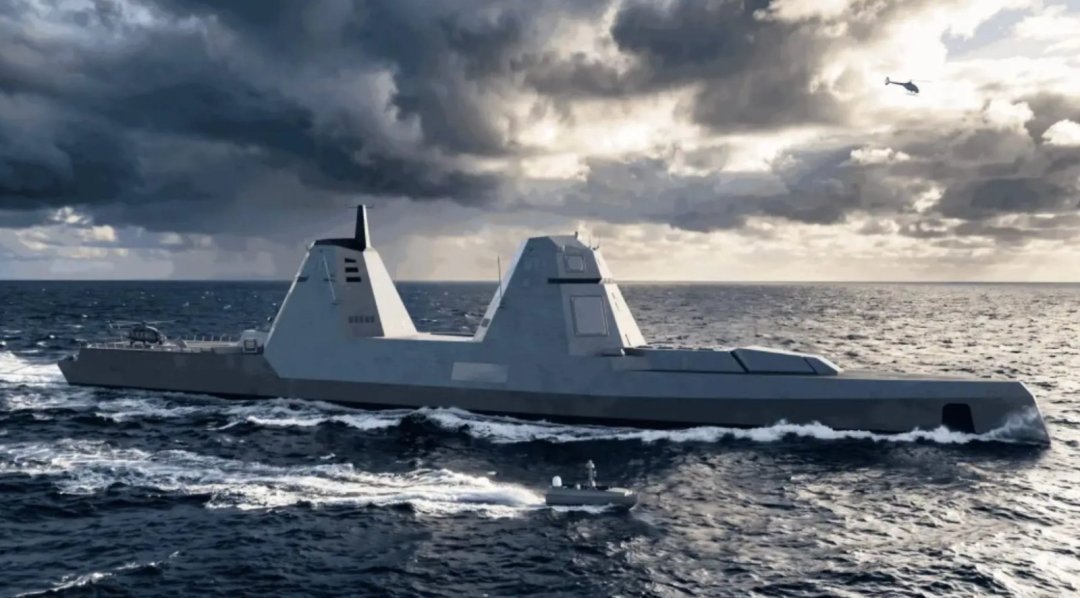
Today post is, in a fashion, a follow-on to yesterday’s post on what will probably be the never-was-has-been BBGN—and what we need to build should this no longer be an option. That being said, there is a long-standing requirement for a large surface combatant—conventional or nuclear—for decades. A big ship brings things to the fight in useful mass that smaller ships can provide only in drips: Capacity: more weapons for more warfare areas to sustain combat over a longer period Capability: large missiles with range and impact downrange require large displacement Power: radar, lasers, railguns take power And no, “drones can do this” is not the answer. They are adjuncts and additions to, not substitutes for manned platforms. The experience of the last few years in the Israeli littoral, the Red Sea, and the seas off the Strait of Hormuz has demonstrated the value of large magazines, superior sensors, and station-keeping that large surface combatants can provide better than any other platform. It also demonstrated that if you need to project power ashore or defend against ballistic missiles, nothing is more capable or survivable than a properly equipped surface vessel. More and more nations are realizing this fact. Some, like Japan, figured it out and acted on it early. All they need to do is find the money to build them. If BBGN is not to see the light of day, then let’s look at two existing ‘large frigates/destroyers’—that are actually cruisers—already at sea; one under construction; and proposals from three other nations waiting to cut steel. The ProposalsSome of these may never displace water, but the thinking behind them—and the commonality of mission—leaves an impression. From France, we have a proposal for the rail-gun armed, drone-focused SCX26. Just next door, the Germans are pondering the F127. Heading south, Italy’s DD(X) seems to fit the bill. Under ConstructionAs we’ve discussed before, Japan has the yet-to-be-properly-named ASEV under construction. At SeaOf course, we have our highly modified and updated late-Cold-War Arleigh Burke Flight III. And of course, we have the People’s Liberation Army Navy’s answer to the challenge, the Type 055. It isn’t a new design or concept any more than the Arleigh Burke, but it fits the category. Here they are for comparison’s. It used to be, back before the turn of the century, that the U.S. Navy led the world in warship development. People copied our designs, loved to buy our ships, steal our ideas, but that pretty much ended decades ago. Don’t get me wrong: we are still world-beating, mostly, in offensive and defensive weapons and sensors—but not in what carries them into battle. That can change…but we keep going to the same well expecting different results. Other nations seem to have the right ideas, but just don’t have the money to build substantial fleets. Balk. Stall. Pause. Reconsider…while the rest of the world generates the better ideas. We need to do better. This bit of animation is … fun. Enjoy. Share Leave a comment This Substack is reader-supported. To receive new posts and support my work, consider becoming a free or paid subscriber. View the full article
-
General Atomics Electromagnetic Systems will build parts for the hypersonic glide body used by the U.S. Army’s Dark Eagle and the U.S. Navy’s Conventional Prompt Strike weapons under a multiyear subcontract with Leidos that runs through 2031, the company said on Nov. 4. The San Diego-based company will produce precision-machined parts and cable assemblies for […]View the full article