All Activity
Past hour
-
jawmtoiq joined the community
Today
-
mcehcldw joined the community
-
shoifmeu joined the community
-
htnpuopl joined the community
-
jkcusbaw joined the community
-
wzrnqjwg joined the community
-
Tuesday was the 250th anniversary of the death of a young man who was given so much, earned so much, and at the ripe old age of 21 gave it all in service to our nation at its very birth. In case you missed it, I am referring to one of the greatest Americans the state of Connecticut ever produced. At a time when only a minority were in rebellion against the British crown, he stepped forward. As in all revolutions, the example set by others early — and the efforts made by the few who led the way — is what makes their honor so great. Hale had a lot to lose. He came from, and was raised to assume, the highest roles in the established colonial order. Wiki has a great summary, and I will borrow generously from that account. Nathan Hale was born in Coventry, Connecticut, in 1755, to Deacon Richard Hale and Elizabeth Strong, a descendant of Elder John Strong. He was a great-grandson of the Reverend John Hale, an important figure in the Salem witch trials of 1692. He was also the grand-uncle of Edward Everett Hale, a Unitarian minister, writer, and activist noted for social causes including abolitionism. He was the uncle of journalist Nathan Hale, who founded the Boston Daily Advertiser and helped establish the North American Review. In 1769, when Nathan Hale was fourteen years old, he was sent with his brother Enoch, who was sixteen, to Yale College. He was a classmate of fellow Patriot spy Benjamin Tallmadge. The Hale brothers belonged to the Linonian Society of Yale, which debated topics in astronomy, mathematics, literature, and the ethics of slavery. Nathan graduated with first-class honors in 1773 at age 18 and became a teacher, first in East Haddam and later in New London. At an age when modern young men are still trying to figure out who they will ask to prom and what fraternity they might want to join at college, Hale was already out of college and working as a teacher. Open rebellion started before he was even of legal drinking age, by modern standards. What did he do? At 20 years of age, …Hale joined a Connecticut militia unit and was elected first lieutenant within five months. His company participated in the Siege of Boston, but Hale remained behind. It has been suggested that he was unsure as to whether he wanted to fight, or possibly that he was hindered because his teaching contract in New London, Connecticut did not expire until several months later, in July 1775. On July 4, 1775, Hale received a letter from his classmate and friend Benjamin Tallmadge, who had gone to Boston to see the siege for himself. He wrote to Hale, “Was I in your condition, I think the more extensive service would be my choice. Our holy Religion, the honor of our God, a glorious country, & a happy constitution is what we have to defend.” Tallmadge’s letter was so inspiring that, several days later, Hale accepted a commission as first lieutenant in the 7th Connecticut Regiment under Colonel Charles Webb of Stamford. Hale was also a member of Knowlton’s Rangers, the first organized intelligence service organization of the United States of America, led by Lieutenant Colonel Thomas Knowlton. A few months before his 21st birthday, Hale made a decision. Stop. Ponder where you were at that age. Consider each clause of the next paragraph, and then think about the character and example of this young man. As a side note, that is why I chose the statue in NYC‘s City Hall Park of Hale at the top of this post. Too many artistic representations of him make him look like he’s in his 40s. He wasn’t. He was a young man. He was barely 21 years old. In the spring of 1776, the Continental Army moved to Manhattan to defend New York City against the anticipated British attack. In August, the British soundly defeated the Continentals in the Battle of Long Island via a flanking move from Staten Island across Brooklyn. General George Washington was desperate to determine the location of the imminent British invasion of Manhattan. To that end, Washington called for a spy behind enemy lines, and Hale was the only volunteer. No training as a spy. No senior person to work with…as the revolution was not even a year old. He simply said, “Send me.” On September 8, 1776, Hale volunteered to go behind enemy lines and report on British troop movements, which he knew was an act of spying punishable by death. On September 12, he was ferried across Long Island Sound to Huntington, New York, on British-controlled Long Island. Hale planned to disguise himself as a Dutch schoolteacher looking for work, although he did not travel under an assumed name and reportedly carried with him his Yale diploma bearing his name. … An account of Hale’s capture, later obtained by the Library of Congress, was written by Consider Tiffany, a Connecticut shopkeeper and Loyalist. In Tiffany’s account, Major Robert Rogers of the Queen’s Rangers saw Hale in a tavern and recognized him. After luring Hale into betraying his allegiance by pretending to be a Patriot himself, Rogers and his Rangers apprehended Hale near Flushing Bay in Queens, New York. Another story is that Hale’s cousin, a Loyalist named Samuel Hale, was the one who revealed his true identity. British General William Howe had established his headquarters in the Beekman House in a then-rural part of Manhattan … Hale reportedly was questioned by Howe, and physical evidence was found on him. ... According to some accounts, Hale spent the night in a greenhouse at the mansion, while others say he spent it in a bedroom there. He requested a Bible; his request was denied. Sometime later, he requested a clergyman. Again, the request was denied. … According to the standards of the time, spies were hanged as illegal combatants. By all accounts, Hale comported himself well before the hanging.[15][16][17] Frederick MacKensie, a British officer, wrote this diary entry for the day:[15] He behaved with great composure and resolution, saying he thought it the duty of every good Officer, to obey any orders given him by his Commander-in-Chief; and desired the Spectators to be at all times prepared to meet death in whatever shape it might appear. On the morning of September 22, 1776, Hale was marched along Post Road to the Park of Artillery, which was next to a public house called the Dove Tavern (at modern-day 66th Street and Third Avenue), and hanged. He was 21 years old. Yes, some mythology has evolved around him. So what? Much of it appears to have a sound basis on what happened. In 1776, they did not make recordings of all meetings. They did not have cameras and microphones. There were no stenographers or legions of press around every corner. However, there were records—not perfect—but enough to give substance to the core of the story as understood by two centuries. Perfect accounting of events? Rarely. Good enough? Sure. No official records were kept of Hale’s final speech. It has traditionally been reported that his last words, either entirely or in part, were: “I only regret that I have but one life to lose for my country.” The account of the quote originated with British Captain John Montresor, who was present at the hanging. The next day, he spoke with American Captain William Hull under a flag of truce. Hull recorded in his memoirs the following quote by Montresor: “On the morning of his execution,” continued the officer, “my station was near the fatal spot, and I requested the Provost Marshal [William Cunningham] to permit the prisoner to sit in my marquee, while he was making the necessary preparations. Captain Hale entered: he was calm, and bore himself with gentle dignity, in the consciousness of rectitude and high intentions. He asked for writing materials, which I furnished him: he wrote two letters, one to his mother and one to a brother officer. He was shortly after summoned to the gallows. But a few persons were around him, yet his characteristic dying words were remembered. He said, ‘I only regret, that I have but one life to lose for my country.’”[19] Because Hull was not an eyewitness to Hale’s speech, some historians have questioned the reliability of this account.[18] Over the years, there has been a great deal of speculation as to whether Hale uttered this line or some variation of it.[20] If Hale did not originate the statement, it is possible he instead repeated a passage from Joseph Addison‘s play Cato,[21] which was widely popular at the time and an ideological inspiration to many Patriots: How beautiful is death, when earn’d by virtue! Who would not be that youth? What pity is it That we can die but once to serve our country. It is almost certain that Hale’s last speech was longer than one sentence. Several early accounts mention different things he said. These are not necessarily contradictory, but rather, together they give an idea of what the speech might have been like. I am willing to give Hale, and history, the benefit of the doubt. BT BT BT This is where I go into a rant on the absolute state of history and historians in the United States. I won’t repeat the arguments I made—and linked to—back in 2024. You can find them at this link if you need to catch up. We can just add this to the stack of evidence from your local community college to our service academies and war colleges over the last few decades. The left ducks are picking ducks, and the results are all around us. People are policy…and how history is reported. I think reasonable people would surmise that Hale would be an iconic figure for the state of Connecticut, an example for the young to look to when trying to understand what service, duty, and honor expects from those to whom much is given. Part of a historian’s job is, of course, to ensure that facts are reported, but there is a right way and a wrong way to do it. You’d expect a balanced approach with all things, but especially historically important individuals. Well, you’d be wrong. The state of Connecticut has a public Connecticut history page. If you go to the “About” section, you’re given a bit of a warning. ConnecticutHistory.org, a project of Connecticut Humanities, is a state public history resource written for a diverse set of readers, ranging from students to educators to history enthusiasts. We provide engaging, well-researched stories about Connecticut history that link to reliable primary and interpretive resources. Our goal is to encourage readers to engage with the institutions, archives, museums, and communities that hold and interpret the materials that explore the diversity of Connecticut’s history. They have an entry on Hale. When you look at the CV of the author, you have another warning. Nancy Finlay grew up in Manchester, Connecticut. She has a BA from Smith College and an MFA and PhD from Princeton University. From 1998 to 2015, she was Curator of Graphics at the Connecticut Historical Society. Her 1984 PhD was in art history (NTTIAWWT) with a dissertation on, Animal Themes in the Painting of Eugène Delacroix — so the American Revolution may not be her strong suit. However, that didn’t stop her, He never lived in the Nathan Hale Homestead. There is no credible proof he ever said, “I only regret that I have but one life to give for my country.” Actually, there are credible accounts, as referenced earlier…but Nancy is on a roll, pissing on the sacrifice of greater humans. Don’t forget, this is published on an official Connecticut history website. Washington and his army holed up in Manhattan and badly in need of reliable information about the opposing forces. Washington began recruiting spies. Although spying was not considered a very honorable occupation for a gentleman, Hale had been in the army for over a year and had yet to see any action. He decided to volunteer. … …but he asked too many questions and soon aroused suspicion. In conversation with a British agent posing as an American sympathizer, he revealed his mission and British authorities promptly arrested him. In the few days that Hale had been absent, Washington’s troops retreated again and the British occupied New York. Hale was brought to General Howe’s headquarters at what is now First Avenue and 51st Street, and promptly condemned to death. The following morning, September 22, he was taken to the artillery park at what is now Third Avenue and 66th Street and, after mounting a ladder, was hanged from a tree. … Hale was not a very good spy, … his famous last words, “I only regret that I have but one life to give for my country.” The words are from Joseph Addison’s play Cato, and though the play was a favorite of Hale and his friends when at Yale, there is no reason to think that Hale spoke them at his execution. Again, there is “reason to think”. All you have to do is review primary sources, as described above. After slinging all the above, she almost seems resentful that, In 1985, a vote by the Connecticut legislature officially designated Nathan Hale as Connecticut’s state hero. I’m sorry Nancy, but what did you do when you were 20 and 21? How would you compose yourself when walking up a ladder to a noose at that age? In Dante’s Ninth Circle of Hell, the vast frozen lake Cocytus, the inner circle called Judecca, is where you find those who betrayed their lords and benefactors. Their souls encased in ice in distorted positions. Every American owes their position to our benefactors who bought, bit by bit, our independence with their sacrifice. To betray this memory with such laziness and callousness is monstrous. Shame on Connecticut for allowing this treatment of their state hero. Shame. Leave a comment Share This Substack is reader-supported. To receive new posts and support my work, consider becoming a free or paid subscriber. View the full article

-
bvfhxzob joined the community
-
Latvia is working to buy Anduril’s Barracuda long-range cruise missiles, President Edgars Rinkēvičs said after visiting the American defense company and meeting its founder, Palmer Luckey. Rinkēvičs wrote that he looked forward to completing the acquisition of the missiles and to further defense industry cooperation. During the visit he also witnessed the signing of memoranda […]View the full article
-
The Defense Threat Reduction Agency has awarded General Dynamics Information Technology a $16.6 million contract to keep running the computer systems the U.S. military uses to track every nuclear weapon in its stockpile, the U.S. Department of War announced. The cost-plus-fixed-fee contract covers continued support for the Defense Stockpile Management System. The agency said the […]View the full article
-
rceetikb joined the community
-
The U.S. Army has awarded Leonardo Electronics US $30.1 million to keep developing a way to combine the light from many small semiconductor lasers into a single, more powerful beam, the U.S. Department of War announced. The modification to an existing research contract covers work to develop, study and scale up the power emitted in […]View the full article
-
atfozlsq joined the community
-
The U.S. Air Force has taken delivery of its first two Collaborative Combat Aircraft, uncrewed jets built to fly alongside fighter pilots, at Creech Air Force Base in Nevada, the Department of the Air Force said Sept. 24. Anduril delivered its YFQ-44A Fury to the base’s Experimental Operations Unit in August, and General Atomics followed […]View the full article
-
A Chinese HQ-17 short-range air defense system painted in camouflage matching Algerian military vehicles has appeared in photos shared widely on Weibo, with Chinese sources claiming the system is headed to Algeria. The photos were highlighted by an OSINT defense account, which noted that the camouflage pattern matches the paint used on a large number […]View the full article
-
The U.S. Air Force has more than doubled the value of its contract with DZYNE Technologies for operational testing of ULTRA, a glider-like surveillance drone that can stay in the air for more than three days, the U.S. Department of War announced. The $46.1 million modification raises the contract’s total value to $85.6 million, up […]View the full article
-
The U.S. Air Force has added $87.4 million to Northrop Grumman’s contract for the AN/ALQ-257 Integrated Viper Electronic Warfare Suite, a new radar-jamming and threat-warning system for the F-16 fighter, the U.S. Department of War announced. The modification funds low-rate initial production, the first small production run before full-rate manufacturing. It raises the total value […]View the full article
-
The U.S. Navy has awarded Northrop Grumman up to $123.8 million to buy long-lead parts for 67 AN/APG-85 radars, the new radar meant for the F-35 fighter, as brand-new jets continue to reach U.S. squadrons with ballast in their noses instead of radars. The contract, announced Sept. 24 by the U.S. Department of War, covers […]View the full article
-
Romania has received its first K9 self-propelled howitzers, K10 ammunition resupply vehicles and K12 vehicles from South Korea’s Hanwha Aerospace under its tracked self-propelled howitzer program. Romania signed a contract worth nearly $1 billion with Hanwha on July 9, 2024, for 54 K9 howitzers and 36 K10 resupply vehicles, along with ammunition and tracked and […]View the full article
Yesterday
-
A Safran Patroller surveillance drone flew along Poland’s eastern border with Belarus on Thursday, passing near the Białowieża Forest and the town of Hajnówka, flight-tracking data showed. The flight was flagged on X by the open-source account Coffe Report. A Flightradar24 capture from 14:50 UTC listed the aircraft as a Safran S-15 Patroller, categorized as […]View the full article
-
If you are an old NATO hand, you are very familiar with the struggle to fill the Combined Joint Statement of Requirements (CJSOR), which is where you try to find the actual military units to fill the requirements of your Operational Plans (troops-to-task). Once you finally get some troop-contributing nation (and yes, this is a bunch of land-centric verbiage, but welcome to NATO) to pony up for a specific line, you then have to review the National Caveats that will come with the offer. More often than not, we would be better off not having them arrive at all. A few real world reasons: They can come with so many restrictions (our company of security personnel cannot conduct kinetic operations outside the perimeter of the airport. “Sorry, if you are ambushed 50 yards from the gate, they can’t help you”) that they become more of a burden than a help. They arrive, but they don’t have enough equipment to do their job…and ask other nations to supply everything from ammunition to kevlar and food. They arrive, but their systems do not work in combat environments. They worked fine on PPT and in a controlled range with bespoke systems, but standard-issue real-world performance? Nope. This is all well known for NATO staff officers. However, even NATO staff officers would roll their eyes when they had to work with the European Union’s nascent military arm and its staff. Its bureaucratic process was so Continental, cumbersome, and often just silly, that it made us NATO staff-weenies feel like snake eaters. Take whatever frustration level you have working inside NATO and multiply it by three. That’s the EU military staff…which is not a shock, as it lacks the Anglo-Saxon military umph that the U.S., UK, and Canada bring to NATO operations. Well, as we briefly discussed on the last Midrats Podcast, the EU escort mission in the Red Sea, Operation Aspides, seems to be getting a little wobbly. When the Italians, of all people, are getting tired of your ineffective bureaucracy, you know you have a problem. Italy is considering using its naval assets already deployed under the EU’s Aspides mission to independently escort Italian merchant ships through the Bab el-Mandeb Strait, with Defence Minister Guido Crosetto warning that Rome cannot wait for EU bureaucracy to respond to a renewed Houthi threat. The move comes as fighting and tensions involving Yemen’s Houthi rebels have escalated again, with the group threatening shipping through the Red Sea and contributing to a sharp rise in gas prices. “We cannot allow bureaucratic delays in decision-making to aggravate an already complex situation,” Crosetto said on Thursday, announcing “we have decided, with the Chief of Staff, not to wait for Aspides to decide whether our ships can pass or not”. Foreign Minister Antonio Tajani praised Crosetto’s initiative and called on other EU countries to provide more ships for Aspides, saying some are not making the necessary contribution to the mission. Apparently, this is not just Italians complaining about everyone else. The European Union’s naval mission to protect shipping in the Red Sea would need to boost its numbers to more than 10 warships, its foreign policy chief said on Monday, adding that for now there were not that many in the area. The EU’s Aspides mission was launched in 2024 to protect shipping from attacks by Yemen’s Iran-aligned Houthis, and diplomats have said there are currently six warships operating. … "When Aspides was put in place, then the indication was that it needs at least 10 ships. The situation, I think, is even more grave right now," Kaja Kallas told reporters on the sidelines of the annual gathering of world leaders at the United Nations. The EU military staff is notorious for underestimating military requirements. They lowball the lowball in an attempt to force-mode their means to their end. 10 ships? I would bet the number the core planning team wanted was closer to 15, but got downgraded by the senior leadership. Kallas sent a letter to the EU’s 27 member states on September 19 asking them to up their contributions. The issue would be discussed at upcoming defence and foreign ministers meetings, she said in the letter. “This situation, which is still evolving as we speak, is already affecting European interests with repercussions on our supply chains and could have implications for our ability to support our economies which were already hit by rising fuel prices,” she said in the letter. The Europeans, whether wearing their NATO or EU hat, have two problems; capacity and capability. Capacity: they have underspent on their military and their navies for so long that they simply do not have enough ships on paper to sustain a naval operation for any extended period of time. Note I said, “on paper”. When you actually pull the readiness numbers, the number of ships they actually have that are fully mission capable is even smaller. Their Sailors are great—and in some cases better than your average US Navy Sailor (O or E)—but they simply do not have the right warships to go in harm’s way. Capability: As we covered earlier this month, they have a significant shortfall in missiles to meet the threats they will face, even against 3rd and 4th-rate threats like the Houthis. They just aren’t. Even when they do, they run into problems like we saw in 2024 with the Danish frigate Iver Huitfeldt. Roll both of those issues together along with an instinct to bluff for a bit and head home, like the FS Charles de Gaulle (R91) Carrier Strike Group did this summer, and…there you go. Keep this in mind when the “1,000 Ship Navy” mindset tries to work its way back into our naval considerations and planning. Do not let them use that discredited excuse for not building the navy we need. “We don’t need frigates. Our allies have them.” “We don’t need robust mine clearing capabilities. Our allies have them.” “We don’t need that many escorts. Our allies will contribute some ships.” We’ve seen where that mindset gets us. Allies are great and wonderful and are great contributors when they arrive…but we cannot expect for them to be there whenever and wherever we need them. That is a recipe for retreat and defeat. Until then, may the Italians spend more on their wonderful navy. They really do make good stuff, and are great Sailors. Leave a comment Share This Substack is reader-supported. To receive new posts and support my work, consider becoming a free or paid subscriber. View the full article
-
The Netherlands plans to turn an Australian-designed laser into a working weapon against drones and build it on Dutch soil, the Dutch Ministry of Defense said Thursday. State Secretary for Defense Derk Boswijk signed a letter of intent this week with Electro Optic Systems (EOS), the Canberra-based maker of the Apollo high-energy laser. The ministry […]View the full article
-
The U.S. Navy has added $876.4 million to L3Harris Technologies’ contract for the Next Generation Jammer Low Band, a radar-jamming pod for the EA-18G Growler electronic attack jet flown by the U.S. Navy and the Royal Australian Air Force, the U.S. Department of War announced. The award is a modification to the $587.4 million contract […]View the full article
-
Italy’s Defense Ministry has opened a €5.14 billion ($5.86 billion) procurement for a new main battle tank and vehicles built on it, according to a record published Sept. 21 in the database of Italy’s National Anti-Corruption Authority (ANAC). The entry, listed under code BD0D09994D, covers the supply of a new tank and its derivatives for […]View the full article
-
A U.S. Army heavy battalion equipped with M1 Abrams tanks and an engineer battalion will deploy to Lithuania, the country’s Defense Ministry said Thursday, ending a gap of several months without a U.S. rotational force in the Baltic state. Defense Minister Robertas Kaunas said both battalions will arrive at the end of October. The force […]View the full article
-
Azerbaijan’s army in the Nakhchivan exclave has received Sivrisinek kamikaze drones, the Baykar-built loitering munition also known as YIHA-III, the Azerbaijani defense outlet TURAN Defence AZ reported. The drones went to the Nakhchivan Separate Combined Arms Army, according to the post. Baku has not announced the delivery, and there is no word on how many […]View the full article
-
Ethiopia’s military appears to have gained a new shield for its drone fleet: Chinese-made FK-2000 air defense systems, most likely delivered through the United Arab Emirates. Video shared on TikTok reportedly shows at least two of the truck-mounted systems on the road to Amhara, the northern region where government troops have been fighting Fano militias […]View the full article
-
China’s spaceplane has spent the past three months releasing, retrieving, and then recapturing the same small satellite in orbit, according to a timeline astrophysicist Jonathan McDowell posted Sept. 23 based on U.S. Space Force tracking data. It’s the clearest look yet at what the vehicle, known unofficially as Shenlong, has been doing during its fourth […]View the full article
-
North Korea test-fired an upgraded, precision-guided 240mm rocket on Sept. 22, state media said Sept. 24, claiming the new round can strike targets up to 115 km (71 miles) away, close enough to reach the Seoul metropolitan area from launch positions north of the Demilitarized Zone. North Korea has built the rocket along the same […]View the full article
-
Canada’s first F-35A fighter jet completed its maiden flight Sept. 23, taking off from Lockheed Martin’s production facility in Fort Worth, Texas. The aircraft, which carries the construction number AR-1 and will be designated CF-35A once in Royal Canadian Air Force service, flew with an F-35C acting as a safety chase plane. The jet already […]View the full article
-
Russia has delivered a new batch of Su-57 stealth fighters to its air force, and the jets come in what the manufacturer calls a “new technical configuration,” with upgraded onboard systems and an expanded set of weapons options. Rostec, the state conglomerate that owns manufacturer United Aircraft Corporation, announced the delivery but did not say […]View the full article
-
SummaryThis episode explores recent developments in US military strategy, technology, and infrastructure, emphasizing the importance of fundamentals and realistic planning in national defense. Key TopicsUS-Greenland-US relations and strategic agreements Impact of NATO and European NATO capabilities Development and deployment of the MQ-25A Challenges in mai… Read more View the full article
Last week
-
A Russian military Mi-8 helicopter briefly entered Polish airspace Wednesday morning, flying north of the town of Braniewo near the border with Russia’s Kaliningrad exclave, Poland’s Operational Command said. The aircraft penetrated Polish territory to a depth of about 300 meters and remained inside Polish airspace for 42 seconds before returning to Kaliningrad airspace. Polish […]View the full article
-
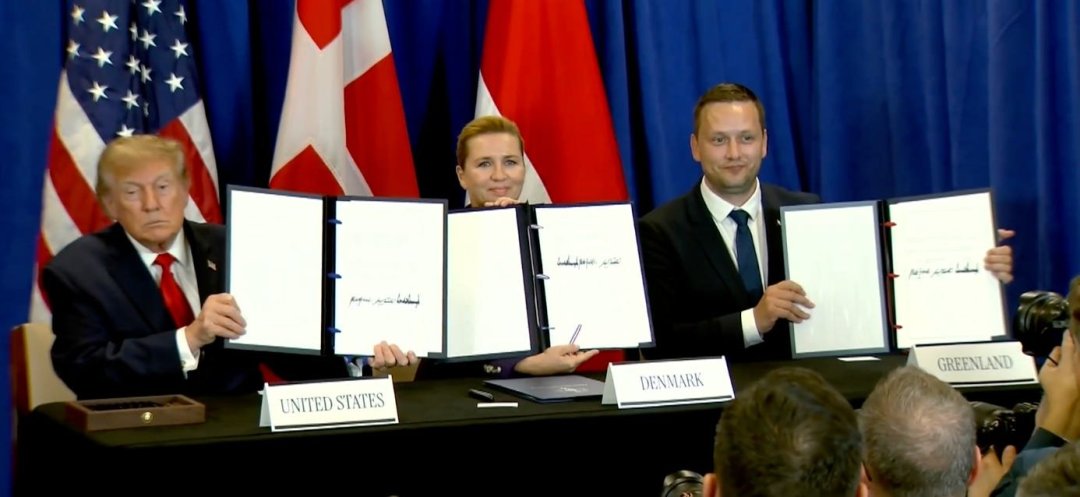
…and there you go. President Donald J. Trump signs the Greenland security deal with Danish Prime Minister Mette Frederiksen and Greenland Prime Minister Jens-Frederik Nielsen. We’ve kept up reasonably steady reporting the last couple of years on Greenland. I was never quite sure where it would come out, but I was confident that it would be—non-inclusive—in between the two extremes we heard coming out of the overly excitable and narrowly sourced commentariat of the U.S. invading or the U.S. being kicked out…and it did. I have to give a nod to our Australian friend Liz Buchanan who gave some great observations on the issue on the Midrats Podcast back in September of 2025 and January of this year. The full text of the agreement can be found here if you want to read it in detail, but let’s stick to the big pixels, as it is really a good news story for everyone…especially NATO. Rod Martin created a great executive summary…I’m just going to steal it. Bravo Zulu to the team that kept working this issue. From a national security point of view, everyone got the most important things they wanted—that’s what matters. As we like to do here, let’s go to the chartroom. We should start with something I posted five days ago over on X. Where were we in Greenland before the agreement compared to the Cold War? Well…we aren’t getting that much…but more, in a fashion. Looking just as the military aspects of the agreement (which is only a part). In addition to old Thule (now Pituffik), we will add/return to Narsarsuaq in southern Greenland, which was the site of the former US Bluie West One air base. It was used in World War II and the early Cold War before closing in the 1950s. Ashore, it has an existing airport with a runway that operates year-round and at sea, access to a deep-water port. The other is Mestersvig in northeast Greenland, which currently serves as a base for Denmark’s Sirius Dog Sled Patrol (an elite special forces unit) and has a 1,800-meter gravel airstrip. It is isolated, with a very small permanent presence, but it offers access to the east coast and adjacent waters. This is where it scratches the old Cold War itch while addressing the very real fact that regardless of what happens in the Russo-Ukrainian War and with the demographics of those nations in the coming decades, the geography is not changing. Russia is not going to disappear. Here are the three bases in context. More commentary from me here would just be a selfish imposition on your time. The maps tell the story. A final note about maps. The map at the top with my great circle routes gives a pretty solid view of the relative size of Greenland. One of the more tiresome things one hears in this discussion—on par with a 13-year-old-boy explaining the nuances of sex to a barbershop full of married men—is the, “Greenland is not that big…it just looks that way on Mercator projections…” OK, fine, yes…but, Shipmate, that ain’t small. Greenland is ~147% as large as Alaska. Doesn’t matter if it is 80% covered with ice. Our three bases will be VERY spread out. It would be as if we were defending the East Coast of the U.S. from NAS Key West to the old NAS Brunswick in Maine and then to Scott Air Force Base in Illinois. However, three beats one…and keeping the Chinese and Russians away…priceless. Take the “W”. Leave a comment Share This Substack is reader-supported. To receive new posts and support my work, consider becoming a free or paid subscriber. View the full article