All Activity
- Today
-
Lockheed Martin has secured a $61 million U.S. Army contract to develop and demonstrate two of the most consequential near-term upgrades to the Patriot air defense system: a containerized missile launcher and a hemispherical guidance device that eliminates one of Patriot’s most significant tactical limitations, the inability to engage threats approaching from outside a fixed […]View the full article
-
General Dynamics Land Systems has secured a $229.6 million contract to produce 50 Stryker Double V-Hull (DVH) A1 armored vehicles for the U.S. Army, continuing a production line that has delivered one of the service’s most combat-proven wheeled infantry platforms through more than two decades of operational use across multiple theaters. Army Contracting Command at […]View the full article
-
The U.S. Army has awarded Northrop Grumman a $325.5 million contract to develop a high-altitude long-endurance drone specifically designed to collect test data from high-speed weapons systems, filling a capability gap that has slowed the Pentagon’s ability to evaluate hypersonic and other advanced high-speed programs at the pace that competition with China and Russia demands. […]View the full article
-
Lockheed Martin has secured a $991 million contract to produce electronic warfare upgrade kits for 432 F-35 Joint Strike Fighters across three U.S. military services and a substantial international customer base, in one of the largest single F-35 modernization awards in the program’s history. The Naval Air Systems Command at Patuxent River, Maryland, issued the […]View the full article
-
Ondas Holdings has unveiled a new robotic ground system called Iron-Wave, a modular unmanned platform designed to integrate multiple robotic units under centralized control and extend military and security operations into contested environments with a reduced operator footprint, the company announced on its official social media account. Ondas Holdings is an American technology holding company […]View the full article
-
HII, one of only two nuclear-capable shipyards in the United States and the sole builder of nuclear-powered aircraft carriers, has delivered two autonomous surface vessels to the U.S. Marine Corps under a Defense Innovation Unit contract, completing sea testing that validated the ROMULUS-25’s advanced autonomous capabilities in an operational maritime environment, the company announced May […]View the full article
-
American and Nigerian forces have killed Abu-Bilal al-Minuki, described by President Donald Trump as the second-in-command of ISIS globally, in a joint operation conducted overnight, the president announced via his personal social media account and confirmed through the official White House channel. Trump announced the operation in a post from his social account, stating that […]View the full article
-
A British aerospace startup that had positioned itself as a potential future replacement for the Royal Air Force’s Red Arrows display team has collapsed into administration, citing sustained cashflow pressure caused by repeated delays to the UK Defence Investment Plan and geopolitical factors affecting its funding sources. Aeralis Limited, the developer of a modular light […]View the full article
-
B.E. Meyers & Co. is heading to SOF Week 2026 in Tampa, Florida, with a new high-power laser targeting and illumination system in tow. The Redmond, Washington-based defense technology manufacturer will unveil the VSLAP-V1 at Booth 1153 when the special operations community’s premier annual gathering opens May 18, positioning the device as the next generation […]View the full article
-
Poland has taken operational control of its own radar satellite reconnaissance constellation less than twelve months after signing the contract to build it, a delivery timeline that ICEYE, the Finnish-American company that built the system, describes as the fastest deployment of an operational satellite program in the world. The handover of the POLSARIS system, which […]View the full article
-
back40t joined the community
- Yesterday
-
A man’s man, a man of God, and someone who really knew, “What would Jesus do?“ ... Kapaun defied orders to evacuate, knowing it meant he would most certainly be captured. He pleaded with an injured Chinese officer to call out to his fellow Chinese to stop shooting, an act that spared the lives of wounded Americans. As Kapaun was being led away, he came across another wounded American in a ditch and an enemy soldier standing over Sgt. Herbert Miller, ready to shoot. Kapaun pushed the enemy aside and helped Miller as they were taken captive. They arrived days later, by foot, at the village in Pyoktong, where a POW camp eventually was established. “This is the valor we honor today -- an American soldier who didn’t fire a gun, but who wielded the mightiest weapon of all, a love for his brothers so pure that he was willing to die so that they might live,” Obama said. At the camp, Kapaun cleaned others’ wounds, convinced them to share scarce food, offered them his own clothes and provided spiritual aid and comfort. On Easter in 1951, he defied his communist captors by conducting Mass with a makeshift crucifix. He died on May 23, 1951, at age 35, after six months in captivity. As we see with those like Father (Captain) Emil Kapaun, USA, who has been awarded the Medal of Honor, it gives one pause to consider one’s own character—and challenges us to meet a higher benchmark in our simple, soft, and easy daily lives. Citation: The President of the United States of America, authorized by Act of Congress, March 3, 1863, has awarded in the name of Congress the Medal of Honor to Chaplain (Captain) Emil J. Kapaun, United States Army. For conspicuous gallantry and intrepidity at the risk of his life above and beyond the call of duty: Chaplain Emil J. Kapaun distinguished himself by acts of gallantry and intrepidity above and beyond the call of duty while serving with the 3d Battalion, 8th Cavalry Regiment, 1st Cavalry Division during combat operations against an armed enemy at Unsan, Korea, from November 1-2, 1950. On November 1, as Chinese Communist Forces viciously attacked friendly elements, Chaplain Kapaun calmly walked through withering enemy fire in order to provide comfort and medical aid to his comrades and rescue friendly wounded from no-man’s land. Though the Americans successfully repelled the assault, they found themselves surrounded by the enemy. Facing annihilation, the able-bodied men were ordered to evacuate. However, Chaplain Kapaun, fully aware of his certain capture, elected to stay behind with the wounded. After the enemy succeeded in breaking through the defense in the early morning hours of November 2, Chaplain Kapaun continually made rounds, as hand-to-hand combat ensued. As Chinese Communist Forces approached the American position, Chaplain Kapaun noticed an injured Chinese officer amongst the wounded and convinced him to negotiate the safe surrender of the American Forces. Shortly after his capture, Chaplain Kapaun, with complete disregard for his personal safety and unwavering resolve, bravely pushed aside an enemy soldier preparing to execute Sergeant First Class Herbert A. Miller. Not only did Chaplain Kapaun’s gallantry save the life of Sergeant Miller, but also his unparalleled courage and leadership inspired all those present, including those who might have otherwise fled in panic, to remain and fight the enemy until captured. Chaplain Kapaun’s extraordinary heroism and selflessness, above and beyond the call of duty, are in keeping with the highest traditions of military service and reflect great credit upon himself, the 3d Battalion, 8th Cavalry Regiment, the 1st Cavalry Division, and the United States Army. The New York Times has more detail on Chaplain Kapaun. Read it all, but here is the executive summary: ... in May 1951, guards sent him into isolation, without food or water, to die. As Mr. Obama recounted, based on testimony from Father Kapaun’s comrades, the priest looked at the guards and said, “Forgive them, for they know not what they do.” His remains were never recovered. At war’s end, the surviving P.O.W.’s walked out of the camp with a four-foot wooden crucifix they had made in his honor. Fullbore. First posted in APR2013.Leave a comment Share This Substack is reader-supported. To receive new posts and support my work, consider becoming a free or paid subscriber. View the full article

- Last week
-
Peru has ordered a fifth C-27J Spartan tactical airlifter, and the contract carries significance well beyond Lima. The purchase pushes the total number of C-27Js sold worldwide to 100, a milestone that Leonardo, the Italian aerospace and defense company that produces the aircraft, marked publicly on May 14, confirming the order through an official program […]View the full article
-
BAE Systems has publicly revealed its Multi-Domain Artillery Cannon System for the first time, offering the defense world its first look at a platform the defense giant is developing to give the U.S. Army a new way to shoot down drones, cruise missiles, and other aerial threats using artillery-style firepower. The images released by BAE […]View the full article
-
Ukraine’s Ministry of Defense has officially codified and cleared for service the Pliushch, a ground-based unmanned reconnaissance and relay platform developed by Ukrainian defense technology company Robotic Complexes, the firm announced Thursday. The certification opens the door to formal procurement by Ukrainian armed forces units and marks another milestone in Kyiv’s effort to field domestically […]View the full article
-
Valinor’s Harbor platform has joined Anduril Industries’ $99.6 million Next-Generation Command and Control contract with the U.S. Army’s 4th Infantry Division, bringing battlefield casualty tracking and medical supply chain data into the same operational picture that commanders use to coordinate fires, sensors, and maneuver forces. The integration puts HarborOS directly into Lattice, the AI-powered command […]View the full article
-
Pete Hegseth, the United States Secretary of War, unveiled the Trump administration’s proposed $1.5 trillion defense budget on Thursday, calling it a “generational down payment” on American national security and framing it as the most ambitious military investment in modern history. The announcement, made via Hegseth’s official social media account and accompanied by a promotional […]View the full article
-
California-based DZYNE Technologies has developed Blitz, a Group 1 expendable unmanned aircraft system designed for mass deployment and swarm operations, announcing the system on May 14, 2026 ahead of its public display at SOF Week 2026 in Tampa. The Blitz fits within an 80-liter rucksack, can be assembled and mission-ready in under two minutes, and […]View the full article
-
A multi-company team has successfully tested a mobile counter-drone and anti-armor system mounted on a light utility vehicle, combining an Echodyne radar, a Dillon Aero M134 minigun, APKWS guided rockets, and Aeon’s Zeus missile in a single modular platform. The system is built on Moog’s Flexible Mission Platform, a modular weapons integration architecture that the […]View the full article
-
Red Cat Holdings has partnered with satellite communications company Kymeta to integrate multi-orbit connectivity into its Blue Ops Variant 7 uncrewed surface vessel, announcing the collaboration on May 14, 2026. Kymeta, a flat-panel satellite terminal manufacturer that has shipped more than 9,000 units across deployments in more than 80 countries and territories, joins Red Cat’s […]View the full article
-
Britain has signed a nearly £1 billion, approximately $1.33 billion, contract for 72 RCH 155 remote-controlled howitzers, the Ministry of Defence announced May 13, 2026. The contract was awarded by the Organisation for Joint Armament Cooperation, known as OCCAR, on behalf of the British Army to ARTEC GmbH, a joint venture between KNDS and Rheinmetall. […]View the full article
-
Ukrainian defense company Fire Point has joined an anti-ballistic missile coalition and unveiled a pan-European ballistic missile defense project called Freya, presenting a system architecture built around a domestically developed interceptor missile and designed to integrate with NATO-standard protocols and existing Western and Ukrainian air defense infrastructure. “Despite attempts to interfere and many distracting factors, […]View the full article
-
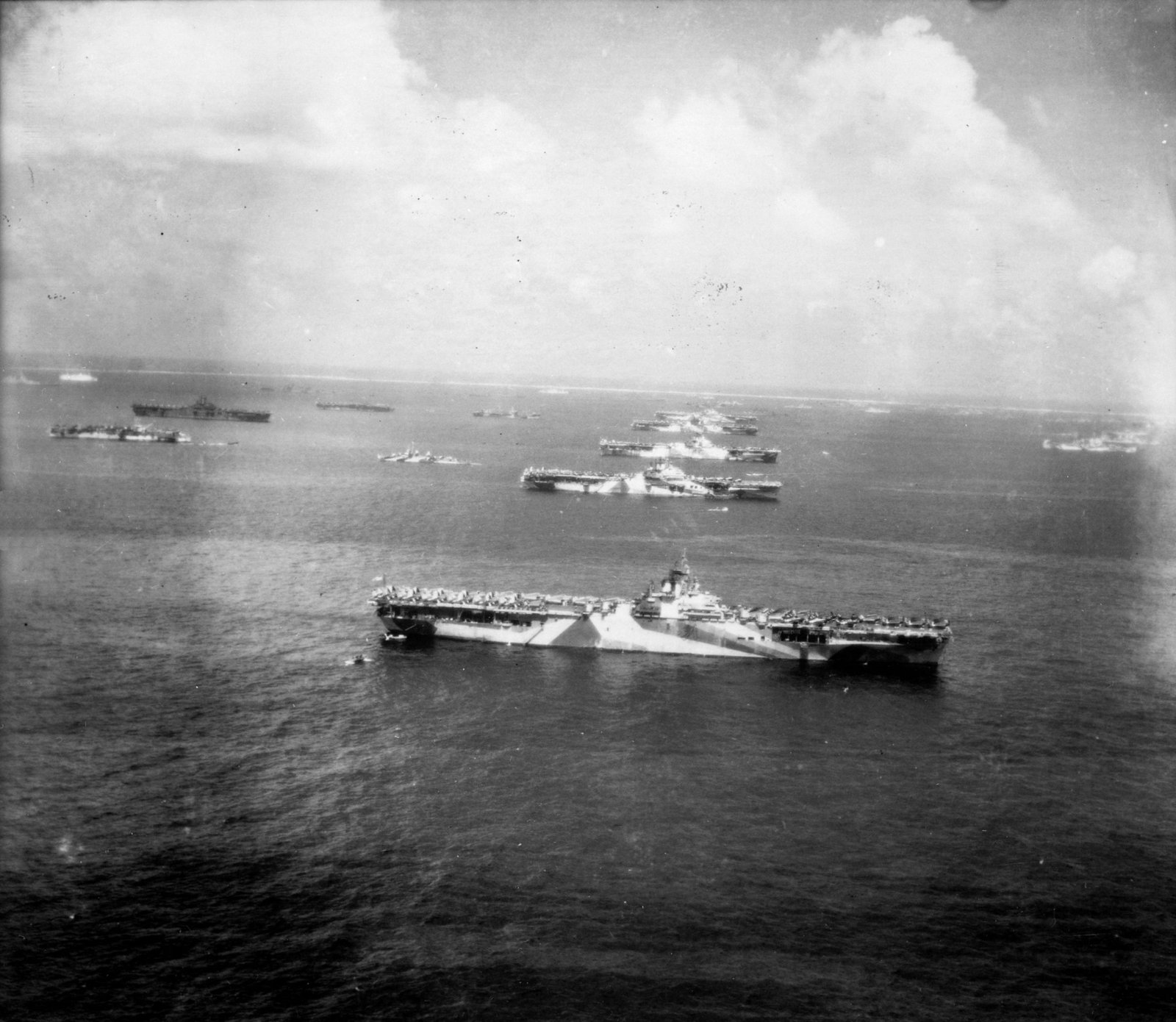
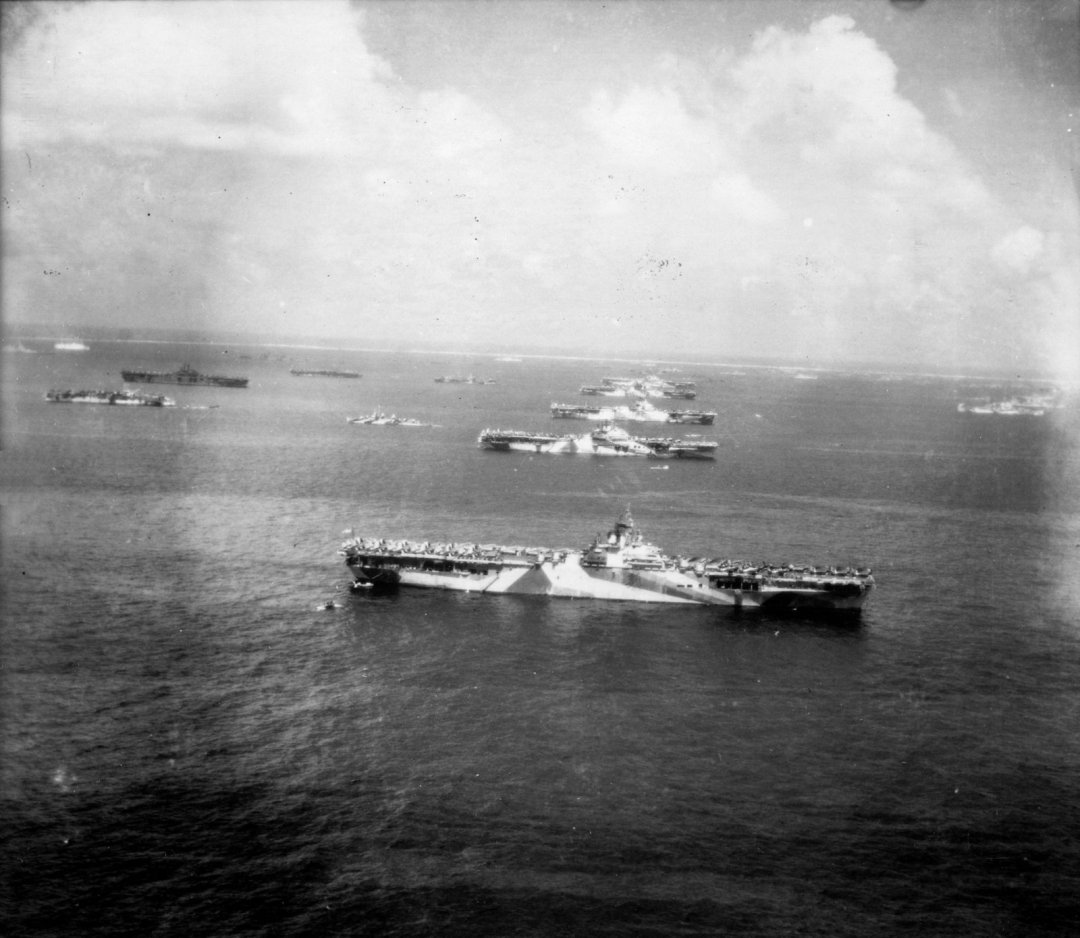
Murderers’ Row. Ulithi anchorage, December 8th, 1944. Just three years after the attack on Pearl Harbor. One of the most iconic pictures of WWII. The carriers are (from front to back): USS Wasp (CV-18), USS Yorktown (CV-10), USS Hornet (CV-12), USS Hancock (CV-19) and USS Ticonderoga (CV-14). The oldest of those ships, Yorktown, was only 19 months old. The youngest, Hancock, was commissioned only a little under eight months earlier. All were laid down and took from a bit under three to a bit under four years to build. Just a year prior, the US Navy was so short of aircraft carriers, it had to borrow a carrier from the Royal Navy. At first glance, it appears to be a flex of American naval power at flood tide—the aircraft carrier’s unassailable invincibility manifest—and it is. However, when you dig deeper, it has a more important story. It gives a warning. It informs us today, if we are willing to listen. It isn’t about the power of being the world’s greatest shipbuider, that we were. It isn’t about an unequalled ability to project national will across the Pacific like no nation ever has in human history, which it is. No. That isn’t what it tells us that is most important. As we have done more than once over the last two decades, we’re taking a holder of a front row seat on the Front Porch and CDR Salamander Plank Owner Sid’s comments, in this case from yesterday, and bringing it to a standalone post. Most of this post is his. The insight certainly is. The actual story this picture tells is much more sobering, right there in plain sight, but you can’t see it. The reality is that on the day this picture was taken, the Fast Carrier Task Force (TF 38/58) was down an entire Task Group from where it started two months earlier. USS Franklin (CV-13) was severely damaged on 27 OCT by kamikaze and had to return CONUS for repairs. USS Belleau Wood (CVL-24) was severely damaged in the same attack. USS Princeton (CVL-23) was sunk on 24 OCT by a Judy dive bomber. USS Essex (CV-9) had a devastating hit by a kamikaze on 24 NOV followed by a disabling machinery casualty requiring a trip back to CONUS for repairs. USS Enterprise (CV-6) departed a few days earlier for repairs in Pearl Harbor. All the carriers in this picture had been damaged to varying degrees. Damage that today would require a trip to the yard to fix, like the absent Enterprise and Essex. For example Ticonderoga (fourth Essex in the line from the bottom) would take damage to her radar waveguides in January. That could not be repaired forward and she would have to return to Bremerton as well. As a note and aside, another member of the Front Porch, Scoob’s father is aboard the Lexington (uncamouflaged carrier on the left) being repaired having taken a kamikaze blow to her island in November. It was Admiral Mitscher’s flagship during the attack, with future CNO Arleigh Burke as his Chief of Staff. 50 killed and 132 wounded in this attack. Also not obvious in the picture is the tremendous replacement effort of aircraft and pilots to replenish from the losses, that today would be called catastrophic, ferried forward by nearly a score of CVE’s shuttling from the west coast and Pearl. When the next Great Pacific War comes, it won’t just be clean numbers on a sheet and your preferred weapon winning—but like it was when the picture at the top was taken, it will be about the entire system built around them. Logistics. Repair. Replacements. Sustained operations, forward, for years on end. An industrial base that can, on a dime, rise from economic doldrums to building a fleet that would rule the world’s oceans. Are we training, manning, and equipping for that? How many CNOs this century chased this or that socio-political trend instead of beating this drum? Why? The norm since the 80’s of deployment of one or even two carriers will not be enough for the fight to come. We are not ready. As I remind everyone I have a chance to, like I did exactly a year ago: Should we find ourselves in a Great Pacific War with the PRC, as our fleet heads west across the International Date Line, we should expect in the first 90-180 days to lose somewhere in the neighborhood of 8-10,000 Sailors and Marines...at sea alone. That is the most-likely outcome; not the most-positive or most-dramatic. Two CVN, a few large deck amphibs, a handful+ of DDG/CG/LCS and SSN—all sunk in the first 90-180 days. That doesn’t even start to outline what will happen to ground-based support from Guam west. This truth is right there in our own history. We have a Naval Academy, a Naval War College, JPME, all of it—and yet the recognition of this clear fact seems shocking, new, unheard this century of to way too many in positions of power and influence. Why? What other things captured their minds? Leave a comment Share This Substack is reader-supported. To receive new posts and support my work, consider becoming a free or paid subscriber. View the full article
-
Romanian manufacturer IRUM has unveiled the IRON-690, a modular autonomous ground drone designed for defensive support operations, at the Black Sea Defense and Aerospace exhibition in Bucharest. The prototype was presented at BSDA on May 13, 2026, according to IRUM’s press release. The IRON-690 is not a conventional vehicle but an adaptable autonomous platform configurable […]View the full article
-
The U.S. Department of War has signed framework agreements with five defense companies to produce more than 10,000 low-cost cruise missiles and 12,000 hypersonic missiles over the next several years, in the most aggressive American missile mass-production commitment in decades. The announcements, made through official Department of War and company channels, establish two parallel programs. […]View the full article
-
Edge Group, the Emirati state-owned defense conglomerate, has released footage of a test of its SHADOW 25 jet-powered loitering munition, a canister-launched one-way attack system. Edge Group published the test footage alongside a statement describing the system’s rapid deployment capability. “Canister-launched SHADOW 25 moves from standby to airborne in seconds, reducing the logistics footprint and […]View the full article