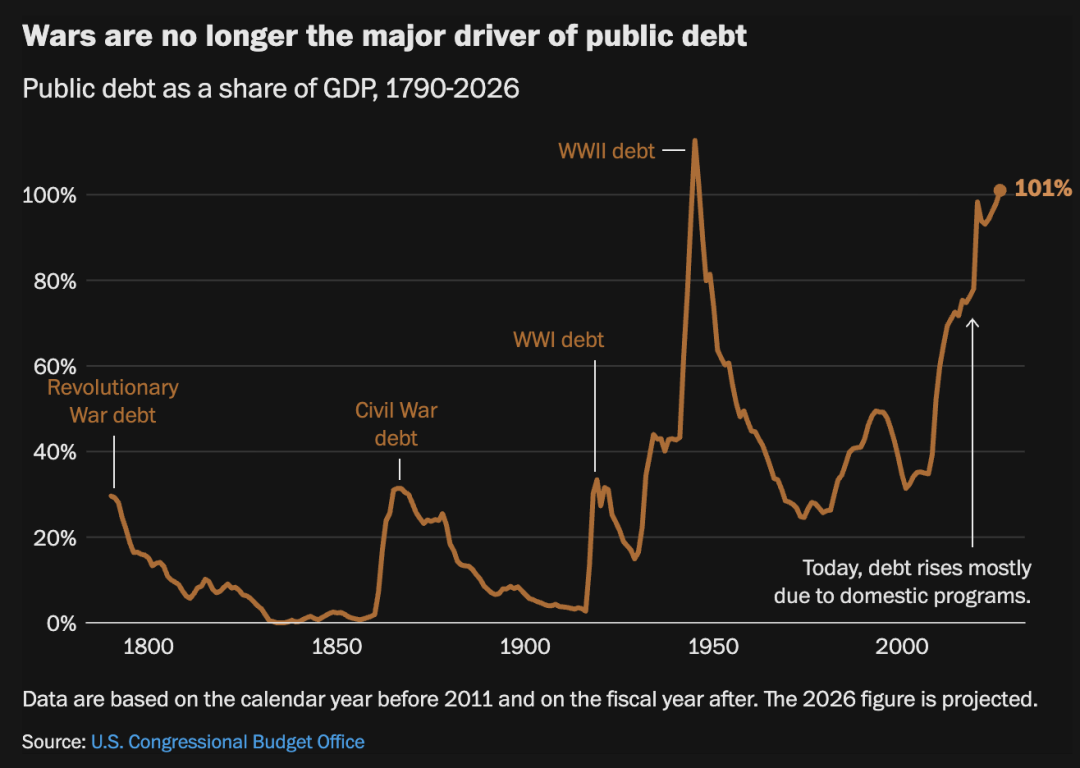
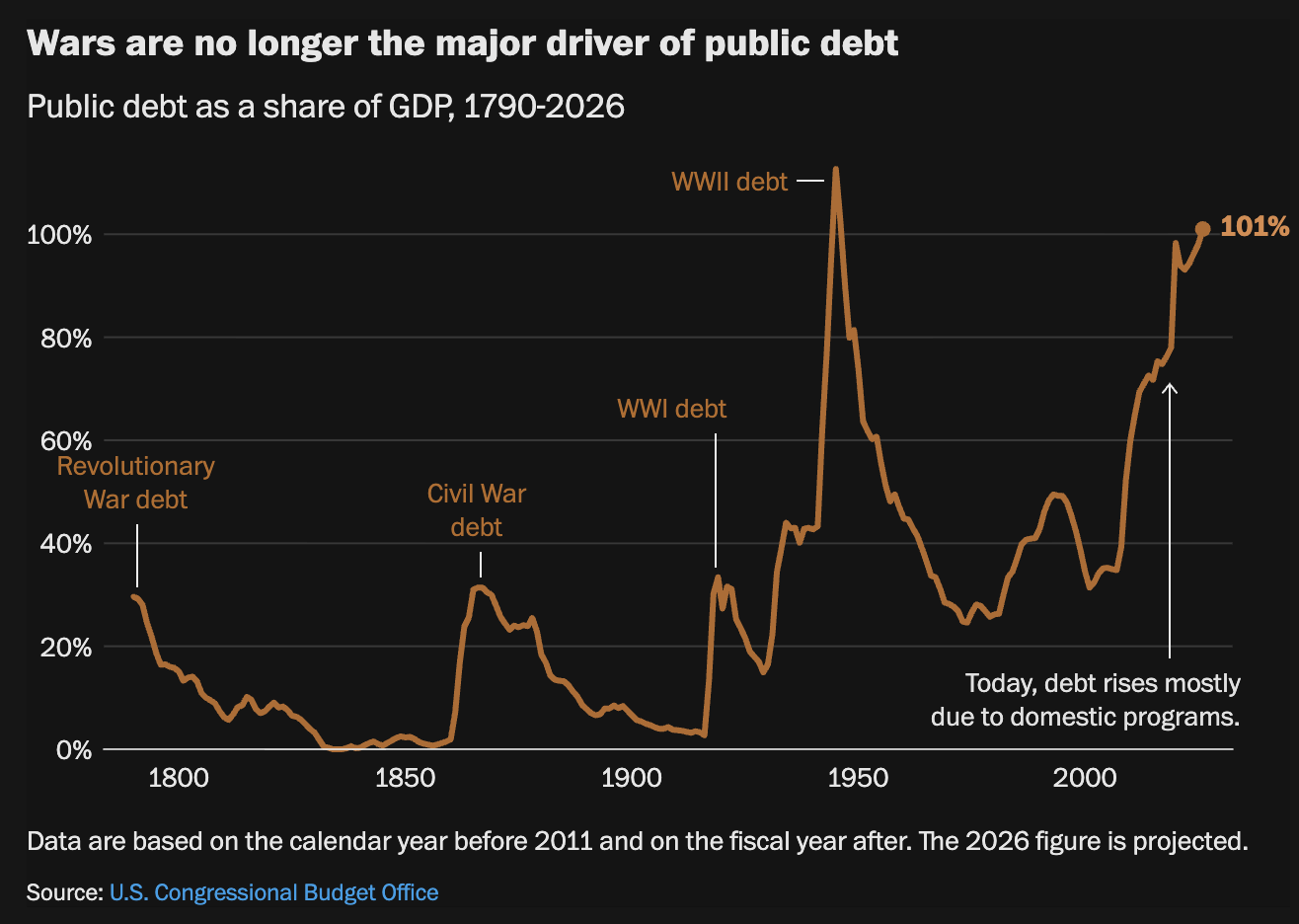
"Have I missed the mark, or, like true archer, do I strike my quarry? Or am I prophet of lies, a babbler from door to door?" - Cassaandra, from Aeschylus’s, Agamemnon Sometimes, WaPo puts something out that makes you realize that, in spite of all its sub-optimal performance as the DC town paper, there is still a lot of talent there. Case in point, in Monday’s opinion section, The U.S. cannot afford a major war. What if one comes anyway? For a whole host of reasons, I read it and thought, “Damn. This is good.” First of all, let’s set the table. In 2026, we are in a much better place than we would have been otherwise for the next big war for two reasons. Both have bought us time insofar as keeping the defense budgets well defended. First: If it were not for the wake-up calls—especially from our allies—of the Russo-Ukrainian War and the ongoing battles with Iran and her proxies following Hamas’s invasion of Israel in OCT 2023, the gravity weighing down on defense budgets across the West, including the U.S., would be catastrophic right now. There simply would not be enough news above-the-fold that would pull fence-sitters over to the military budget support side of the argument. Second: Say what you will about President Trump’s administration, but should either Hillary Clinton have won in 2016 or Kamala Harris in 2024, defense budgets would be smaller for the U.S. and our traditional allies. Our defense industrial base would be even thinner. I’m sorry, but it is simply true. Be happy or be upset, but these were the choices we were given. It was a binary path through the brambles. I’ve tried various scales and measures and am at peace. Even with Donald Trump in charge and (R) holding the House and Senate, I hope everyone has a firm grasp on exactly what our defense budgets look like, where the trends are, and the constraints and restraints going forward. Even today, it isn’t as huge as you think. In some ways, these are the salad days. With that done, let’s dive into the opinion piece. Old-Line members of the Front Porch will see a lot there that we have been discussing for a very long time. Yes, welcome to the party and all…but at last, more and more people are starting to see what we’ve been warning about. Once we’re through reviewing the WaPo opinion piece, I want to share with you a quote from the original post that coined the phrase, The Terrible 20s, at the OG CDR Salamander blog back in FEB 2010, and we’ve continued to visit now and then here on Substack. OK, here we go with WaPo Winning World War II was expensive, and in 1945, national defense spending made up 90 percent of federal outlays. During the Vietnam War, the level was between 35 percent and 50 percent. By 1999, after the Cold War ended and the peace dividend came, the portion for defense had dropped to 16 percent. Even the wars in Afghanistan and Iraq after the terror attacks of Sept. 11, 2001, barely pushed defense over 20 percent of federal spending. This year, defense accounts for 13 percent of federal outlays. The Congressional Budget Office projects that by 2035, it will fall to single digits. Beginning in 2032, more than half of all federal spending will go toward just Social Security and major health care programs. If you think the Boomers—the generation given so much going into adulthood and then leaving so little behind for their children—are going to sacrifice their old age comfort, you’re a fool. Look hard at that last graphic. We, literally, cannot afford to go to war. Of course, we may not have a choice, but what warping effects on our economy, government, politics, and civil society would be for the steps it would have to take to finance such a war? As I did in 2010, it might be helpful to look to the UK. Yes, she “won” WWII, but at the cost of financial implosion. She was lucky that she had a larger and healthier friend in the U.S. to help her through it (though some of that wealth was transferred from the UK during the war to pay for arms, see USS Louisville (CA 28)’s trip to South Africa in 1940), but the issue for the U.S. is that we don’t have a larger, richer, and helpful friend. We have us…and our smaller friends are in the same debt trap we are in, some worse. Everyone loves to show this pie chart: We do have a sizable defense budget as it is…but it isn’t what you think. At least the above pie chart isn’t in the WaPo article, but it is explained well. About 4 in 10 dollars of the Pentagon’s budget go to compensate military personnel or civilian employees. The only employer in the world larger than the U.S. military is the Indian military, and compensation costs for the U.S. military are nearly four times greater than India’s entire defense budget. Military pay raises are linked by law to average private-sector pay raises, meaning the Pentagon’s payroll costs grow at roughly the same rate as the overall economy’s. At this point, we should take our first look back at the introductory post to The Terrible 20s at the OG blog in FEB 2010: What else is happening in the 20s? Well, for one, we will have to find money to re-capitalized the SSBN fleet. I offer to you that the 20 JAN HASC SEF Subcommittee meeting has an outstanding money discussion about that challenge. Deputy SECNAV Work has also discussed this challenge in other venues, and I think he has a very firm grasp of the problem, as do most in positions to know. You have to look at it in the broader context of the budget as well. The hangover in the 20s from this decade’s drunken frenzy of spending will couple with another cohort of Baby Boomers retiring and putting stress on the budget in ways we still do not have a firm grasp on. As I am Navy, I was very focused on the SSBN issue, one part of our strategic Triad. It is also the most survivable. Due to inertia and the worst kind of politics, I don’t see a critical mass to give a fresh look at the use of the Triad in the 21st century. Back in the summer of 2025, I staked out my position on the Triad—specifically the idea of letting the ICBM go the way of horse cavalry. That isn’t going to happen, because the nuclear autists are still selling—successfully—such expensive theory-totems as SLCM-N. If they are finding buyers for that snake oil, there is no way you can sell letting the ICBM go away. It is all madness. Our strategic forces are an antique road show being held together with hope and unimaginable sums of money. At least an SSBN can be turned into a SSGN and a bomber can do conventional work…but ICBMs? The only use they have is as a bomb sponge that forces other nations to expend a lot of their money to counter-target. All three legs of the nuclear triad (bombers, submarines and land-based missiles) rely on decades-old technology. The Iran conflict has shown that the Army, Navy and Air Force are all stretched thin. Modernization efforts are already partially underway, and they will extend into the 2030s and beyond. Sixteen years ago, it was dawning that the requirement to recapitalize the SSBN fleet—and its opportunity cost—would have a cascade effect in the crisis of the third decade of the 21st century, The Terrible 20s. I didn’t even think to factor in the other two legs of our geriatric Triad. Like human demographics, military equipment is subject to Father Time and simple math. Without proper long-term stewardship across decades, eventually conditions are set that at some point the music will stop and it won’t just be one fewer chair than people needing them, but multiple chairs. The story is not much better for much of our military from destroyers at sea to refueling tankers on the tarmac. The CBO projects that the defense budget will grow slower than the economy over the next decade, meaning it will pull the projected total debt-to-GDP ratio down. Of course, those are baseline projections that assume no wars happen and don’t include proposals such as President Donald Trump’s desired $1.5 trillion annual defense budget. For perspective, the $13 billion price tag on a Gerald R. Ford-class aircraft carrier equals about three days of Social Security spending. All purchases of guns up to 30mm caliber across all military branches in 2025 cost about $650 million, less than four hours of Social Security spending. The projected all-in cost of buying, operating, maintaining, upgrading and fueling the notoriously expensive F-35 program over its entire 94-year lifecycle is less than last year’s spending of $2.3 trillion on Medicaid and Social Security. Defending the country is Washington’s most fundamental responsibility. Governments are expected to take on debt in wartime and pay it down in peacetime. Stretching the market for government debt to the limit in peacetime is a dereliction of duty and, ultimately, a danger to national defense. The longer our political class waits to act, the worse the problem will be and the harsher the needed remedy will be. I’m not talking about getting a significantly larger defense budget, we are close to maxed out right now as a % of GDP. No, how do you dig out of this? That is a headwind that has no natural, structural factor that will fix itself. It is not sustainable. We have, by hook or by crook, intentionally or unintentionally, backed ourselves into a Cloward-Piven’s plan. The only question is one of time and intensity—and the direction that follows. Will the American people vote for people who will both understand and act on this early enough to avoid the worst outcome? Have they for decades? This is why I will listen to—but have not been convinced by—the argument that we can “just get by”, especially when it comes to how we capitalize our national defense. Is 3% of GDP the high water mark? I think it is best to plan as if it is. With that, decisions need to be made to maximize our ability to protect our national interests without the assumption that there are unending streams of money available on call. There isn’t. In a later article at the OG Blog in DEC 2010, I outlined in detail Plan Salamander for how our military should be structured. Focus majority of expeditionary and first reaction ground forces to Marine Corps as is fitting for a Maritime Power. Heavy, big, fat, and mean on the ground will mostly be in the Army Reserve and National Guard. Have substantial logistics, replenishment, and strategic sea and air lift in the Navy and Air Force reserve. Space, Air, and Sea should be our first and most capable assets. Light, quick, and deadly on first-responder ground forces with a bias towards consequence management and punitive expeditions as needed - a holding force until relieved as required. We have to make decisions. We have to make choices. We have to decide where to take risk. The above was 17 years ago, just four months ago, I restated it on the UNCLAS Read Board Podcast. Consistency and persistence. You know one of my favorite sayings: “Just when you get sick of telling people things, that is when they start to actually listen.” I am not the only person who saw the problem and offered solutions; it is just that we have not yet won the argument, or we have not yet reached the point at which the imperial “we” have run out of options. Now for the extended quote I promised above from FEB 2010 that described and coined The Terrible 20s. It holds up well. What else is happening in the 20s? Well, for one, we will have to find money to re-capitalized the SSBN fleet. I offer to you that the 20 JAN HASC SEF Subcommittee meeting has an outstanding money discussion about that challenge. Deputy SECNAV Work has also discussed this challenge in other venues, and I think he has a very firm grasp of the problem, as do most in positions to know. You have to look at it in the broader context of the budget as well. The hangover in the 20s from this decade’s drunken frenzy of spending will couple with another cohort of Baby Boomers retiring and putting stress on the budget in ways we still do not have a firm grasp on. In 2020 - that ship built in 1990 will be at 30 years. That LCS built in 2009 will only have 9 years or so of service life (LCS is expected to only last 20-25 years) - so by the end of the 2020s, LCS will be dropping like flies. When you consider that we will be limited this decade to LCS and DDG-51 for our non-amphib surface ship program (don’t throw JHSV at me, that is just a truck - full stop - all else is spin and hope) - you have about a perfect story for the 20s of limited shipbuilding funds and a stunted fleet. Stunted? If you continue to assume that CG(X) is dead, then you might get funding for the much needed DDG(X) follow-on for the DDG-51 class - might. That will be requested in light of the SSBN money sponge - and I don’t see how with all the other needs in the 20’s, we will be able to afford both a DDG(X) and a CG(X) - and there is a good chance that we will simply have to live with DDG-51 Flight III as our “new” platform through the beginning of the mid-21st Century. I know that looking into the future is a fuzzy hobby. Heck, if you outlined in 2000 where we were in 2010 people would have said you were a nutty pessimist - so we can only see 2020 in very large, fuzzy pixels. The beginning of the mid-century (2030) is just a silly exercise in many ways - but one that needs to be done. There are known-knowns (DDG-1000 will be a rump, expensive class of ships, Ticos history, DDG-51 backbone, LCS decomm’n like flies), known-unknowns (will LCS even meet some of its promised ability and numbers, will DDG(X) be moving forward), and unknown-unknowns (Black Swan events), but still - 2020 is closer than we think, and there are economic facts that need to be looked at. Huge challenge, one whose source is the lost decade we just came out of. You know, that “transformational” decade. The one that was to build the Fleet of the future. Well, it sure did, didn’t it? Enjoy the music while it is still playing. Act now to protect yourself and your family, as there will be no bailout. h/t Mackenzie EaglenLeave a comment Share This Substack is reader-supported. To receive new posts and support my work, consider becoming a free or paid subscriber. View the full article