All Activity
- Today
-
thrawn joined the community
-
A Finnish defense communications company has secured a place on the United Kingdom’s largest tactical communications procurement framework, gaining access to a purchasing vehicle valued at approximately $10.5 billion that will govern how British armed forces buy military radio and communications systems for the next eight years. KNL, a defense communications subsidiary of Telenor Group, […]View the full article
-
Polish, Lithuanian, and French troops are conducting a large-scale military exercise in northeastern Poland focused on defending one of NATO’s most vulnerable geographic chokepoints, deploying unmanned ground robots alongside tanks, artillery, and infantry fighting vehicles in scenarios designed to test whether allied forces can hold a 65-kilometer (40-mile) land corridor that military planners have identified […]View the full article
-
Britain has delivered its 100th Boxer armored infantry vehicle to the British Army, hitting a landmark production milestone for one of the most significant land warfare modernization programs in the country’s recent defense history, with all vehicles built at two manufacturing facilities on British soil. The 100th Boxer Mechanised Infantry Vehicle rolled off the production […]View the full article
-
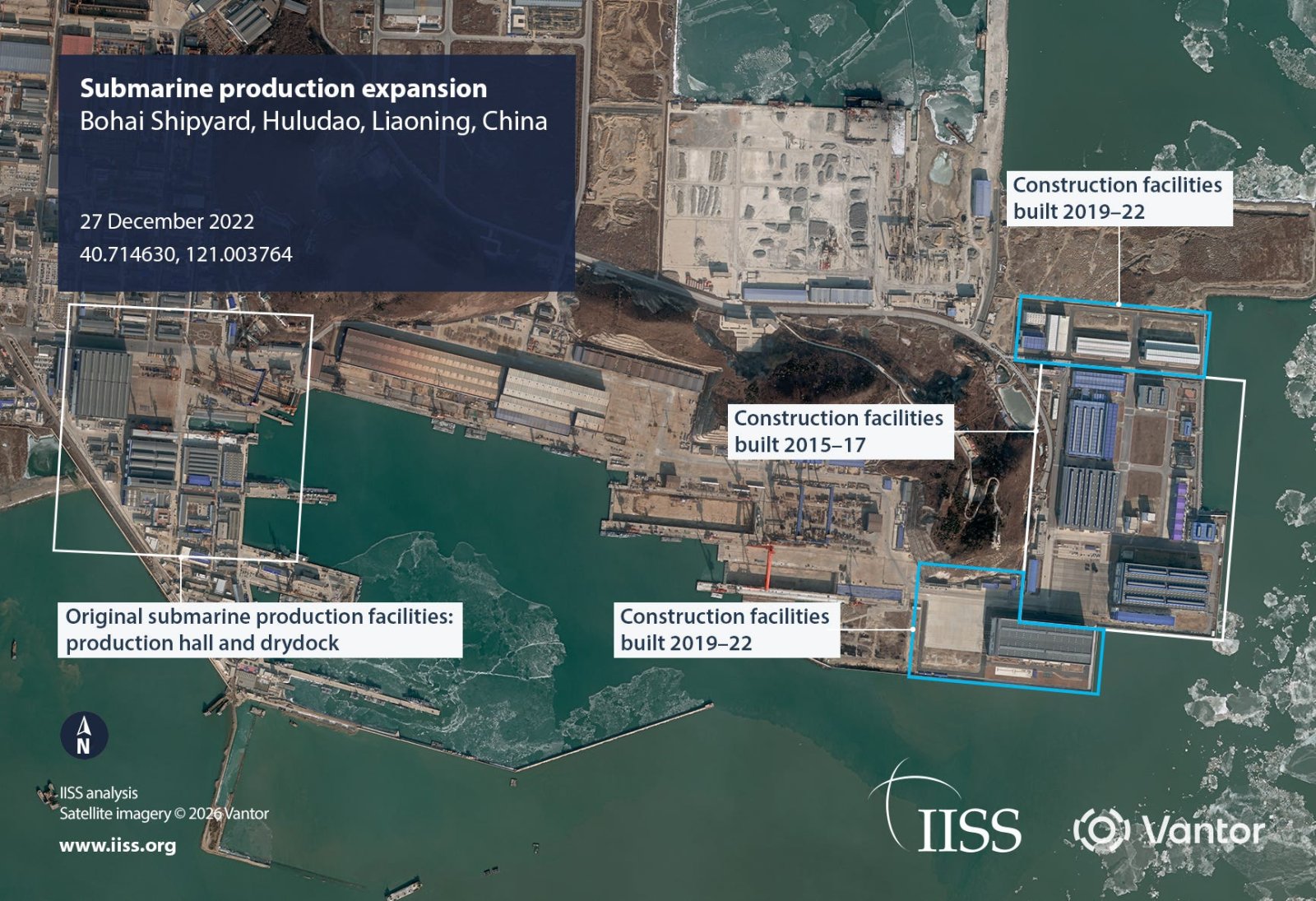
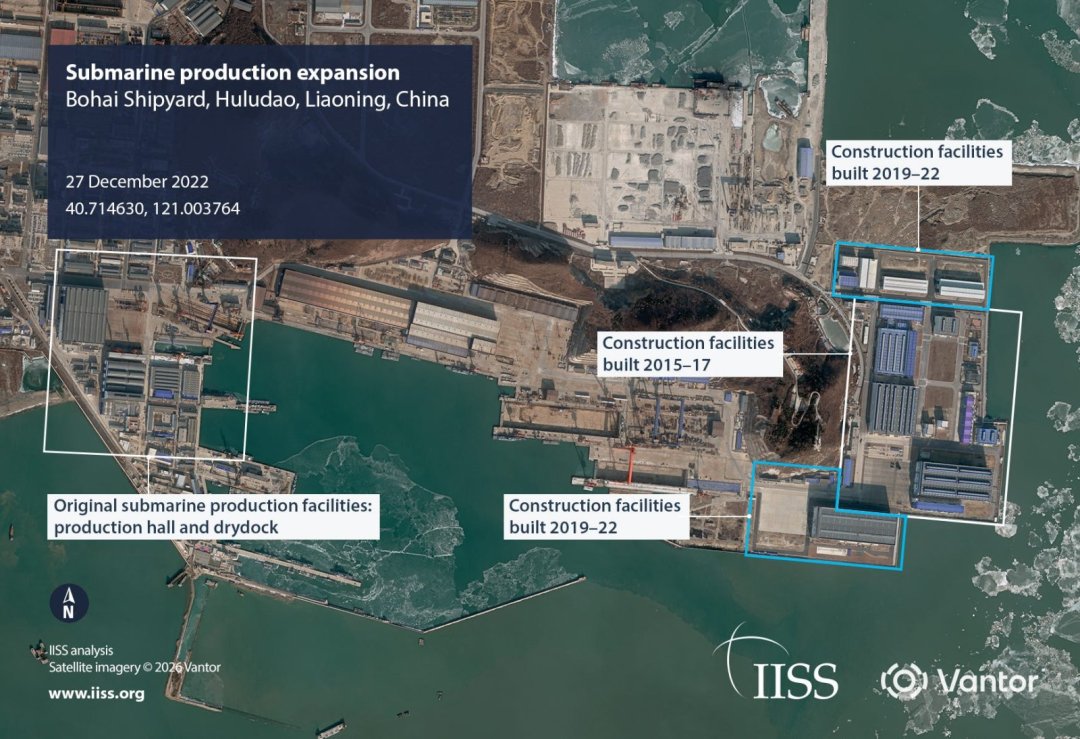
The Chinese are not playing games. Great graphic by HI Sutton over at Naval News on the state of play in the submarine world. Wake up everyone. Conventional non-nuclear submarines remain a key pillar of China’s submarine force, but the focus is changing to nuclear boats. Until very recently the sole shipyard building nuclear submarines was at Huludao in the north of the country. Now two shipyards on the Yangtze River, the Wuchang shipyard in Wuhan and the JN yard in Shanghai, have joined. Wuchang appears likely to focus on the Type-041 Zhou class ‘mini-nuke’ while JN has begun construction of much larger boats. The first nuclear powered boat launched at JN was a new class of attack submarine, known for its very small fin (sail), which is as-yet unnamed. An identical submarine was launched in Huludao just days apart. Exact details of the new class, and how it relates to the also new Type-095 have yet to emerge. Given the three yards now building nuclear submarines, the focus of construction is expected to shift to nuclear boats. China can already launch several each year, which a reasonable estimate now increasing to around six per year. This is triple the rate the United States is aiming for. At the same time, China’s yards in the south of the country seem focused on uncrewed submarines. Although conventional submarines will remain a major force component for at least a decade, they are likely to become smaller and less emphasised part, displaced by more nukes at the top end and large uncrewed platforms at the lower end of their remit. One little detail that keeps bugging me a bit. When you combine known phenomena, with the rapidly expanding capabilities of quantum computing and … he11 … quantum sensing…we may wake up sometime soon and have to completely rethink undersea warfare. As expected, Brent is feeling the same thing. Our SSN cannot/will not be able to do the job all by themselves. Air and surface ASW will have to be ready to play when the whistle goes. If we think, like we do with MIW, that our allied nations can step in to help in warfare areas we’ve neglected, we’re fooling ourselves. Allies are nice, but as the recent Iranian conflict proved…they have agency and may not be where you want them, when you want them, with the kit you need. As a side note: a lot of people have, rightfully, been concerned about our missile inventory. Last year I had a chance to speak to an officer of one of our NATO allies who works in the ASW world. I have an inkling about how many days of ASW weapons we have ourselves in a contested environment (using Royal Navy expenditures on false contacts etc during the Falklands Conflict), and I won’t comment further on this net on that topic, but if we are going to rely on our NATO allies in a pinch, we are deluding ourselves. Let me just say, it may have ASW LWT launch capabilities, but that does not mean it carries them, or may even have some on the base they are flying out of. When some say, “Well, we have some depth charges…” they are not making a joke. That being said…well…best not discussed on this net…as with most things ASW. In closed hearings and in the SCIF, people need to be asking hard questions in this warfare area. The PRC is going to contest it—their build rate makes that clear. Leave a comment Share This Substack is reader-supported. To receive new posts and support my work, consider becoming a free or paid subscriber. View the full article
-
Ukrainian forces destroyed three Russian explosive drone boats attempting to attack the Ukrainian coastline in the early hours of June 23, with Bayraktar TB2 combat drones delivering the strikes that sank the uncrewed vessels at sea, marking one of the relatively rare instances in the current phase of the war where the Turkish-built aircraft have […]View the full article
-
Türkiye has quietly expanded its arsenal of domestically produced ballistic missiles, with the country’s Ministry of National Defense confirming that ROKETSAN has delivered additional TAYFUN Block-2 missiles to the Turkish Armed Forces, continuing a delivery program that has now seen at least two confirmed batches reach military hands within consecutive months. The Turkish Ministry of […]View the full article
-
The U.S. government has awarded Lockheed Martin a $35 billion contract to quadruple production of the Terminal High Altitude Area Defense interceptor, the missile system that forms one of America’s most critical layers of protection against ballistic missile attack, committing to a seven-year procurement that represents one of the largest missile defense contracts in American […]View the full article
-
prsilo joined the community
-
Lockheed Martin has unveiled a new hypersonic glide body designed from the ground up to be manufactured cheaply and at scale, announcing a weapon it calls the Next Generation Glide Body that promises greater range and speed than existing American hypersonic designs while costing significantly less per unit to produce. The announcement, made June 24, […]View the full article
-
The U.S. Army has awarded Northrop Grumman a five-year contract to produce the M1147 Advanced Multi-Purpose round, a single 120 mm (4.7 in) tank cartridge that replaces four separate legacy munitions carried by M1 Abrams crews and gives tank commanders the ability to switch between three different detonation modes depending on what they are shooting […]View the full article
-
A Lithuanian drone company has unveiled a purpose-built interceptor designed to destroy Shahed-class attack drones in flight, adding a new kinetic counter-drone weapon to the growing arsenal of small nations that have turned four years of front-line experience in Ukraine into exportable defense technology. Granta Autonomy announced the Black Wasp on June 24, 2026, describing […]View the full article
- Yesterday
-
The U.S. Air Force has awarded a $12 million contract to Zone 5 Technologies to advance manufacturing technology for the Rusty Dagger program, a fast-moving effort to produce affordable, mass-scale long-range strike missiles that has moved from program launch to potential combat employment in roughly two years. The contract, awarded June 18, 2026, by the […]View the full article
-
The U.S. Marine Corps has placed its first order under a new vehicle contract with Polaris Government and Defense, buying more than 70 MRZR Alpha ultra-light tactical vehicles along with a suite of mission-specific accessories, with more than half of the vehicles configured to export 5 kilowatts of electrical power directly from the vehicle itself. […]View the full article
-
I don’t know about you, but I really want to hear your garden-variety journalist read this from the teleprompter. Türkiye will host a NATO Summit in Ankara on 7- 8 July 2026. The meeting will be chaired by the NATO Secretary General and will take place at the Beştepe Presidential Compound (T.C. Cumhurbaşkanlığı Külliyesi) in Ankara, Türkiye. As we stand by for the summit, I am going to watch who writes “Turkey” like a proper English speaker, or “Türkiye” like a compromised low-T drone scared of its shadow. OK, enough of me being unserious and petty. Let’s dive into the important things. If you don’t have a NATO background, you might not be anticipating much, but that would be a mistake. Big changes can come out of these things. NATO summit meetings are effectively meetings of the North Atlantic Council (NAC) – the Alliance’s principal political decision-making body – at its highest level, that of Heads of State and Government. Due to the political significance of summit meetings, agenda items typically address issues of overarching political or strategic importance. Items can relate to the internal functioning of the Alliance as well as NATO’s relations with external partners. Major decisions Many of NATO’s summit meetings were milestones in the evolution of the Alliance. For instance, the first post-Cold War summit was held in London, in 1990, and outlined proposals for developing relations with Central and Eastern European countries. A year later, in Rome, NATO Heads of State and Government published a Strategic Concept that reflected the new security environment. This was the first time ever that a NATO Strategic Concept was issued as a public document. At the same summit, NATO established the North Atlantic Cooperation Council – a forum that officially brought together NATO and partner countries from Europe, Central Asia and the Caucasus. If you want to know why all the NATO organs continue to not understand the below: You have to understand that it came out of the 360 Degree Approach, a sloppy compromise from the 2016 Warsaw and 2022 Madrid summits as a sop to NATO’s southern-tier members. Pay attention. Most times, the agenda is set well ahead of the summit and the decisions are already set before everyone shows up…but these are exceptional times. There might be a surprise. If you want to see if anything is leaking out ahead of time, you need to look at traditional Atlanticist institutions to see what they’re saying. Let’s pick a couple, starting with the Center for Strategic and International Studies (CSIS), who, to their great credit, use “Turkey.” Allies will gather in Ankara, Turkey, this July at a critical moment. NATO faces a war in Europe, renewed instability in the Middle East, and growing internal tension over priorities, burdens, and risk. NATO has endured disputes before, but a lack of unity—if left unmanaged—can weaken deterrence as effectively as military shortfalls. As Wallace Thies suggests, crisis begins when members become indifferent to sustaining the alliance. By that definition, NATO is under strain—but not yet in crisis—despite reporting that the United States will reassess the value of NATO after its war with Iran. In a more contested international order, the benefits to the United States of remaining in NATO continue to outweigh the costs, particularly as Europe is stepping up to deliver what U.S. officials have termed “NATO 3.0”—a more European NATO in which allies assume greater responsibility for their own defense. The question, therefore, is not whether NATO should endure, but how it should adapt. A modern update to Ismay’s dictum would be for NATO to keep the Americans committed, the Europeans capable, and the Russians contained. That, my friends, is an almost perfect pair of paragraphs. From Washington’s perspective, the argument is familiar: Europe benefits from global stability underwritten by U.S. power and should shoulder more of the burden when that stability is threatened. President Trump has criticized Europe by suggesting the continent was absent when it mattered, and that it does not truly share the sacrifice. Europeans will push back: Tens of thousands of European troops served in Afghanistan over two decades, hundreds died, and the commitment was sustained long after public support had eroded at home. This complicates the free‑rider narrative and risks undermining cooperation. From Europe, the picture looks different. The Iran campaign was launched without allied consultation, rests on contested legal and strategic grounds, and risks diverting attention and resources away from Ukraine. For European leaders already engaged in a difficult domestic debate over sustained defense spending, another major Middle Eastern war is a significant political complication—not a rallying point. That is a fair enough description of the state of play between alliance friends. Over the last two years, all but a couple have made the push to significantly increase defense spending. BZ to them, and the end of the quote above is correct. Some nations will not push more, as their political system won’t make the effort. On the whole though you have to give a thumbs up, progress has been made. This is a good time to jump ahead to a superior product by the Atlantic Council. They have a NATO Defense Spending Tracker that has a couple of new graphics describing allied spending different than the usual bar graph I’ve been referencing over the years. I’ll show you what I mean. Old Line members of the Front Porch have gotten used to the usual pushback we’ve received for the last couple of decades about why 2% of GDP was not “fair”, or that it wasn’t a “nuanced” understanding, small nations blah, blah, blah. My first retort has always been that with friends and neighbors, when work needs to be done that benefits all, everyone is expected to do their fair share. No one expects the 5’2” single mother on public assistance to underwrite lunch for everyone, but if she brings a squash casserole, everyone will be thankful. The beefy guys would never expect her to help move logs, but they’ll be happy to get the other big fellows to help with that. What no one wants, is to deal with the trust fund baby sitting on a chair in the shade, having a smoke while everyone works. The below does a good job in showing who is contributing their fair share—from the stingy on the bottom right, to the best effort in the upper left-hand corner. Our alliance has rich members and poor members. The next graphic isn’t fair in that regard, and I like it the least, but it tells a story. Also, the U.S. defense budget is not too big. Nope. We need to up these numbers. We have more military obligations than many of these European nations. When looked at from that perspective, we are seriously underspending. The UK and Canada underperform here. It also shows that as Poland becomes a richer nation, their relative contribution to collective defense just gets more worthy of notice. Still not sure how to fully absorb this graphic, but it is growing on me. This next graphic can be tricky. It is really two, combined. The two big circles are simply U.S. spending, and then non-U.S. NATO spending…then it is disaggregated. I have one nit to pick. Turkey is not a European nation. It has a little bit of European territory, but it is not an European nation. As such, they should not be included in the “NATO Europe & Canada” bubble…and TBQH, Canada should not be in there either. Of note: European NATO has both a larger population and GDP than the USA. Yeah…that aggregation bubble is trying too hard. Editorial Note: The Atlantic Council is using the correct spelling, “Turkey”, in the text, but is using the incorrect “Türkiye” in the graphic. There are no umlauts in English. Do better. Net one below. There is a similar problem the following graphic. It is too much cope, and trying too hard to make an anti-American point. The EU Institutions contributions should not even be factored in here. The EU is not interchangeable with European NATO, we might as well add the Organization of American States to the U.S. numbers. Disaggregate European NATO contributions to the EU effort and then add that into national totals, that’s fine…unless they are double counting here, which they might be. Net two below. If we want to discuss relative Ukraine contributions, this is a much better graphic. Italy and Spain…really? The UK gives less per person that the U.S.? Well, they are poorer on a per-capita GDP basis as the poorest U.S. state, so that may put them on par. Denmark deserves polite applause. If Germany did that…well… Anyway, we drifted a bit from the summit, but I think this will all be floating in the ether next month at Ankara. Let’s see what others are thinking. I was going to use the Council on Foreign Relations as my next check, but alas…there is 0.0 mentions of NATO on their main page. The Usual Suspects™ think America is neglecting NATO… So, instead, we’ll check back in with the highly civilized Atlantic Council’s article from Tuesday by Jason Davidson. It is the freshest of a series. Recent years have seen a whipsaw of NATO engagement with its neighbors to the south. After pressure from Italy and other allies on the Alliance’s southern flank, NATO agreed to the Southern Neighborhood Action Plan (SNAP) at the 2024 Washington summit. At the 2025 Hague summit, however, NATO adopted no significant new measures in this area. The upcoming Ankara summit is the perfect occasion for NATO to deepen engagement with its southern neighborhood in a more consistent way going forward. … The communiqué after NATO’s 2023 Vilnius summit defined its southern neighborhood as the Middle East, North Africa, and the Sahel region. The allies agreed on the neighborhood’s “security, demographic, economic, and political challenges” and that those challenges provided a fertile environment for terrorism and an opportunity for interference by strategic competitors (Russia and China) and resulted in human trafficking and irregular migration. A NATO expert group report on the southern neighborhood the following year concluded that “threats, challenges and opportunities in NATO’s southern neighborhoods matter to Allied security and to NATO partners.” Look no further than the Iran war this year to see a vivid illustration of the importance of the region to NATO allies’ security. In March, NATO-designated air defense systems intercepted several ballistic missiles in Turkish airspace that Turkish officials claimed originated in Iran. One of the missiles caused an explosion near Incirlik Air Base. The same month, drones from Lebanon—believed to have been launched by Hezbollah—attacked a British air base on the island of Cyprus. At first, I squinted a bit at this take, but then it hit me spot on—the Iran and Strait of Hormuz issue may well dominate the summit. …the Alliance should provide enhanced and integrated air-defense and counter-drone capabilities for allies on the southern flank. The previously discussed missile attacks on Turkey and the British base in Cyprus demonstrate the vulnerability of southern allies. The Alliance can use Operation Eastern Sentry, begun in response to Russian drone incursions along NATO’s eastern flank, as a model for how to bolster the deterrence and defense of vulnerable allies to drone and missile attacks. Moreover, as southern allies move toward meeting their commitment to spend 3.5 percent of their gross domestic product on defense, they can devote some of those resources toward air-defense and counter-drone measures, which will also help them justify that increased spending to their publics. If, as it appears, the Islamic Republic of Iran isn’t going anywhere, the investment in air defense is a wise proposal. As we’ve discussed here the last few months, the primary thing accomplished by the U.S. and Israeli strikes this year is to buy the international community time. Political will can change quickly in the U.S., and there is a good chance that in five to ten years’ time, those in power in Washington DC will not have the desire, inclination, or even capability to buy the international community more time after Iran rebuilds its ballistic missile and nuclear programs. The U.S. may not decide to “mow the lawn” again. Add to that the non-zero possibility that it might be engaged in a Great Pacific War with the People’s Republic of China…that would put European concerns on par with the priority given to the Burma Theater in WWII. The 2026 National Defense Strategy states “we will be clear with our European allies that their efforts and resources are best focused on Europe.” The document argues that given increasing US focus on the Indo-Pacific and Western Hemisphere, European allies can make the greatest difference for transatlantic security in Europe. There are reasons for optimism regarding the United States’ position on NATO’s engagement with its southern neighborhood, however. First, it would be fair to read the National Defense Strategy’s language as a reaction to European efforts to bolster security in the Indo-Pacific, which is a greater challenge for them geographically than engagement with the southern neighborhood. Second, the measures described above are relatively low-cost and mostly entail enhancements of activities NATO is already engaged in. Moreover, NATO’s efforts in the southern neighborhood could enhance allies’ security without taking away from European efforts to deter Russian aggression in the East. Solid analysis. That is enough for now. If you want more reading, especially on the view from Anatolia as the summit gets ready, I’d recommend giving this article by Ali Mammadov at the Modern War Institute a read. And if you’re looking for a nice giggle, give a read Deutsche Welle’s take on Turkey’s crack-down on Islamists and commies prior to the summit…and along the same vein, the socialist bedwetting over the same thing. Leave a comment Share This Substack is reader-supported. To receive new posts and support my work, consider becoming a free or paid subscriber. View the full article

-
The U.S. Army has committed $8.4 billion to expand production of its next-generation Precision Strike Missile, awarding Lockheed Martin one of the largest ground-launched missile contracts in years and locking in a manufacturing pipeline that runs through the end of fiscal year 2032. The modification, signed June 23, 2026, expands an existing contract with Lockheed […]View the full article
-
Poland has ordered nearly 46,000 of its domestically produced MSBS GROT assault rifles in the latest A3 configuration, signing a contract worth approximately $160 million with the state-owned manufacturer Fabryka Broni “Łucznik” Radom, with all deliveries scheduled for completion by the end of 2027. The contract, announced June 24, 2026, by Poland’s Armament Agency, the […]View the full article
-
A Ukrainian defense firm has developed a hand-launched reconnaissance drone capable of flying 150 km (93 miles) into enemy territory while resisting electronic jamming, with serial deliveries expected to begin this autumn, the Ukrainian defense outlet Militarny reported. The drone is called Sweetheart, and the company behind it is General Chereshnya, a Ukrainian developer whose […]View the full article
-
A Ukrainian air defense system built by the U.S. defense company Sierra Nevada Corporation was destroyed in Kharkiv region by a Russian first-person-view (FPV) drone operated by the “Sever” (North) assault grouping, marking what appears to be the first confirmed combat loss of the MAAWLR anti-drone missile launcher in the war. The MAAWLR, which stands […]View the full article
-
A Munich-based artificial intelligence startup called SE3 Labs stepped out of stealth mode on June 26, 2026, announcing that its spatial AI platform is already under contract with the German Bundeswehr and operational in military exercises across Europe, where the company says it has reduced the time between detecting a target and engaging it by […]View the full article
-
Two Norwegian companies have joined forces to put better magnetic technology into the hands of military boarding teams around the world, with Blumags and H. Henriksen AS announcing an exclusive supply agreement on June 23, 2026, that reshapes how corrosion-resistant tactical magnets reach the specialized operators who depend on them. Under the deal, Blumags becomes […]View the full article
-
Poland has signed a contract worth approximately $16 million to purchase American-made V-BAT vertical takeoff and landing drones for its Navy, with the deal set to be completed before the end of 2026, Defence24 reported. The agreement, confirmed by Poland’s Armament Agency, covers one full system set and several aerial platforms, making Poland one of […]View the full article
-
Ukraine has received a fresh batch of Canadian-built armored medical evacuation vehicles purchased through donations to the UNITED24 fundraising platform, with 13 INKAS Sentry AMEV units handed over to military medics operating on the front lines. The Sentry AMEV sits on a Ford F-550 Heavy Duty chassis and is built from the ground up for […]View the full article
- Last week
-
The experimental aircraft that could change how every future military jet is built just cleared another milestone, after Aurora Flight Sciences announced that the triangular wings for its X-65 demonstrator have arrived at its Virginia integration facility and are now being mated to the fuselage, bringing the program a significant step closer to a first […]View the full article
-
Estonia took delivery of its first medium-range air defense missile system on June 22, 2026, when the Estonian Air Defence Wing received the IRIS-T SLM at Ämari Air Base, giving a NATO member that shares a 294-kilometer (183-mile) border with Russia the ability to engage aircraft, cruise missiles, and helicopters at ranges and altitudes that […]View the full article
-
Dutch soldiers are training with anti-drone tunnels, the netted covered routes first developed by Ukrainian forces to shield vehicles from kamikaze drone strikes, after the Netherlands became one of the first NATO armies to integrate Ukrainian battlefield lessons directly into its largest military exercise in twenty years, Eindhovens Dagblad reported from the field in northern […]View the full article
-
If I am ever invited into someone’s personal study, office, or library—especially someone who puts themselves forward as a national security type—one of the things I not-so-subtly look for is maps, charts, or better yet, a globe. Yes, I will judge you. It matters. I have seen exceptionally credentialed and powerful uniformed and civilian leadership here and in Europe have an almost comical ignorance of the world in which they hold access to levers of almost unimaginable power. From a complete disinterest bordering on criminal unawareness of the bottom topography of the Baltic and Taiwan Strait, to not knowing where the Cape of Good Hope is, or even what a Great Circle Route is. That kind of ignorance gets people killed. They got their positions of power and influence for a whole host of reasons, but an understanding of geography and the ability to read a map was probably not one of them. This all goes back to not just an incomplete education—but an incuriosity of the fundamentals that makes me question completely anything these individuals have to say on any subject outside of the Coke v. Pepsi rivalry. Our regulars are probably tired of seeing me write, “Let’s go to the chartroom…”. It is more than a tagline. I mean it. You have to ground everything you do relative to the stage on which it is being presented. In the national security arena for a global power—it is the planet. But what representation are you using? What projection of that three dimensional object is informing your decisions? If someone says, “When you look at a map of the world…”, more likely than not, what will pop into your mind will be what is at the top of the post, the Mercator Projection. That may be one of the contributing factors to inadequate strategic thinking in the modern age. Of course, any attempt to represent a three-dimensional object on a two-dimensional format is going to create some problems. You need multiple perspectives, and often the one that best serves in helping you understand the challenge of the moment. As we continue to argue the point here, we don’t need a new force design, or national strategy, we need a national understanding. We need to understand the fact we are a maritime and aerospace power, and those are the two domains where the majority of fighting in any war against the People’s Republic of China is going to take place. It has a unique set of challenges that have nothing to do with politics, people, culture or anything from man; it has to do with the interface of land, water, time, and distance. As we learned and then forgot from WWII, any war in the far reaches of the Pacific requires range, scale, and the logistics system that appreciates both and can sustain the fight forward. Stop throwing spreadsheets and hundred-page think tank products at a leadership class that are more verbal and personable personality types than they are numbers and engineering thinkers. On top of that, they are busy. You need to catch their attention at the start and keep it long enough to give them the highlights of the Executive Summary. They like pictures…but you need the right pictures to make your point. I give you the Spilhaus Projection: In 1942 (Athelstan Frederick) Spilhaus tackled the problem of displaying the world's oceans in an unbroken view. He achieved this by carefully selecting antipodal points as the centers for two hemispheric projections.[12] However it wasn't until 1979 that he published maps using continental shorelines as "natural boundaries", including one that has become the typical example of Spilhaus's technique. It uses locations near Hankou in China and Córdoba in Argentina as poles with a cut joining them across the Bering Strait.[13] In 1991, Spilhaus published Atlas of the World illustrated with a large selection of maps having "geophysical boundaries", typically coastlines, in various orientations and for various purposes. He published several other papers and articles on the topic.[14] More recently, the Spilhaus Projection has been used to map multiple seafloor characteristics such as tectonic plate boundaries, hydrothermal vents, and drilling hole sites.[15] You can get a more full background here, but let’s discuss why this should be the map we should be pondering the most now. What are the top-5 even the novice should get? AUKUS is a must-succeed. Don’t balk. Don’t stutter. Don’t be difficult. Make it work. It reinforces our left flank. Australia and the Philippines are our shield and redoubt. Taiwan is the stopper that keeps the PRC relatively contained. If you lose that, Guam is your new front line. A strong Japan and South Korea must be made stronger and closer. They are our right flank. What does the PRC want? Once you accept that they want everything from the line drawn from Alaska to New Zealand to their coast under their uncontested control, but are more than happy to let us have everything on the other side, then you understand what they have been doing for decades in the small island nations in the Southwest Pacific. People grow up with maps that emphasize Europe and the North Atlantic. This projection breaks that mental fixation, putting Europe and the North Atlantic in a minor corner of the map, almost an afterthought that barely catches the eye. A slightly more recognizable version is below. Do you know that if you turn this into square tiles, they can all fit together in a repeating pattern? You can cover floors with it. It looks like this. When does the Secretary of War’s bathroom need to be retiled? h/t Simon KuenstenmacherLeave a comment Share This Substack is reader-supported. To receive new posts and support my work, consider becoming a free or paid subscriber. View the full article