All Activity
Past hour
-
Ukraine would do better buying Turkey’s Bayraktar Kızılelma unmanned fighter than Czech-made L-39NG jets, according to Taras Chmut, who heads Come Back Alive, one of Ukraine’s largest charities supplying the military. “I think it’s better for us to buy such aircraft than the L-39NG,” Chmut wrote in Ukrainian. He added a caveat. The Kızılelma “could […]View the full article
-
Troops from eight NATO countries, including Lithuania, staged a combat river crossing in Lithuania as part of the Freedom Shield 26-II exercise, the Lithuanian Defense Ministry said. The ministry announced the crossing on Friday. “Strong Eastern Flank defence means NATO ready to act together,” said Vice Minister of National Defence B. Bieliauskas. A combat river […]View the full article
-
Utah drone maker Vector has unveiled BOMBARD, a ground-launched one-way attack drone powered by a pulse jet that it says can fly up to 1,100 km (680 miles) and carry a 50 kg (110-pound) payload, the company said in a release on Thursday. Vector showed the weapon at the Axios Future of Defense Summit in […]View the full article
-
French Rafale jets from the unit that carries France’s nuclear weapons have trained alongside Swedish Gripen fighters for the first time, France’s military said. The exercise, called EXCALIBUR SWEDEN 2026, brought together the Strategic Air Forces and the Swedish Air Force, the French Armed Forces General Staff announced. It took place under what Paris and […]View the full article
Today
-
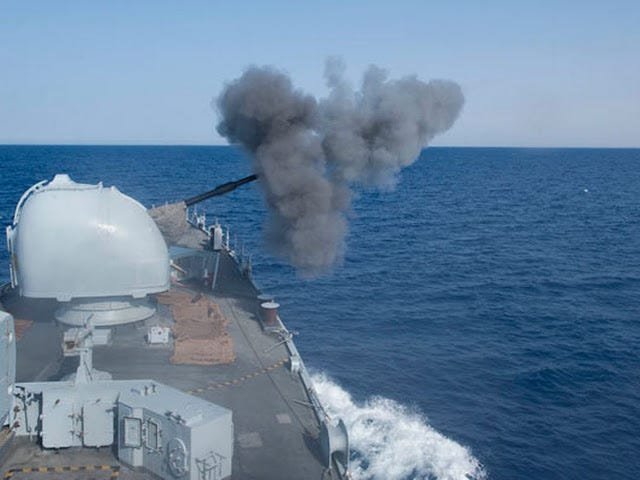
Commander Colin Williams said: ‘It was a good old fashioned ding-dong. The enemy fire was coming in pretty close. It was fairly close-range stuff but we’ve trained for this and we were ready to win the fight. Repeat after me: “There is no more important weapon on a warship than its main gun battery.” Translate that in to Latin and we’ll put it into Auto-Tune for ‘ya and make it a Gregorian Chant. Heck, we’ll put it on t-shirts and sell them. The Portsmouth-based destroyer was just six miles off the coast of Gaddafi-held territory when she came under a barrage of rockets and heavy calibre machine gunfire yesterday. But the Libyan forces were no match for her 4.5in gun, which silenced the attack within half an hour with no casualties or damage to the ship. ... Cdr Williams said: ‘We had a couple of contacts moving down the coast. The other two ships went in to investigate and we sent up our helicopter in support. ‘Then they started getting fired on by the vessels and from the shore and it all got a bit hairy from there.’ As her helicopter dodged gunfire, Liverpool fired an opening salvo and manoeuvred into position to take on the shore battalion. The captain said: ‘It took us about 20 or 30 minutes to bring it to an end. ... He revealed he was actually asleep when the attack began at 2am yesterday. He said: ‘I was woken as we prepared and it was very humbling to see my ship’s company working so calmly and quietly. Exactly. Though the shore-duty theorists, with their discredited but persistent transformationalist fetish, continue to ignore facts that interfere with their religion—history and reality, their worst enemies—they continue to tell us what you need to get right in your warships. This time it is Libya—and again—it is the Royal Navy (what is left of her) that tells us what we need to know. Other things to go with our chant: As Seaman Murphy gundecks PMS and his brother at the factory have quality-control issues—it is best a-la SPRUANCE and TICO to have two main batteries. Larger isn’t better; it is essential. Bean counters, men insecure about their manhood, and the non-battleminded like small-caliber weapons. Those who need to kill or be killed know that if a 3” will do, a 5” is needed. If a 5” will fit, an 8” should be there instead. If you think I am nuts, just ask a Marine. If you think he is nuts, tell him to his face, please. You will close the shore—you will be shot at - you will need to shoot back. Make sure those who have a comfortable commute and a comfortable home build you the ships you need—not the ones they think are neat. First posted, May 2011Leave a comment Share This Substack is reader-supported. To receive new posts and support my work, consider becoming a free or paid subscriber. View the full article
-
Leonardo DRS will develop a next-generation infrared sensor for the THAAD missile defense interceptor under a contract from BAE Systems, the company said in a release on Thursday. The part is a “next-generation infrared focal plane array,” the heat-sensing chip at the core of the interceptor’s seeker, which guides the missile to its target. Leonardo […]View the full article
-
The Louisiana Air National Guard has turned its 122d Air Support Operations Squadron, a unit that called in airstrikes for ground troops, into a cyber defense squadron, the Louisiana National Guard said this week. The unit was redesignated the 122d Cyberspace Operations Squadron at a ceremony at Jackson Barracks in New Orleans on Nov. 7. […]View the full article
-
The U.S. Army has tested Saronic’s Corsair uncrewed surface vessel (USV) as robotic patrol craft at its two main ammunition shipping ports, after the terminals asked for help with staff shortages and patrol boats that kept breaking down, the service said this week. Engineers from the Army’s DEVCOM Ground Vehicle Systems Center ran “multi-day evaluations” […]View the full article
-
BAE Systems has opened a new explosive filling plant at Glascoed in South Wales that it says will raise its capacity to make 155mm artillery shells sixteen-fold, the company said in a release on Friday. The company called the site the “first fully automated large calibre ammunition factory in the UK.” It’s part of a […]View the full article
Yesterday
-
As Air Force One carried President Donald Trump home from China on Thursday, flight trackers spotted a second, rarely discussed Boeing 747 crossing the Pacific south of Japan: the E-4B, known as the “doomsday plane.” Andrew Leyden, who tracks military flights on X, posted that “Air Force One and the two other 747 backup aircraft […]View the full article
-
A new medium tank with a 120 mm gun drove across rough ground and fired at targets in Slovakia on Thursday, the first time potential buyers had seen the CFL-120 Karpat in action, the Czechoslovak Group said. CSG showed the tank at the Záhorie Military Testing Area in western Slovakia, the company said in a […]View the full article
-
A French Army maintenance unit has started working with a ground robot built to carry equipment for soldiers, and the army says it went from request to field trials in just one year. The Army Technical Section, known by its French initials STAT, announced the trial. The machine, an unmanned ground vehicle, or UGV, was […]View the full article
-
Heckler & Koch’s British arm has pointed to the U.S. Marine Corps’ larger M27 rifle contract, together with French, German and Ukrainian use of the HK416 family, as proof of demand for its rifles across NATO, in a LinkedIn post this week. The company called the rise in the Marine Corps’ M27 contract ceiling, from […]View the full article
-
The U.S. Army wants companies to build 400 one-way attack drones that cost no more than $3,000 apiece, using motors, batteries and frames supplied by the government, as the first event of its new Manufacturing Rodeo, according to a solicitation from Army Contracting Command. Selected companies would also deliver 20 ground control stations, with everything […]View the full article
-
The French Navy now has three of its new Albatros sea-watching jets, after France’s defense procurement agency handed over the third one on Nov. 16. The agency, known as the DGA, announced the delivery on X on Thursday in a thread about the Falcon 2000 Albatros, a Dassault business jet rebuilt for maritime surveillance and […]View the full article
-
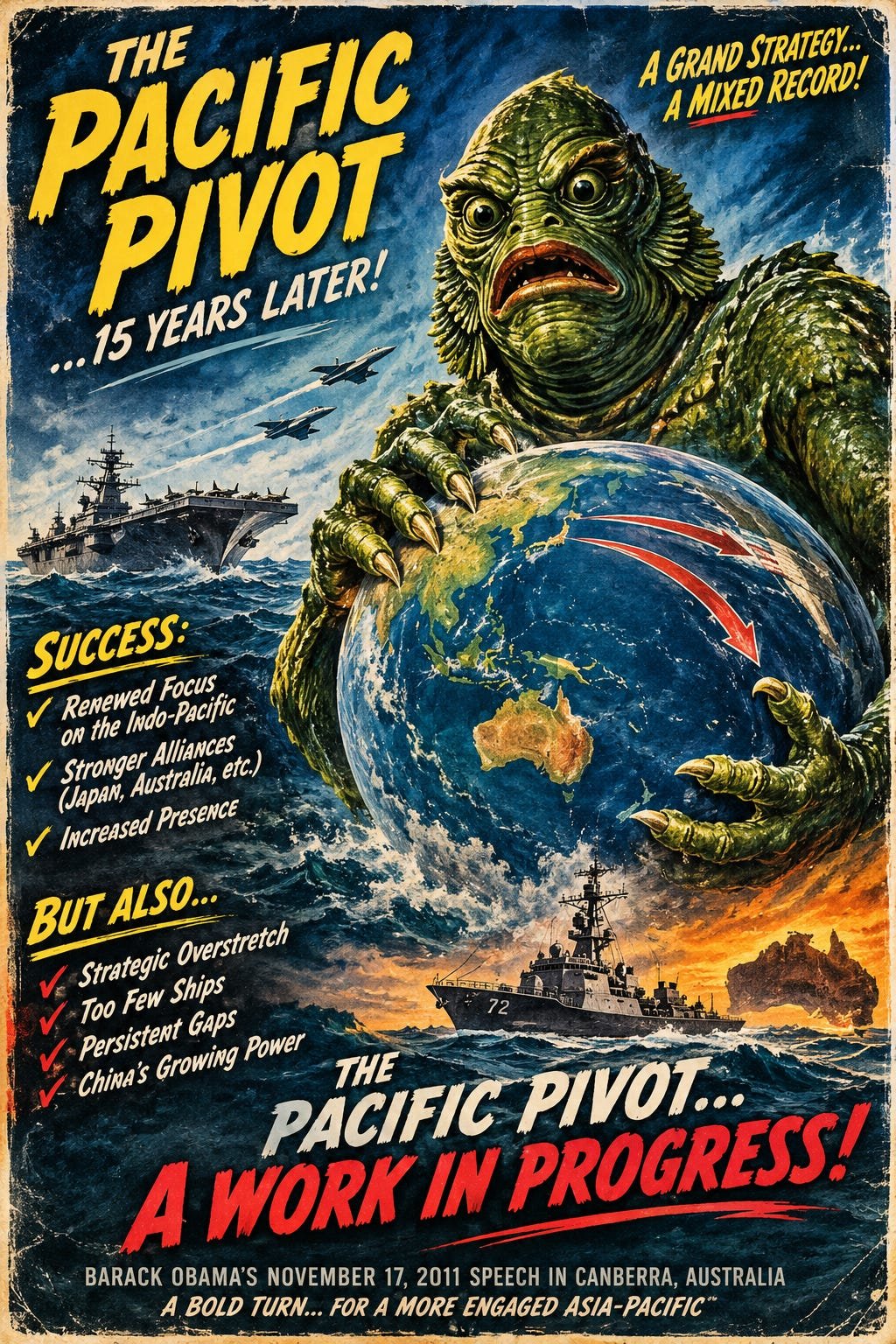
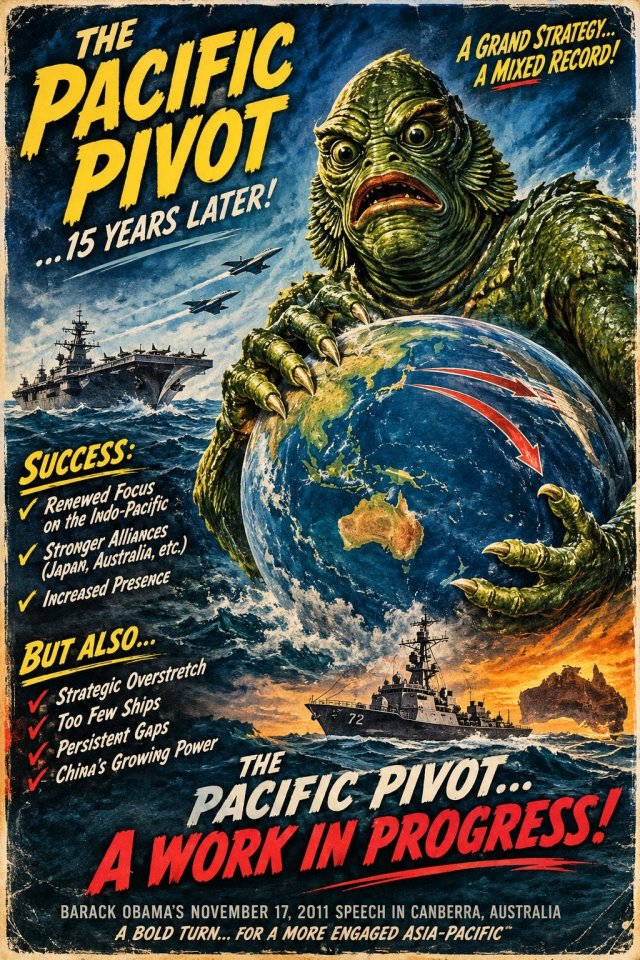
Earlier this week was the 15th anniversary of President Obama’s “Pacific Pivot” speech in Parliament House in Canberra, Australia on 17 November, 2011. I’ll post a video of the full speech at the bottom of today’s post. These four paragraphs are the most-quoted portion of the speech. Let’s read it, pick it apart a bit, and then get to the part of the speech I find the most interesting. So make no mistake, the tide of war is receding, and America is looking ahead to the future that we must build. From Europe to the Americas, we’ve strengthened alliances and partnerships. At home, we’re investing in the sources of our long-term economic strength -- the education of our children, the training of our workers, the infrastructure that fuels commerce, the science and the research that leads to new breakthroughs. We’ve made hard decisions to cut our deficit and put our fiscal house in order -- and we will continue to do more. Because our economic strength at home is the foundation of our leadership in the world, including here in the Asia Pacific. Our new focus on this region reflects a fundamental truth -- the United States has been, and always will be, a Pacific nation. Asian immigrants helped build America, and millions of American families, including my own, cherish our ties to this region. From the bombing of Darwin to the liberation of Pacific islands, from the rice paddies of Southeast Asia to a cold Korean Peninsula, generations of Americans have served here, and died here -- so democracies could take root; so economic miracles could lift hundreds of millions to prosperity. Americans have bled with you for this progress, and we will not allow it -- we will never allow it to be reversed. Here, we see the future. As the world’s fastest-growing region -- and home to more than half the global economy -- the Asia Pacific is critical to achieving my highest priority, and that’s creating jobs and opportunity for the American people. With most of the world’s nuclear power and some half of humanity, Asia will largely define whether the century ahead will be marked by conflict or cooperation, needless suffering or human progress. As President, I have, therefore, made a deliberate and strategic decision -- as a Pacific nation, the United States will play a larger and long-term role in shaping this region and its future, by upholding core principles and in close partnership with our allies and friends. That first paragraph makes some interesting claims/statements. Let’s see how they stand a decade and a half later. A green comment from me means we’re doing well. Red means, well, notsomuch. Blue, a mixed bag. Let’s fisk. the tide of war is receding Well, no. Of course he was talking about Afghanistan and Iraq. We know what happened in the years that followed, and from the Pontic Steppe to the Strait of Hormuz. I’m sorry, the tide of war never recedes for long. It ebbs and flows. You only get in trouble if you build your future at the low-water mark. From Europe to the Americas, we’ve strengthened alliances and partnerships. In Europe, we can’t even agree on what to do with the war in Ukraine. None of our NATO allies were interested in mowing the Iranian nuclear grass. However, some of NATO is showing progress (the Baltic Republics and Poland), while the traditional main powers—Great Britain, France, and Germany—are consuming themselves, with too little energy left to think much beyond their borders. Turkey is more Islamist than at any time in a century. Finland and Sweden have joined. On balance, NATO is a mixed bag, but NATO always is. In Asia, things are looking rather solid in the arc from Japan, South Korea, Vietnam, Philippines, and Australia. On balance, not bad. Lots of issues and work to do, but not bad. At home, we’re investing in the sources of our long-term economic strength -- the education of our children, the training of our workers, the infrastructure that fuels commerce, the science and the research that leads to new breakthroughs. We could have done better, but especially in the last few years, a lot of progress has been made. Still, these are only the first steps. However, in the technologies that will define the rest of the century—from AI to compute to aerospace—the U.S.A. is still on top. We’ve made hard decisions to cut our deficit and put our fiscal house in order -- and we will continue to do more. Because our economic strength at home is the foundation of our leadership in the world, including here in the Asia Pacific. Bright, shining red. $40 trillion of unsustainable red. Next paragraph. Our new focus on this region reflects a fundamental truth -- the United States has been, and always will be, a Pacific nation. More than ever. More people are recognizing this, but not the progress one would expect in 15 years. The big problem is that the gravity of our history and the imperial inertia toward security in Europe and the Middle East will not let us go. Our allies’ sense of entitlement is driving the former, and unending sectarian strife we entangled ourselves in over the decades, the other. Asian immigrants helped build America, and millions of American families, including my own, cherish our ties to this region. From the bombing of Darwin to the liberation of Pacific islands, from the rice paddies of Southeast Asia to a cold Korean Peninsula, generations of Americans have served here, and died here -- so democracies could take root; so economic miracles could lift hundreds of millions to prosperity. Americans have bled with you for this progress, and we will not allow it -- we will never allow it to be reversed. We have allowed the People’s Republic of China (PRC) to expand its influence throughout the small island nations of the Southwest Pacific, into Cambodia, and along the Belt and Road, which now extends into the Western Hemisphere. Until the last couple of years, we largely ignored the problem. Talk is easy on our part. Action is more of a challenge. Here, we see the future. As the world’s fastest-growing region -- and home to more than half the global economy -- the Asia Pacific is critical to achieving my highest priority, and that’s creating jobs and opportunity for the American people. With most of the world’s nuclear power and some half of humanity, Asia will largely define whether the century ahead will be marked by conflict or cooperation, needless suffering or human progress. It will be defined, as all of human history has been, by all four. The last paragraph really need no commentary. Now, let’s get to the part I find most interesting. Let me tell you what this means. First, we seek security, which is the foundation of peace and prosperity. We stand for an international order in which the rights and responsibilities of all nations and all people are upheld. Where international law and norms are enforced. Where commerce and freedom of navigation are not impeded. Where emerging powers contribute to regional security, and where disagreements are resolved peacefully. That’s the future that we seek. We failed horribly here. We never held the PRC to account for its human rights abuses against its ethnic minorities. We did nothing about its island-building in the South China Sea or its aggressive actions against its neighbors’ maritime claims. The PRC now has the world’s largest navy. The US Navy has not successfully designed and built a new class of surface warship since this speech was made. Now, I know that some in this region have wondered about America’s commitment to upholding these principles. So let me address this directly. As the United States puts our fiscal house in order, we are reducing our spending. And, yes, after a decade of extraordinary growth in our military budgets -- and as we definitively end the war in Iraq, and begin to wind down the war in Afghanistan -- we will make some reductions in defense spending. In November 2015, U.S. national debt was $15.22 trillion. It is not $40.5 trillion. U.S. military spending as a percentage of GDP was 4.8% in 2011. By the end of the Obama presidency, it had fallen to 3.8%. By 2025, it was down to 3.1%. For 2026, it is estimated at 3.4%. As we consider the future of our armed forces, we’ve begun a review that will identify our most important strategic interests and guide our defense priorities and spending over the coming decade. So here is what this region must know. As we end today’s wars, I have directed my national security team to make our presence and mission in the Asia Pacific a top priority. As a result, reductions in U.S. defense spending will not -- I repeat, will not -- come at the expense of the Asia Pacific. Just look at where our military has deployed over the last decade. We still have not built additional shipyards or production facilities on the West Coast. We have shut down Red Hills. Do I need to list more? … All of our nations -- Australia, the United States -- all of our nations have a profound interest in the rise of a peaceful and prosperous China. That’s why the United States welcomes it. We’ve seen that China can be a partner from reducing tensions on the Korean Peninsula to preventing proliferation. And we’ll seek more opportunities for cooperation with Beijing, including greater communication between our militaries to promote understanding and avoid miscalculation. We will do this, even as we continue to speak candidly to Beijing about the importance of upholding international norms and respecting the universal human rights of the Chinese people. How is this working out for everyone? That was the great weakness of the Obama Administration, and its echo in the Biden Administration: from Iran to the PRC, assume the best of your nation’s opponents—from Tehran to Beijing. Treat the foreign as a nuisance to be mitigated, the domestic as an enemy to be crushed. OK. Let’s return to November of 2026. In the Trump Administration, the person who advocates for a Pacific Pivot more than anyone else, Midrats Podcast alumnus Under Secretary Elbridge Colby, is still trying to make the argument President Obama put out in 2011. You may hold any opinion you wish about former President Barack Obama, he was an exceptional speaker and, once he got through his apology tour, almost always represented his nation well on the world stage. h/t CB.Leave a comment Share This Substack is reader-supported. To receive new posts and support my work, consider becoming a free or paid subscriber. View the full article
-
The U.S. Army has a new .50-caliber machine gun round built to give up partway through its flight. The reduced range ammunition, or RRA, is designed to tumble and drop to the ground at “less than half the distance of its standard counterpart,” according to the U.S. Army Combat Capabilities Development Command Armaments Center at […]View the full article
-
Delta Battery, 6th Battalion, 52nd Air Defense Artillery Regiment, is the first operational Patriot battery in the U.S. Army to certify on the Integrated Air and Missile Defense Battle Command System, or IBCS, Eighth Army said Nov. 18. IBCS is the Northrop Grumman-built network the service is fielding to run its air and missile defenses. […]View the full article
-
A Chinese-built Y-9E military transport plane has landed in Almaty and joined Kazakhstan’s armed forces, the Kazakh Defense Ministry said. “Y-9E military transport aircraft arrives in Kazakhstan,” the ministry wrote on X. The plane “has joined the fleet of military transport aircraft of the Armed Forces of the Republic of Kazakhstan,” the ministry added, in […]View the full article
-
France has ordered 72,000 more Heckler & Koch HK416F assault rifles, plus suppressors and optical sights, to be delivered over the next ten years, the French Armed Forces Ministry said. The ministry announced the order in a press release dated Nov. 18 in Paris. France’s defense procurement agency, the DGA, notified Heckler & Koch France […]View the full article
-
The Netherlands has taken the first formal step toward joining a European armored vehicle program that has already ordered nearly 2,000 of Finland’s Patria 6×6 troop carriers, the company said on Thursday. Dutch State Secretary for Defence Derk Boswijk signed the Technical Arrangement of the Common Armoured Vehicle System, or CAVS, program at the Dutch […]View the full article
-
A 45-meter (148-foot) ship that can partly operate on its own has been launched in Estonia, and the country’s Defense Ministry says it’s the largest warship ever built there. “The largest warship ever built in Estonia has been launched!” the ministry wrote on X on Thursday. The vessel, named Euroguard, was built by Estonian shipbuilder […]View the full article
-
Two Russian Tu-95 bombers flew north between Taiwan and Japan’s westernmost island on Thursday, then crossed into the Sea of Japan after two Tu-142 patrol planes came south to meet them over the East China Sea, Japan’s Ministry of Defense said. The ministry posted the account on X on Nov. 19 with a map of […]View the full article
-
A South Korean unmanned ground vehicle crept through mountain forest in Romania last month, spotting hidden soldiers and vehicles with its cameras and streaming the video to a Romanian command post, Hanwha Aerospace Romania said Thursday. The company, the Romanian subsidiary of South Korea’s Hanwha Aerospace, said it took part in EXPERIMENT 26.2, an exercise […]View the full article
-
The U.S. Army has awarded General Dynamics Land Systems a contract worth up to $332.5 million to keep its Stryker armored vehicles running and to get new ones into soldiers’ hands. The deal covers “total package fielding, deprocessing, new equipment training, and field-level maintenance support” for the Stryker family of vehicles, according to a Pentagon […]View the full article