All Activity
Past hour
-
gmetfqfd joined the community
Yesterday
-
The U.S. Army has selected nine companies as finalists in a competition to find autonomous ground and air vehicles that can resupply troops spread across Pacific islands, and their systems will go before soldiers in Hawaii next month. The competition, called G-TEAD USARPAC ACE 27-01: Autonomous Sustainment, is run by the Army’s Global Tactical Edge […]View the full article
-
Japan’s Ground Self-Defense Force has been carrying out live-fire air defense training since July 2026 at ranges in northern Japan and in the United States, where its medium-range missile units are firing alongside Japan Air Self-Defense Force Patriot batteries at McGregor Range in New Mexico. The Ground Self-Defense Force, Japan’s army, said on X that […]View the full article
-
The U.S. Department of War is preparing orders for 60,000 small attack drones from nine companies after the second round of its Drone Dominance Program, with Perennial Autonomy and Neros each set to receive the maximum initial order of 8,000 units. The Defense Innovation Unit, which runs the program with the Test Resource Management Center, […]View the full article
-
The U.S. Department of War and Lockheed Martin have agreed on a framework for a 10-year F-35 production and sustainment deal that covers 850 aircraft for the United States, along with spare parts, modification kits and international orders across production Lots 21 through 30. The framework keeps F-35 production at 156 aircraft a year and […]View the full article
-
Türkiye’s Ministry of National Defence has delivered a new batch of Roketsan Tayfun Block 2 ballistic missiles to the Turkish Land Forces Command, adding to a missile force that began entering service only five months ago. The delivery was reported on Oct. 22, 2026, and in line with previous handovers, the ministry kept the number […]View the full article
-
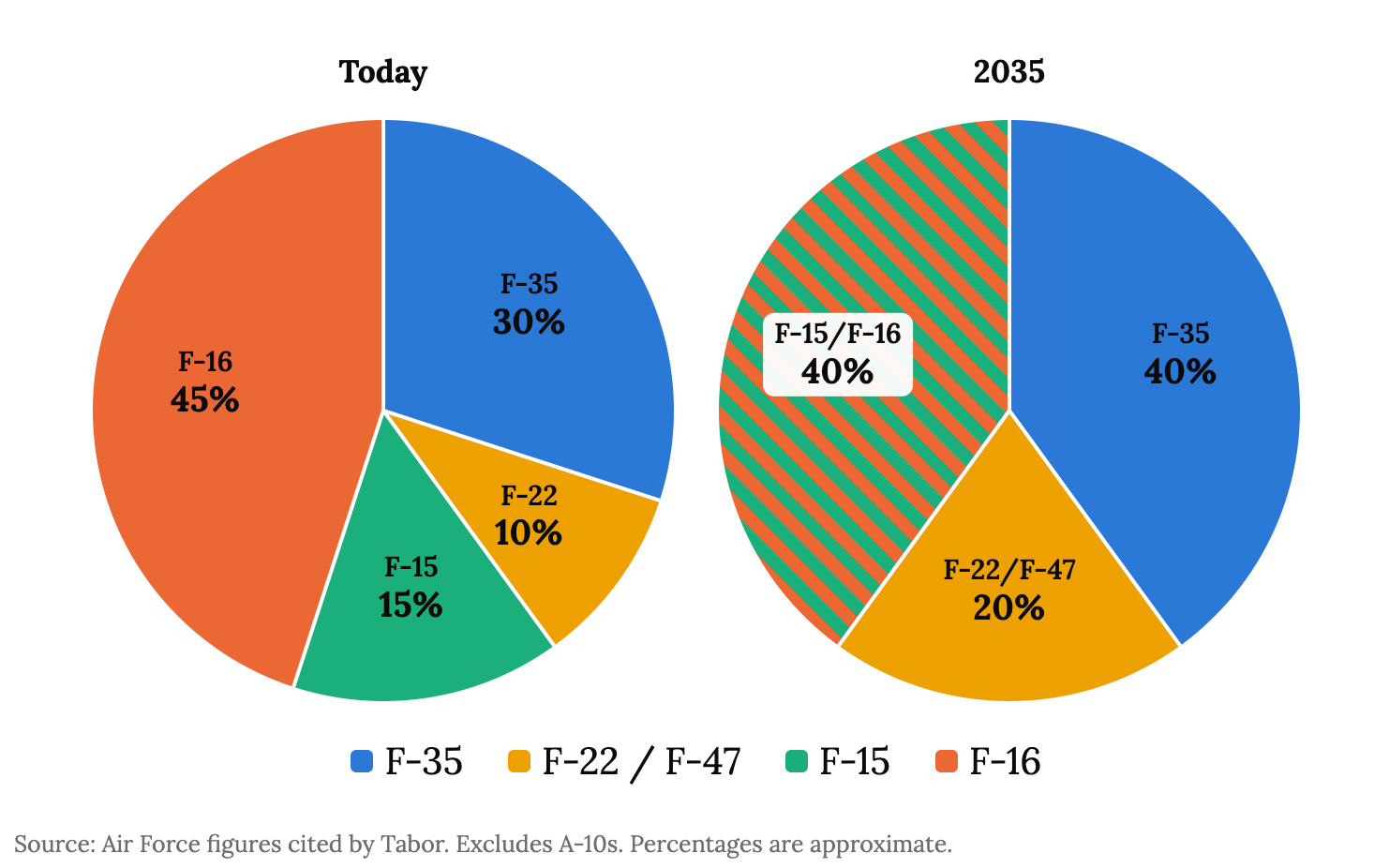
I think I have posted as many pro-USAF posts in the last year as I have in the last decade…and I ain’t happy about it. However, you have to give the Boys-in-Blue a tip of the hat. They have their new fighter by number, even if they have not given it a name yet or given everyone a good view of it. They have their new bomber on the way. They still have some work to do in replacing the older-than-Sal C-135 Class derivatives and are overdue for new-build strategic airlift…but in the tactical and strategic air arenas, they are cooking with gas. They’re thinking right. Via Stephen Losey at Air & Space Forces Magazine, Currently, the fighter fleet—not counting A-10s—is split roughly 45 percent F-16s, 30 percent F-35s, 15 percent F-15s, and 10 percent F-22s. Beyond the mix of the fighters, the force structure report also provides a new estimate of the total number of fighters the Air Force says it will need in the years to come: 1,509 combat-coded aircraft by 2035. That’s up from the 1,271 the service estimated it would have in 2026 and the 1,369 combat-coded fighters it was shooting for by 2030 in last year’s report, Tabor said. The additional 140 jets would be a mixture of F-35s, F-15EXs, and F-47s. 2030 is as close to now as we are to 2022…which seems like yesterday. Getting to the new 2035 goal depends on two key factors falling into place, Tabor said. First, Congress will need to provide the funds the Air Force needs to buy the jets. And the defense industrial base—in particular, prime contractors Lockheed Martin and Boeing—must produce enough aircraft in time. We’re seeing that all over the Navy side of the house, especially in the submarine side of the house. No one said re-industrialization would be easy. What did you think the Peace Dividend meant, vibes? Top Air Force officials have for years said the service needs to buy 72 new fighters each year to replace its older, retiring jets and modernize the fleet. The fiscal 2027 budget request doesn’t reach that level, proposing 38 new F-35s and 24 F-15EXs for a total of 62. Tabor said those purchases can “ramp over time” to hit the numbers the Air Force needs. “The question is, can industry produce at those levels?” Tabor said. “They’ve assured us that they can, and we believe them, but we also actually need to see it manifest.” OK, here is where I have to bring up something I’ve been proposing for years—we need to buy off the F-16 line that our allies are keeping running. The USAF has not purchased a new F-16 since 2005. Yes, that is correct, 21 years ago. Last month we heard rumors of an F-16G buy based off the exceptional Block 70. This needs to happen. The F-15EX is a winner, and so would the F-16G too. Older F-16s will reach the end of their lifespans in the mid-2030s, Tabor said, and “we are very conscious of that.” The simple—“and maybe the lazy”—way to approach that problem, Tabor said, is to automatically replace them with new F-16s. But that might not be the best strategy, he said. “There is a spectrum of capability that we might want to replace the F-16s with,” he said. “It’s not urgent, frankly. What we don’t want to get to is a point where it is urgent, and we haven’t done the homework and decided ‘hey, this is really the right place to be.’ We do have time to churn through that and make sure that we have a good option going forward.” Bullsh1t. We need to be ready for a war sooner rather than later. Your “we might want” can stuff it. While you figure that out and demonstrate how you’ll do it, we should keep cranking F-16s out of the factory. Likewise, we cannot let the F/A-18 line go cold-iron. Until the F/A-18 is in full-rate production, keep them coming—but it appears we are stupidly going to do that. We need numbers, just like the USAF does. That is just on the active duty side. Remember what Navy aircraft numbers in USNR looked like in the Cold War? I do. We need that surge capability again…but we need numbers to do that. The Navy is being stupid. The USAF is being smart. Go ahead, quote me on that. Leave a comment Share This Substack is reader-supported. To receive new posts and support my work, consider becoming a free or paid subscriber. View the full article

-
A U.S. Army Patriot air defense battalion at Fort Hood, Texas, has put its launchers, radars and support vehicles into the field for a battalion-wide readiness exercise, according to photos released by the service on Oct. 21, 2026. The exercise involves the 1st Battalion, 62nd Air Defense Artillery Regiment, part of the 69th Air Defense […]View the full article
-
U.S. Air Force F-22 Raptor stealth fighters from Alaska are operating from Tsuiki Air Base on Japan’s southern island of Kyushu as part of Keen Sword 27, the largest iteration so far of the biennial U.S.-Japan military exercise. A photo released by the U.S. military shows an F-22 from the 525th Expeditionary Fighter Squadron parked […]View the full article
-
General Dynamics Land Systems has rolled out an upgraded version of PERCH, a bolt-on kit that lets M1A2 Abrams tanks and Stryker armored vehicles launch AeroVironment’s Switchblade 300 loitering munitions, small drones that can scout ahead of a vehicle and then dive onto a target as a guided weapon. The company announced PERCH 2.0 in […]View the full article
-
U.S. Navy engineers in California have tested a prototype camera system designed to spot a sailor falling overboard and alert the ship’s bridge automatically, throwing a 35-pound rescue dummy off the side of a decommissioned destroyer to see whether the cameras would catch it. The test took place on Aug. 14 aboard the Self Defense […]View the full article
-
Ukraine’s military intelligence agency has published a detailed breakdown of Filin, a new Russian ground-launched cruise missile that Moscow began firing at Ukraine in late summer 2026. According to the agency, the missile combines a composite airframe and a Russian jet engine with onboard electronics built largely from American and Chinese parts. The Main Intelligence […]View the full article
Last week
-
rxjokmgw joined the community
-
gkorjreq joined the community
-
qtibfurm joined the community
-
Some posts are just sad to write, but they are often the ones you need to write. It is no fun watching a friend intentionally and deliberately destroy themselves for no reason. I guess it is time to pick up the conversation we had back in March and June. When I first saw this, I thought, ‘This is reporting from The Sun. Just tabloid trash.’ Not a single submarine commander passed the legendary Perisher course last year. … Only three were selected to attempt it, with two failing at the simulator stage. Surface ships fared little better with less than ten officers passing the command qualification known as CQ2. The Navy needs 35 passes a year to sustain its sea commands. Sources say the only reason the shortage has not affected operations is because so many ships have been scrapped or stuck in port for repairs. But no, it isn’t. Navy Lookout and others with very reliable track records are on it too. Senior naval sources told Defence Eye that the Royal Navy has not run a Submarine Command Course, which qualifies officers to take command of its submarines, since December 2024. The course, popularly known as ‘The Perisher’, dates back to World War One and is famous for its high standards and realistic training exercises. It has long been considered the ‘gold standard’ of submarine officer training, with navies from around the world sending officers to participate in the course. For the past two years, the Royal Navy Astute-class fleet has been hit by a series of breakdowns and a long maintenance backlog. This year alone, it has only been able to put one boat, HMS Anson, to sea for a four month-long cruise to Australia. Since she returned to Devonport naval base for repairs in May no Astute boats have been recorded as going to sea. With no boats available for operational tasking, it is not a surprise that training has had to be put on the back burner by the Royal Navy. The naval source briefed Defence Eye on the status of the Perisher Course in response to criticism from Australia, that the UK was unable to generate trained personnel to operate its submarines to meet its commitments under the AUKUS deal. “Since [December 2024], three officers have successfully qualified for command through allied submarine command courses, including programmes delivered by Norway and Australia,” said the source. He suggested that the Royal Navy submarine availability crisis was soon to turn a corner, commenting, that “the next UK Perisher Course is due to commence next month, with a further candidate scheduled to undertake the Norwegian course in January.” What submarines the British do have don’t get much underway time. You can’t be the best at something—or at least moderately competent—if you don’t actually do it. I don’t fault those who failed. There is no serious person who thinks there is the political or economic ability right now for a serious recovery in British military capability at sea or ashore, regardless of who gives what speech. How much further can it fall? Things can always get worse, but all the wiggle room is gone. Most are familiar with the rolling train wreck that is the once exemplary British submarine industrial capability. Even their closest Commonwealth allies have concerns. The admittedly challenged US submarine industrial base will have to carry the AUKUS load. All of Britain’s traditional allies and partners over the last century assumed that, should war come, they could rely on even a diminished Royal Navy to come over the horizon to help. That time is long past. Everyone needs to reconsider that assumption. Though Britain may have the desire at some point, it just doesn’t have the ability to provide anything more than token assistance from here on out. On paper, the Royal Navy today has 10 submarines: six SSN and four SSBN. Only a small fraction of those are combat-ready or could be made combat-ready in a reasonable time. The US Navy today has 81 submarines: 53 fast attack submarines, 14 ballistic-missile submarines and four guided-missile submarines. In the mid-1980s, at the height of the Cold War, the Royal Navy had 32+/- submarines: 4 SSBN 28 SSN and SSK patrol submarines. At the same time, the US Navy had roughly 138 submarines: 37 SSBN 97 SSN 4 SSK The Royal Navy’s relative collapse is shocking. Since the mid-1980s, the US Navy’s submarine force has shrunk to 59% of its 1985 level. The Royal Navy’s submarine force has shrunk to 31% of its 1985 level. Today, the Royal Navy should have at least five more submarines in service if they paced the US Navy’s post-Cold War drawdown. Back to the Perisher course. Here’s the BBC documentary on it from 1985. There were enough people in the course to have a proper dinner. Now? Sad. Behold the land where giants once tread—the Royal Navy Midshipman Salamander remembers. Share Leave a comment This Substack is reader-supported. To receive new posts and support my work, consider becoming a free or paid subscriber. View the full article

-
A Russian Su-30SM fighter jet crashed during a training flight in the Chernyakhovsk district of Russia’s Kaliningrad region, coming down between the villages of Timofeyevka and Zelyony Bor, and both pilots ejected before impact. The two crew members were injured and taken to a military hospital, and Russian outlets published the first details of the […]View the full article
-
wswjctqe joined the community
-
tmognlcl joined the community
-
A heavy-lift cargo drone built by BAE Systems subsidiary Malloy Aeronautics has shot down several one-way attack drones with laser-guided rockets during a Pentagon experiment in Florida, firing one rocket after another without having to land and reload. The modified aircraft, known as the TRV-150, carried a three-pod launcher loaded with BAE Systems’ APKWS rockets […]View the full article
-
Russia’s United Aircraft Corporation is looking at artificial intelligence and other new software to speed up the design of future aircraft and cut the cost of developing new versions of existing ones, the state-owned planemaker said in a statement on its social media. UAC, which builds nearly all of Russia’s military and civil aircraft, from […]View the full article
-
Türkiye is preparing to deploy military personnel to Saudi Arabia under the new joint defense pact it signed with the kingdom and Pakistan, and the government will send a deployment mandate to the Turkish parliament once lawmakers ratify the agreement, Reuters reported. Ankara has already submitted the pact, known as the Mecca Joint Defense Agreement, […]View the full article
-
A tracked ASCOD cargo carrier from General Dynamics European Land Systems has appeared at Spain’s Atlas 26 counter-drone exercise fitted with launch containers for ARMMO’s Bandit-X interceptor drones, turning the armored logistics vehicle into a mobile platform for hunting enemy drones. A screengrab from video shared by Spanish defense watcher ArmaduraXXI shows the ASCOD-based heavy […]View the full article
-
Indian defense startup Apollyon Dynamics has released the first photos of its Nightshade Mk-2, a new jet-powered drone that the Hyderabad-based company is developing as a successor to the Nightshade it unveiled earlier this year. Co-founder and CEO Jayant Khatri shared an image of the aircraft lying on a hangar floor next to a team […]View the full article
-
Ukraine’s Defense Minister Evgeniy Khmara and Commander-in-Chief Mykhailo Drapatyi met a Lockheed Martin delegation led by Orlando Sanchez Jr., president of Lockheed Martin Aeronautics, to press for steady weapons deliveries, more PAC-3 interceptors for Patriot and wider F-16 maintenance across Ukraine, the Ukrainian Defense Ministry said. The talks centered on the F-16, which the ministry […]View the full article
-
The Ottawa Police Service’s tactical unit has added a Roshel Senator armored vehicle fitted with a hydraulic assault ramp that can lift officers to second-floor windows and rooftops in seconds, giving Canada’s capital the same Canadian-built armored vehicle that Ukraine has used in large numbers on the battlefield. U.S. manufacturer Patriot3 announced that its LIBERATOR […]View the full article
-
Britain has now received seven Challenger 3 prototype tanks for trials, with an eighth in the final stages of build, as the British Army works to prove the design of its next main battle tank before full production begins, UK Defence Journal reported. Defence minister Luke Pollard gave the figures in a written answer in […]View the full article
-
The German Army has received its first heavy-lift cargo drone, with the 131st Supply Battalion in Bad Frankenhausen, Thuringia, taking delivery of an uncrewed aircraft from Portuguese manufacturer TEKEVER to test how drones can haul equipment and supplies to troops in the field. The Bundeswehr in Thuringia announced the handover on Oct. 13, describing it […]View the full article
-
The U.S. Air Force plans to grow its fighter force to 1,509 combat-coded jets by 2035, with the F-35 becoming its most numerous fighter and the new F-47 taking over from the F-22, under a revised force structure plan the service sent to Congress on Oct. 16. Lt. Gen. David Tabor, deputy chief of staff […]View the full article
-
cjqiqbph joined the community
-
A French Mirage 2000D ground-attack jet crashed late on Oct. 20 near the village of Rogéville in Meurthe-et-Moselle, in eastern France, as it was returning from a mission, killing at least one of its two crew members, while rescuers continue searching for the second. The French Air and Space Force said the accident happened at […]View the full article
-
Lockheed Martin is promoting the idea of a special version of the F-16 fighter built around Ukraine’s needs, with longer range, a new AESA radar and stronger air defense capabilities, sources at the company told The Defence Blog. The idea is being floated as the U.S. defense giant expands its work with Kyiv, and it […]View the full article