All Activity
- Yesterday
-
Peru has ordered a fifth C-27J Spartan tactical airlifter, and the contract carries significance well beyond Lima. The purchase pushes the total number of C-27Js sold worldwide to 100, a milestone that Leonardo, the Italian aerospace and defense company that produces the aircraft, marked publicly on May 14, confirming the order through an official program […]View the full article
-
BAE Systems has publicly revealed its Multi-Domain Artillery Cannon System for the first time, offering the defense world its first look at a platform the defense giant is developing to give the U.S. Army a new way to shoot down drones, cruise missiles, and other aerial threats using artillery-style firepower. The images released by BAE […]View the full article
-
Ukraine’s Ministry of Defense has officially codified and cleared for service the Pliushch, a ground-based unmanned reconnaissance and relay platform developed by Ukrainian defense technology company Robotic Complexes, the firm announced Thursday. The certification opens the door to formal procurement by Ukrainian armed forces units and marks another milestone in Kyiv’s effort to field domestically […]View the full article
-
Valinor’s Harbor platform has joined Anduril Industries’ $99.6 million Next-Generation Command and Control contract with the U.S. Army’s 4th Infantry Division, bringing battlefield casualty tracking and medical supply chain data into the same operational picture that commanders use to coordinate fires, sensors, and maneuver forces. The integration puts HarborOS directly into Lattice, the AI-powered command […]View the full article
-
Pete Hegseth, the United States Secretary of War, unveiled the Trump administration’s proposed $1.5 trillion defense budget on Thursday, calling it a “generational down payment” on American national security and framing it as the most ambitious military investment in modern history. The announcement, made via Hegseth’s official social media account and accompanied by a promotional […]View the full article
-
California-based DZYNE Technologies has developed Blitz, a Group 1 expendable unmanned aircraft system designed for mass deployment and swarm operations, announcing the system on May 14, 2026 ahead of its public display at SOF Week 2026 in Tampa. The Blitz fits within an 80-liter rucksack, can be assembled and mission-ready in under two minutes, and […]View the full article
-
A multi-company team has successfully tested a mobile counter-drone and anti-armor system mounted on a light utility vehicle, combining an Echodyne radar, a Dillon Aero M134 minigun, APKWS guided rockets, and Aeon’s Zeus missile in a single modular platform. The system is built on Moog’s Flexible Mission Platform, a modular weapons integration architecture that the […]View the full article
-
Red Cat Holdings has partnered with satellite communications company Kymeta to integrate multi-orbit connectivity into its Blue Ops Variant 7 uncrewed surface vessel, announcing the collaboration on May 14, 2026. Kymeta, a flat-panel satellite terminal manufacturer that has shipped more than 9,000 units across deployments in more than 80 countries and territories, joins Red Cat’s […]View the full article
-
Britain has signed a nearly £1 billion, approximately $1.33 billion, contract for 72 RCH 155 remote-controlled howitzers, the Ministry of Defence announced May 13, 2026. The contract was awarded by the Organisation for Joint Armament Cooperation, known as OCCAR, on behalf of the British Army to ARTEC GmbH, a joint venture between KNDS and Rheinmetall. […]View the full article
-
Ukrainian defense company Fire Point has joined an anti-ballistic missile coalition and unveiled a pan-European ballistic missile defense project called Freya, presenting a system architecture built around a domestically developed interceptor missile and designed to integrate with NATO-standard protocols and existing Western and Ukrainian air defense infrastructure. “Despite attempts to interfere and many distracting factors, […]View the full article
-
Murderers’ Row. Ulithi anchorage, December 8th, 1944. Just three years after the attack on Pearl Harbor. One of the most iconic pictures of WWII. The carriers are (from front to back): USS Wasp (CV-18), USS Yorktown (CV-10), USS Hornet (CV-12), USS Hancock (CV-19) and USS Ticonderoga (CV-14). The oldest of those ships, Yorktown, was only 19 months old. The youngest, Hancock, was commissioned only a little under eight months earlier. All were laid down and took from a bit under three to a bit under four years to build. Just a year prior, the US Navy was so short of aircraft carriers, it had to borrow a carrier from the Royal Navy. At first glance, it appears to be a flex of American naval power at flood tide—the aircraft carrier’s unassailable invincibility manifest—and it is. However, when you dig deeper, it has a more important story. It gives a warning. It informs us today, if we are willing to listen. It isn’t about the power of being the world’s greatest shipbuider, that we were. It isn’t about an unequalled ability to project national will across the Pacific like no nation ever has in human history, which it is. No. That isn’t what it tells us that is most important. As we have done more than once over the last two decades, we’re taking a holder of a front row seat on the Front Porch and CDR Salamander Plank Owner Sid’s comments, in this case from yesterday, and bringing it to a standalone post. Most of this post is his. The insight certainly is. The actual story this picture tells is much more sobering, right there in plain sight, but you can’t see it. The reality is that on the day this picture was taken, the Fast Carrier Task Force (TF 38/58) was down an entire Task Group from where it started two months earlier. USS Franklin (CV-13) was severely damaged on 27 OCT by kamikaze and had to return CONUS for repairs. USS Belleau Wood (CVL-24) was severely damaged in the same attack. USS Princeton (CVL-23) was sunk on 24 OCT by a Judy dive bomber. USS Essex (CV-9) had a devastating hit by a kamikaze on 24 NOV followed by a disabling machinery casualty requiring a trip back to CONUS for repairs. USS Enterprise (CV-6) departed a few days earlier for repairs in Pearl Harbor. All the carriers in this picture had been damaged to varying degrees. Damage that today would require a trip to the yard to fix, like the absent Enterprise and Essex. For example Ticonderoga (fourth Essex in the line from the bottom) would take damage to her radar waveguides in January. That could not be repaired forward and she would have to return to Bremerton as well. As a note and aside, another member of the Front Porch, Scoob’s father is aboard the Lexington (uncamouflaged carrier on the left) being repaired having taken a kamikaze blow to her island in November. It was Admiral Mitscher’s flagship during the attack, with future CNO Arleigh Burke as his Chief of Staff. 50 killed and 132 wounded in this attack. Also not obvious in the picture is the tremendous replacement effort of aircraft and pilots to replenish from the losses, that today would be called catastrophic, ferried forward by nearly a score of CVE’s shuttling from the west coast and Pearl. When the next Great Pacific War comes, it won’t just be clean numbers on a sheet and your preferred weapon winning—but like it was when the picture at the top was taken, it will be about the entire system built around them. Logistics. Repair. Replacements. Sustained operations, forward, for years on end. An industrial base that can, on a dime, rise from economic doldrums to building a fleet that would rule the world’s oceans. Are we training, manning, and equipping for that? How many CNOs this century chased this or that socio-political trend instead of beating this drum? Why? The norm since the 80’s of deployment of one or even two carriers will not be enough for the fight to come. We are not ready. As I remind everyone I have a chance to, like I did exactly a year ago: Should we find ourselves in a Great Pacific War with the PRC, as our fleet heads west across the International Date Line, we should expect in the first 90-180 days to lose somewhere in the neighborhood of 8-10,000 Sailors and Marines...at sea alone. That is the most-likely outcome; not the most-positive or most-dramatic. Two CVN, a few large deck amphibs, a handful+ of DDG/CG/LCS and SSN—all sunk in the first 90-180 days. That doesn’t even start to outline what will happen to ground-based support from Guam west. This truth is right there in our own history. We have a Naval Academy, a Naval War College, JPME, all of it—and yet the recognition of this clear fact seems shocking, new, unheard this century of to way too many in positions of power and influence. Why? What other things captured their minds? Leave a comment Share This Substack is reader-supported. To receive new posts and support my work, consider becoming a free or paid subscriber. View the full article

-
Romanian manufacturer IRUM has unveiled the IRON-690, a modular autonomous ground drone designed for defensive support operations, at the Black Sea Defense and Aerospace exhibition in Bucharest. The prototype was presented at BSDA on May 13, 2026, according to IRUM’s press release. The IRON-690 is not a conventional vehicle but an adaptable autonomous platform configurable […]View the full article
-
The U.S. Department of War has signed framework agreements with five defense companies to produce more than 10,000 low-cost cruise missiles and 12,000 hypersonic missiles over the next several years, in the most aggressive American missile mass-production commitment in decades. The announcements, made through official Department of War and company channels, establish two parallel programs. […]View the full article
-
Edge Group, the Emirati state-owned defense conglomerate, has released footage of a test of its SHADOW 25 jet-powered loitering munition, a canister-launched one-way attack system. Edge Group published the test footage alongside a statement describing the system’s rapid deployment capability. “Canister-launched SHADOW 25 moves from standby to airborne in seconds, reducing the logistics footprint and […]View the full article
-
Ukrainian drone interceptor manufacturer Wild Hornets announced Thursday that its STING interceptor drone downed more than 300 targets in a single day and overnight period, with three units responsible for over 200 of those kills and one crew alone accounting for 120 intercepts. The announcement came directly from Wild Hornets’ official account on X, posted […]View the full article
-
The U.S. Army’s 11th Airborne Division at Joint Base Elmendorf-Richardson in Alaska is training soldiers to detect, evade, and counter small drones using commercial off-the-shelf aircraft loaded with tennis balls to simulate explosive drops. Donovan Fredericksen, a training developer and integrator with U.S. Army Pacific’s G3 Home Station Training Team supporting the 11th Airborne Division, […]View the full article
-
A Ukrainian software company has developed an AI-powered drone detection system that runs entirely offline on standard consumer hardware, detects targets as small as four pixels at distances up to 2.5 kilometers depending on optics, and automatically alerts military units through messengers with photographs and coordinates within milliseconds of identifying a threat. The system, called […]View the full article
-
L3Harris Technologies has developed software that turns existing tactical radios into AI-enabled counter-drone sensors, announcing Wraith Shield as a capability that allows soldiers to detect, classify, and disrupt small unmanned aerial systems using communications equipment they already carry, without adding new hardware to an already heavy infantry load. The announcement, published May 13, 2026, describes […]View the full article
- Last week
-
I just bought CMO, moving up from Harpoon Classic 97. I installed it, and my computer fans run hot even without a scenario loaded. What would be the best way to set up CMO to reduce the load on my computer? I don't care about graphics or video speed, etc. I would rather have the hardware just handle the background tasks. And if I need to minimize those as well, then so be it. I will be upgrading my computer in the next few months, but I want to get started before that. Thanks for your input, and looking forward to this new endeavour.
-
Chinese-made FN-16 man-portable air defense systems have appeared in service with soldiers of the air defense battalion of Ukraine’s 160th Mechanized Brigade, photographs published by the brigade’s press service confirm. The brigade’s press service published the imagery alongside a statement describing the unit’s around-the-clock mission. “Fighters of the anti-aircraft missile battalion keep the sky under […]View the full article
-
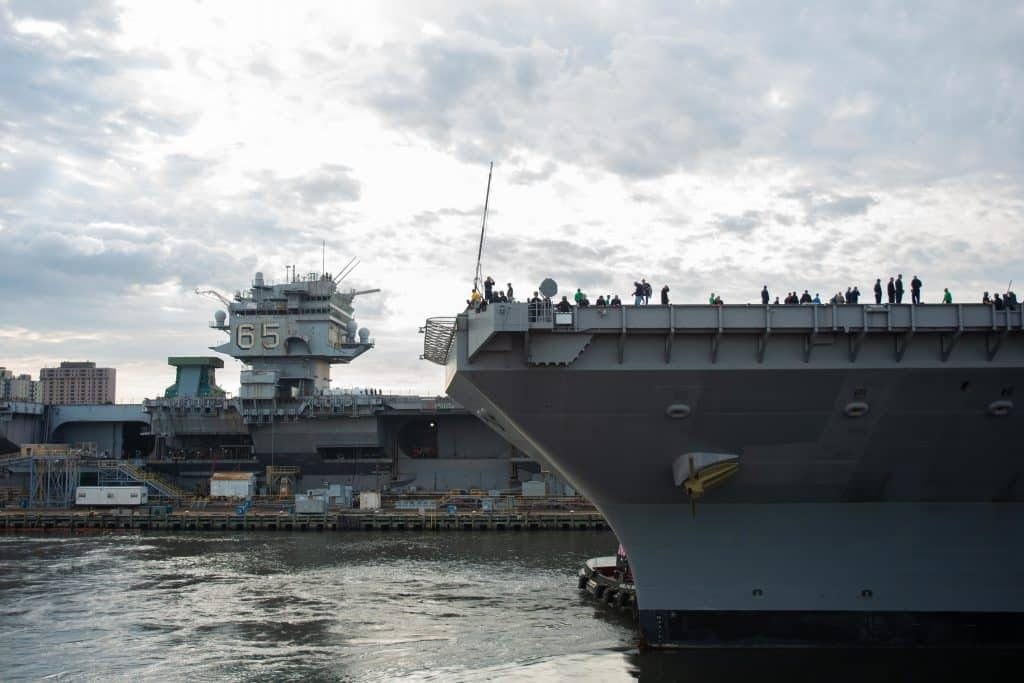
Ethan Gossrow over at Naval News did a detailed look at the carrier portion of the 30-year shipbuilding plan that gives some texture for those who, like myself, are concerned about the slow approach to bringing new carriers online. Even though today is no different from any other day over the last half decade, there are those who will continue to try to explain why the USN’s CVNs are “obsolete” and not worth the investment. However, reality continues to get in their way, as he quotes from the Plan: “Underpinning Expanded Maritime Maneuver (EMM) the CVN serves as a persistent, survivable, mobile sea base that enables the Navy to dominate contested environments and deliver decisive effects at ranges that outpace adversary anti- access/area-denial (A2/AD) envelopes without the need for Access, Basing, and Overflight.” There is no other way to project national will anywhere on the planet like a CVN. There just isn’t. Even though we are an 11-carrier navy in a 15-carrier world…we’re not growing. The U.S. Navy’s carrier availability rates may periodically drop due to Nimitz-class hulls being retired as the Fords continue to be slowly be inducted into service. By 2040, 4 carriers are scheduled to be delivered to the Navy, CVN-79 in 2027, CVN-80 in 2031, CVN-81 in 2034, and CVN-82 in 2039. However, in the same time frame, 1 U.S. Carrier will exit service for each one inducted (assuming there are no deviations from current projections), with the departure timeline leaving gaps in 2030, 2033, 2037, and 2038 where there are only 10 carriers in service. Aircraft carrier sustainability is of particular concern to both Congress and Navy leadership, with previous Navy plans structured around maintaining a congressionally demanded minimum of 11 carriers, with the last instance of a 10 carrier Navy occurring between the commissioning of CVN-78 and the decommissioning of the USS Enterprise (CVN-65) in the early to mid 2010s. A 10 carrier Navy appears to be on the horizon again, placing further strain on what is perhaps the U.S.’s most in demand strategic asset. It isn’t for lack of funding: Gerald R. Ford-class…will receive roughly $4.07 billion in funding in Fiscal Year 2027, and a total of $22.34 billion stretching into FY 2031. The $22.3 billion allotted will provide $4.2 billion for advanced procurement relating to CVN-82 and $3.9 billion in advanced procurement for CVN-83. Total CVN earmarked funding across the next 5 fiscal years is as follows; $4.067 billion for FY 2027, $4.822 billion for FY 2028, $5.358 billion for FY 2029, $5.027 billion for FY 2030, and $3.066 billion in FY 2031. Industrial base upgrades come in the form of $6.7 billion invested in the surface ship industrial base and a further $7.2 billion invested in Nuclear shipyard capability from fiscal years 2027-2031. Additionally, the procurement of CVN-82 will be moved up by one fiscal year, transitioning from FY 2030 to FY 2029 with the acceleration fueled by additional funding. CVN-82 will be the Navy’s only new carrier to be procured within the FY 27 – FY 31 period, even despite the apparent re-prioritization given to the U.S. Navy’s primary strike asset. This is the best case scenario. Can this be sustained on a bipartisan basis, regardless of who is in power in the Executive and Legislative Branches? It will need to be. Everyone needs to hone their arguments and have them ready. Make no mistake, over the next decade there will be a regular assault on the carriers by Good Idea Fairies and Smartest People in the Room™ who will try to bolster themselves and their theories by going after the carriers. Your arguments better be good, because their Syren’s song will be hard to resist. This Substack is reader-supported. To receive new posts and support my work, consider becoming a free or paid subscriber. Share Leave a comment View the full article
-
Reveal Technology says its Identifi mobile biometric system has been formally adopted as a Program of Record by U.S. Special Operations Command, placing the company’s handheld identity tool inside SOCOM’s official tactical biometrics portfolio as initial fielding begins. The veteran-founded defense technology company announced the adoption on May 13, saying Identifi is designed to let […]View the full article
-
Australian Skyborne Technologies has received a U.S. Department of War Limited Safety Release for its CODiAQ armed quadruped robot, clearing the system to proceed into Operational Test and Evaluation and combat assessments with U.S. Special Operations Command units and a partnered foreign ally. The safety release, granted through a competitively awarded research, development, test, and […]View the full article
-
The U.S. Army has evaluated CX2’s Wraith, an autonomous airborne electronic warfare drone capable of geolocating and identifying radio frequency threats without GPS, during Exercise Ivy Mass at Fort Carson, Colorado, with an EW platoon from the 4th Infantry Division executing nearly a dozen autonomous missions over two weeks of operational testing. Apache Company’s Electronic […]View the full article
-
A French startup has completed ground avionics testing of an unusual fixed-wing aircraft with a pneumatic wing structure, targeting long-endurance cargo logistics missions with a design that trades speed for dramatically reduced energy consumption per kilogram transported. “Celeste isn’t a blimp, it’s a fixed-wing aircraft,” the company stated. “Lift is aerodynamic, not buoyancy. What’s pneumatic […]View the full article