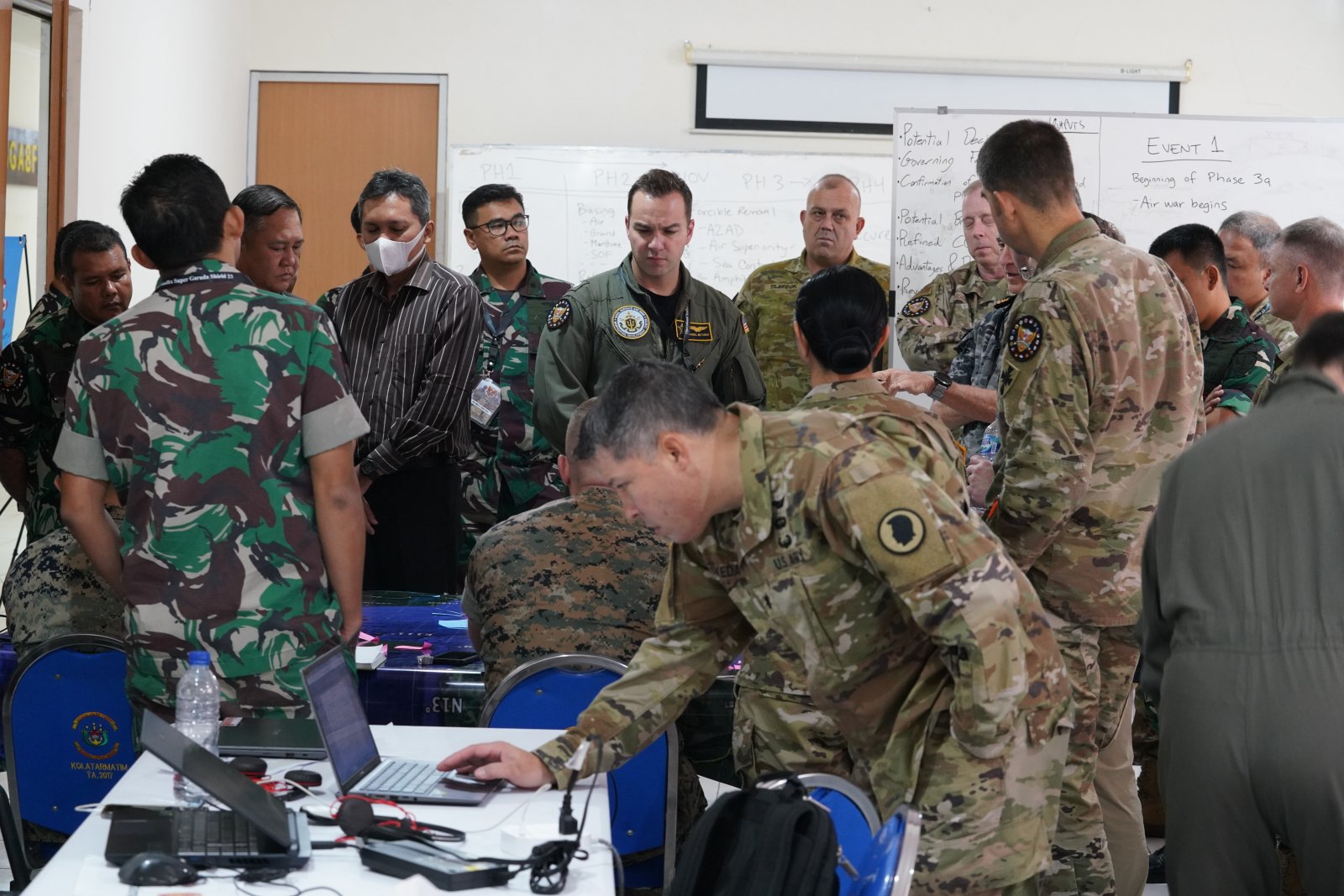
For those in the business, one of the most triggering phrases you can read or hear is some pogue out there saying, ‘Well, we have wargamed this, and…’ and then you wait to see if you have a reasonable follow-on, or some cringe-inducing abuse of the military art. Way too many people are abusing war games for the wrong purposes. Everyone wants a national security 8-Ball to tell them the future, and some look to war games to hear what they want to hear. When you see that, it’s a tell. That person/institution does not understand what they are talking about. In the latest Naval War College Review, Charles Edward Gehrke has a simply outstanding article everyone needs to take a few minutes to read, What War Games Actually Teach—Threat Recognition, Not Prediction. From war gaming’s earliest institutional adoption, it has been repeatedly evaluated as though it were a forecasting instrument or a decision aid at best and a surrogate for empirical proof at worst. Each of these expectations imposes criteria that war games are structurally unsuited to meet. The resulting recurring cycle of enthusiasm, disappointment, and rediscovery has accompanied war gaming for more than a century. There is the core of the problem and where too many people go off the rails when it comes to the use and utility of war games. As is true with many things in life, trying to force something to meet your unrealistic desires always leads to tragedy. The rough part is that, in the national security arena, the consequences run the spectrum from death to an existential danger to the nation. You have to nip this in the bud whenever it comes up, regardless of how powerful the person or institution behind these desires may be. The enduring value of war gaming is neither prediction nor optimization. Its primary product is something simultaneously more modest and more profound: the cultivation of threat recognition under conditions of uncertainty. War games are incapable of telling either participants or their respective services what will happen in the future. What they actually can do is to put participants in situations that simulate danger effectively and communicate to them why these situations appear dangerous. And then it can train them to anticipate ways in which others will respond to similar real-world dangers. In doing so, war games train participants to recognize how threats are perceived, interpreted, and acted on by all parties operating with incomplete information and under intense time pressure. Training and testing, not predicting. This misunderstanding has consequences. Many of the recurring debates around war gaming—including debates over rigor, realism, bias, and usefulness—stem from evaluating games against criteria that the games were never designed to satisfy. When war games are judged primarily as forecasting tools, they will almost always disappoint. When they are assessed as decision engines, they will appear indeterminate. When they are expected to produce consensus, they will seem inconclusive. Only when they are understood as instruments for revealing cognitive and institutional blind spots do their contributions become more clear and more durable. Bingo. You are looking for intersections of individual factors, constraints, restraints, and perspectives. The next bit had me grin some, as it reminded me of hearing many an exasperated voice ask, ‘Did anyone war game this?’ The measure of a successful war game, therefore, is not whether it got the future right, but whether it revealed previously unrecognized threat perceptions, challenged embedded assumptions, or clarified the role of judgment in environments in which calculation alone is insufficient. Controlling variables is what makes war games so valuable. You are testing ideas, concepts, factors. When someone walks in with a goal to use and abuse a war game to validate their idea or worldview, a well-run war game will crack open the weaknesses for all to see. On the flip side, a poorly run or unethically run war game can lead to disaster. You have to realize their base nature. War games do not operate like analytic models. They are not closed systems, nor are they designed to be. They do not attempt to isolate variables to measure their individual effects. Instead, they deliberately entangle political, military, economic, and human factors in ways that resist clean separation, but resemble the real world. The resulting complexity is a defining feature. It reflects the reality that strategic decision-making rarely unfolds in environments in which variables can be controlled or outcomes cleanly attributed. They are not just good for testing ‘things.’ Indeed, their greatest utility is testing people. A war game’s most consequential outputs are not quantitative results at all. They are moments of surprise, confusion, or disagreement. A player discovers that an adversary behaves in ways that feel irrational or escalatory. A familiar course of action produces unintended consequences. A strategy that appears sound in briefing slides unravels once it encounters resistance. These moments are indicators that previously unexamined assumptions have been exposed. Thinking. Imagination. Cognitive flexibility. Character. Oh, you can find them in a war game. Treating war games as predictive tools, therefore, creates a category error. It asks games to function like models while ignoring the features that distinguish them. Human judgment and adversarial adaptation are not sources of noise to be eliminated. They are the very phenomena that war games are designed to bring to the surface. Evaluating games by their ability to suppress these dynamics in the service of prediction misunderstands their purpose. This demand for prediction also obscures the reason that war gaming has endured for more than a century—despite repeated failures to get the future right. If prediction were the standard, war gaming would have been abandoned long ago. Time and again, games have failed to anticipate specific wars, campaigns, and outcomes. Yet institutions continue to invest in them, not because of inertia or sentimentality, but because games provide forms of insight that cannot be generated through analysis alone. … It bears repeating that the insights generated by this process are not always answers to specific questions. War games do not resolve debates or produce definitive conclusions. Instead, they refine mental models. Participants leave with a clearer sense of which assumptions are fragile, which signals are ambiguous, and which aspects of a problem space they had previously taken for granted. These adjustments are subtle but consequential. They shape how future information will be interpreted and how future decisions will be framed. In this way, war gaming contributes to professional development in a manner that is difficult to replicate through other methods. It teaches participants how their thinking changes under pressure and how the recognition of threat influences judgment when certainty is unavailable. It does not teach them what to think. These lessons are not tidy. They are not easily summarized. But they are precisely the lessons that strategic leaders most need to learn. I’ve always found that a well-run war game’s superpower is its brutal effectiveness at revealing weak and convenient planning assumptions. We are all familiar with fragile egos and too-clever-by-half CONOPS that too many people love far too much. They exist because they have never been challenged—the classic ‘fragile vignette’ used to promote the latest White Elephant or 72-hour war. In real strategic environments, outcomes are rarely predictable in the face of even small changes. Decisions hinge on interpretation rather than certainty. Signals are incomplete, intentions are inferred, and actors continuously adjust their behavior in response to what they believe others might do. Institutions act on beliefs that are formed under pressure, shaped by prior experience, and constrained by organizational context. Perfect information is something institutions want in these circumstances, but it is rarely something that they have. A tool that purports to produce reliable, predictable outcomes in such an environment risks misleading its users. The next part of Gehrke’s article is chicken soup for my soul—an ode to ambiguity. Organizations prefer clarity, alignment, and decisiveness. Ambiguity is associated with risk of failure. And yet strategic leaders routinely operate in environments where clarity is unavailable and alignment is provisional. The ability to function effectively under such conditions is not innate—it must be practiced. War gaming provides a controlled environment in which this practice can occur. The stakes are simulated, but the cognitive demands are real. Participants experience the pressure of making decisions without full understanding of the situation. They confront the consequences of misinterpretation, overreaction, and hesitation. They observe how uncertainty can amplify perceived threats and drive escalation even, or perhaps especially, in the absence of deliberate intent. No other form of professional military education reproduces this. Lectures and readings can describe uncertainty, but they cannot reproduce its effects on judgment. Analysis can account for risk, but it does so after the fact. War games, by contrast, immerse participants in uncertainty as games unfold, forcing them to grapple with uncertainty in real time. When properly applied, ambiguity helps future-proof a war game. A clever person/institution cannot over-prepare for ambiguity. A weak intellect cannot rely on a staff to cover for its inability to adjust to the unexpected, the grey, the vague. I really started to nod my head at the next word he spent some time on: humility. Especially in the last few years, we’ve visited the concept of humility as a force multiplier, hubris, mindsets, and arrogance. A well-run war game can ferret out them all. Postgame discussion fosters cognitive humility. Participants learn that their interpretations of threat are not universal and that reasonable professionals can arrive at different conclusions when faced with the same information. They also learn that their own perceptions are shaped by role, experience, and institutional context. War gaming further structures these perceptions in ways that make the warfighter as effective as possible under the wartime conditions of ambiguity that war games seek to emulate, but perceptions must be examined if they are to be refined. To be examined they must first be made clear. … By cultivating cognitive humility at both the individual and institutional levels, war gaming strengthens the capacity for adaptation. Institutions that can recognize the limits of their own collective assumptions are better prepared to adapt to surprise and ambiguity. In this way, war gaming contributes not only to professional education but to institutional resilience. … Humility does not imply indecision or restraint for its own sake. It simply reflects an awareness of the conditions under which strategic decisions are made and the cognitive processes that govern them. Leaders who have practiced operating under uncertainty are better equipped to act decisively when clarity is unavailable. Institutions that have examined their own assumptions are more resilient when confronted with novelty or disruption. The question, then, is not whether war games can tell us what will happen. It is whether they can help us see ourselves, our institutions, and our adversaries more clearly before hostilities unfold. By that measure, war gaming’s value is not only defensible; it is indispensable. Amen. Read the full thing. Leave a comment Share This Substack is reader-supported. To receive new posts and support my work, consider becoming a free or paid subscriber. View the full article