All Activity
Past hour
-
sufwgwge joined the community
-
pnoaxnlg joined the community
-
obliaggc joined the community
Today
-
yubngiek joined the community
-
tgfibokj joined the community
-
txsyizwv joined the community
-
gtjxdnfy joined the community
-
The U.S. Navy is paying Raytheon up to $30.2 million to line up additional suppliers for key parts of the AIM-9X Sidewinder air-to-air missile, including the cooling engine for its heat-seeking sensor and its warhead components. The undefinitized contract modification, announced by the U.S. Department of War, covers engineering work to qualify new manufacturing sources […]View the full article
-
The United States will supply the Philippine Coast Guard with three secondhand King Air 350 turboprop aircraft, two of them fitted with surveillance sensors, under a $39.6 million contract that finalizes a deal the two countries signed in February. The U.S. Department of War announced the firm-fixed-price award to Technology Service Corp., a small business […]View the full article
-
The Pentagon has ordered another $52.3 million worth of L3Harris proximity fuzes that turn laser-guided APKWS rockets into drone killers, more than doubling the value of a fuze contract signed just four months ago. The firm-fixed-price modification, announced by the U.S. Department of War, adds to a contract the Naval Surface Warfare Center Indian Head […]View the full article
-
The U.S. Air Force Research Laboratory has awarded Honeywell Aerospace $25.6 million to keep developing a small, radiation-hardened gyroscope accurate enough for “strategic” use, the class of navigation sensor that has to work in space and survive the effects of a nuclear environment. The cost-plus-fixed-fee contract covers what the Pentagon calls the compact strategic gyroscope […]View the full article
-
The U.S. Air Force has awarded balloon maker Aerostar a $64.4 million contract to quickly build a prototype for an urgent high-altitude balloon requirement under a project called Swamp Gas. The contract covers development of a “minimum viable product” prototype, meaning an early working version with just enough capability to be tested and used, to […]View the full article
-
Russia plans to spend a record 17.1 trillion rubles ($201 billion) on its military in 2027, while its budget deficit this year is now expected to reach double the government’s earlier forecast, according to government documents seen by Reuters. The defense figure is about 27% higher than the 13.5 trillion rubles Moscow had previously penciled […]View the full article
-
ueukawwd joined the community
-
The U.S. Air Force has awarded Raytheon a multi-year contract worth up to $20.7 billion to build AMRAAM air-to-air missiles, a deal the company says will push production of the weapon to record levels. The award, announced Sept. 25 by the U.S. Department of War, covers complete missiles, spare guidance sections and related work, and […]View the full article
-
President Donald Trump on Monday denied discussing U.S. weapons sales to China with Chinese President Xi Jinping, a day after his ambassador to Beijing said Trump had floated the idea, though Trump added that China would “probably like to buy” American arms. Trump was asked by reporters about comments by David Perdue, the U.S. ambassador […]View the full article
-
krmymzsx joined the community
-
cpykrnvp joined the community
Yesterday
-
Denmark’s armed forces have taken delivery of nine unmanned ground vehicles built by Dropla, a Danish company founded by Ukrainians, to train drone operators, including conscripts, at the country’s military drone center. Denmark’s defense procurement agency, known by its Danish initials FMI, bought the Dropla 4×4 vehicles for the Danish Defence Drone Center, the agency […]View the full article
-
The CIA has restored the helicopter that carried the first American team into Afghanistan after the Sept. 11 attacks, repainting it in the camouflage it wore in 2001 to mark the 25th anniversary of the mission. The Russian-designed helicopter sits on the grounds of CIA headquarters in Langley, Virginia. It flew a seven-man CIA team, […]View the full article
-
Ukrainian missile maker Fire Point has changed the published specifications of its FP-7.x anti-ballistic interceptor, now listing a combined infrared and radar seeker for the weapon instead of the infrared-only seeker it described earlier. The company posted an updated specification card for the missile on X, which it calls the FP-7.x Freyja interceptor. In August, […]View the full article
-
Redwire has now delivered more than 300 of its Penguin reconnaissance drones to Ukraine, the company said, and the version flying there today climbs much higher than the aircraft first sent in 2022 so that Russian FPV attack drones have a harder time reaching it. The U.S. space and defense company disclosed the figure in […]View the full article
-
Liminal Industries, a U.S. startup building unmanned ground vehicles meant to be produced and fielded in large numbers, has advanced to the second phase of the GroundBreaker 1 competition and will demonstrate its DUEL-V vehicle to U.S. military evaluators in North Dakota next month. The company announced Sept. 28 that its Phase I submission passed […]View the full article
-
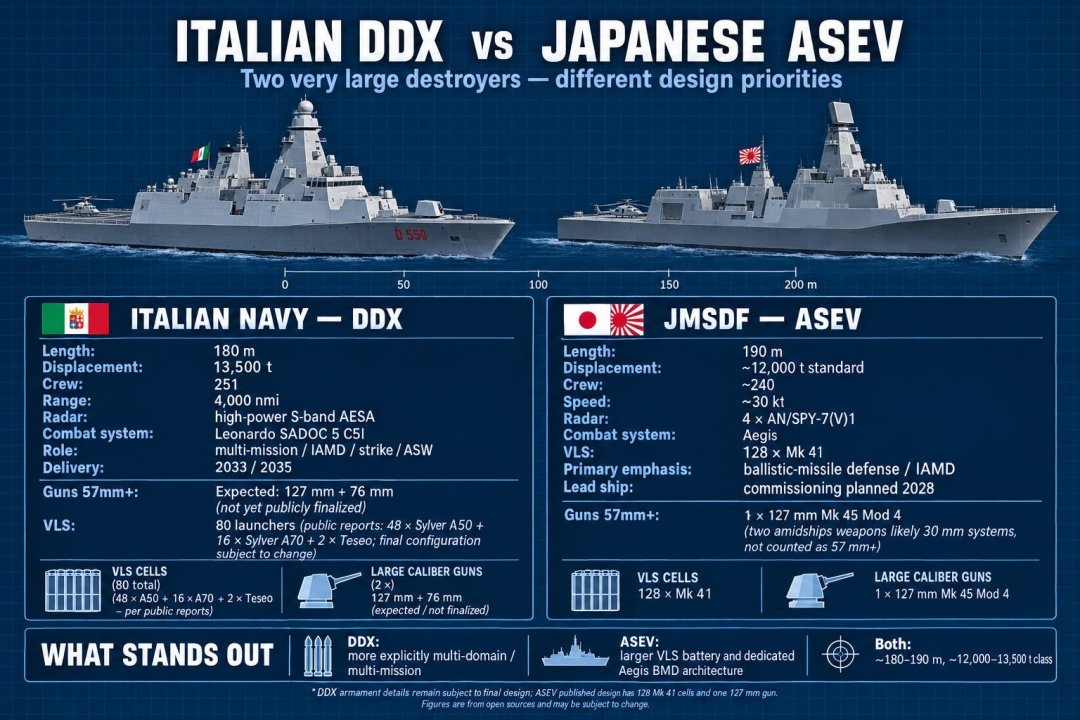
It is no secret that I am a huge fan of Japan’s yet-unnamed cruiser, the ASEV. I put my thoughts down about it 18 months ago. You can click here to review if you wish. Like I said to more than one person, “So, the Japanese are going to get the CG(X) we should have already in the fleet?” Well, now the Italians are making me green with envy too. Europe’s Organisation for Joint Armament Cooperation (OCCAR) has issued a €3.7 billion ($4.2 billion) contract for the production of two Italian Navy DDX destroyers to the Orizzonte Sistemi Navali (OSN) joint venture, made up of local firms Fincantieri and Leonardo. “The DDX programme is set to redefine the Italian Navy’s capability profile in the field of air and missile defence through a significant generational leap” at both a platform and combat systems level, said the two manufacturers in a joint statement today. … The DDX measures 180 meters (590.5 feet) long and features a 13,500-tonne (14,881.2-ton) displacement, in addition to a range in excess of 4,000 nautical miles, according to the joint statement. The statement added that the surface ship will provide an “unprecedented” integrated air and missile defense (IAMD) “capability against missile, ballistic and hypersonic threats” courtesy of a SADOC 5 C5I system, a digital S-band AESA radar and MBDA-made weapons. In line with a first quarter financial results and a business outlook update, Fincantieri indicated in May that it expected to seal near-term orders worth around €5 billion, including the DDX deal. The shipbuilder noted then that two units from the Italian Navy’s Joint Maritime Mission System (J3MS) program would be contracted within months. Beyond domestic business, the firm “plans to finalize major contracts with several foreign navies both for the supply of surface vessels, including FREMM frigates, and for the provision of services in the Middle East and other key geographic areas,” reads the Q1 summary. Back in my post last year, I included this handy comparison that included the South Korean cruiser (and yes, I know they are calling these destroyers, but my Aunt Fanny, these are cruisers) and the Arleigh Burke Flight III for comparison. I’ve added in the Italian ship. (NB: depending on sources, numbers can vary slightly, and the comparison below includes the ASEV’s higher displacement). I don’t want this to degenerate into a discussion about BBGN and the mothballing of the DDG(X) program. No. On a very serious note I want to point again to a marker I put down years ago: NAVSEA and our entire military shipbuilding infrastructure have yet to produce an effective surface warship design since the Cold War ended three decades ago. We have a whole series of outright failures like LCS, DDG-1000, FFG-62, and programs that never left the PPT like CG(X) and DDG(X). Other nations with significantly smaller bureaucracies and industries out-think, out-manage, and out-lead our Navy when it comes to the design-build corner of maritime power. We have great weapons. Superior electronics. But they’re all being shoe-horned and spot-welded onto designs two generations old. A fix is supposed to be in. Let’s hope it is. However, we won’t really know until we have more new ships being built, and the only new clean-sheet design with funding, BBGN, is displacing water. Years. It will take years. Until then, well, Arleigh Burkes until the crack of doom, and we can watch other nations do what we were once world leaders in. Has anyone been held accountable? Has a name-and-shame story been told that lets the American people know the who and why? Why not? We know the who and why of the Ford Pinto. We know the who and why of the DC-10. We know the who and why of AMC. …but still. Here we are. Where is our Navy’s Richard Feynman? Feynman is one of your humble blogger’s heroes. He’s the one who famously demonstrated how the cold compromised the Challenger’s O-rings and helped explain why the Space Shuttle Challenger blew up. That is what we need. Again, reform is great. Perhaps some of the changes we have recently made will bear fruit—but that will be for nothing if we do not have a clear, blunt, and open discussion about how this nation’s greatest gift from prior generations—its Navy—was allowed to drift into serial incompetence and bureaucratic self-indulgence. If we do not pull out the truth and hold it up to the light for all to see, then the system and the people in it will drift back to their prior state; the dog will return to its vomit. Until then, congrats to our Italian and Japanese allies. Take whatever number you are planning to build and double it. Make no mistake, it will increase your nation’s security, your collective security with your allies, and I will bet good money that one day if the balloon goes up the U.S. Navy will come begging for you to help escort our CVN and ESG. Leave a comment Share This Substack is reader-supported. To receive new posts and support my work, consider becoming a free or paid subscriber. View the full article
-
Russian air defense troops appear to be using Chinese-designed shoulder-fired anti-aircraft missiles, according to an analysis by Ukrainian defense outlet Militarnyi of footage aired on Russian state television. The launchers were shown during an exercise by a mobile fire group of Russia’s 51st Air Defense Division in the Rostov region, in a segment broadcast by […]View the full article
-
South Korea’s arms procurement agency has asked Türkiye whether it can buy the Turkish PD170 drone engine, a powerplant already flying on some of the world’s most combat-tested drones, as Korean military drone programs suffer a string of public crashes. Turkish Aerospace Industries, or TAI, recently received an inquiry from South Korea’s Defense Acquisition Program […]View the full article
-
Taiwan broke ground Monday on an aerospace and drone industrial park in the southern county of Chiayi, where the island’s main military research institute wants to build a drone supply chain free of Chinese parts. President Lai Ching-te led the Sept. 28 ceremony, which also opened a new Minxiong campus for the National Chung-Shan Institute […]View the full article
-
The U.S. Navy’s newest destroyer, the future USS Ted Stevens (DDG 128), arrived in Whittier, Alaska, on Sept. 27, less than a week before it is due to be formally commissioned there in a ceremony the state has not hosted in more than a decade. The Flight III Arleigh Burke-class guided-missile destroyer will be commissioned […]View the full article
-
The U.S. Department of War is setting up a permanent team inside the Pentagon comptroller’s office to find programs and processes it considers wasteful, inefficient or duplicative and recommend cutting, merging or reshaping them, under a memo signed by Deputy Secretary of War Steve Feinberg. The new Force Agility and Streamlining Team, or FAST, will […]View the full article
Last week
-
Japanese radar satellite company Synspective has signed a contract with Mitsubishi Heavy Industries to launch two of its StriX satellites on Japan’s H3 rocket in 2027, moving part of a constellation that feeds imagery to Japan’s Ministry of Defense onto a domestic launcher for the first time. The company announced the agreement Sept. 18. The […]View the full article
-
British startup Cambridge Aerospace plans to build its low-cost drone interceptor missiles in Japan and offer them to Japan’s Ministry of Defense, with each round priced at several million yen, or tens of thousands of dollars, the Nikkei business daily reported. The company’s interceptors cost tens of times less than conventional air defense missiles, and […]View the full article
-
Japan’s Ministry of Defense will start building at least 65 new ammunition depots for the Self-Defense Forces from fiscal 2027, using a single standardized design to get them into service faster, the Nikkei business daily reported Sept. 20. The push to store more ammunition follows lessons Tokyo has drawn from Russia’s war in Ukraine, where […]View the full article
-
Turkish defense company ASELSAN has shown its KORKUT 35 air defense gun system shooting down drones and hitting a moving target while driving, in a live-fire demonstration watched by military delegations from 12 countries. The company released video of the firing. The demonstration focused on drones, and KORKUT 35 engaged fixed-wing, delta-wing and small mini […]View the full article
-
A U.S. Army program that builds realistic enemy threats for training flew Performance Drone Works’ C100X drone at Fort Indiantown Gap, Pennsylvania, on Sept. 25, testing its thermal camera, its ability to drop inert practice munitions and whether it could be used in future training scenarios. The flights were carried out by members of the […]View the full article
-
U.S. Space Command held the third of four wargames with commercial space companies on Sept. 23, this time focused on spacecraft that operate outside the orbits most satellites use today, including very low Earth orbit and the space between Earth and the Moon. The tabletop exercise, part of a series called APOLLO INSIGHT, brought military […]View the full article